
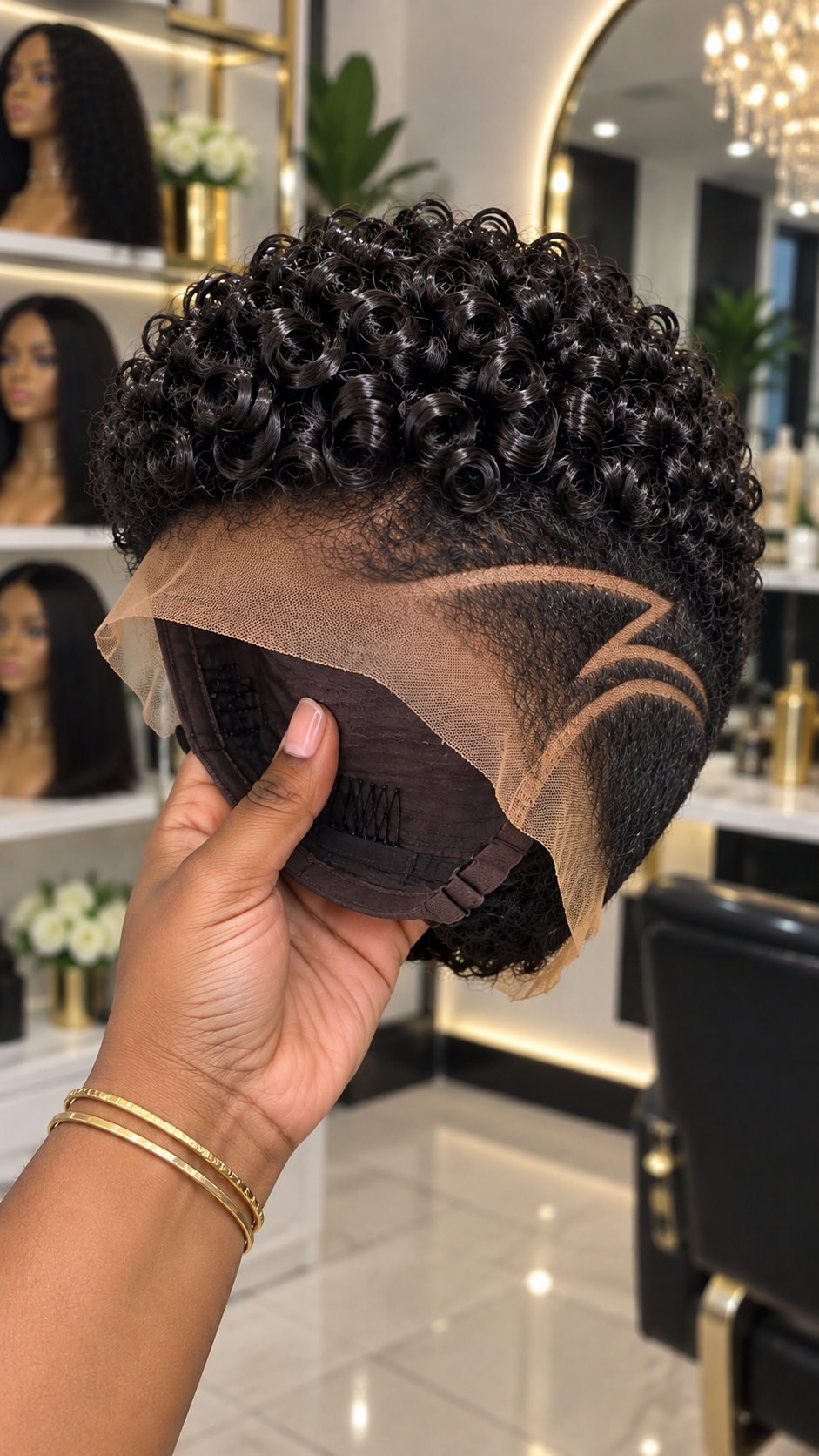
The most memorable detail of this jet black pixie wig is not immediately found in its curls. It appears along the temple, where a long carved channel changes direction sharply before meeting a second set of curved separations. The resulting pattern resembles a lightning-inspired geometric design, creating a striking contrast with the rounded spiral coils covering the crown.
This hairstyle combines two very different visual elements. Above, numerous glossy black curls form compact circular openings, producing a rounded crown with considerable detail. Below, the closely fitted side contains an angular upper channel and curved lower accents that introduce a more architectural appearance. The contrast between circular hair formations and sharp directional changes makes the design distinctive without requiring colored highlights.
The photograph shows the wig being held before installation inside a hair boutique. Its beige lace remains untrimmed, and the exposed underside reveals a dark fabric cap, a visible comb attachment, stitching, and adjustment hardware. These details provide useful information for buyers considering a custom wig, although the image cannot establish the exact fiber, lace grade, supplier, or whether the unit is suitable for adhesive-free wear.


A Lightning-Inspired Temple Pattern That Requires Precision
The most unusual styling element is the angular separation along the visible side. Beginning near the front, the upper channel travels backward in a relatively narrow line before changing direction into a pointed, zigzag-like formation.
This sharp change distinguishes the pattern from conventional curved barber lines. Rather than continuing as a single uninterrupted arc, the upper channel forms a noticeable angle that creates a lightning-inspired impression.
Beneath this angular detail, additional curved channels follow the contour of the temple. The lower separations are more rounded, producing a visual transition from the pointed upper design into sweeping arcs.
The exposed channels appear lighter than the surrounding black hair because the underlying lace-colored surface is visible. Dark bands of closely fitted hair remain between the separations.
Although the design resembles precision razor carving, the photograph does not establish exactly how the pattern was manufactured. It may involve deliberate hair placement, cutting, or another wig-construction technique.
Why an Ordinary Side-Line Request Would Be Insufficient
Describing this hairstyle as a pixie with side lines would leave out its most important characteristic: the angular change in the upper channel.
A stylist could create several parallel curves and still produce a substantially different design. The pointed upper section is what gives this particular side pattern its recognizable identity.
For a custom commission, the buyer should provide a close photograph of the temple and identify the location of the sharp bend.
The curved lower channels should also be included in the reference because their spacing and direction contribute to the overall geometry.
Before any permanent cutting, ask the wig maker to explain how the pattern will be reproduced without exposing or damaging the underlying cap.
The Black Spiral Crown Creates a Rounded Counterbalance
The upper hairstyle contains numerous compact spiral curls, many forming recognizable circular openings. The ringlets overlap in a dense arrangement across the crown, creating a rounded silhouette above the angular side design.
Several curls near the front form larger circular loops, while smaller spirals appear between them and toward the visible outer edges.
The curls are not arranged as long, downward-hanging ringlets. Instead, they remain relatively close to the crown, producing a compact hairstyle with visible elevation.
The black color appears consistent across the visible upper section. Strong reflections follow the curved strands, making individual loops easier to distinguish against the darker spaces between them.
These reflections do not establish a separate highlight color. The photograph does not show clearly identifiable blonde, copper, silver, or other dyed sections.
Understanding the Difference Between Spiral Coils and Ribbon Curls
This crown differs from hairstyles built around elongated strands sweeping backward into broad ribbon-like loops.
Here, the curls appear more compact and circular. Several form nearly complete rings with visible centers, while others create smaller spiral formations that fill the spaces between larger curls.
This arrangement gives the crown a denser appearance than a hairstyle containing only a few broad swept sections.
When comparing products, buyers should examine the curl diameter, spacing, and overall crown height rather than relying exclusively on the term curly pixie.
A wig with loose waves or large hanging ringlets would not reproduce the same compact circular arrangement.
How the Hairline Supports the Side Geometry
The front hairline contains fine black strands that transition into the denser spiral crown. These strands are visible against the beige lace, particularly near the forehead and temple.
The hairline appears relatively delicate compared with the upper curls. This difference allows the front to remain visually lighter while the crown carries most of the volume.
Near the decorated side, the fine hair continues into a closely fitted temple section. The carved channels begin within this lower area rather than cutting directly through the raised spiral crown.
This separation is important because it allows the curls and geometric design to remain visually independent.
The wig does not show an elaborate colored hairline or a prominent contrasting fringe. Its front styling remains within the same black color family as the rest of the visible hair.
The Side Density Makes the Angular Pattern Visible
The decorated side contains closely cropped-looking black hair that lies relatively flat against the cap.
This lower density is essential to the appearance of the carved channels. If the surrounding hair were as long as the crown curls, it could obscure the angular design.
The side is not completely bare. Fine strands remain visible within the dark sections between the channels and along the lower temple.
The transition from the crown into the side is relatively compact, helping the wig maintain a proportional silhouette.
For custom orders, the buyer should ask whether the side has sufficient hair coverage to support the intended design without exposing construction materials in unintended areas.
Why Side Carving on a Wig Requires Different Judgment
On natural hair, a barber can create decorative lines knowing that the hair will eventually grow back. A wig does not offer the same possibility.
Removing too many strands may create permanent gaps or reveal the cap beneath.
The wig maker should therefore assess the density and attachment method before any cutting takes place.
Customers should avoid asking a barber to deepen or widen the channels without first confirming that the construction can tolerate the change.
If the original pattern becomes irregular, professional evaluation is safer than attempting additional carving at home.
What the Exposed Lace and Cap Reveal
The photograph provides a particularly useful view of the wig’s pre-installation construction.
A broad beige lace section extends beyond the front hairline and across the decorated temple. The lace remains untrimmed, leaving additional material available for fitting.
Inside the unit, a dark brown fabric cap is visible. The exposed interior includes stitching, a comb attachment, and adjustment hardware near the lower edge.
These components indicate that the wig includes at least some internal fastening and adjustment elements.
However, the photograph does not establish the complete cap system or confirm that the unit can be worn securely without adhesive.
The exact lace grade also remains unverified. Fine mesh appearance alone is not sufficient evidence of a particular lace category.
Questions to Ask About the Interior Construction
Before purchasing, request a photograph showing the cap completely opened and turned inside out.
Ask the supplier to identify the available combs, straps, adjustment points, and any additional fastening components.
Confirm the cap circumference and other measurements required for an accurate fit.
Because the side design extends toward the temple, cap positioning will influence how the angular channels appear when worn.
If adhesive-free installation is important, request explicit confirmation that the unit is designed for that method.
Finding a Wig Maker for an Angular Temple Design
This hairstyle is a suitable candidate for a specialist custom order because the side pattern is more complicated than ordinary parallel razor lines.
Look for wig makers experienced in sculpted pixie hairstyles, compact spiral curls, and barber-inspired geometric detailing.
Local wig boutiques may be useful when the buyer wants to inspect the lace and cap before purchase. Online custom suppliers may offer additional options, but their previous work should be examined carefully.
Ask whether the supplier has produced wigs with angular or zigzag side designs rather than only curved lines.
A portfolio containing similar precision work provides more relevant evidence than general photographs of straight or loosely curled wigs.
Preparing a Custom Order That Protects the Original Design
Send the reference photograph and describe the hairstyle as a jet black spiral-coil pixie lace wig with a compact circular crown and an angular lightning-inspired temple pattern.
Specify that the upper channel should contain a pointed directional change, while the lower separations should follow curved paths.
Explain that the crown must remain predominantly circular rather than being converted into long swept ribbon curls.
Confirm the fiber type, lace specifications, cap measurements, and expected production timeline.
Ask whether the wig will arrive fully styled and whether any additional salon work will be required after delivery.
Before payment, establish the revision policy and request photographs of the completed unit for approval.
Why Ready-Made Black Curly Pixies May Differ
A ready-made black curly pixie may offer a similar color and compact crown at a lower initial cost.
However, most standard products may not include this particular angular side pattern.
Some ready-made units can be customized, but the feasibility depends on their material, side density, and cap construction.
Before purchasing a base wig for modification, ask a professional whether the desired channels can be created safely.
Custom construction may provide greater control over the side geometry and crown proportions, although the final result depends on the maker’s skill.
Illustrative Pricing for Black Spiral Pixie Wigs With Geometric Side Work
The following USD ranges are illustrative budgeting estimates rather than verified current product prices. The photographed wig’s actual material, supplier, and selling price are unknown.
| Wig Category | Illustrative USD Range | Potential Cost Considerations |
|---|---|---|
| Premium Custom | $320–$730+ | Individual cap sizing, compact spiral-coil arrangement, fine hairline work, and precision angular temple carving. |
| Standard Custom | $175–$380 | Selected cap options with customized curls and a coordinated geometric side pattern. |
| Basic Human Hair | $100–$255 | A human-hair starting unit that may require curl setting, cutting, and specialist side detailing. |
| Premium Synthetic | $70–$180 | A manufactured black curly pixie with preformed spirals and possible decorative side customization. |
| Basic Synthetic | $28–$85 | A lower-cost black curly pixie alternative that may not reproduce the angular temple pattern accurately. |
The angular side design may increase labor costs because its pointed change in direction requires careful planning.
The compact spiral crown may also require specialist styling to maintain recognizable circular openings across the upper surface.
Cap construction, lace dimensions, hairline customization, and finishing work can further affect the quotation.
Additional charges may include shipping, taxes, installation, and future restyling.
Request an itemized quotation to understand whether the advertised price includes the completed geometric side pattern and finished crown.
Booking a Professional Installation
The first fitting should focus on cap placement and the position of the angular temple design.
A wig stylist can assess whether the lace lies appropriately against the forehead and whether the side pattern follows the intended contour.
The excess lace should remain intact until the correct wearing position has been established.
Trimming too close to the hairline may damage delicate strands or reduce the available fitting margin.
The stylist should also inspect the spiral crown for compression caused by shipping or packaging.
If the curls require restoration, the appropriate method should depend on the confirmed fiber type and manufacturer instructions.
Heat styling should not be applied automatically because different materials have different tolerances.
Maintaining the Circular Coils and Angular Channels
The upper curls depend on retaining their compact circular shape. Repeated brushing or pulling through the crown can stretch individual loops and disturb their arrangement.
Handle the spirals carefully and avoid unnecessary separation of neighboring curls.
If the wig contains human hair, a professional stylist may be able to reset displaced curls using suitable techniques.
If the wig contains synthetic fibers, conventional heated tools may be unsuitable. Follow the manufacturer’s instructions before attempting restyling.
Heavy styling products can collect between the coils, reducing the visibility of their circular openings.
Preserving the Lightning-Inspired Side Pattern
The closely fitted side should be handled separately from the raised crown.
Brushing across the carved channels may move strands into the exposed areas and make the angular pattern less distinct.
If the pointed upper section becomes irregular, consult a stylist familiar with wig construction before attempting corrective cutting.
When storing the unit, support it on an appropriately sized stand that preserves the crown shape without pressing against the temple design.
For travel, use protective packaging that provides enough room for the raised spirals and prevents the lace from snagging or folding.
A Black Pixie With a Distinctive Geometric Identity
This jet black pixie demonstrates how a single-color hairstyle can achieve a striking appearance through the relationship between circular curls and angular side detailing.
The dense spiral crown creates a rounded silhouette, while the closely fitted temple provides a contrasting surface for the lightning-inspired channels.
The design may appeal to customers seeking a compact statement hairstyle for photographs, celebrations, or regular personal styling.
Its practicality will depend on cap comfort, installation requirements, and the maintenance needed to preserve both the curls and the carved pattern.
Before purchasing, verify the fiber, lace specifications, cap measurements, fastening method, and whether the wig arrives fully styled.
The most accurate reproduction will preserve the jet black circular spiral crown, fine front hairline, angular upper temple channel, curved lower separations, and visible pre-installation lace construction. These details provide a practical foundation for comparing suppliers, approving a custom order, and planning professional installation.
Search Terms
Jet black spiral coil pixie lace wig · Lightning zigzag temple carving hairstyle · Angular side design black curly wig · Compact circular black ringlet crown · Curved lower temple channels lace unit · Beige untrimmed lace geometric pixie · Black cap comb and adjustable strap wig · Sculpted lightning side spiral crown wig