
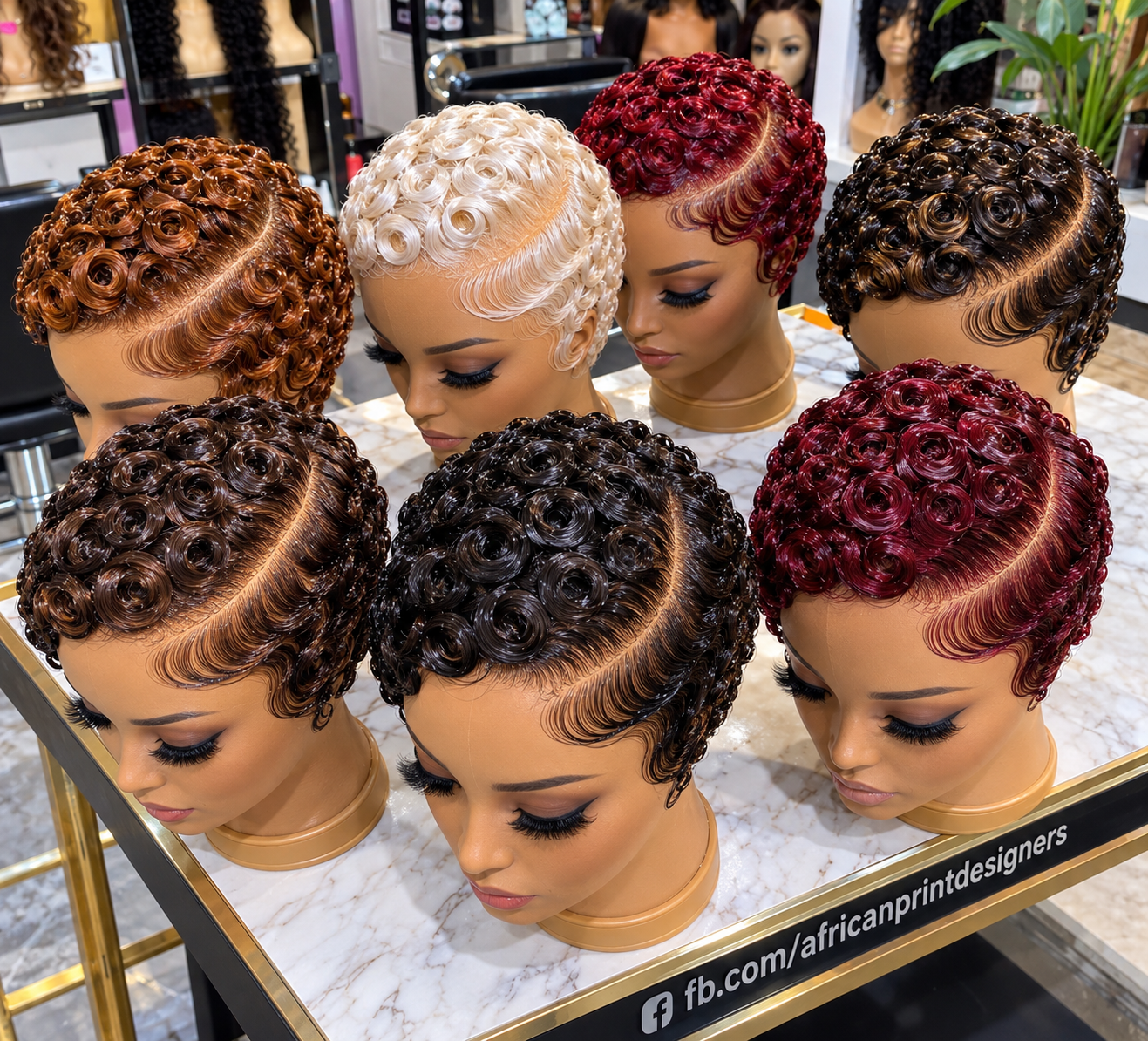
Choosing a sculpted pixie wig becomes considerably easier when several colors and curl arrangements can be compared side by side. This seven-piece salon collection presents a coordinated selection of compact spiral hairstyles in copper auburn, pearl blonde, ruby burgundy, dark chocolate brown and glossy black. Each wig has an elevated crown filled with small circular ringlets, a diagonal scalp-toned part and a sweeping finger-wave arrangement around the forehead. Although the general construction is related, the different colors reveal individual details of the curl placement and face-framing work.
The collection is displayed on seven realistic female mannequin heads arranged in two rows on a white marble-patterned salon table. Four units occupy the rear row, while three larger mannequin presentations stand at the front. The rear selection includes warm copper, pale pearl blonde, deep red and black-brown colors. The front row emphasizes rich chocolate, jet black and ruby-burgundy versions.
The most useful aspect of this arrangement is the opportunity to compare how a single styling concept changes with color. On black hair, the circular curls gain definition through glossy reflections and dark openings. On pearl blonde, the parting and feathered strands become exceptionally visible. Burgundy introduces rich red depth, while copper and brown variations emphasize warmth and individual curl surfaces.
The photograph shows the finished exterior styling rather than the interior construction. The mannequin heads do not establish whether the wigs are made from human hair or synthetic fiber, and their lace materials, cap dimensions and attachment systems remain unverified. Buyers should request those details independently before ordering.


The Seven-Wig Display Offers Several Color Directions
The collection should not be interpreted as seven completely identical units in different shades. Their crown curls share a common circular structure, but the size and placement of the rings vary slightly. The diagonal partings also sit at somewhat different angles, influencing the appearance of the forehead waves.
These distinctions matter when commissioning a custom wig. A customer might prefer the color of the pearl-blonde unit but the curl density of the foreground black version. Another might favor the copper crown while wanting the front-wave placement shown on the burgundy model.
A custom maker may be able to combine selected characteristics, depending on the available foundation and styling techniques. Such changes should be discussed before production rather than assumed possible from the group photograph.
Pearl Blonde Makes the Sculpted Hairline Highly Visible
The pearl-blonde wig in the upper row displays tightly arranged circular curls in a pale cream-white and champagne-blonde color family. Its lighter shade makes the individual curled surfaces and directional forehead strands particularly easy to distinguish.
The exposed diagonal part appears especially prominent because it separates sections of pale hair arranged in different directions.
Below the crown, fine strands curve across the forehead in a feathered wave. The light color makes their individual paths more noticeable than on the darkest wigs.
For a custom order, the buyer should request a pale pearl-blonde result with compact circular coils and a precise diagonal parting.
The photograph does not establish whether the pale color was achieved through lightening human hair or using pre-colored synthetic fiber. That distinction matters for future maintenance and should be verified with the supplier.
Ruby Burgundy Creates Rich Reflections Within the Rings
The collection includes two prominent burgundy variations. Their curls range visually from deep wine red to brighter ruby and cherry reflections, with darker recessed sections inside the circles.
These warm red tones make the ringlets highly noticeable without introducing blonde highlights.
The front burgundy wig has a particularly clear diagonal part and an elongated red finger-wave section crossing the forehead. The larger crown curls sit above this directional styling, creating a layered face-framing arrangement.
A customer ordering burgundy should distinguish the desired shade from bright red, magenta or purple. Burgundy generally describes a deeper wine-red family, but commercial shade names are not standardized.
A neutral-light color sample or photograph can help establish the intended result.
Copper Auburn Provides a Rich Golden-Red Alternative
The copper-auburn unit in the upper-left position displays warm reddish-brown ringlets with brighter bronze and orange-copper reflections. Its color appears lighter and more golden than the burgundy versions.
The spiral crown includes numerous small circular openings, while a prominent diagonal part creates a flowing transition toward the forehead.
The brighter copper surfaces reveal individual curl directions clearly. Some rings appear nearly circular from the viewing angle, while others overlap and form tighter loops.
For custom coloring, specify copper auburn with darker recessed depth rather than uniformly bright orange or pale golden blonde.
The goal is a rich warm color that continues to reveal the circular curl construction.
Chocolate Brown Gives the Front Collection a Softer Contrast
The front-left wig belongs to a deep chocolate-brown family with warm chestnut reflections. Its curls have glossy outer surfaces and dark interiors, creating depth without the stronger red saturation of burgundy.
The diagonal part is pronounced and follows a curved route across the upper side. Beneath it, elongated strands sweep toward the forehead and temple.
This provides a comparatively understated color option while retaining elaborate sculpted styling.
For buyers who prefer brown rather than black or vivid red, chocolate can emphasize the curl structure without creating a strongly contrasting palette.
A visual reference should accompany the order because chocolate brown may range from very dark espresso to considerably lighter chestnut depending on the supplier.
Jet Black Highlights the Precision of the Circular Crown
The foreground-center black wig offers one of the clearest views of the circular coil arrangement. Numerous glossy rings are distributed across the crown, with several larger openings surrounded by smaller supporting curls.
Its deep black color creates strong contrast between reflective outer strands and dark recessed centers.
The pronounced diagonal part separates the upper curls from an elongated finger-wave section. Several fine strands curve across the forehead before turning toward the temple.
This demonstrates how monochromatic hair can remain visually detailed through precise styling rather than additional highlighting.
A custom maker should preserve the circular openings and the directional front arrangement instead of introducing unrelated colors or decorative carving.
The Black-Brown Rear Wig Offers Another Dark Variation
The upper-right unit appears dark black-brown, with subtle warm reflections across its spiral crown. Its ringlets remain compact, and the diagonal parting is visible along the upper side.
The color is close to black, but some raised surfaces appear warmer under the salon lighting.
This illustrates why a buyer should request actual color confirmation rather than assuming every dark wig in the display uses the same shade.
Natural black, dark chocolate and espresso brown can look similar under certain lighting conditions but differ noticeably in daylight.
Across the collection, the upper hair is arranged into numerous rounded tubular coils rather than long hanging curls.
Several ringlets have visible open centers, while smaller formations fill the spaces around them. Their closely arranged placement creates a full crown without excessive length.
The circular construction is essential to the appearance. Replacing it with loose waves or very small spring curls would change the hairstyle even if the color remained identical.
For custom ordering, the buyer should specify compact hollow ringlets with mixed diameters and a rounded crown silhouette.
Individual Curl Openings Should Remain Recognizable
One of the important quality considerations is the visibility of the ringlet centers. The darker interiors create shadow, while the raised outer strands catch light.
This is especially noticeable in the black and chocolate versions, but the same principle applies to the lighter colors.
Increasing density indiscriminately can cause neighboring curls to overlap until their openings become difficult to distinguish.
A professional should therefore balance coverage with separation rather than assuming that maximum fullness always produces the best result.
The Diagonal Parts Organize the Crown Direction
Each clearly visible wig uses a diagonal part that separates the rounded coil field from the front finger-wave styling.
The parting provides a structural boundary. Above it, the strands form circular curls. Below it, the hair follows elongated directional waves.
The angle varies slightly across the collection, creating differences in how the hairstyles frame the mannequin faces.
For a custom reproduction, the desired parting position should be approved independently from the color.
The Forehead Finger Waves Add a Separate Styling Technique
The front-wave sections are among the most distinctive details of the collection. Fine strands travel across the forehead in broad, controlled curves, creating a flowing contrast with the circular crown.
Some units use longer waves that reach toward the temple, while others have more compact arrangements around the front.
These sections should not be dismissed as incidental baby hairs. They occupy a substantial visual area and contribute directly to the face-framing design.
A custom maker should maintain the difference between the elongated waves and upper ringlets.
Temple Curls Complete the Face-Framing Arrangement
Several wigs contain small curled accents near the temples. These strands bend inward beneath the larger crown curls and follow the direction established by the forehead waves.
Their relatively small scale helps complete the styling without overwhelming the face.
During custom production, the buyer should identify whether these accents are included in the desired reference.
Enlarging them considerably or adding extra decorative strands could produce a different appearance.
The Compact Length Keeps the Collection Proportional
Despite the elaborate circular crowns, the wigs remain relatively compact. Their curls concentrate around the upper head rather than extending into long lengths over the neck or shoulders.
This allows the diagonal parts and forehead waves to remain prominent.
The lower areas appear closely arranged, maintaining a rounded pixie silhouette across the different colors.
For custom styling, crown height and lower curl size should be considered together. Excessive crown volume can make the wig appear disproportionate even when individual curls are attractive.
The Mannequin Display Does Not Reveal Cap Construction
The photograph presents the wigs fully styled on mannequin heads. Their interior caps and attachment components are concealed.
Consequently, the image does not verify whether any particular unit uses a lace front, full lace, adjustable cap, internal combs or another securing system.
The visible parting and hairline styling should not automatically be interpreted as evidence of HD lace.
Buyers should request separate underside photographs and product specifications for the exact wig they intend to purchase.
Choosing a Cap Size Before Ordering
The diagonal parts and front waves are attached to each wig’s foundation. Their position changes if the cap sits too far forward or backward.
Accurate sizing therefore matters for both comfort and visual consistency.
For custom construction, follow the maker’s measurement instructions. Depending on the cap, circumference, front-to-nape and ear-to-ear dimensions may be required.
A professional wig stylist can assist with sizing if necessary.
Where to Buy Sculpted Finger-Coil Pixie Wigs
Specialist wig makers, custom lace-wig studios, beauty supply retailers and salons experienced with finger-coil styling are practical sources for comparable designs.
A ready-made unit can be convenient when its curl arrangement and color already match the customer’s preference.
A custom order may be more appropriate when combining the color of one display wig with the styling of another.
Before placing a deposit, ask whether the seller can supply the exact requested curl construction and front-wave arrangement.
Finding a Professional for Spiral and Finger-Wave Styling
The crown and front require different techniques. The upper hair uses compact circular ringlets, while the forehead contains long directional waves.
A stylist experienced only with loose curly wigs may not automatically reproduce these details.
When reviewing a portfolio, look for close images of sculpted coil crowns and precision finger-wave styling.
Custom wig studios and stylists experienced with compact sculpted pixie hairstyles are appropriate professionals to contact.
How to Prepare a Custom Order From the Display
Begin by identifying the exact mannequin whose hairstyle should be reproduced.
Specify the preferred crown density, curl diameter and visible ringlet openings.
Identify the angle of the diagonal part and the direction of the forehead waves.
Select the color separately, using an actual shade reference rather than only a broad color name.
Finally, confirm the hair material, cap dimensions, available lace options and intended installation method.
Approval Photographs Should Show Each Unit Individually
A group photograph is valuable for comparing colors, but it does not reveal every construction detail.
Before purchasing, ask for front, side, rear and elevated crown photographs of the exact selected wig.
The underside should also be documented if cap construction affects the buying decision.
For custom orders, approval images should show the actual completed unit rather than a different example from the same collection.
Pricing Reflects Curl Construction and Color Selection
The compact length of these wigs does not necessarily make them simple to produce. The crowns contain numerous individually arranged circular coils, while the fronts require detailed directional styling.
Color processing, cap construction and lace preparation can add further costs.
Estimated Price Comparison for Seven-Color Sculpted Pixie Wigs
| Category | Illustrative Price Range | Potential Scope |
|---|---|---|
| Premium Custom | $325–$600+ | Higher-grade hair, personalized cap sizing, custom color selection, hand-arranged circular ringlets, detailed diagonal partings, finger-wave styling and lace preparation where applicable. |
| Standard Custom | $195–$355 | Prepared ringlet crown, selected color, front-wave styling and standardized cap options. |
| Basic Human Hair | $115–$215 | A human-hair foundation requiring additional color work, spiral setting, front-wave styling and professional fitting. |
| Premium Synthetic | $75–$155 | A quality pre-colored and pre-set interpretation that may retain its circular curls with relatively limited professional resetting. |
| Basic Synthetic | $35–$90 | A budget alternative where coil separation, color depth, parting detail or cap construction may be simpler. |
These figures are illustrative budgeting estimates rather than confirmed prices for the displayed wigs. Actual quotations depend on material, supplier, location, customization labor, cap construction, shipping and installation.
Before comparing sellers, ask whether the price includes the completed circular crown and finger-wave front. An unfinished foundation may require additional services that substantially change the total expense.
Human Hair Offers Greater Restyling Flexibility
A human-hair version may allow individual ringlets to be reset when they lose their shape, depending on the condition of the hair.
Color-processed human hair, particularly very light blonde or vivid red shades, may require additional care.
Heat should be chosen according to the actual condition and processing history of the strands.
Premium Synthetic May Retain Pre-Set Ringlets
A quality synthetic unit may preserve its circular curl arrangement with comparatively limited daily manipulation.
This can be practical for customers who want to maintain the original style.
However, heat tolerance varies by fiber, and conventional permanent hair dye should not be assumed suitable.
The actual material should guide future care decisions.
Protect the Circular Crowns During Washing
Before washing, photograph the selected wig from above. This records the original position and size of the individual curls.
During cleansing, avoid aggressive rubbing that can intertwine neighboring ringlets and close their circular openings.
Use care methods appropriate for the confirmed hair or fiber.
After drying, restore only the sections that have shifted rather than rebuilding the entire crown.
Maintain the Finger Waves Separately
The forehead waves should retain their elongated movement instead of being rolled into additional spirals.
If a wave loses its direction, guide it back along the original curve using material-appropriate techniques.
Heavy styling products can cause neighboring strands to stick together and obscure the fine arrangement.
Color Maintenance Varies by Shade
Black wigs may require relatively little tonal refreshing compared with heavily processed light-colored human-hair versions.
Burgundy and copper human hair can gradually lose color intensity through washing and heat exposure.
Pearl-blonde hair may require particular attention to the products and techniques used to preserve its intended shade.
A professional should assess the actual material and processing history before recommending color treatments.
Store the Wigs Without Flattening the Crown
A suitable wig stand or mannequin head can help maintain the circular curl structure between wears.
Avoid stacking hairpieces on top of one another, since pressure can flatten the ringlet openings.
The front-wave styling should also remain free from compression.
Make sure each wig is fully dry before storage.
The Best Choice Combines Color Preference With Curl Accuracy
This seven-piece collection demonstrates how one sculpted pixie concept can produce distinct appearances through color and subtle changes in curl placement. Pearl blonde emphasizes fine strand detail, burgundy creates rich red depth, copper highlights warm circular surfaces, chocolate offers softer brown contrast and black relies on glossy light-and-shadow variation.
For buyers, the most important quality checks are crown curl size, visible ringlet openings, diagonal part placement, forehead-wave direction, temple accents, color accuracy and verified cap construction.
For wig businesses, displaying several related designs together helps customers compare options, while individual product photographs and accurate specifications turn that inspiration into an informed purchase.
A successful custom reproduction should preserve the selected unit’s curl architecture and face-framing details rather than treating every color variation as interchangeable. The value of the collection lies in offering different combinations of sculpted ringlets, directional front waves and rich color without sacrificing the compact pixie silhouette.
Search Terms
pearl blonde sculpted pixie wig · ruby burgundy finger coil wig · copper auburn circular curls · chocolate brown diagonal part wig · jet black finger wave pixie · seven sculpted ringlet wigs · deep wine red spiral crown · pearl white curly pixie hairpiece