
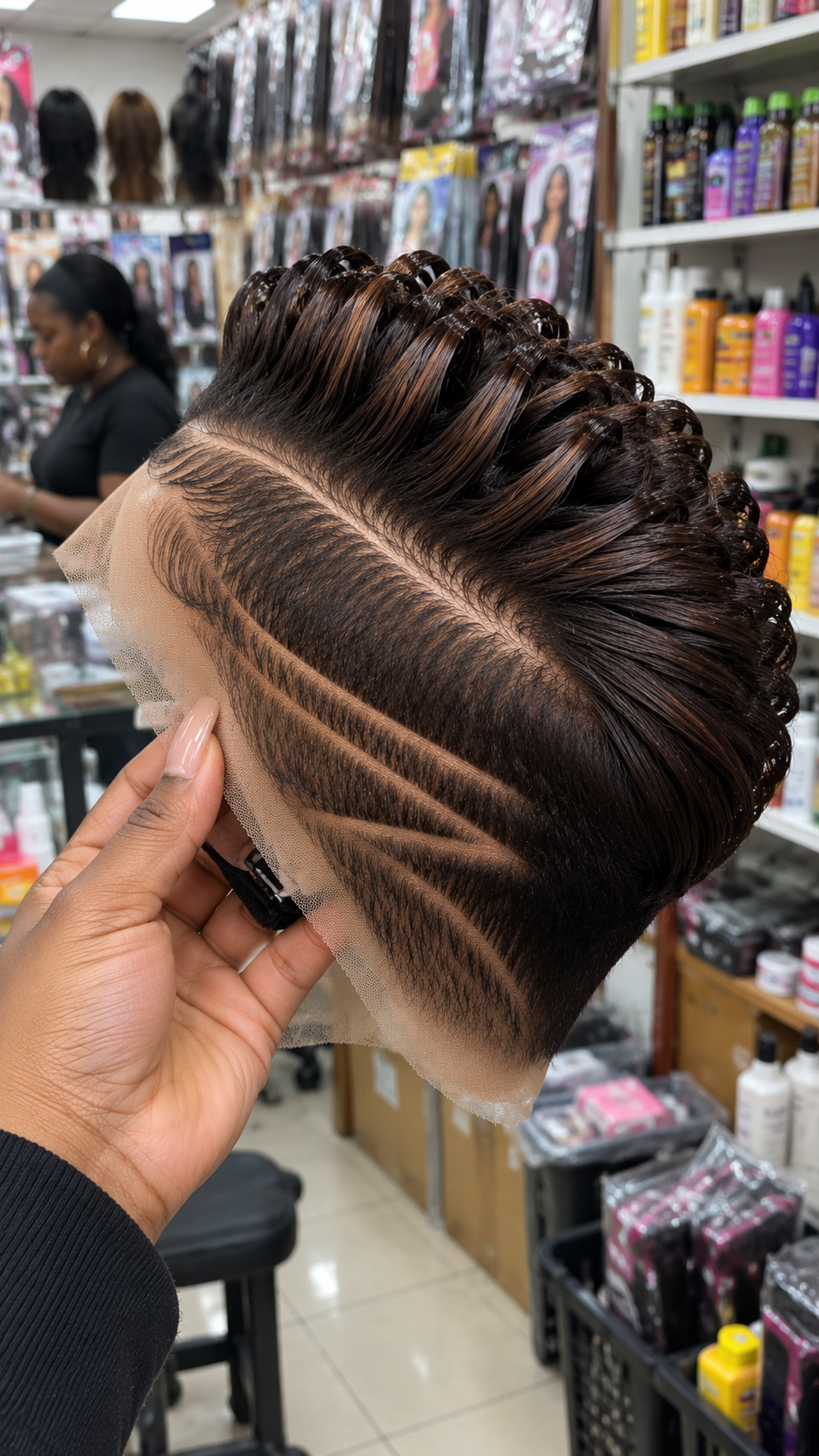
When a wig is displayed before installation, the most revealing details are often those that disappear once it is worn. This mocha-brown and black pixie hairpiece offers a particularly useful example. Held at an elevated side angle inside a beauty supply shop, it reveals a series of backward-bending ribbon curls above three tapered side channels, along with untrimmed beige lace and a partially visible securing attachment beneath the front edge.
The hairstyle is built around a contrast in direction. The upper strands rise from a dark foundation, curve backward, and gather into rounded loops. Below them, the hair lies close to the cap in long, diagonal sections. The visible separation channels divide these lower sections into progressively narrower panels, creating a distinctive layered profile.
Its coloring is restrained compared with bright copper or blonde wigs. The hair appears predominantly espresso-black, with mocha and medium-brown reflections following selected upper curls. Some of those warmer areas may represent lighter strands, while the shop lighting also contributes to their appearance. The result is a hairstyle whose shape remains more prominent than its color.


For anyone considering a similar lace pixie wig, the purchasing challenge is finding a product that preserves the upper curl direction, the side-channel arrangement, and the natural-looking transition toward the front hairline. These elements should be evaluated separately before deciding whether to purchase a ready-made unit or commission a custom reproduction.
Three Side Channels, Three Different Visual Roles
The lower side deserves attention before the upper curls because its geometry establishes much of the hairstyle’s character. A broad diagonal separation runs beneath the raised upper hair, beginning near the front and extending toward the rearward section.
This upper channel creates a clear boundary between the elevated ribbon curls and the closely arranged dark side panel. Its pale appearance contrasts with the surrounding hair, making the division immediately recognizable.
Beneath it, a second narrower channel follows a descending path through the lower side. The hair between these first two divisions remains relatively broad and dark, providing a substantial visual foundation.
A third, shorter channel appears closer to the lower edge. It bends downward and gradually narrows, creating a pointed, feather-like arrangement near the rearward portion of the visible side.
These divisions are not simply three identical parallel lines. Their lengths, widths, and directions vary. The uppermost separation is more extensive, while the lower channels create a progressively finer pattern.
The photograph does not establish whether these channels were made using clippers, a razor, deliberate parting, or another styling method. What can be verified is the arrangement of exposed separations between closely positioned hair sections.
The Importance of the Tapered Lower Ending
The lowest channel is especially distinctive because it does not continue as a uniform stripe across the entire side. Its visible path narrows into the surrounding dark hair, contributing to the feathered appearance of the lower design.
This ending should be preserved when commissioning a reproduction. Extending the channel too far or making it uniformly wide would change the visual balance.
The lower hair panels also retain visible strand coverage. They are not shaved completely to bare skin, and the photograph does not demonstrate a skin fade.
For buyers who prefer intricate side styling without a severely exposed temple, this arrangement offers an interesting alternative. Its detail comes from the positioning of hair and separations rather than the complete removal of the lower section.
Mocha Reflections Travel Along the Upper Hair Direction
The upper curls contain dark brown-black strands with warmer mocha and chestnut-brown areas visible along several raised sections. These lighter reflections are not distributed uniformly throughout the hairstyle.
Some appear as narrow brown ribbons following the curve of the hair. Others are more subdued, becoming visible only where the strands face the overhead lighting.
The darker foundation remains prominent between the raised sections and throughout the lower side.
This restrained color distribution helps emphasize the shape of the upper curls without creating a dramatically highlighted appearance.
Buyers should avoid assuming that the wig contains a particular factory highlight pattern based solely on the photograph. The image cannot distinguish every intentionally lighter strand from reflected light.
For an accurate custom color request, describe the desired appearance as predominantly espresso-black with subtle mocha-brown accents concentrated along selected upper sections.
Ask the seller for photographs under neutral daylight before approving a specific color code.
Why the Upper Hair Resembles Folded Ribbons
The upper hairstyle consists of elongated sections that rise from the front-side area and travel backward. Many strands form broad arcs before folding into rounded loops toward the crown.
The curls are not compact circular ringlets with uniformly visible openings. Instead, their shapes are longer and more directional, resembling ribbons of hair bent into controlled arches.
Several raised sections appear relatively wide near their bases. As they curve backward, the strands gather into smaller overlapping loops.
The upper silhouette remains compact, with noticeable elevation but without long hair hanging freely over the face.
The rearward portion visible in the photograph contains closely arranged curls that appear more compact than the elongated sections near the front.
This progression creates movement from the front toward the back. A reproduction using ordinary loose curls might have similar overall volume but would not reproduce the same directional structure.
Reproducing the Hair Flow Without Increasing Volume
When ordering, ask the maker to preserve the backward direction of the raised sections. The upper hair should not be transformed into an oversized curly crown.
Increasing density excessively may conceal the separation between individual ribbons. Adding length may cause the arches to extend farther above the head or fall into hanging curls.
The photograph suggests carefully positioned styling, but it does not establish the exact setting technique or products used.
A wig maker experienced in sculpted pixie hairstyles should be able to discuss how similar shapes can be achieved with the proposed hair material.
Request examples of previous work showing elongated loop arrangements rather than relying only on photographs of ordinary curly wigs.
The Front Hairline Has a Distinct Sweeping Pattern
Near the forehead, fine dark strands are arranged into a series of gentle curves. The hair follows a backward direction before joining the raised upper sections.
This creates a gradual transition from the lace edge toward the fuller hairstyle.
The front hairline is not covered by a long fringe. Instead, the upper curls rise away from the forehead, leaving the closely arranged front strands visible.
The hairline appears carefully prepared, although its final appearance cannot be determined before installation.
Cap position, lace trimming, and any additional customization will influence how the strands sit against the wearer’s skin.
A stylist should therefore evaluate the front hairline and the side channels together during fitting.
The Untrimmed Beige Lace Is Part of the Buying Decision
A substantial section of beige-toned lace extends beyond the front and visible temple. The mesh remains untrimmed and hangs freely beneath the styled hair.
This provides room for fitting, but the photograph does not establish the exact lace material or commercial classification.
The visible mesh should not automatically be described as HD lace. Such claims require reliable manufacturer or seller information.
The lace also appears lighter than the surrounding dark hair, which is normal for an uninstalled unit photographed against a contrasting background.
Whether the lace will blend appropriately with a particular wearer’s skin depends on its actual shade, transparency, and installation method.
Before purchasing, ask the seller to identify the lace type, available colors, and recommended preparation process.
A Partially Visible Attachment Does Not Confirm the Entire Cap
Near the lower front opening, a dark securing component is visible beneath the lace. However, the photograph does not expose the complete underside of the wig.
The total number of combs, the arrangement of adjustable straps, and the full cap construction cannot be verified from this angle.
The visible attachment also does not prove that the wig is designed for adhesive-free wear.
For buyers seeking a glueless installation, the seller should explain the intended securing method and demonstrate whether the cap can remain stable without adhesive.
Request a complete inside-out photograph showing the front, rear, and side attachment areas.
Cap measurements should also be confirmed. Circumference, front-to-back length, and ear-to-ear dimensions can affect comfort and positioning.
Choosing a Supplier Based on Side-Pattern Accuracy
For this particular design, the side geometry may be a better indicator of manufacturing skill than the general appearance of the upper curls.
Many wig makers can produce dark curly pixie hairstyles. Fewer may be experienced in arranging several narrow, tapered channels with consistent spacing and a precise lower ending.
When reviewing a supplier’s portfolio, look for close side photographs of completed sculpted wigs.
Pay attention to whether the separation channels remain distinct and whether the surrounding hair follows their direction.
A maker whose work shows uneven gaps, excessive exposed cap material, or poorly aligned hair may struggle to reproduce the reference accurately.
Ask whether the supplier can create the design using the proposed cap construction without damaging the supporting lace or fabric.
Ready-Made Shopping: What to Compare First
A ready-made wig may be a practical option if the buyer finds a product with comparable upper curls, side channels, and cap measurements.
However, generic pixie wig listings often group several different hairstyles under similar names.
One product may have the correct dark brown color but ordinary curls. Another may feature backward-directed loops but only one side parting.
A third may contain multiple decorative channels but lack the tapered lower ending visible in this reference.
For this reason, compare the actual side photographs before focusing on price.
Ask whether the listing images show the exact unit available for shipment. If not, request photographs of the individual wig that will be supplied.
Commissioning a Custom Version With Clear Instructions
Begin the custom-order process by sending the reference photograph and identifying the three side channels as a priority.
Explain that the uppermost channel should be broad, while the lower divisions should become narrower and follow a tapered arrangement.
Next, describe the upper hair as elongated, backward-directed ribbon curls rather than ordinary loose spirals.
Specify the predominantly espresso-black appearance with restrained mocha-brown accents.
Ask the maker to preserve the compact upper silhouette and the closely arranged lower side.
Finally, provide cap measurements and request confirmation of the lace material, attachment system, and intended installation method.
If possible, obtain a progress photograph before final styling is completed. This can help identify differences in the side geometry while corrections may still be feasible.
Booking the Right Salon for Installation
After receiving the wig, inspect the curl arrangement, side channels, lace, and visible cap components before making any adjustments.
When booking a salon appointment, explain that the hairstyle contains directional ribbon curls and three tapered side separations.
Ask whether the stylist has experience installing sculpted pixie wigs and preserving detailed side patterns.
At the appointment, the cap should be positioned and checked for comfort before any lace trimming.
The stylist should evaluate how the channels align with the temple and whether the upper curls sit at the intended angle.
Any cutting near the side pattern should be approached cautiously because the wig may contain lace or cap material immediately beneath the hair.
If the upper curls become disturbed during shipping, ask whether the salon can restore the directional arrangement using methods appropriate for the confirmed material.
Illustrative Pricing for a Mocha Ribbon Curl Pixie Wig
The cost of reproducing this hairstyle may depend on hair material, cap construction, lace coverage, styling labor, and the complexity of the tapered side channels.
The photograph does not establish the manufacturer, fiber composition, or actual selling price.
The following US dollar amounts are illustrative planning ranges rather than verified current product prices.
| Wig Category | Illustrative USD Range | Potential Cost Considerations |
|---|---|---|
| Premium Custom | $365–$830+ | Individual cap sizing, detailed ribbon curl placement, precision tapered side channels, and specialist hairline preparation. |
| Standard Custom | $190–$435 | Selected adjustments to curl direction, mocha color accents, cap sizing, and side-channel geometry. |
| Basic Human Hair | $110–$285 | A human-hair base unit that may require additional professional sculpting and color work. |
| Premium Synthetic | $75–$215 | A higher-grade synthetic option with potentially prearranged ribbon curls and detailed side styling. |
| Basic Synthetic | $30–$110 | A budget alternative where exact curl direction and tapered channel accuracy may vary. |
These categories represent possible purchasing approaches and do not identify the material of the photographed wig.
Installation, shipping, lace preparation, cap adjustments, and future restyling may be charged separately.
Ask for an itemized quotation and confirm whether the seller guarantees the agreed styling details.
Maintaining the Directional Curls and Tapered Side Pattern
The upper ribbon curls depend on their backward-directed shape. Brushing through them may separate the grouped strands and alter the intended arrangement.
Before attempting maintenance, ask the supplier how the curls were set and whether they are designed to retain their shape after washing.
If the wig contains synthetic fibers, avoid heat tools unless the manufacturer confirms the permitted temperature.
If the unit contains human hair, professional resetting may be possible, but the appropriate method depends on previous processing and the original styling technique.
The side channels require separate attention. Repeated brushing across the narrow divisions may move hair into the exposed areas and reduce their visibility.
The tapered lower ending is particularly vulnerable to changes in hair direction because its narrow sections depend on precise placement.
Ask whether the hairstyle requires periodic professional maintenance and how the wig should be stored without compressing the upper loops.
Photographs That Can Confirm the Finished Wig
The supplied image provides a strong view of one side and the upper hairstyle, but it does not reveal the complete rear or opposite temple.
A direct front photograph would help establish the hairline and upper-loop distribution.
An opposite-side view would show whether the three tapered channels are repeated or whether the other side has a different arrangement.
A rear photograph would reveal how the elongated curls transition toward the nape.
A complete underside image would help verify the cap construction and attachment components.
A brief video under neutral lighting would also provide a more reliable impression of the mocha-brown reflections and overall proportions.
When the Side Geometry Becomes the Main Reason to Buy
This wig combines restrained mocha-brown accents with elongated black ribbon curls and three carefully arranged side channels. The upper hair provides elevation and movement, while the lower sections create a layered pattern through their tapered separations.
The untrimmed lace and partially visible securing component provide useful construction clues, although they do not establish the complete cap specifications or fiber composition.
For buyers seeking a distinctive sculpted pixie wig, the strongest purchasing strategy is to prioritize the accuracy of the side geometry, the direction of the upper curls, and the suitability of the cap.
A successful reproduction should preserve the narrow lower ending and dark side coverage without adding unrelated decorative lines or increasing the upper volume unnecessarily.
With careful supplier selection, clear custom-order instructions, and appropriate professional fitting, the design can provide a refined alternative to conventional curly pixie wigs.
Search Terms
Mocha black backward ribbon curl wig · Three tapered side channel pixie · Espresso brown sculpted lace hairpiece · Feather ending curved temple parting · Dark brown elongated loop crown wig · Beige untrimmed lace mocha pixie · Triple descending side separation wig · Black swept hairline ribbon curl unit