
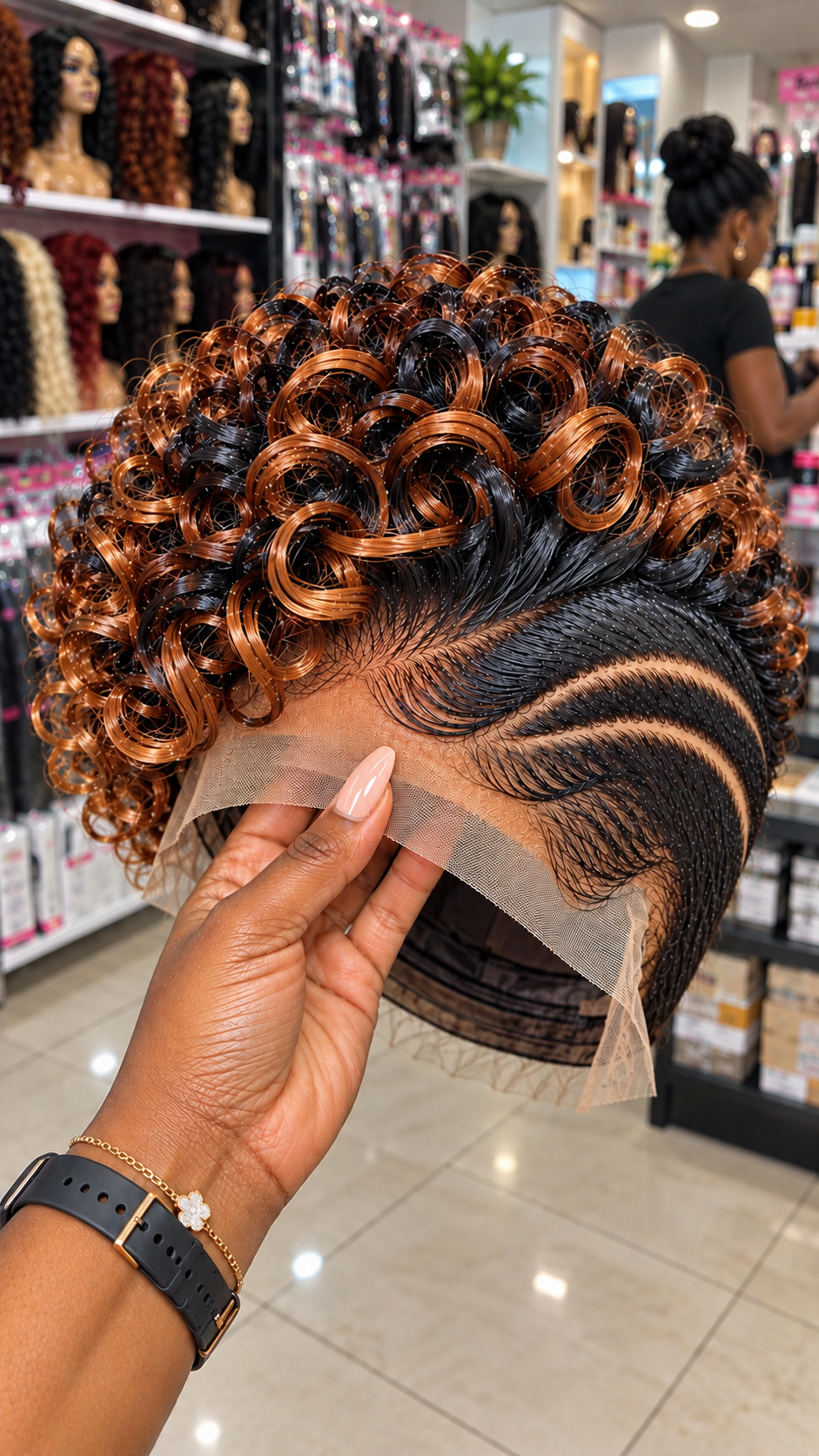
At a glance, the golden copper circles dominate this sculpted wig. A closer examination reveals a more complicated relationship between the crown and the side: warm metallic-looking ringlets rise above a black foundation, finely directed strands form a sweeping transition, and three curved exposed channels descend across the temple. The combination produces a distinctive hairpiece whose appearance depends on deliberate curl positioning and precision side work rather than color alone.
The photograph captures the unit inside a working beauty supply store. A hand supports the front mesh, leaving the unfinished lace perimeter and part of the dark cap visible beneath the styled hair. The crown contains large, hollow tubular curls in copper, chestnut and bronze-brown tones, interspersed with dark sections that create considerable depth. The side remains primarily black, with elongated finger-wave ridges arranged above and between the carved paths.
For someone ordering this design, the important questions are not limited to finding an attractive copper shade. The maker must understand the varying diameters of the ringlets, the black root distribution, the broad movement of the front waves and the graduated lengths of the temple channels. Each contributes to the design in a different way.
The Temple Artwork Follows a Graduated Pattern
The exposed pathways across the side are not an identical set of horizontal stripes. The upper curve follows a broad route beneath the crown. Below it, another channel runs through the middle of the dark hair, followed by a shorter lower accent that tapers toward the forward temple.


This creates a descending visual rhythm. The channels are related in direction but differ in length, width and endpoint, so the result appears more deliberate than a series of equal parallel cuts.
The dark strands between the exposed paths provide the contrast necessary for each channel to remain visible. Their preservation matters as much as the lines themselves.
If a stylist widens the channels excessively, the retained sections may become too narrow. This could cause the lower design to lose its separate arcs and appear as one broad exposed area.
For a commissioned wig, the side artwork should be mapped and approved before permanent cutting begins.
The Front Wave Connects the Carving to the Crown
Between the copper ringlets and the carved temple sits a comparatively flat arrangement of black hair. Fine strands travel backward from the front, creating a broad sweeping wave before continuing toward the closely arranged side.
This intermediate section is one of the most useful details in the reference. It prevents the large circular crown from meeting the exposed channels abruptly.
The crown uses compact rolled formations. The front uses elongated directional strands. The lower side uses closely placed hair interrupted by narrow curved paths. Together, they establish three different scales of movement.
A recreation should retain this transition. Adding additional circular ringlets throughout the side would obscure the carving, while removing the sweeping wave could make the crown appear disconnected from the lower hair.
Copper Color Occupies the Raised Circular Surfaces
The crown displays burnished copper, reddish bronze and warm chestnut reflections. Some ringlets appear especially bright along their outer curves, while inner portions and the spaces between them remain considerably darker.
There is no clear evidence that every apparent shade represents a separate dye formula. Reflective hair surfaces and salon lighting can produce meaningful variations within a single color family.
The important visible characteristic is the contrast between warm outer ribbons and dark recessed hair.
For a custom color request, describe the crown as rich copper-bronze with dark black roots and deeper brown interior sections. Avoid requesting a uniformly orange crown if the objective is to reproduce the photograph.
A neutral-light color sample is useful before approving the final shade, particularly when the buyer wants to distinguish reddish copper from golden caramel.
The Hollow Rings Need More Space Than Conventional Curls
Several prominent coils form broad circles with clearly visible openings. Their strands travel around the outside like narrow ribbons rather than falling downward as loose ringlets.
These openings give the crown its visual identity. They reveal darker hair beneath the copper and allow the individual rings to remain distinguishable despite the considerable density.
Some circles face directly outward, while others turn sideways or slightly backward. Smaller curled sections fill neighboring gaps.
This variation helps create a rounded crown without arranging every ring in a rigid repeated pattern.
When commissioning a similar hairstyle, buyers should request a mixture of large hollow rings and smaller supporting coils. Asking for identical curls everywhere could produce a more mechanical appearance than the reference.
A Concentrated Crown Creates Volume Without Long Hair
The upper ringlets create considerable visual fullness, but the hair remains compact around the head. The curls do not extend into long hanging lengths or cover the lower side.
The strongest volume appears across the upper and forward crown, with additional rings continuing toward the visible rear.
This concentration allows the dark temple artwork to remain prominent. If the crown were enlarged substantially downward, it could conceal some of the lower design.
A professional should therefore balance crown projection with side visibility instead of simply maximizing the number or size of curls.
Root Depth Gives the Ringlets Their Dark Interiors
Near the foundation, the hair appears almost black. These dark roots continue into the closely arranged side, connecting the warm crown and black temple panel.
The darker areas also create shadow inside the open circular curls, making their copper surfaces appear more prominent.
Uniform coloring from root to end would change this relationship. A wig made entirely from bright copper hair could appear less dimensional even if the coil arrangement were similar.
For custom coloring, the maker should preserve substantial root depth and concentrate lighter tones on the raised hair.
The Curved Side Lines Require a Skilled Hand
Creating several narrow channels on a wig is different from cutting a temporary design into naturally growing hair. The hairpiece cannot replenish strands removed during carving.
The professional must therefore decide exactly where hair should remain before exposing the pathways.
For the pictured design, the upper channel should retain its long sweeping route, while the lower accents should become progressively shorter.
Additional lines would not necessarily improve the appearance. They could crowd the side and change the relationship between the carving and the crown.
Buyers should look for custom wig makers or wig-cutting specialists whose portfolios show accurately spaced curved temple artwork.
The Side Remains Dense Below the Exposed Channels
The lower side contains closely arranged dark hair rather than an entirely bare surface. Its fine strands follow the shape of the wig, maintaining a compact silhouette beneath the carving.
This area helps the design remain visually complete. Too much removal could make the foundation appear overly exposed.
At the same time, excess length could allow strands to cross the channels and hide their intended curves.
A balanced recreation should maintain closely arranged lower hair while keeping the exposed paths readable.
The Lace Is Ready for Individual Preparation
The image clearly shows a broad section of beige-toned lace extending beyond the front and side hair-bearing areas. The wig has not yet been trimmed to match an individual’s hairline.
This is useful during professional fitting because the installer can position the unit and determine where the excess material should be removed.
The lace appears fine in the photograph, but its precise grade and composition cannot be verified visually. It should not automatically be identified as HD lace.
Buyers should ask the seller for the actual lace material, available shades and any recommended installation requirements.
The Interior Cap Is Only Partially Visible
The dark foundation can be seen beneath the extended mesh, but the photograph does not reveal the complete fastening or adjustment system.
A customer should request a separate underside photograph showing the entire cap before making a decision based on interior construction.
This is particularly relevant for buyers who prefer specific comb arrangements, adjustable bands or adhesive-free installation methods.
None of those characteristics should be guaranteed solely from the exterior photograph.
Cap Measurements Influence the Side Design’s Position
The temple channels are fixed to the wig foundation. Their placement changes if the cap is shifted forward or backward during installation.
A correctly carved design can therefore appear misplaced when worn on an unsuitable cap.
For a custom order, follow the maker’s measurement instructions. Circumference, front-to-nape and ear-to-ear dimensions may be relevant depending on the construction.
A professional wig stylist can assist with measuring and determine whether a standard cap or personalized sizing is more appropriate.
Choose a Seller Based on the Work That Matters Most
General wig retailers may stock copper curly hairpieces, but the complete design requires more than the right shade.
The seller should be able to demonstrate experience with hollow ringlet crowns, black directional front waves and precision temple carving.
Portfolio photographs should show individual curls from above and side designs from a direct profile. These views provide more useful information than distant mannequin photographs.
If one specialist cannot perform every stage, the buyer may consider a custom wig maker for the crown and a wig-cutting professional for the temple artwork.
Any final side refinement should be completed after cap placement has been evaluated.
Where to Source the Design
Custom lace-wig studios, sculpted-wig makers and salons experienced with finger-coil hairpieces are suitable places to begin searching.
A ready-made copper foundation may reduce some preparation work, but the exact ringlets and temple pattern could still require extensive styling.
When contacting a supplier, send the reference photograph and ask whether the quoted price includes the completed circular crown, dark roots, finger-wave transition and side channels.
If the seller provides only an unfinished base, obtain separate estimates for the required professional services before comparing the total cost.
A Production Brief Should Separate Four Requirements
Begin with the crown construction: large hollow circular ringlets in mixed sizes, positioned close together over a rounded upper foundation.
Next, establish color placement: burnished copper and warm chestnut surfaces above substantial black root depth.
The third requirement is the side: a broad directional black wave with several descending curved exposed channels and compact dark hair beneath them.
The final requirement concerns the practical foundation, including cap measurements, lace specification, attachment preferences and the intended delivery condition.
This creates a usable production brief without relying on a vague instruction for a copper curly wig with shaved lines.
Approval Should Happen Before Permanent Customization Is Complete
For expensive made-to-order work, buyers should request photographs at meaningful stages wherever the seller offers them.
An elevated crown image can confirm ring diameter, spacing and color distribution.
A direct side photograph should reveal each exposed pathway and the dark hair retained between them.
A rear view can establish whether the curl construction continues consistently around the back. An underside photograph can document the cap and lace.
These images are particularly helpful before the seller ships a unit that has been customized specifically for the buyer.
Consider Both Production Price and Future Maintenance
The purchase price may include individually arranged curls, coloring, side carving and lace preparation. However, the buyer should also consider the future cost of preserving the hairstyle.
Ringlets may need professional resetting, while the carved side requires conservative care to prevent gradual widening.
Illustrative Pricing for a Copper Ringlet Wig With Graduated Temple Channels
| Category | Estimated Price Range | Possible Inclusions |
|---|---|---|
| Premium Custom | $355–$640+ | Higher-grade hair, individualized cap sizing, copper-bronze coloring, hand-arranged open ringlets, precision temple channels and personalized lace preparation. |
| Standard Custom | $215–$385 | Completed copper ringlet crown, dark side styling and the graduated temple pattern on a standard cap. |
| Basic Human Hair | $125–$230 | Human-hair base requiring additional coloring, spiral setting, side customization and fitting. |
| Premium Synthetic | $85–$170 | Pre-colored and pre-set hairpiece with potential ringlet-retention advantages and more limited future alterations. |
| Basic Synthetic | $40–$95 | Budget interpretation with potentially simpler curl openings, tonal variation, side artwork or cap construction. |
These figures are illustrative budgeting estimates, not verified prices for the photographed wig. Actual amounts depend on material, supplier, location, labor, cap construction, shipping and installation.
Customers should compare the cost of a fully completed hairpiece rather than the base price alone. Additional coloring, ringlet setting and precision side cutting can substantially change the total expense.
Material Selection Changes the Restoration Options
Human hair may offer more flexibility when individual curls need professional resetting, depending on the condition of the strands.
Copper-colored human hair may have undergone processing, which should influence future heat and chemical services.
Premium synthetic fiber can offer advantages in preserving a pre-set circular arrangement, although substantial restyling and recoloring may be more restricted.
The photograph does not establish the hair type, so maintenance should be based on verified material specifications rather than appearance.
Protect the Curl Openings During Cleansing
The crown’s hollow circular forms are vulnerable to excessive manipulation. Rubbing neighboring curls together may cause their strands to intertwine and obscure the openings.
Before washing, photograph the crown from above to record its original arrangement.
Use care methods appropriate for the confirmed material, and allow the wig to dry without compressing the raised curls.
Afterward, identify which sections have moved and restore those individually instead of rebuilding the entire crown automatically.
The Side Artwork Does Not Need Routine Enlargement
Unlike naturally growing hair, wig strands do not return after cutting. The exposed temple channels should therefore be preserved rather than continually widened.
If fine hairs shift across a line, repositioning may restore its appearance without additional cutting.
When professional refinement is necessary, the original side photograph should guide the widths, spacing and tapered endpoints.
This helps protect the dark panels that make the descending pattern recognizable.
Copper Refreshing Should Retain the Black Foundation
If a human-hair version eventually requires color maintenance, the deep roots should remain part of the plan.
Uniformly recoloring the crown bright copper could reduce the dark interior contrast that emphasizes the hollow rings.
A colorist should assess which warm sections actually need