
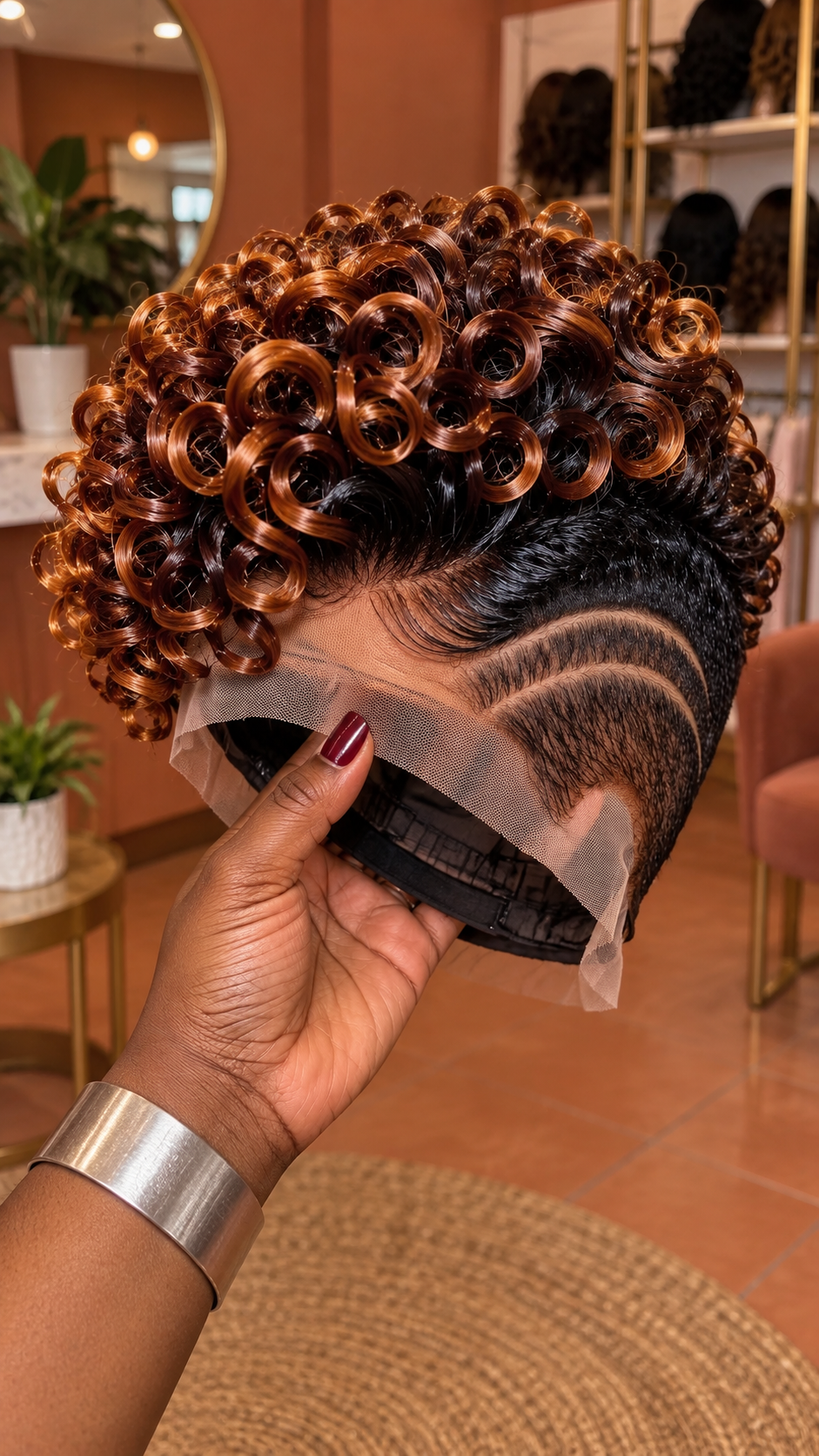
The most expensive part of ordering a sculpted wig is not necessarily the hair itself. It can be the specialist labor required to reproduce the details that distinguish one design from another. This burnt-copper ringlet wig is a good example. Its densely populated crown contains large open circular curls in warm copper and auburn shades, while the lower side is predominantly black and carries two sweeping crescent-shaped divisions. The design succeeds because the color, crown construction and side geometry occupy carefully balanced areas.
The photograph shows the wig before installation, supported by one hand inside a salon with warm terracotta-colored surroundings. The front mesh remains untrimmed, extending beyond the visible hair-bearing edge. A portion of the dark cap interior is exposed beneath the hair. This makes the photograph helpful for examining the finished crown and temple design before the unit is fitted to a wearer, but it does not prove a particular hair material, lace grade or adhesive-free installation method.
Unlike wigs with many fine barber lines or complicated symbols, this unit relies on two major curved channels. They sit beneath a dark directional front section and contrast against the bright ringlet crown. The ringlets are not ordinary loose curls; they are carefully rolled into open circular forms, with warm copper outer surfaces and darker recessed interiors. For a buyer who wants this exact appearance, those relationships matter much more than a general description such as copper curly wig.
Begin With the Shape of the Dark Temple Panel
The most useful place to begin evaluating this hairstyle is the dark side beneath the ringlet crown. Here, closely arranged black strands form a substantial panel with two exposed curved pathways. The upper channel follows the contour beneath the crown, while the lower channel creates a second crescent-like boundary closer to the temple.


These curves are not simply decorative additions. They divide the lower hair into recognizable sections and establish a flowing direction through the side.
The hair between the paths remains dense enough to create contrast. If the channels were cut considerably wider, the separating panel could become too narrow, causing the two curves to appear merged.
A custom stylist should therefore treat the retained dark hair as part of the intended design. The goal is not to expose as much foundation as possible but to preserve the relationship between the curved openings and the hair surrounding them.
The Lower Crescent Has a More Pronounced Downward Turn
The lower of the two exposed channels bends toward the front and drops into a more rounded shape near the temple. This gives the pattern a recognizable endpoint rather than allowing both lines to travel indefinitely toward the rear.
Its curvature is especially important because it creates a nested appearance beneath the upper arc.
A buyer requesting this look should provide a direct side photograph instead of asking for two ordinary shaved lines. Straight or evenly parallel stripes would create a different result.
Before permanent cutting begins, the maker should map the position and width of both paths. This is especially important on a wig because strands removed during carving cannot grow back.
The Copper Crown Provides Contrast Without Additional Side Color
The ringlet crown contains warm burnt-copper, auburn and reddish-brown reflections, while the side remains much darker. This separation gives each area a distinct purpose.
The upper hair attracts attention through bright circular forms. The lower side provides a quieter black foundation that makes the exposed channels visible.
Extending copper color throughout the dark temple area would change the contrast and could make the side pattern less prominent.
For a custom order, the buyer should therefore specify copper-dominant crown styling over deep black roots and sides. The dark sections are intentional rather than unfinished coloring.
Large Hollow Ringlets Establish the Upper Architecture
The crown contains numerous circular curls with visibly open centers. Some rings are relatively large and face outward, while smaller formations fill the spaces between them. This creates a rounded, full upper profile without requiring long hair that hangs around the neck or shoulders.
The construction differs from conventional loose ringlets. Instead of falling downward, the curls remain arranged close to the crown, with individual strands rolled into tubular formations.
The open centers are particularly important. They allow the deeper hair beneath to remain visible and create separation between neighboring curls.
Adding excessive density could make the upper hair appear fuller while concealing the individual circles. A successful recreation should retain substantial coverage without closing the distinctive openings.
The Front Rings Are Larger Than Some of the Supporting Curls
Several prominent ringlets appear near the forward crown. Their circular openings are easy to distinguish, and their outer strands reflect bright copper light.
Smaller curls occupy the surrounding areas, especially toward the side and rear. This mixture prevents the crown from resembling a repeated grid of identical rings.
The difference in diameter helps the hair follow the rounded foundation and creates a natural variation in the upper silhouette.
When commissioning the wig, ask the maker to preserve a combination of major open ringlets and smaller supporting curls. Simply requesting large curls everywhere could produce unnecessary bulk.
Burnt Copper Is Richer Than a Flat Orange Shade
The crown appears within a warm auburn-copper family, with brighter orange-copper reflections across raised surfaces and darker reddish-brown strands inside many circular openings.
There is no evidence that every curl has been colored identically from root to end. Some of the tonal variation may result from lighting and the orientation of the strands.
A customer should therefore rely on visual color references rather than shade names alone. Burnt copper, auburn, copper brown and fiery copper can describe different results depending on the supplier.
Requesting a neutral-light photograph of the actual available hair can help establish whether the final shade will be more orange, red or brown than intended.
Deep Black Roots Create the Shadow Beneath the Ringlets
Near the front and beneath the larger copper curls, the hair becomes almost black. This dark foundation provides the shadow that makes the circular openings more noticeable.
The black roots also connect the crown to the dark temple panel, giving the hairstyle visual continuity despite its strong contrast.
Lightening the roots throughout the entire unit would make the crown appear more uniformly copper and reduce some of its depth.
A custom colorist should preserve the dark beginning of the strands and allow the warmer color to dominate the raised ringlet surfaces.
The Front Transition Uses Fine Backward-Directed Strands
Beneath the copper ringlets, a section of fine black hair travels backward toward the side. These strands are flatter than the circular crown and follow a controlled direction.
This transition is important because it prevents the dense ringlets from beginning abruptly at the lace perimeter.
The darker front also creates a visual connection to the temple arcs. The eye moves naturally from the raised copper curls through the black strands and into the curved side design.
During fitting, a stylist should examine these finer hairs before trimming. Removing them automatically could create a harsher front than the reference suggests.
The Side Depends on Hair Density as Much as Geometry
The dark hair around the crescent channels is closely arranged rather than entirely shaved away. This retained density creates a clear background for the exposed paths.
It also prevents the lower section from appearing disconnected from the crown. Although the styling techniques differ, both areas remain part of one compact foundation.
A barber working on a custom wig should avoid aggressive thinning around the channels. Removed strands cannot naturally return, so excessive cutting can permanently change the design.
The best maintenance method is often to preserve the original density and reposition displaced strands instead of routinely deepening the exposed lines.
The Untrimmed Lace Is Part of the Purchasing Decision
A broad section of mesh remains visible across the front and side. This indicates that the wig has not yet been trimmed for an individual wearer.
The excess lace gives a professional installer flexibility to position the unit before establishing the final edge.
Because the temple artwork is fixed to the cap, placement should be checked before any permanent trimming occurs.
The apparent beige-brown mesh shade may be influenced by salon lighting and the hand beneath it. The photograph does not confirm the exact commercial lace material or grade.
Buyers should request verified specifications if HD lace or a particular lace shade is important.
The Interior Cap Is Only Partially Visible
The dark cap beneath the lace can be seen through the open underside. However, the photograph does not reveal every attachment component or the complete adjustment system.
It would therefore be inaccurate to guarantee a specific securing method based only on this image.
Before purchasing, ask the seller for a complete underside photograph showing the actual cap, interior attachments and available adjustment hardware.
For made-to-order units, cap sizing and attachment preferences should be discussed before production rather than left until the final fitting appointment.
Accurate Cap Position Keeps the Crescents at the Temple
The two curved channels are attached to the wig foundation. Their position changes whenever the cap moves forward or backward on the head.
A unit that fits poorly may place the temple design differently from the reference, even if the carving itself has been reproduced accurately.
For a custom order, follow the manufacturer’s measuring guide. Depending on the construction, circumference, front-to-nape and ear-to-ear measurements may be required.
A wig stylist can assist with these measurements and help determine whether a standard cap size is appropriate.
Where to Find a Maker for Copper Ringlets and Crescent Carving
Custom lace-wig studios, specialist wig makers and salons offering sculpted ringlet hairstyles are practical places to begin.
The maker should be familiar with creating large hollow circular curls and preserving their openings. The side artwork requires additional precision-cutting ability.
Not every professional who creates beautiful curly wigs can reproduce temple carving accurately. Buyers should ask to see previous examples of both techniques.
If the work is divided between a wig maker and a local barber, final side refinement should take place after the unit has been fitted so that the artwork aligns with the wearer.
A Custom Order Should Separate the Crown From the Side Artwork
The first specification should describe the copper crown: large open circular ringlets, mixed diameters, a rounded compact silhouette and darker roots.
The second should establish the side: deep black closely arranged hair with two prominent crescent-shaped exposed channels.
The third should cover the transition: fine backward-directed black strands connecting the crown and temple.
Finally, the buyer should discuss cap measurements, lace material, available shades and installation preferences.
Separating these requirements helps prevent a seller from reproducing the color while overlooking the distinctive side geometry.
Approval Photographs Should Reveal the Actual Crescent Shape
A direct side photograph is the most valuable approval image for this design. It should show both exposed channels and the dark hair retained between them.
An overhead crown photograph should reveal the diameter and placement of the major copper ringlets.
A rear three-quarter image can confirm that the upper curl construction continues coherently around the back.
If cap construction affects the purchase, request a separate underside photograph of the actual unit rather than relying on generic product descriptions.
The Price Reflects Color, Curl Construction and Precision Cutting
Although this wig has a compact length, producing its appearance can require several types of skilled work. The crown contains numerous individually rolled curls, the dark-root color arrangement needs consistency, and the temple arcs require accurate cutting.
Cap construction and lace preparation may add further expense.
Estimated Costs for a Burnt Copper Double-Crescent Wig
| Category | Illustrative Price Range | Potential Scope |
|---|---|---|
| Premium Custom | $350–$635+ | Higher-grade hair, individual cap sizing, custom burnt-copper coloring, hand-arranged hollow ringlets, double-crescent side construction and detailed lace preparation. |
| Standard Custom | $215–$380 | Prepared copper ringlet crown, black root foundation, completed temple arcs and standardized cap options. |
| Basic Human Hair | $125–$230 | A human-hair foundation requiring additional coloring, spiral setting, side cutting and professional fitting. |
| Premium Synthetic | $85–$170 | A quality pre-colored and pre-set alternative with potential curl-retention advantages and more limited future restyling options. |
| Basic Synthetic | $40–$95 | A budget interpretation where ringlet spacing, copper depth, side precision or cap construction may be simplified. |
These figures are illustrative budgeting estimates rather than confirmed prices for the photographed unit. Actual costs vary according to material, seller location, customization labor, cap construction, shipping and installation.
Before comparing sellers, ask whether the price includes the complete ringlet crown and both curved temple channels. A lower-priced base requiring substantial additional work may become more expensive than a finished custom piece.
Human Hair Allows Greater Flexibility for Future Ringlet Repair
A human-hair version may allow a professional to reset individual ringlets when they lose their original circular shape, depending on the hair’s condition.
However, copper coloring may have involved chemical processing. Future heat should therefore be selected according to the actual tolerance of the strands.
Restoring only displaced curls can reduce unnecessary manipulation compared with rebuilding the entire crown.
Pre-Set Synthetic Fiber Can Help Retain the Open Rings
A well-made synthetic version may preserve the original ringlet arrangement with relatively limited daily styling.
This can be useful for customers who intend to wear the same sculpted hairstyle repeatedly.
However, heat tolerance varies by fiber and conventional permanent dye should not be assumed suitable.
The actual material should be verified before maintenance tools or products are selected.
The Circular Crown Needs Gentle Section-by-Section Care
Before the first wash, photograph the upper hair from above. This documents the placement and diameter of the larger rings.
During cleansing, avoid aggressive rubbing between neighboring curls. Such movement can cause strands to intertwine and obscure the hollow openings.
Use products appropriate for the confirmed fiber and allow the wig to dry without compressing the crown.
Afterward, restore only the sections that have shifted.
The Crescent Channels Should Not Be Recut on a Fixed Schedule
Wig side artwork does not grow out like a natural haircut. The two exposed pathways should therefore be preserved rather than automatically widened at every maintenance appointment.
If fine strands move across the channels, careful repositioning may restore their visibility without cutting.
When professional refinement is necessary, use the original side photograph to maintain the width and curvature.
Repeated aggressive cutting can eventually reduce the dark hair separating the crescents.
Maintain the Copper Color Without Losing Black Root Depth
If a human-hair version eventually requires color refreshing, a stylist should preserve the darker foundation beneath the ringlets.
Applying copper uniformly from root to end could remove the contrast that makes the circular openings more noticeable.
A targeted color service may preserve the original relationship more effectively, depending on the condition of the hair.
Synthetic versions should follow their fiber-specific care instructions rather than conventional human-hair coloring methods.
Avoid Excess Product Inside the Ringlet Openings
The crown already has a highly reflective surface. Heavy oils or waxes can cause neighboring strands to adhere together, reducing the visibility of individual rings.
Product buildup may also make the warm copper appear darker or more heavily coated.
Use only what the confirmed material requires. Appropriate cleansing can be more useful than applying additional shine product when buildup becomes noticeable.
Professional Installation Should Begin With the Side Alignment
When the wig arrives, inspect the crown, color, temple crescents, lace and cap before permanent alterations.
The installer should establish the final wearing position and check where the curved side channels fall relative to the temple.
Only after that alignment is correct should the excess lace be trimmed and optional side refinement considered.
If the artwork already matches the reference, further cutting may not be necessary.
Storage Should Protect Both the Raised Crown and Temple Pattern
A suitable wig stand or mannequin head can help preserve the hollow circular ringlets between wears.
The dark side should remain free from pressure that could move fine strands across the exposed channels.
Make sure the lace and cap are fully dry before storage.
For travel, use packaging that gives the raised curls enough space to retain their openings.
The Best Recreation Preserves the Contrast Between Circular and Curved Forms
This burnt-copper wig gains its identity from two different types of movement. Large hollow ringlets create circular shapes across the crown, while the dark side carries two longer crescent pathways. Fine black strands connect those areas and give the hairstyle a deliberate transition.
For buyers, the most important quality checks are ringlet diameter, visible curl centers, copper color depth, black root coverage, crescent curvature, retained dark hair, lace condition and cap fit.
For wig businesses, detailed product photography should show both the crown and side rather than relying exclusively on a flattering front view. An overhead image, direct side photograph and verified cap information can help customers understand what is included in the purchase.
A faithful custom reproduction should maintain these relationships without automatically adding brighter highlights, larger curls or extra carved lines. The design works because the warm circular crown and compact double-crescent side remain balanced.
Search Terms
burnt copper hollow ringlet wig · black root copper crown wig · twin crescent temple design · auburn circular coil lace wig · copper orange open ring curls · dark side crescent wig · sculpted copper hairpiece · untrimmed lace auburn curls
“`