
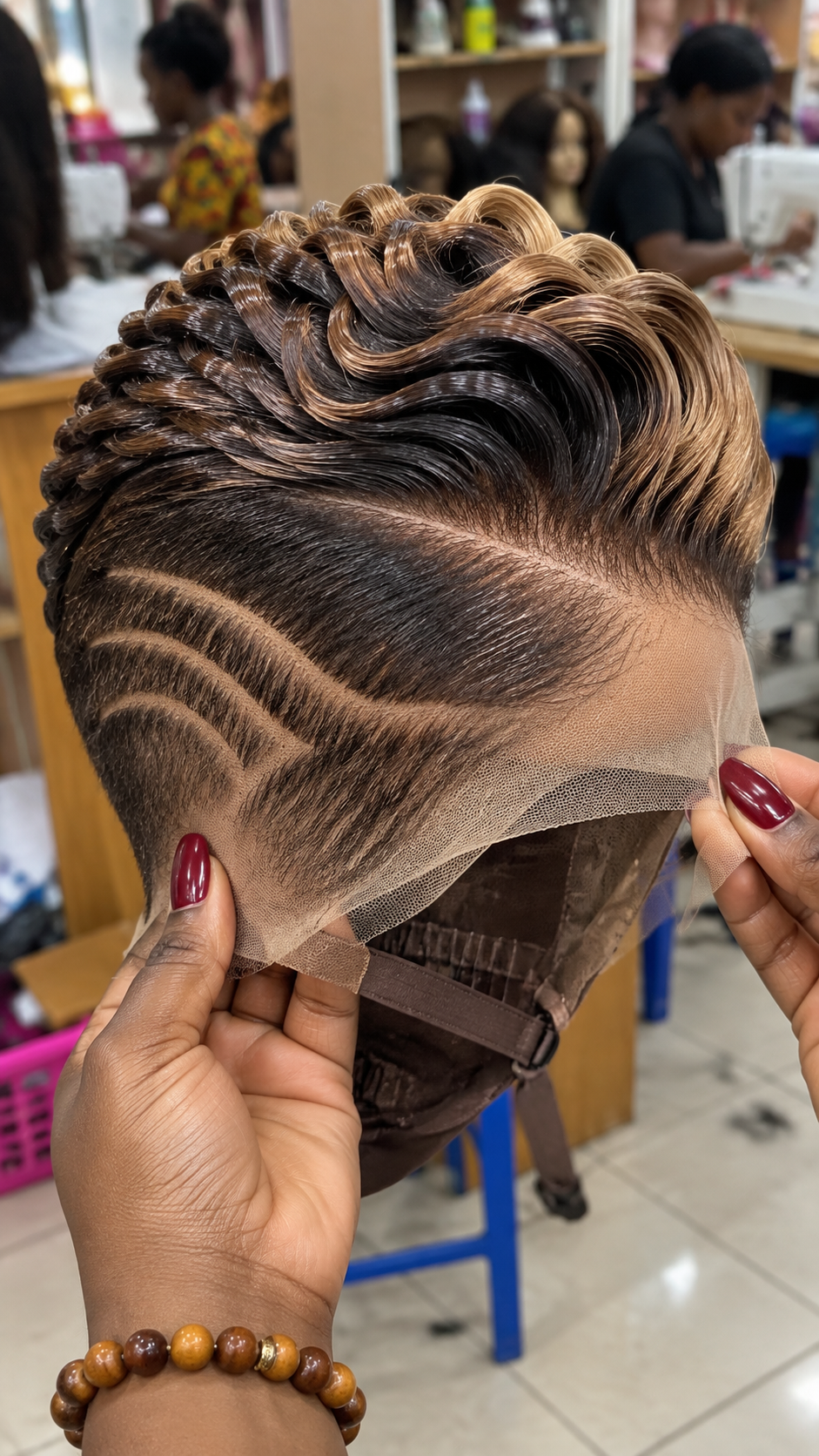
The most revealing part of this chocolate-espresso wig is the way its highlighted crown changes direction without losing its sculpted shape. Broad sections of dark brown hair rise from the foundation, bend into elevated waves and carry selective champagne-blonde ribbons toward the front. Beneath them, a sharply organized side contains three curved exposed pathways, closely arranged dark hair and a gradual transition toward the lower perimeter. This is not an ordinary highlighted curly wig. It is a carefully sectioned hairpiece whose appearance depends on the placement of each raised wave and the spacing of the side artwork.
The photograph shows the unit being held open inside a beauty supply salon before installation. Beige-toned lace extends beyond the front and side hair-bearing areas, while the underside reveals a brown cap and visible adjustment strap. The crown is already styled, and the curved side markings are clearly visible. However, the photograph does not establish whether the hair is human or synthetic, whether the mesh is HD lace or whether the complete cap is designed for adhesive-free wear. Those are specifications a buyer should verify directly with the supplier.
The color arrangement gives this wig a more refined contrast than a conventional black-and-blonde combination. Espresso and chocolate dominate the roots and lower side. Lighter champagne and golden-beige ribbons appear along selected raised sections, especially toward the forward crown. The brighter strands emphasize the direction of the waves rather than covering the entire hairstyle in blonde.
The Crown Is Built Around Sculpted Waves Instead of Circular Ringlets
One of the first details to recognize is the absence of the densely packed hollow circular coils found on many finger-coil wigs. Here, the upper sections are broader and more elongated. Hair travels upward from dark roots before folding backward into large sculpted waves.


Several of the forward sections have noticeable elevation, while the middle and rear portions overlap in a flowing pattern. Their surfaces are relatively broad, allowing the blonde ribbons to remain visible as the hair changes direction.
This difference matters when commissioning a recreation. Asking for spiral curls could produce a crown filled with small circular coils instead of the broad folded waves shown here.
The correct styling brief should emphasize raised, backward-flowing ribbon waves with controlled overlap and a rounded compact silhouette.
Champagne Blonde Appears Along Selected Hair Ribbons
The lighter color is not distributed evenly through every strand. Instead, champagne-blonde and warm beige-gold sections appear along selected upper waves, particularly where the hair rises and bends toward the front.
This selective placement creates a directional effect. The eye can follow each lighter ribbon through its curve while darker chocolate hair remains visible beneath it.
Some areas show relatively narrow blonde streaks, while others contain broader light sections. This variation helps prevent the crown from looking like a rigid sequence of identical highlights.
A custom colorist should therefore plan the lighter strands according to the final wave placement. Traditional straight highlighting may produce a different result once the hair is arranged into elevated folds.
Dark Chocolate Roots Provide the Foundation for the Color
The roots remain substantially darker than the highlighted lengths. Deep espresso and dark chocolate are visible throughout the base of the crown and along the side.
These dark areas create shadow beneath the raised waves, making the blonde ribbons appear more dimensional. They also connect the upper hairstyle to the closely arranged lower hair.
Lightening the entire foundation would weaken that contrast. A uniformly golden-brown wig might be attractive, but it would not preserve the same relationship between the dark roots and bright upper surfaces.
When ordering, specify a predominantly espresso-brown foundation with selective champagne-blonde and caramel highlights rather than an all-over blonde transformation.
The Forward Waves Establish the Highest Point
The front upper sections rise more prominently than the hair farther back. Several broad ribbons curve upward before turning backward, creating a rounded elevated profile.
This concentration of height is important because it allows the crown to appear full without extending the same volume around the entire head.
The forward waves should remain separate enough for their individual shapes to be recognized. Compressing them into one continuous backward sweep would remove the layered arrangement.
A direct side photograph is particularly useful for quality control. It shows whether the crown retains the intended elevation and whether the front waves remain proportional to the compact lower side.
The Middle Crown Uses Overlapping Directional Sections
As the raised waves travel toward the middle of the head, they begin overlapping more closely. Some hair sections turn earlier, while others continue farther before folding backward.
This creates a visual rhythm that is related but not mechanically repeated. The lighter ribbons move through different angles, producing changing highlights across the crown.
The darker foundation remains visible between sections, preventing the upper hair from appearing as one solid blonde surface.
A custom maker should preserve this variation. Using identical waves throughout the entire crown could make the result more uniform than the reference.
The Rear Crown Becomes More Compact
At the visible rear portion, the raised waves begin settling closer to the foundation. The strands remain directional, but the projection decreases compared with the forward crown.
This reduction helps create a balanced silhouette. The hairstyle has a noticeable elevated front without becoming equally tall around the entire back.
The supplied photograph does not reveal every rear angle, so buyers should request a rear three-quarter view before approving a custom unit.
That photograph can establish whether the smaller folded sections continue naturally and whether the rear remains proportionate.
The Long Side Part Organizes the Entire Hairstyle
A narrow exposed division travels diagonally beneath the crown. It begins near the front and continues backward, separating the raised wave construction from the closely arranged side.
This parting is more than a decorative line. Its position determines how much hair belongs to the upper crown and how much remains within the lower section.
Moving the division significantly would alter the wig’s proportions. A higher part could reduce the apparent crown, while a lower placement might leave less room for the side artwork.
For custom construction, the diagonal boundary should be established before the final waves and carved markings are completed.
Three Curved Side Channels Create a Layered Pattern
The lower side contains three visible curved exposed pathways arranged beneath the primary crown division. These lines follow a sweeping direction rather than forming ordinary straight horizontal stripes.
The upper decorative channel extends farther toward the rear, while the lower paths become shorter and more concentrated toward the front. Together they create a descending arrangement across the compact dark hair.
The pattern introduces precision geometry without using an elaborate lightning bolt or circular spiral motif.
For a faithful recreation, the buyer should provide a close side reference and request the same channel curvature, relative lengths and spacing.
The Dark Panels Between the Arcs Are Essential
The exposed channels remain distinct because dark hair separates them. These retained sections create the contrast that allows each curved path to be recognized independently.
Cutting too much hair between the channels could cause them to merge visually into one broad exposed area.
This consideration is especially important for wigs because removed strands cannot naturally grow back.
A professional should map the side artwork before cutting and preserve its width during future maintenance. The goal is accurate separation rather than maximum exposure.
The Lower Side Remains Closely Arranged
Beneath the side channels, the hair becomes more compact and follows the contour of the foundation. The dark chocolate color remains prominent, creating a quiet visual base beneath the brighter upper styling.
This lower section is not covered with the same large waves as the crown. Its purpose is to complete the silhouette without competing with the raised hair.
Removing too much of the lower hair could make the foundation excessively visible. Leaving it too long might obscure the decorative channels.
A custom stylist should therefore control the density carefully rather than treating the area as a conventional shaved section.
The Front Transition Uses Fine Directional Strands
Near the front hairline, thinner strands travel backward toward the crown. Their direction follows the neighboring waves, creating a gradual transition into the heavier upper construction.
These fine strands should be evaluated after the wig is positioned on the wearer. Automatically removing them may produce a harder hairline than the reference suggests.
The transition also helps the raised crown appear more natural in proportion, because the heavier hair begins behind a lighter perimeter.
During professional fitting, the stylist should preserve the intended direction wherever possible.
The Visible Lace Has Not Yet Been Trimmed
The photograph shows beige-toned mesh extending beyond the front and side hair-bearing areas. This indicates that final lace trimming remains part of the installation process.
For a customer planning professional fitting, the extra lace can provide flexibility. The stylist can position the cap, assess the crown and side artwork, and only then establish the final trimming route.
The apparent lace color may be affected by salon lighting and the hands holding the wig.
Buyers should confirm the actual lace shade and material with the supplier. A fine-looking mesh does not automatically establish HD lace or any particular commercial grade.
The Interior Reveals an Adjustable Band
Part of the brown interior cap is visible beneath the extended lace. An adjustment strap crosses the lower foundation, indicating that the unit contains at least one visible mechanism for changing the fit.
This is useful practical information, but the photograph does not establish the complete cap system or all attachment components.
An adjustable band may help fine-tune fit within its intended range, but it does not replace accurate cap measurements.
Before purchasing, ask the seller for a full underside photograph showing the cap, lace connection, adjustment hardware and any comb attachments.
Cap Sizing Determines Where the Side Design Falls
The curved channels are fixed to the wig foundation. If the cap sits too far forward or backward, the entire artwork shifts relative to the wearer’s temple.
Correct sizing therefore affects both comfort and visual accuracy.
For made-to-order wigs, follow the maker’s measurement guide. Depending on construction, circumference, front-to-nape length and ear-to-ear width may all be relevant.
A professional wig stylist can assist with measurements before the order is placed.
Choose a Maker Experienced With Sculpted Wave Crowns
This hairstyle requires more than ordinary curling. The crown contains broad raised waves, the side uses close directional hair and the decorative channels require precision cutting.
Look for custom wig makers whose portfolios demonstrate similar folded-wave construction.
Experience with tightly packed finger coils alone may not be sufficient, because the upper hair here uses longer continuous ribbons rather than numerous small circular spirals.
If the side artwork will be completed locally, choose a professional familiar with cutting wig hair and preserving the surrounding density.
Where to Buy a Comparable Highlighted Wave Wig
Custom lace-wig studios, specialist wig makers and salons offering sculpted pixie styling are practical places to begin.
A general retailer may have a suitable chocolate-and-blonde foundation, but the precise crown and side arrangement could require additional professional services.
When contacting a seller, provide the photograph and explain that the desired result includes raised ribbon waves, dark roots, champagne-blonde placement and three curved side channels.
Ask whether the quoted price covers the completed style or only the base unit.
A Custom Order Should Be Divided Into Separate Approvals
The first approval should concern crown shape: raised forward waves, overlapping middle ribbons and a compact rear transition.
The second should establish color placement: deep chocolate roots with selective champagne-blonde and warm caramel sections.
The third should focus on the side artwork, including the diagonal crown part and three curved exposed channels.
Finally, cap size, lace material, adjustment components and installation preferences should be confirmed.
This approach helps prevent a seller from matching the color while overlooking the construction.
Approval Photographs Should Prioritize the Side Geometry
A direct side photograph is essential because it reveals the curved channels and their relationship with the crown.
An elevated image should show how the blonde ribbons follow the raised waves and whether the darker strands remain visible between them.
A rear three-quarter photograph can confirm the reduction in crown height toward the back.
If the supplier advertises a particular lace or cap construction, request a separate underside photograph of the actual finished unit.
Pricing Should Reflect Coloring, Wave Setting and Precision Side Work
The compact proportions of the wig do not necessarily make it inexpensive to construct. The upper waves require directional setting, the blonde highlights need careful placement, and the lower channels involve precision work.
Cap construction and lace preparation may also affect the quotation.
Estimated Pricing for Chocolate and Champagne Sculpted Wave Wigs
| Category | Illustrative Price Range | Potential Scope |
|---|---|---|
| Premium Custom | $345–$625+ | Higher-grade hair, individual cap sizing, custom chocolate-to-champagne color placement, hand-arranged sculpted waves, triple side-channel work and detailed lace preparation. |
| Standard Custom | $210–$375 | Prepared highlighted wave crown, dark side foundation, curved channels and standardized fitting options. |
| Basic Human Hair | $120–$225 | A human-hair foundation requiring highlighting, wave setting, side customization and professional installation. |
| Premium Synthetic | $85–$165 | A pre-colored and pre-set interpretation with potential shape-retention benefits and fewer future modification options. |
| Basic Synthetic | $40–$95 | A budget alternative where highlight placement, wave structure, side accuracy or cap construction may be simpler. |
These figures are illustrative budgeting estimates rather than verified prices for the pictured wig. Actual quotations depend on material, seller location, customization labor, cap construction, shipping and installation.
Before comparing suppliers, ask which styling services are included. A lower-priced foundation requiring extensive highlighting and wave setting may ultimately cost more than a finished custom unit.
Human Hair Allows More Flexibility for Future Wave Repair
A human-hair version may allow individual folded sections to be reset when they begin losing their direction.
However, the lighter champagne-blonde strands may have undergone color processing. Future heat should be chosen according to the hair’s actual condition.
Selective repair can reduce unnecessary manipulation when only a few waves have moved.
The goal should be to preserve the original crown rather than repeatedly reconstructing every section.
Premium Synthetic May Retain Pre-Set Crown Waves
A quality synthetic version may preserve the broad folded-wave arrangement with relatively limited daily styling.
This can suit wearers who prefer to retain the original hairstyle rather than change it frequently.
Heat tolerance varies by fiber, and conventional permanent dye should not be assumed compatible.
Confirm the exact material before attempting major restyling or recoloring.
Washing Should Follow the Direction of the Hair
The upper crown contains long directional waves rather than ordinary loose curls. During cleansing, avoid aggressive rubbing that mixes neighboring sections and changes their arrangement.
Before the first wash, photograph the crown from above and from the side. These images document the original direction of the raised ribbons.
After drying, restore only the sections that have shifted.
This can help preserve the carefully arranged relationship between dark and blonde strands.
The Side Channels Should Not Be Recut Automatically
Because the three curved pathways are permanent elements of the wig, they do not need to be widened on a fixed schedule.
If fine strands move across an exposed channel, careful repositioning may restore its appearance.
When refinement becomes necessary, use the original side photograph to preserve the width and spacing of the paths.
Repeated aggressive cutting can gradually reduce the dark sections separating them.
Color Refreshing Should Preserve the Espresso Foundation
If the wig is human hair and the blonde sections eventually require maintenance, the deeper roots should remain part of the plan.
Applying champagne blonde throughout the entire crown could eliminate the contrast that gives the raised waves their dimensional appearance.
A professional colorist should evaluate which ribbons actually need refreshing rather than treating every strand identically.
Synthetic units should only be colored using methods confirmed suitable for the fiber.
Avoid Product Buildup Between the Folded Waves
The crown already reflects light strongly. Excessive oils or waxes can cause neighboring ribbons to adhere together and reduce the visible separation between waves.
Product residue may also make the lighter blonde strands appear darker or less distinct.
Use only what the confirmed material requires. When buildup becomes noticeable, suitable cleansing may restore the original appearance more effectively than additional shine product.
The First Installation Should Preserve Crown and Side Alignment
When the finished wig arrives, inspect the crown, color distribution, side channels, lace and cap before making permanent changes.
The installer should establish the final cap position and check where the side artwork falls relative to the temple.
Only after that position has been approved should excess lace be trimmed and optional adjustments considered.
If the styling remains intact after shipping, extensive restyling may not be necessary.
Storage Should Protect the Raised Waves
The upper sections can lose their shape when compressed. A suitable wig stand or mannequin head can help preserve the crown between wears.
The decorated side should also remain free from pressure, since displaced strands may cover the exposed channels.
Store the unit only when the cap and lace are completely dry.
For transportation, choose packaging deep enough to protect the elevated crown rather than pressing it into a flattened position.
The Value Lies in Directional Styling and Controlled Contrast
This chocolate-and-champagne wig demonstrates how a compact hairpiece can combine bold crown movement with precision side detailing. Raised ribbon waves carry selective blonde highlights, while deep espresso roots create shadow and connect the upper styling to a dark side containing three curved channels.
For buyers, the essential quality checks are the width and direction of the crown waves, blonde placement, root depth, diagonal parting, side-channel spacing, lower hair density, lace condition and cap fit.
For wig businesses, a direct side photograph is particularly important because it reveals both the raised crown and the precise lower artwork. An elevated crown image and verified interior information can further clarify the construction.
A faithful recreation should preserve the original proportions rather than exaggerating the blonde, height or side markings. Its recognizable identity comes from the coordinated relationship between the highlighted folded waves and the carefully arranged dark lower section.
Search Terms
chocolate espresso sculpted wave wig · champagne blonde ribbon crown · triple curved side channel wig · dark root highlighted pixie wig · raised folded wave lace front · espresso brown temple etching wig · golden beige swept crown wig · untrimmed lace chocolate wig