
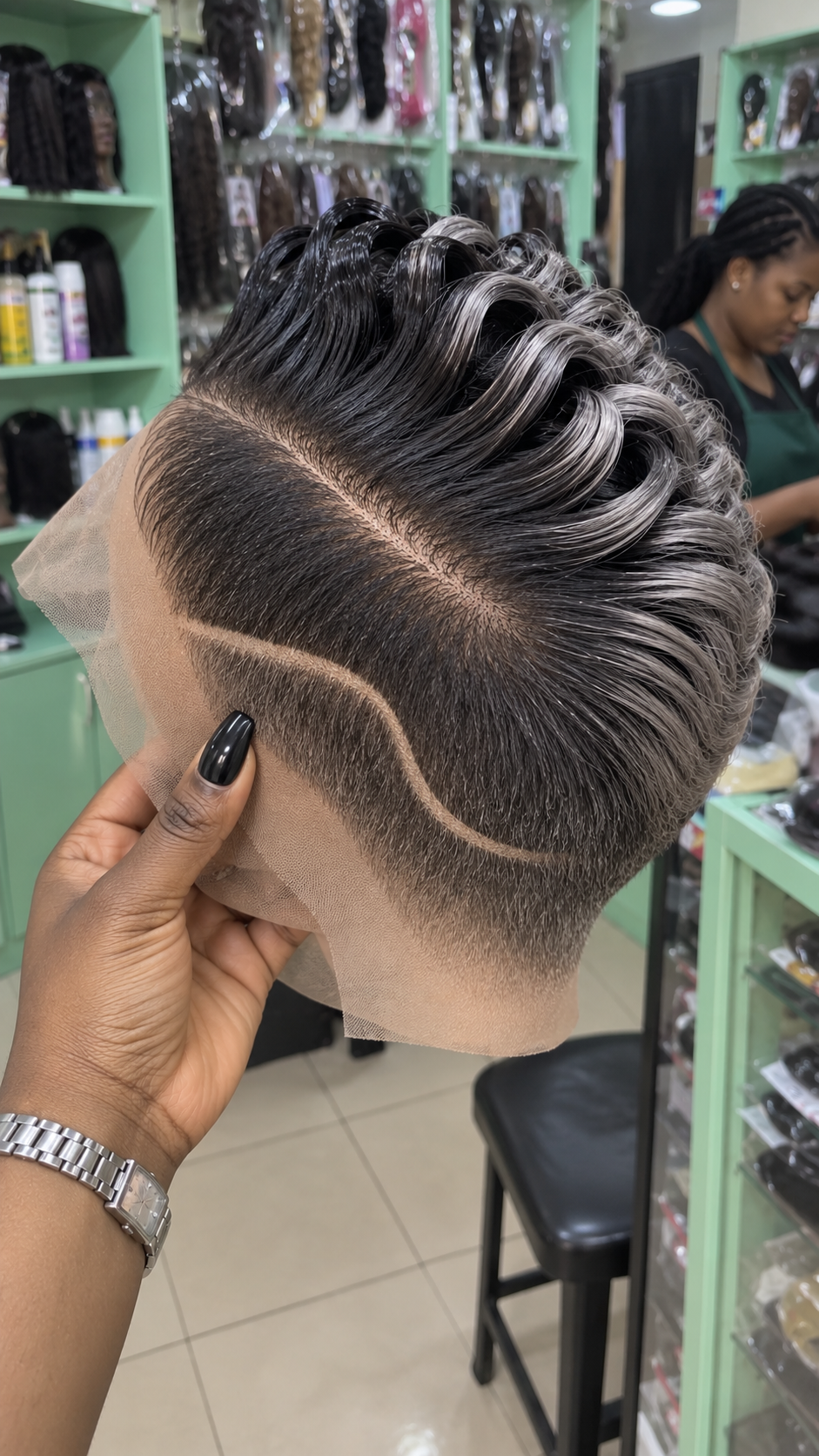
Silver hair can look dramatically different depending on where the lighter strands are placed. In this striking pixie wig, the color transition follows the direction of broad, backward-swept ribbon waves, creating a contrast between glossy black sections and smoky silver-gray strands. Beneath the raised upper hairstyle, a closely arranged dark side is divided by two distinct separation channels, including a lower curve that descends toward the rear perimeter.
The photograph shows the wig held in one hand inside a beauty supply shop with mint-green shelving. Its tan lace remains untrimmed, and the side profile is displayed prominently enough to examine the arrangement of the upper waves, the lower hair density, and the geometry of the separation channels. Unlike a conventional silver curly wig, this design relies on directional styling rather than a crown filled with small circular ringlets.
The most important purchasing consideration is the relationship between the black and silver hair. The lighter strands are concentrated through the upper and rearward sections, while the forward raised hair remains predominantly black. This creates a gradual visual shift across the hairstyle without requiring the entire crown to be uniformly gray.


For women interested in a black and silver pixie wig, this photograph provides a detailed styling reference. However, it does not establish the fiber composition, exact cap construction, lace grade, or whether the hair has been chemically colored. Those details must be confirmed before purchase.
Silver Placement Creates a Directional Color Story
The upper front section appears predominantly glossy black, with broad strands rising from the hairline and bending backward into elevated ribbon-like waves. Moving toward the visible rear portion, the hair becomes increasingly silver-gray, with pale strands running alongside darker ones.
The transition is not a simple black-root-to-silver-tip gradient across every strand. Instead, the photograph shows different concentrations of dark and light hair depending on the section. Some upper waves contain both colors, while others remain largely black or appear predominantly silver.
The lighter areas range visually from smoky gray to pale silver, with some nearly platinum reflections under the shop lighting. The photograph does not establish whether these are separate manufactured colors, chemically processed highlights, or variations caused partly by reflection.
The lower side remains considerably darker, creating a strong contrast with the silver-toned upper rear section. This helps the hairstyle retain a compact appearance even where the raised waves become lighter.
Why a Uniform Gray Wig Would Not Match
A wig made entirely from silver-gray hair would remove the dark foundation that gives this design its contrast. Similarly, a conventional black wig with a few scattered silver highlights might not reproduce the directional color placement.
For an accurate custom order, describe the desired effect as predominantly black raised front waves transitioning into smoky silver-gray sections toward the upper rear, with a dark closely arranged side.
Ask the supplier for photographs under neutral daylight. Fluorescent lighting can make silver hair appear cooler and brighter, while warmer illumination may introduce beige or taupe reflections.
If the seller uses numbered color codes, request actual swatches rather than assuming that labels such as silver, gray, or platinum will match the reference.
The Upper Waves Are Broad, Elevated, and Directed Backward
The crown contains a sequence of large curved sections that rise from the front and sweep toward the rear. Several strands form open arches, creating visible spaces beneath the raised hair.
These shapes differ from small finger coils or tightly packed circular ringlets. The visible hair is arranged in broad ribbons that travel together, producing a more directional silhouette.
The front waves are especially dark and glossy, with strong reflections along their curved surfaces. Farther back, the waves become lighter and more silver-toned, making the individual strands easier to distinguish.
The upper styling creates noticeable height without forming an oversized rounded crown. The volume is concentrated along the raised wave sequence, while the side remains close to the foundation.
This relationship between height and direction is essential. A wig with loose curls falling in several directions would not reproduce the same appearance, even if the color combination were similar.
Preserving the Wave Openings During Custom Styling
The raised waves contain recognizable openings where the hair bends backward. These spaces contribute to the sculptural appearance and should not be eliminated by excessive compression or additional hair volume.
For a custom commission, ask the stylist to maintain broad ribbon sections with consistent backward movement. The waves should remain individually recognizable rather than merging into a dense mass.
Too much height could make the crown appear disproportionate to the lower side. Too little height would reduce the contrast between the raised upper styling and the compact temple section.
A slow rotation video can help establish whether the wave arrangement continues consistently across the crown. The photograph does not reveal every rear angle, so the complete back should be confirmed separately.
The Side Geometry Is More Complex Than a Single Parting
The visible side contains two prominent separation channels. The upper channel begins near the forward upper side and travels diagonally backward beneath the raised waves. A second channel sits lower, following a curved path that descends toward the rear perimeter.
The channels are not identical in direction. The upper separation is relatively straight through its central portion, while the lower channel forms a more pronounced descending curve.
Between the two channels, the hair is closely arranged and predominantly dark. The strands follow the contour of the wig, creating a compact band beneath the upper hairstyle.
Below the lower channel, the hair becomes progressively finer and less dense toward the bottom edge. This produces a tapered visual effect, although the photograph does not establish that a conventional barber fade technique was used.
The exposed channels appear pale because the underlying foundation is visible between the dark strands. They should not automatically be described as shaved razor lines on a natural scalp.
The Descending Curve Changes the Entire Side Profile
The lower channel is particularly distinctive because it does not remain horizontal. It begins near the forward side, travels backward, and bends downward as it approaches the rear.
This creates a flowing boundary between the middle hair section and the lower tapered area. The curve also complements the backward direction of the upper waves.
If a stylist replaced this descending channel with a straight line, the hairstyle would lose an important part of its identity.
For custom work, ask the wig maker to reproduce the lower curve carefully and maintain the compact hair section above it. A direct side photograph should be used to establish the exact path.
Because the wig is held in the hand, the final position of the channels against an individual’s head cannot be confirmed from the photograph alone. A fitting session is necessary before making permanent adjustments.
The Lower Hair Creates a Gradual Tapered Appearance
The bottom section contains numerous fine, closely arranged strands that become less visually dense toward the lower perimeter. The tan foundation becomes increasingly visible through the hair near the edge.
This creates a gradual transition rather than an abrupt boundary. The darker middle section remains relatively dense, while the lower area appears lighter because fewer strands are visible.
The effect resembles a close taper, but the photograph does not establish the precise cutting or construction technique used.
For buyers, the important detail is the visual progression from the raised upper waves to the compact side and finally to the finer lower perimeter.
A reproduction with a bulky lower section would change the silhouette and reduce the contrast between the crown and the side.
Ask the seller for a close-up of the lower edge and a photograph showing how the taper continues around the back. This is particularly useful if the wig will be worn with the nape area visible.
The Front Hairline Is Closely Arranged Beneath the Raised Waves
At the front, fine dark strands rise from the lace and travel backward into the elevated upper styling. Their direction creates a continuous transition between the hairline and the broad ribbon waves.
Unlike hairstyles with decorative forehead finger waves, this design emphasizes upward and backward movement. The front strands appear closely arranged before lifting into the larger curved sections.
The hairline does not contain clearly visible large circular ringlets. Its structure is comparatively restrained, allowing the raised waves to remain the main focal point.
For an accurate recreation, the stylist should preserve the direction of the front strands rather than introducing unrelated forehead curls or decorative baby-hair patterns.
The photograph does not establish whether the hairline has been pre-plucked or customized using a particular technique. Those details should be confirmed through product specifications or additional close-up images.
Untrimmed Tan Lace and Its Practical Implications
A broad section of tan mesh extends beyond the front and lower side perimeter. The lace remains untrimmed, indicating that the wig is being displayed before final installation preparation.
The mesh is especially visible along the forward side and lower edge, where it hangs beneath the closely arranged hair.
The photograph does not reveal the complete interior cap. It therefore cannot confirm the number of attachment combs, adjustable straps, elastic bands, or other hardware that may be present.
The lace should not be classified as HD lace based on appearance alone. Its grade, transparency, thickness, and dimensions require confirmation from the seller.
Measurements to Confirm Before Ordering
Ask for the cap circumference, front-to-nape length, and ear-to-ear measurements. These dimensions help determine whether the wig is likely to fit comfortably.
Request a complete underside photograph showing the cap construction and any attachment hardware.
The seller should also confirm the lace color, front lace dimensions, and whether the wig arrives with the mesh untrimmed as shown.
If the product is described as glueless, ask what construction elements support that claim. The visible lace does not independently establish adhesive-free security.
Finally, confirm the fiber composition and styling limitations. The glossy black and silver waves may be made from human hair, synthetic fiber, or another material, but the photograph cannot identify the composition reliably.
Finding a Wig Maker Who Understands Silver Ribbon Styling
Ready-made black and silver pixie wigs are available in many styles, but the combination of broad backward waves, a descending side channel, and a close tapered lower section is more specific than a general product category.
When browsing online stores, examine the actual product photographs rather than relying only on descriptions such as gray pixie wig or silver highlighted lace wig.
A suitable ready-made piece should already display the directional wave arrangement and the two distinct side channels.
If these characteristics are absent, extensive customization may be required.
A custom wig maker may offer greater control over the placement of the silver strands, the height of the upper waves, and the curvature of the lower separation channel.
Before paying a deposit, confirm the material composition, cap specifications, color options, production schedule, shipping arrangements, and return conditions.
Ask whether the seller can provide photographs of the finished wig before shipping. A direct side view and a rear view are especially useful for checking the descending channel and the silver color distribution.
Booking a Stylist for Precision Wave Installation
The most relevant professional is a wig customization specialist experienced in sculpted pixie hairstyles, directional wave placement, and lace-front preparation.
When contacting a salon, describe the desired hairstyle as a black and smoky silver pixie wig with broad backward ribbon waves, an upper diagonal parting, and a lower descending curved channel.
Provide the reference photograph and ask whether the stylist has experience maintaining raised wave structures during fitting and installation.
A consultation should address the intended crown height, silver placement, side-channel position, lace fit, and attachment method.
If the wig is being purchased separately, schedule the fitting after the actual product arrives. The stylist may need to inspect the construction before determining whether further customization is appropriate.
Preparing the Wig Without Disturbing the Silver Transition
When the wig arrives, inspect the raised waves before making permanent changes. Check that the silver sections remain distributed toward the upper rear and that the darker front waves retain their shape.
The stylist should then position the wig on the intended wearer and assess how the two side channels align with the head.
The lower descending curve should follow the intended contour without shifting too far forward or backward.
Only after the correct position has been established should the lace be trimmed where necessary. Removing too much lace can compromise the hairline and may be impossible to reverse.
Any final wave adjustments should preserve the backward movement and the contrast between the black and silver sections.
The attachment method should be selected according to the verified cap construction and the wearer’s comfort. The photograph does not establish whether adhesive is required.
After installation, examine the hairstyle from the front, side, and rear. The raised waves should remain balanced, the silver transition should be visible, and the descending side channel should retain its distinctive curve.
Illustrative Prices for a Black and Smoky Silver Wave Pixie
The cost of recreating this hairstyle may depend on the black-to-silver color distribution, the broad ribbon-wave construction, the precision of the two side channels, and the lace preparation required for fitting.
The following USD ranges are illustrative planning estimates rather than verified live selling prices. The actual material and retail price of the photographed wig are unknown.
| Wig Category | Illustrative USD Range | Potential Cost Considerations |
|---|---|---|
| Premium Custom | $410–$970+ | Individual cap fitting, specialist ribbon-wave construction, smoky silver color placement, and detailed side-channel customization. |
| Standard Custom | $205–$465 | Selected cap options, customized wave direction, and adjustments to the descending side curve. |
| Basic Human Hair | $115–$300 | Human-hair base unit that may require separate silver coloring, wave setting, and lace preparation. |
| Premium Synthetic | $75–$200 | Higher-grade synthetic alternatives with prearranged black and silver waves and material-dependent styling flexibility. |
| Basic Synthetic | $30–$95 | Budget alternatives that may differ in silver placement, wave precision, and cap construction. |
These categories describe possible purchasing routes rather than confirmed classifications of the photographed product. Actual prices vary by supplier, country, materials, workmanship, and included services.
The silver color may increase the cost if the desired shade requires additional processing or specialized fiber selection. The broad wave construction and descending side geometry can also involve substantial styling labor.
Ask whether the quotation includes the completed hairstyle, lace preparation, fitting, installation, shipping, and future maintenance appointments.
A lower-priced base wig may become more expensive if extensive customization is required to reproduce the reference accurately.
Maintaining the Raised Waves and Silver Sections
The primary maintenance concern is preserving the broad curved openings of the upper waves. Repeated brushing, aggressive finger separation, or compression can disturb their arrangement.
Ask the supplier how the waves were formed and whether they can be safely repositioned. Some constructions may require professional resetting after significant disturbance.
The side channels need separate attention. Hair crossing the exposed areas can reduce their visibility, so maintenance should preserve the direction of the closely arranged strands.
Cleaning instructions must follow the confirmed fiber composition. Synthetic hair should not be exposed to heat unless the manufacturer specifically permits it. Human hair may allow different styling methods, but any previous lightening or chemical processing should be considered.
The silver sections may require different care depending on whether they are manufactured fiber colors or chemically processed human hair. Do not assume that purple shampoos or toning products are appropriate without confirming the material and color treatment.
When storing the wig, avoid compressing the raised waves or stretching the lace. A suitable support can help preserve the compact silhouette without placing unnecessary tension on the hairline.
If the waves lose their recognizable arches or the side channels become difficult to maintain, professional restyling may be preferable to extensive home adjustments.
Evaluating the Finished Result Beyond the Color
The defining characteristics of this hairstyle are its predominantly black raised front waves, smoky silver-gray upper rear sections, two distinct side separation channels, and gradually tapered lower perimeter.
The hairstyle’s identity depends on the relationship between these elements. A uniformly silver wig, a crown of small circular ringlets, or a side design with several parallel straight lines would produce a different appearance.
Before purchasing, request multiple product angles, confirm the material and cap specifications, and determine whether the seller can reproduce the silver distribution and descending side curve accurately.
By treating the wig as a carefully constructed directional hairstyle rather than a generic gray pixie, buyers can make more informed decisions and communicate their expectations more clearly to a wig maker or salon stylist.
Search Terms
Smoky silver black ribbon wave pixie wig · Gray swept back crown lace hairpiece · Two channel side part black silver wig · Descending curved line tapered pixie · Black front waves with silver rear crown · Untrimmed tan lace gray black wig · Silver highlighted raised ribbon curls · Dark close tapered side smoky gray pixie