
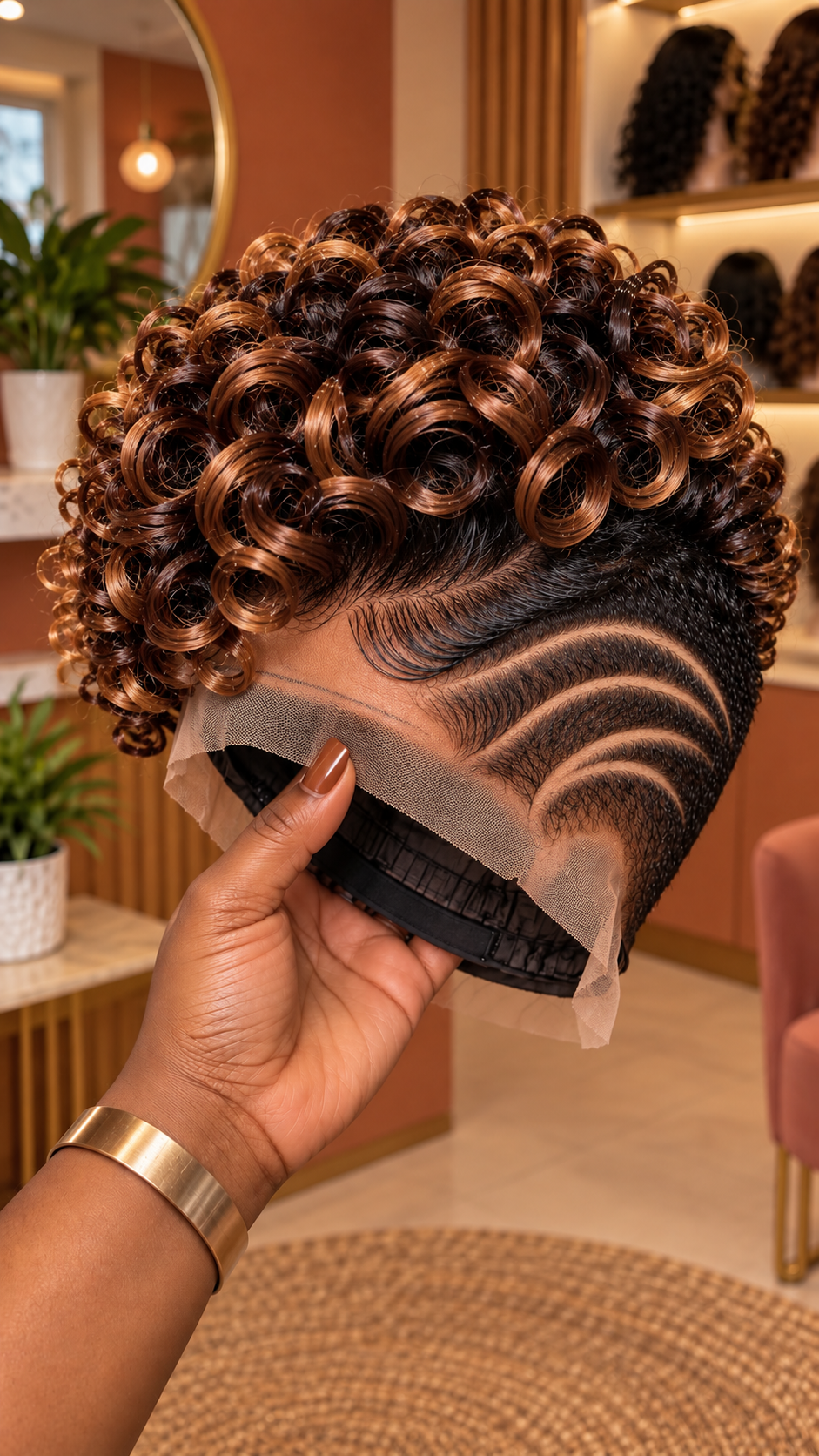
The most revealing detail in this chestnut copper wig is not the color or the abundance of curls. It is the sequence of three closely arranged curved channels along the visible temple, each following a progressively smaller arc toward the area above the ear. That unusual side geometry transforms a familiar curly pixie silhouette into a more intricate hairstyle. Above it, glossy chestnut and copper-brown ringlets create a dense collection of open circular formations, while the espresso-dark hair beneath them provides contrast and structure.
The photograph captures the wig before installation, supported by one hand inside a warmly illuminated salon. Its beige lace remains extended beyond the hairline, and a portion of the black interior cap is visible below the front edge. The image is particularly useful for buyers because it shows the decorative side, the transition into the upper curls, and the unfinished lace in one view.
Unlike similar designs with two sweeping temple channels, this hairstyle contains three prominent curved separations. Their spacing creates several narrow bands of dark hair that follow the same general direction. The upper curls are also distinctive: rather than falling in loose spirals, they form compact circular rings with visible openings and overlapping sections.


Anyone considering this wig should evaluate the design as a coordinated arrangement of color, curl geometry, and temple detailing. A product with the correct copper shade but the wrong number of side lines would not reproduce the reference accurately. Similarly, a wig with three carved channels but ordinary loose curls would lose much of its distinctive upper structure.
Three Temple Channels Create a Layered Side Profile
The visible side contains three principal curved channels arranged one beneath another. Each channel exposes a lighter-looking separation within the dark hair, creating a series of sweeping arcs.
The uppermost curve begins near the front portion of the temple and travels backward along the boundary of the darker side section. Beneath it, the second channel follows a related path, leaving a narrow band of dark hair between the two.
The third channel sits lower, curving around the area where an ear would be positioned when the wig is worn. Its arc is more compact, creating a nested appearance within the larger curves above.
These lines are not straight horizontal stripes. Their paths follow the rounded contour of the side, and the lower curves become progressively tighter.
The dark hair between the channels remains visible and closely arranged. This separation is important because the hairstyle depends on the contrast between exposed channels and the narrow bands of hair that remain.
Why the Number of Lines Must Be Confirmed Before Ordering
Decorative temple patterns are frequently described using broad terms such as curved side lines or barber designs. Those descriptions can be insufficient when a buyer wants an exact reproduction.
For this wig, the visible pattern contains three primary channels. A supplier offering only two curves would create a simpler design, while adding a fourth line could make the side appear crowded.
When commissioning the hairstyle, ask the maker to confirm the number of channels in writing and provide a close side photograph before completing the cutting.
The channels should remain distinct, with dark hair separating them. If the spaces become too narrow, the lines may visually merge. If the channels are widened excessively, the remaining hair bands may lose their intended proportions.
Because cutting hair from a wig can be irreversible, the pattern should be approved before any permanent modification.
The Upper Ringlets Use Circular Openings Rather Than Hanging Length
The crown contains numerous compact ringlets with visible circular centers. Several large rings occupy the front and central upper section, while smaller curls fill the surrounding areas.
Some rings face directly toward the camera, revealing their hollow centers. Others tilt sideways or overlap neighboring curls, creating a layered arrangement.
The strands travel around the circular openings in broad bands, producing glossy outer surfaces and darker recessed areas.
This structure differs from ordinary corkscrew curls, which often hang downward or form a continuous curly mass. Here, the ringlets are arranged to remain individually recognizable across the crown.
The front-left area contains several curls that extend slightly lower than the central crown, while the visible right side becomes more compact as the curls approach the dark temple section.
Despite the number of curls, the overall silhouette remains relatively compact. The hair does not extend into long hanging sections, and the volume is concentrated above the side panel.
Balancing Large Rings With Smaller Supporting Curls
The hairstyle’s visual rhythm depends on variation in ring size. Larger circular formations establish the most recognizable shapes, while smaller curls fill the spaces between them.
A custom maker should avoid producing identical rings throughout the crown. That could make the hairstyle appear overly repetitive and remove the natural variation visible in the reference.
Excessive density is another concern. Adding too much hair can obscure the circular openings and make the upper section appear bulky.
When ordering, ask for compact open-centered ringlets with varied orientations and controlled crown height.
A photograph taken from slightly above the wig can help determine whether the rings remain visible across the upper surface. The complete back is not shown in the reference, so a separate rear photograph should also be requested.
Chestnut Copper Color With a Deep Espresso Foundation
The upper curls display a warm combination of chestnut brown, copper, and reddish-brown reflections. Some raised sections appear brighter and more golden, while the recessed areas remain darker.
The color is not uniformly blonde or orange. Its overall appearance is a rich copper-brown with substantial dark depth.
The lower side remains espresso to nearly black, creating a strong contrast with the illuminated ringlets above.
The brightest copper reflections occur along the outer surfaces of the circular curls, where the salon lighting strikes the hair directly.
The photograph does not establish whether these variations were created through dyeing, pre-colored fibers, or a combination of differently colored strands. It also cannot confirm whether the wig contains human hair or synthetic material.
Choosing a Copper Shade That Preserves Brown Depth
Wig sellers may use descriptions such as copper brown, auburn, cinnamon, chestnut, and caramel for noticeably different colors.
The reference shows a brown-rich copper appearance rather than a uniformly bright ginger shade. A wig made entirely from orange or golden fibers could lose the darker contrast visible within the ringlets.
When contacting a supplier, request chestnut copper curls with reddish-brown reflections and a distinctly darker espresso foundation.
Ask for color samples photographed under daylight and ordinary indoor lighting. Warm salon illumination can intensify copper reflections, so additional photographs are useful for evaluating the actual shade.
The relationship between the upper color and the dark side is more important than selecting a single color number without reference to the complete hairstyle.
The Dark Transition Keeps the Crown and Temple Connected
Between the circular curls and the carved side pattern, the hair follows a broad directional sweep. The dark strands lie closer to the foundation than the raised ringlets above.
Near the front, the hair curves toward the temple, creating a wave-like transition into the decorated side.
This area provides visual continuity. Without it, the copper ringlets could appear abruptly separated from the lower side design.
The dark transitional section also helps keep the three carved channels visible. Its close arrangement prevents the upper curls from covering the temple pattern.
For a custom reproduction, the stylist should preserve this directional movement rather than allowing the ringlets to fall freely across the side.
The photograph shows the transition clearly on one side, but it does not reveal the complete opposite side or rear. Those areas should be confirmed through additional photographs before purchasing.
The Beige Lace Is Still Awaiting Final Fitting
A broad beige lace section extends beyond the front and temple hairline. The mesh remains untrimmed, indicating that the wig has not yet been customized for an individual wearer.
Fine dark strands are visible near the front boundary, where the espresso side hair approaches the lace.
The lace extends beneath the carved temple area, making the final fitting position particularly important.
The photograph does not establish the exact lace grade, thickness, or manufacturing specification. Visible lace should not automatically be described as HD lace.
The final appearance against skin will depend on the wearer’s complexion, the lace color, and the installation method.
Part of the black interior cap is visible beneath the lower edge, but the photograph does not show the complete construction or attachment system.
Cap Measurements and Attachment Questions
Before purchasing, ask the seller for the cap circumference, front-to-back length, and ear-to-ear measurements.
Request a complete underside photograph showing any combs, clips, adjustable bands, or straps.
The partial interior view in the reference is not sufficient to establish whether the wig is designed for adhesive-free use.
Cap fit is especially important for this hairstyle because the three temple channels should sit in a suitable position relative to the face.
If the wig sits too far forward or backward, the curved pattern may appear at an unintended angle.
The installer should verify the fit before trimming the lace. Cutting too close to the hairline or temple area could damage the existing design.
Finding a Wig Maker for Circular Ringlets and Triple-Line Carving
This hairstyle combines two specialist techniques: sculpted circular curls and precision decorative cutting.
When contacting a custom wig maker, send the reference photograph and describe the desired unit as a chestnut copper circular-ringlet pixie lace wig with an espresso side panel and three curved temple channels.
Ask whether the maker has experience creating open-centered ringlets rather than ordinary loose curls.
For the side pattern, request examples of decorative cutting performed on wigs. A barber experienced with natural hair may not necessarily understand the limitations of lace foundations.
Online wig marketplaces, independent custom wig makers, specialist lace wig boutiques, and local beauty supply stores are possible places to begin searching.
Exact availability and product specifications should be confirmed directly. A listing containing a similar photograph does not guarantee that the delivered unit will match the reference.
Approving the Design Before Shipping
A custom commission should begin with agreement on the main elements: chestnut copper ringlets, dark espresso foundation, compact crown proportions, and three nested temple curves.
Next, confirm the cap measurements, fiber material, and intended attachment method.
Ask whether the maker will provide photographs before completing the carved side pattern. This is particularly valuable because cutting may be difficult to reverse.
Once the side design is approved, request final photographs showing the front, both sides, the back, and the complete underside.
For a local installation appointment, confirm whether the salon can perform lace fitting, hairline customization, curl adjustments, and any necessary barber work.
The safest sequence is to inspect the delivered wig, verify the cap fit, and complete permanent adjustments only after the intended wearing position has been established.
Illustrative Price Ranges for Chestnut Copper Triple-Line Pixie Wigs
The following USD amounts are broad illustrative planning ranges, not verified live prices for the photographed wig. Actual quotations may vary substantially according to supplier, location, material, cap construction, color processing, and styling labor.
| Wig Category | Illustrative USD Range | Potential Cost Considerations |
|---|---|---|
| Premium Custom | $390–$950+ | Individual construction, chestnut copper coloring, elaborate circular ringlets, precision triple-line carving, and possible personalized fitting |
| Standard Custom | $215–$510 | Customized copper crown, dark foundation, selected cap options, sculpted curls, and specified temple detailing |
| Basic Human Hair | $120–$315 | Base human-hair unit with potential additional charges for coloring, ringlet setting, and decorative cutting |
| Premium Synthetic | $85–$230 | Pre-styled circular curls, warm copper appearance, cap specifications, and fiber-dependent maintenance limitations |
| Basic Synthetic | $35–$125 | General copper curly pixie resemblance, simpler construction, and potentially less accurate ringlet or temple details |
These categories represent possible purchasing alternatives. The photograph does not establish whether the wig contains human hair, synthetic fiber, or a blend.
The elaborate circular crown may contribute significantly to the total cost because individual rings require careful positioning.
Color customization can also influence the quotation, particularly if a human-hair unit requires additional processing to achieve the desired chestnut copper appearance.
The triple temple carving may involve separate specialist labor. Some wig makers include decorative cutting, while others charge separately or recommend a barber.
Shipping, taxes, installation, lace customization, and additional salon appointments may not be included in the initial price.
Ask for an itemized quotation covering the base wig, coloring, styling, cap options, carved design, and fitting services before committing to an order.
Maintaining the Circular Crown and Protecting the Temple Channels
The upper ringlets are vulnerable to distortion if they are repeatedly brushed, pulled, or compressed. Their circular openings are central to the hairstyle’s appearance, so maintenance should focus on preserving those shapes.
Ask the supplier how the curls were created and which products are appropriate for the actual fiber.
Synthetic hair may have restrictions involving heat and chemical processing. Human hair may permit different treatments, but previously colored strands can still require careful handling.
Do not attempt to restore flattened ringlets with high heat until the material and its temperature limitations have been confirmed.
Heavy product buildup may cause adjacent curls to stick together, reducing the visibility of individual circular openings.
Keeping the Three Curves Distinct
The temple pattern should be maintained with particular caution. Its appearance depends on the shape of the channels and the dark hair remaining between them.
If nearby strands begin covering the lines, a stylist should first assess whether careful repositioning can restore their visibility.
Repeatedly widening the channels may permanently alter the pattern or expose too much of the foundation.
When storing the wig, use an appropriately sized support that does not compress the crown or stretch the cap.
The lace should also be protected from snagging and excessive pulling during removal and storage.
Final Checks Before Accepting the Finished Wig
A faithful reproduction should be evaluated through several specific details rather than a general impression of similarity.
First, examine the crown. The chestnut copper ringlets should form recognizable circular openings, with larger rings surrounded by smaller supporting curls. The overall silhouette should remain compact rather than excessively tall.
Next, compare the color relationship. Warm copper and reddish-brown tones should dominate the upper hair, while the espresso foundation remains visible beneath the curls and throughout the side section.
The temple should contain three distinct curved channels arranged in a nested formation. Their spacing and shape should resemble the reference without introducing additional lines.
Finally, inspect the lace and cap construction. Confirm the measurements, attachment method, and fitting requirements before any permanent trimming or installation work.
The defining appeal of this wig comes from the contrast between circular chestnut-copper ringlets and the layered geometry of its dark temple carving. Preserving the three curved channels is especially important because they distinguish this design from simpler double-line alternatives. A careful custom order should treat the crown, side geometry, and cap fit as connected parts of one hairstyle.
Search Terms
chestnut copper circular ringlet wig · triple curved temple line lace pixie · espresso side nested arc hairpiece · reddish brown open coil crown wig · three carved temple channels copper curls · beige lace chestnut spiral pixie · dark side triple crescent hairstyle · glossy copper brown rings with temple carving