
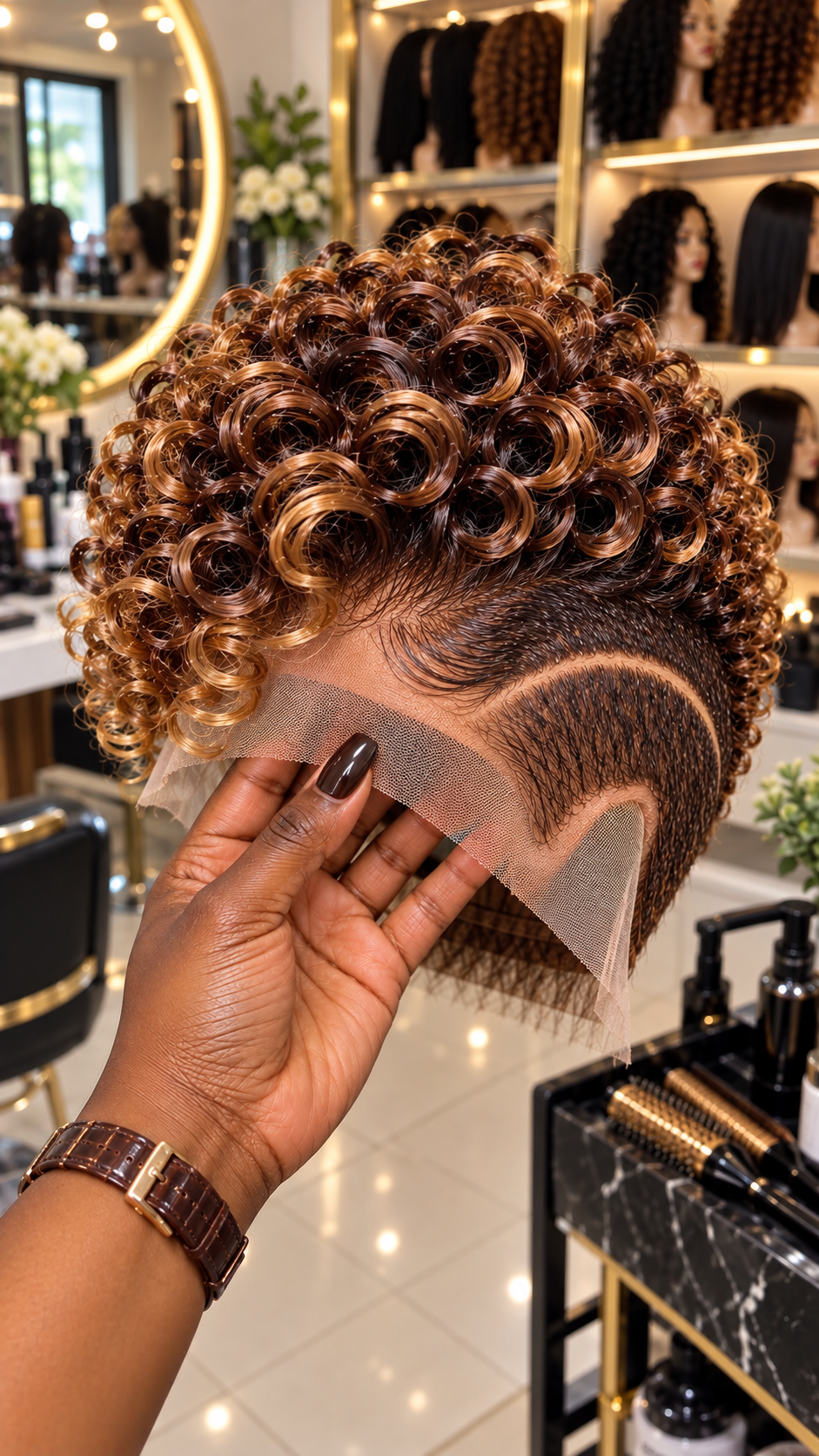
One of the most important decisions when purchasing a sculpted pixie wig is determining which details make the hairstyle worth buying. With this particular hairpiece, the answer lies in the relationship between the circular copper curls and the dramatic curved separation at the temple. The upper hairstyle is filled with glossy, hollow-centered loops in warm toffee, copper, and chestnut tones, while the lower section remains dark and closely arranged against the wig base.
The photograph captures the wig before installation, held in one hand inside a salon with illuminated mirrors and displays of longer wigs in the background. The angle reveals the rounded upper hairstyle, the sweeping front hairline, a single prominent curved temple channel, and the beige lace extending beyond the hair. It also shows a portion of the interior beneath the lace, although the complete cap construction is not visible.
What distinguishes this design from an ordinary copper curly pixie is the way the individual loops are positioned. Many face outward, forming recognizable circular openings, while others overlap or turn diagonally. The curls are especially prominent near the front and upper center, where brighter copper reflections contrast with the darker hair underneath.


For women interested in a sculpted lace wig with a compact silhouette, this hairstyle offers a useful reference for evaluating curl accuracy, color distribution, temple styling, and installation requirements. The following guide focuses on the visible characteristics and the practical decisions needed to purchase or commission a comparable unit.
The Circular Openings Give the Upper Hairstyle Its Character
The upper portion contains numerous rounded curls with visible openings at their centers. These loops resemble carefully arranged circular ribbons rather than loose spirals hanging freely around the face.
Several larger loops sit across the front and central upper area. Their openings are particularly noticeable because the surrounding strands reflect warm light while the interiors remain darker.
Smaller curls fill the spaces between these larger formations and continue toward the visible rearward section. This variation in loop diameter gives the hairstyle a layered appearance without requiring excessive height.
The curls do not all face the same direction. Some openings point directly toward the camera, while others turn sideways or overlap neighboring sections.
This irregularity is important. A reproduction made from identical loops arranged in rigid rows could appear noticeably different from the reference.
The upper silhouette remains rounded and compact. Although the curls provide considerable visual fullness, the hairstyle does not extend into a tall afro shape or long hanging ringlets.
What to Tell a Stylist About Loop Diameter
When requesting a similar wig, avoid relying entirely on descriptions such as curly pixie or spiral curl hairstyle. Those terms can refer to many different arrangements.
Explain that the upper hair should contain open circular loops with a mixture of small and medium diameters. The larger loops should remain visible near the front and center, while smaller curls fill the surrounding areas.
Ask the maker to preserve the compact upper profile rather than increasing the height or allowing the curls to fall into long spirals.
The photograph does not reveal the exact setting technique. Depending on the material, a wig maker may use different methods to create and secure the circular forms.
Before approving a custom order, request examples of previous work showing comparable loop arrangements.
Toffee Copper and Chestnut Create a Layered Color Appearance
The photographed curls display warm toffee brown, copper, caramel, and deeper chestnut tones. The brightest areas occur where the rounded strands catch the salon lighting.
Some loops have golden-copper reflections along their outer curves, while their interiors appear substantially darker. Others display a richer reddish-brown appearance.
The hair beneath the upper curls is predominantly dark brown to nearly black, creating a strong contrast between the luminous upper arrangement and the close-fitting temple section.
This relationship gives the hairstyle depth. A uniformly bright copper wig might reproduce the approximate color family but would not necessarily have the same contrast.
The photograph cannot establish the precise color formula or whether every tonal variation results from intentional highlighting. Indoor lighting and reflective styling products may influence the appearance.
Buyers should therefore request additional photographs under neutral daylight before selecting a color.
Choosing Between Caramel, Copper, and Auburn Shades
Wig suppliers often use similar names for noticeably different colors. One seller’s caramel copper may appear golden brown, while another may offer a much redder shade.
To communicate the desired appearance, describe the upper curls as warm copper-brown with golden toffee reflections and a darker foundation.
Ask whether the supplier can provide a photograph of the actual color or a sample showing the available options.
For a custom human-hair unit, color processing should account for the hair’s previous treatment. For a synthetic option, the desired shade may need to be selected from available manufactured fibers.
The material of the photographed wig is not confirmed, so neither coloring approach should be assumed suitable for the actual product.
The Temple Curve Is More Important Than Additional Decorative Lines
One prominent curved separation channel is visible across the temple. It begins near the upper front-side area and sweeps backward in a broad arc.
The channel separates the dark upper-side hair from a closely arranged lower panel. Its pale appearance contrasts with the surrounding strands, making the curve clearly visible.
The design does not show a collection of three parallel shaved stripes or a complicated geometric barber pattern. The visible side is dominated by one main curved division.
Near the lower front, the hair follows the shape of the temple and narrows toward the lace edge. This gives the side a compact, carefully arranged appearance.
The photograph does not establish whether the channel was produced through cutting, parting, or another styling technique. It is more accurate to describe its visible geometry than to claim a specific manufacturing process.
For a custom reproduction, ask the stylist to preserve the single broad curve and avoid introducing additional decorative channels that would change the reference.
Dark Finger-Wave Styling Connects the Curls to the Hairline
Immediately beneath the copper loops, the front hair is arranged into a sweeping dark wave. Fine strands follow a backward direction from the hairline, creating a gradual transition toward the upper hairstyle.
This section appears flatter than the circular curls above it. The contrast between the raised loops and the closely arranged front hair contributes to the compact silhouette.
The wave bends toward the visible temple, visually connecting the upper hairstyle with the curved side channel.
The hairline includes delicate strands that appear carefully positioned near the lace. However, the final appearance against a wearer’s forehead cannot be established from the uninstalled photograph.
Cap fit, lace trimming, and any additional customization will influence how these strands sit once the wig is worn.
A stylist should evaluate the entire front arrangement before making changes because moving the hairline could alter the relationship between the copper curls and the dark temple wave.
The Lower Side Retains a Close-Fitting Hair Panel
Below the curved channel, dark strands remain visible across the side. They are arranged close to the supporting structure rather than projecting outward into curls.
This lower panel gives the hairstyle a restrained profile beneath the fuller upper section.
The hair is not visibly shaved down to bare skin. Instead, the side retains coverage, with strands directed downward and backward.
Near the lower front edge, the hair becomes finer and follows the curve of the temple. This produces a tapered-looking appearance without proving that the section was created using clippers.
For buyers comparing ready-made wigs, side density is an important consideration. A wig with the correct copper curls but an overly full side may appear considerably different.
Likewise, a unit with an extremely close-cut side may expose more of the cap than intended.
What the Untrimmed Lace Reveals
A broad beige-toned lace section extends beyond the front and temple hairline. The mesh remains untrimmed and is visibly held away from the cap.
The lace provides additional material for fitting, but its presence does not establish the exact commercial lace classification.
The photograph does not confirm whether the unit uses HD lace, Swiss lace, transparent lace, or another type. Those specifications require reliable seller information.
Part of the dark interior is visible beneath the lace, but the full cap construction cannot be examined from this angle.
The image does not establish the total number of combs, the arrangement of adjustable straps, or whether the wig was designed for adhesive-free wear.
Before purchasing, request a complete underside photograph and written specifications for the cap and lace.
Fitting the Lace Without Disturbing the Temple Design
The curved temple channel sits close to the area where the wig must align with the wearer’s natural hairline.
If the cap is positioned too far forward, the decorative curve may extend into an unintended area of the face. If it sits too far backward, the pattern may become less prominent.
A professional stylist should first position the wig and check the relationship between the front curls, temple wave, and side channel.
Only after confirming the fit should the lace be trimmed where necessary.
Cutting too much lace prematurely may reduce fitting flexibility and make later adjustments difficult.
How to Find a Comparable Wig Online or Locally
Specialized wig boutiques, custom lace wig makers, and salons experienced in sculpted pixie hairstyles are suitable starting points for this design.
Useful search descriptions include toffee copper circular curl wig, sculpted ringlet pixie, dark-rooted copper lace wig, and finger-wave pixie with a curved temple part.
When browsing online listings, compare actual photographs rather than relying solely on product titles.
A generic copper curly pixie may have the correct approximate color but lack the open circular loops. Another wig may reproduce the curls while using a different temple arrangement.
For a ready-made product, ask whether the listing photographs show the exact unit available for shipment.
For a custom order, request examples of comparable completed work before paying a deposit.
Building a Clear Custom-Order Request
Begin by identifying the upper circular loops as the most important structural requirement. Explain that the hairstyle should remain compact, with visible openings and varied curl diameters.
Next, describe the warm copper-brown color and darker foundation. Provide the reference photograph so the maker can evaluate the relationship between the upper curls and the lower side.
Identify the single curved temple channel and the dark finger-wave section near the front.
Ask the maker not to add extra shaved lines, increase the crown height, or replace the circular loops with ordinary loose curls.
Finally, confirm the cap measurements, lace specifications, hair material, and intended installation method.
If possible, request a progress photograph before final styling is completed. This can help identify significant differences while adjustments may still be feasible.
Ready-Made Convenience Versus Custom Accuracy
A ready-made wig may be suitable if the buyer finds a unit with comparable curls, color distribution, and cap dimensions.
However, exact reproduction may be difficult because the reference combines several specific characteristics.
Custom production offers more control over curl placement, color depth, and the position of the temple channel.
The trade-off may involve higher cost and additional production time.
Before choosing either route, determine which details are essential and which minor variations would be acceptable.
For this hairstyle, the circular curl openings, warm copper reflections, dark foundation, and single temple curve are the strongest identifying elements.
Booking a Stylist for Installation and Curl Care
After receiving the wig, inspect the curls, lace, and cap before making any adjustments.
When booking a salon appointment, explain that the hairstyle contains carefully arranged circular loops and a curved temple channel.
Ask whether the stylist has experience installing sculpted pixie wigs without disturbing the upper curls.
At the appointment, the cap should be positioned and checked for comfort before any lace trimming.
If the side requires adjustment, the stylist should inspect the underlying construction before using cutting tools.
For future maintenance, ask whether the salon can restore individual loops if they lose their circular shape during wear or washing.
Illustrative Pricing for a Toffee Copper Circular Coil Wig
The cost of reproducing this hairstyle may depend on hair material, cap construction, lace coverage, color requirements, and the labor involved in arranging the circular curls.
The photograph does not establish the actual manufacturer, fiber composition, or selling price.
The following US dollar figures are illustrative planning estimates rather than verified current product prices.
| Wig Category | Illustrative USD Range | Potential Cost Considerations |
|---|---|---|
| Premium Custom | $335–$770+ | Personalized cap measurements, detailed circular curl setting, custom copper-brown color work, and specialist hairline preparation. |
| Standard Custom | $180–$395 | Selected adjustments to curl placement, color distribution, cap sizing, and temple styling. |
| Basic Human Hair | $105–$270 | A human-hair base unit that may require additional coloring and professional ringlet setting. |
| Premium Synthetic | $70–$200 | A higher-grade synthetic option with potentially prearranged circular curls and blended warm coloring. |
| Basic Synthetic | $30–$105 | A budget alternative where exact loop placement and color depth may vary. |
These categories describe possible purchasing approaches and do not identify the material of the photographed wig.
Installation, shipping, lace preparation, and future curl restoration may be charged separately.
Ask for an itemized quotation and confirm which services are included before paying.
Keeping the Circular Curls Intact
The upper ringlets are the most visually delicate part of this hairstyle. Their appearance depends on individual loops retaining their rounded shape and remaining separated enough for their openings to be visible.
Brushing through the curls could disturb their arrangement. Before attempting maintenance, ask the supplier how the loops were formed and which products are appropriate for the material.
If the wig contains synthetic fibers, heat tools should only be used within manufacturer-confirmed limits.
If the unit contains human hair, professional curl resetting may be possible, but the appropriate method depends on previous processing and the original styling technique.
The copper color may also require attention. For confirmed color-treated human hair, repeated washing, excessive heat, and sunlight can influence color longevity.
For synthetic fibers, conventional hair dye should not be assumed suitable.
The dark temple section should be maintained without excessive manipulation, particularly near the curved separation channel.
Additional Photographs Worth Requesting
The reference provides a strong view of the upper curls and one temple, but it does not reveal the complete rear or opposite side.
A direct front photograph would help establish how the circular curls frame the forehead.
An opposite-side view would show whether the curved temple channel is repeated or whether the other side has a different arrangement.
A rear photograph would reveal how the ringlets continue toward the nape.
A complete underside image would help verify the cap construction and attachment components.
A brief video under neutral lighting would also provide a more reliable impression of the toffee copper color and overall proportions.
Choosing This Design for Its Balance of Color and Structure
This wig combines warm toffee copper ringlets with a darker foundation and a single sweeping temple separation. The upper curls create a lively circular arrangement, while the closely styled side keeps the silhouette compact.
The untrimmed lace and partially visible interior provide useful information, but they do not establish the complete construction or fiber composition.
For buyers seeking a sculpted pixie hairstyle, the strongest purchasing strategy is to evaluate curl shape, color distribution, temple geometry, and cap fit as connected considerations.
A successful reproduction should preserve the circular openings and warm copper depth without introducing additional decorative side lines or changing the hairstyle into ordinary loose curls.
With accurate supplier communication, appropriate fitting, and maintenance suited to the confirmed hair material, this design can offer a distinctive alternative to conventional curly pixie wigs.
Search Terms
Toffee copper hollow circular coil wig · Chestnut caramel ringlet pixie hairpiece · Dark finger wave copper lace wig · Broad curved temple parting hairstyle · Warm copper brown sculpted curl crown · Beige uncut front lace ringlet wig · Dark rooted toffee spiral pixie · Copper loop wig with close temple panel