
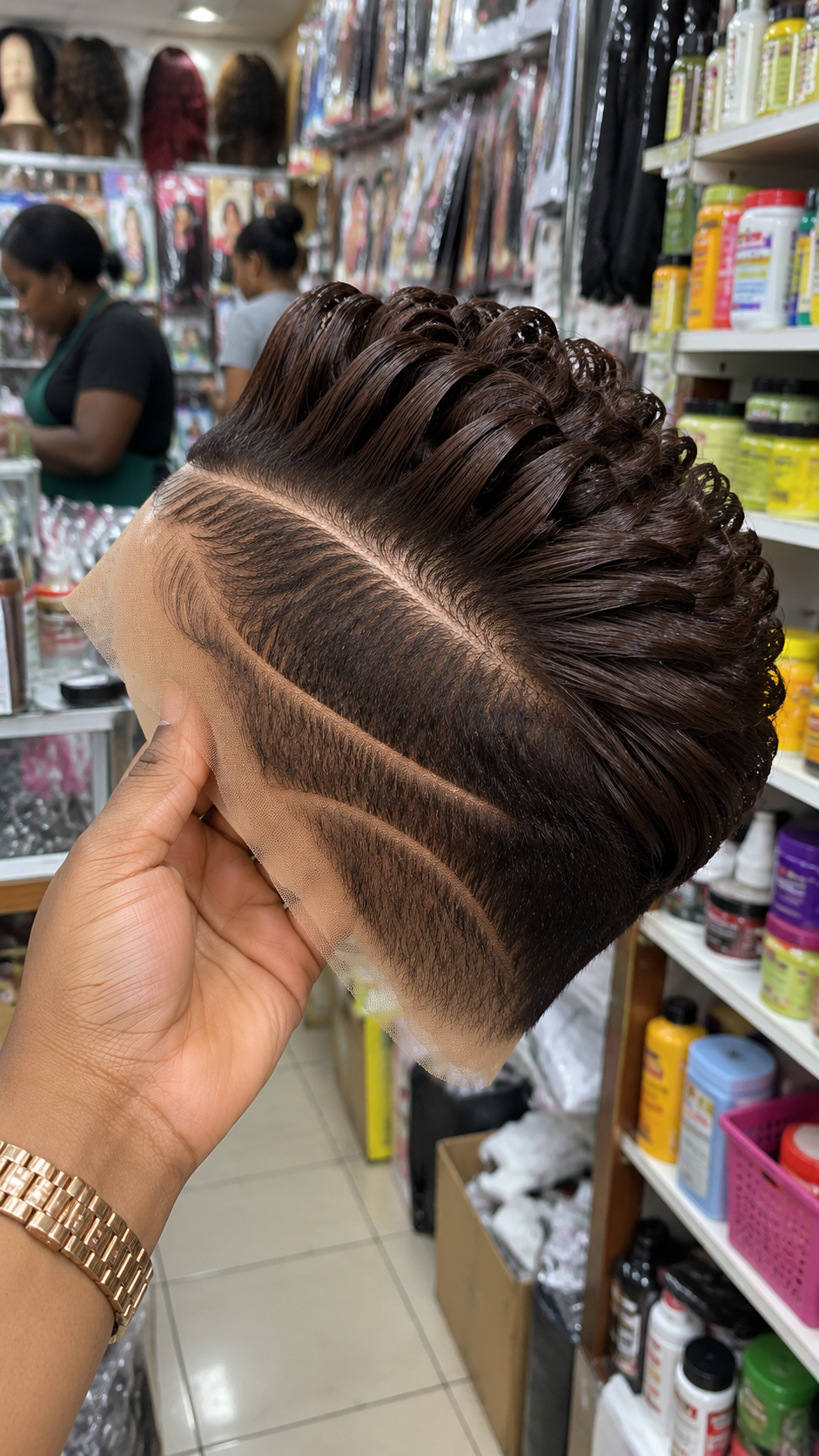
Espresso brown changes the entire reading of this sculpted wig. Instead of depending on bright highlights or dramatic color contrast, the design uses a rich brown tone across the crown and side structure, allowing light to reveal the shape of each section. The upper hair rises in broad folded loops before traveling backward, while the lower side stays compact and close to the foundation. Between those areas, sweeping exposed channels create a strong diagonal movement that gives the profile its distinctive character.
This photograph is particularly useful because the wig is shown before installation. The lace extends beyond the finished hair area, finer strands can be examined around the front, and the transition between the sculpted crown and close side is unobstructed. The visible material confirms a lace construction, but the photograph does not provide enough evidence to classify it specifically as HD lace. Buyers should request that specification directly from the seller rather than assuming it from appearance.
Espresso Brown Makes Light Part of the Design
The color appears as a deep espresso or dark chocolate brown rather than black. Under the store lighting, warmer brown reflections become visible along the upper surfaces of the crown loops. Recessed areas remain darker, producing natural contrast without introducing a second obvious highlight shade.
This tonal behavior is important because the crown contains several overlapping sections. Light catches each raised bend separately, helping the eye distinguish one loop from the next. In a flatter hairstyle, the same brown might appear relatively uniform. Here, the sculpted surface creates multiple shades from a single color family simply through changes in angle and depth.
Anyone ordering this wig should therefore be cautious about replacing the brown with a much lighter shade. The depth of the espresso foundation contributes to the shadow between sections. A brighter color could make the same construction appear visually larger and reduce some of the dimensional contrast that gives this version its character.
The Crown Is Organized in Graduated Sections
The upper portion is not one continuous backward sweep. Several large sections begin near the front and rise individually before folding toward the rear. They sit beside one another with visible separation, creating a sequence across the crown rather than a single uninterrupted surface.
The largest bends occupy the forward and central region. As the construction approaches the back, the sections become tighter and smaller looped elements begin to appear. This creates a gradual reduction in scale. The front provides the strongest sculptural movement, while the rear resolves that movement into a more compact arrangement.
This progression is worth protecting during salon work. Combing all of the crown backward into one shape might appear tidy, but it would erase the spacing that makes the original construction interesting. A stylist refreshing the unit should identify the existing sections first and work with them individually.
For a custom order, an overhead photograph can be more useful than a conventional front portrait. It reveals whether the loops have been separated correctly and whether the crown changes scale as it approaches the rear.
The Front Transition Is Intentionally Fine
Along the lace boundary, finer espresso strands appear before the hair becomes denser toward the upper crown. This creates a transitional zone rather than placing the heaviest hair directly against the front perimeter. The photographed unit still has substantial uncut lace, so the final relationship between this area and a wearer’s skin will depend on fitting and trimming.
A stylist should avoid deciding the final lace boundary while the wig is simply being held in the hand. Positioning it on the wearer first allows the front, temple area and side channels to be evaluated together. That matters because shifting the wig forward or backward changes where the entire side composition sits.
The fine front strands should also be handled conservatively. Removing too many during customization can create an abrupt jump into the heavier crown. The objective should be to retain a believable progression while adapting the perimeter to the wearer.
Two Sweeping Channels Control the Side Profile
The side treatment gives this particular wig a noticeably different identity from units built around several small decorative cuts. Here, the strongest geometry comes from two long sweeping channels. The upper path follows the underside of the crown and creates a substantial separation between the heavier top and compact lower section. Beneath it, another broad curved path travels toward the lower rear.
The two channels do not behave like straight parallel stripes. They follow the rounded shape of the unit, and the distance between them changes as they travel. This gives the side a flowing appearance and makes the pattern feel integrated with the head shape rather than placed on top of it.
Dark brown hair remains between and around the channels. That preserved density is important because it keeps each path readable. Removing too much hair between the curves would merge them into one large exposed area and fundamentally change the design.
When commissioning the wig, the reference photograph should accompany any written description of the side. Terms such as “double line” are useful for search, but they do not communicate the exact width, curvature or placement needed for reproduction.
A Wider Upper Division Creates Visual Balance
The upper separation deserves attention independently from the lower channel. It runs immediately beneath the sculpted crown and acts almost like a border around the heavier hair. Because this pathway is visually strong, it creates a clear break before the eye reaches the lower side.
That break is one reason the crown can carry large loops without making the entire wig feel dense. The exposed division introduces visual breathing room. It also emphasizes the direction of the upper hair by tracing the line from which many of those larger sections appear to rise.
A barber refining the piece should preserve the width of this division rather than repeatedly cutting into it. Unlike growing hair, a wig has a finite amount of material. Each unnecessary pass can permanently alter the balance between the exposed channel and surrounding brown hair.
This Wig Benefits From Fit-First Customization
Side artwork creates an additional reason to prioritize cap fit. On a wig without geometric detailing, a small positional shift might primarily affect the front hairline. Here, the same shift also moves the long side channels relative to the temple and ear.
Before ordering, use the measurement method requested by the wig maker. Do not assume that one manufacturer’s medium cap is identical to another manufacturer’s medium. If the seller requests circumference, ear-to-ear or front-to-nape measurements, provide each one carefully.
Once the wig arrives, a fitting appointment can establish its natural resting position. The stylist can check the cap, determine how the lace should be trimmed and decide whether the side requires any refinement. Only after that assessment should irreversible cutting begin.
Buying the Base and Buying the Finished Design Are Different Purchases
A customer searching for this look may encounter inexpensive brown lace wigs that appear similar in size but contain none of the specialized crown or side work. Those units should be viewed as potential foundations rather than equivalent finished products.
If purchasing a base, calculate the cost of local customization before deciding whether it represents better value. Creating the crown sections, controlling side density and mapping the two long channels all require labor. A cheaper starting price can become considerably higher after multiple salon appointments.
A completed custom unit carries the opposite consideration. The buyer pays more initially, but much of the artistic work may already be included. The important question becomes whether the maker can reproduce the reference accurately enough to justify doing that work before fitting.
Ask for examples of previous sculpted wigs from the seller or stylist. A portfolio showing lace fitting alone does not necessarily demonstrate experience with this kind of crown architecture and barber-inspired side design.
Turn the Reference Into a Production Brief
When requesting this wig, begin with the color: deep espresso brown across the visible hair rather than black with bright contrasting highlights. Then describe the upper construction as separated, backward-folding crown sections with larger loops toward the front and tighter curled work toward the rear.
Next, explain that the lower side should remain close and compact. Identify the prominent curved division beneath the crown and the second sweeping channel below it. Mention that brown hair needs to remain between the channels so they stay distinct.
Finally, discuss cap size, lace shade and the desired installation state. If the wig will be fitted locally, ask whether it can arrive with the lace untrimmed. If the seller provides trimming, make sure they have the measurements required to do it responsibly.
Before shipping, request photographs of the actual finished unit whenever possible. A side image should show the full channel arrangement. An elevated crown view should demonstrate section placement, while a rear three-quarter photograph can confirm that the larger loops transition into smaller work rather than stopping abruptly.
Where the Budget Changes the Result
The compact proportions of this wig can make it appear inexpensive to manufacture, but length is only one part of wig pricing. Hand labor can represent a significant share of the cost. Crown formation, side density control, lace work and the curved channels all add time to the construction process.
| Category | Planning Range | What May Justify the Price |
|---|---|---|
| Premium Custom | $300–$525+ | Higher-grade hair, personalized cap preparation, carefully graduated crown work, precision side channels and extensive hand finishing. |
| Standard Custom | $185–$315 | Prepared espresso crown construction and deliberate side detailing with a more standardized cap or finishing process. |
| Basic Human Hair | $115–$205 | A human-hair foundation suitable for local shaping when the buyer has access to an experienced stylist or barber. |
| Premium Synthetic | $75–$145 | A higher-quality pre-set version that may retain the folded crown arrangement with limited daily reshaping. |
| Basic Synthetic | $35–$85 | A budget interpretation where crown separation, side precision or lace construction may be less elaborate. |
These figures are broad estimates intended for comparing construction levels. Actual prices can vary substantially according to country, hair source, fiber, lace option, cap construction, stylist labor and seller margin. Installation, shipping and later maintenance appointments may not be included.
A useful quotation should state whether the crown arrives styled, whether the side channels are included, whether color work is required and whether lace preparation is part of the service. Comparing those details is more informative than comparing the final numbers without context.
Human Hair Offers Flexibility, While Pre-Set Fiber Can Offer Convenience
A human-hair version may appeal to someone who expects to refresh the crown professionally over time. The large sections can potentially be reset when they begin to relax, and an experienced stylist has greater freedom to adjust direction. However, the brown hair may have undergone coloring, so safe heat levels should be established before using heated tools.
A premium synthetic version can suit a different routine. If the crown is manufactured in its intended arrangement, the loops may retain their form with less frequent manipulation. The tradeoff is reduced freedom to reshape the wig, especially when the exact fiber’s heat tolerance is unknown.
Neither material is automatically the correct choice. The better option depends on whether the wearer prioritizes future restyling or wants to preserve a pre-arranged silhouette with minimal intervention.
Protect the Brown Tone From Unnecessary Processing
The espresso color contributes heavily to the depth of this piece. Human-hair versions should therefore be treated as color-sensitive even if the brown appears dark. Frequent high-temperature styling and unsuitable cleansing products can gradually change the richness of the shade.
If the color eventually needs refreshing, preserve the single-family brown appearance rather than automatically adding highlights. The current design obtains contrast through light and shadow across the crown, so additional streaks would change its visual logic.
For synthetic fiber, ordinary permanent hair dye should not be assumed suitable. Fiber-specific methods vary, and some materials cannot be recolored reliably at all. Confirm the composition before attempting any chemical alteration.
Reset the Crown by Following Its Existing Direction
Maintenance becomes easier when the crown is treated as a map. Before washing or major restyling, photograph it from above and from both sides. Those images provide a record of which sections rise near the front, how they bend backward and where the smaller rear loops begin.
During routine care, avoid dragging a brush through several loops simultaneously. If separation is needed, work with one section at a time and preserve the spaces between neighboring pieces. Heavy product application should also be avoided because it can cause adjacent sections to adhere to one another and visually flatten the crown.
After washing, the wig should dry in a position that does not compress the upper construction. Once dry and according to the material’s care requirements, the sections can be guided back into their established paths. A suitable wig stand helps protect the silhouette between wears.
Keep the Side Channels Narrow Through Conservative Maintenance
The lower geometry should not be refreshed according to a fixed calendar. Unlike a natural haircut, the wig does not continuously replace removed strands. If the channels are recut aggressively at every appointment, they will gradually widen.
When the side starts to lose clarity, first inspect whether nearby hairs have simply shifted across the exposed areas. Repositioning them may restore the pattern without removing anything. If cutting is genuinely required, the original photograph provides a useful width and curvature reference.
This is also where an experienced barber can add value. The objective is preservation, not redesign. The two sweeping channels should remain recognizable as separate paths, with sufficient espresso hair between them to maintain contrast.
Plan Booking Around Delivery and Inspection
For an online custom order, avoid scheduling a permanent installation before the wig has arrived and been inspected. First check the color, crown arrangement, side geometry, cap size and lace condition. If anything differs significantly from the agreed reference, contact the seller before altering the unit because trimming lace or cutting hair can affect return eligibility.
Once the wig passes inspection, book the fitting with the professional who will handle the lace. If separate barber work is required, that appointment can follow after the cap position is established. This sequence gives the side channels a stable reference point.
Customers sourcing locally can reverse the process by booking a consultation first. A wig stylist may help identify an appropriate base, record measurements and determine which portions of the construction should be completed before the unit reaches the barber.
Judge This Piece by Proportion Rather Than Decoration
The strongest quality of this espresso wig is restraint. It does not need bright color changes or a crowded collection of side markings. Large crown folds create height where needed, smaller rear loops control the transition, and two sweeping channels provide movement through the compact side.
That makes proportion the best quality-control tool. The crown should remain substantial without becoming oversized. The lower section should stay close enough for the side artwork to remain visible. The exposed channels should be broad enough to read clearly but not so wide that the brown sections between them disappear.
For buyers, matching those relationships is more important than finding a product with an identical marketing name. Send the reference, specify the visible construction, request several approval angles and confirm what the quoted customization includes. For wig businesses, documenting the unit before installation is equally valuable because customers can see the craftsmanship that would otherwise be hidden once the lace is trimmed and the wig is worn.
Search Terms
espresso brown loop crown wig · deep brown lace front wig · double sweeping side channel wig · folded crown brown wig · curved side separation hairpiece · dark chocolate sculpted wig · close side espresso wig · untrimmed lace brown crown wig