
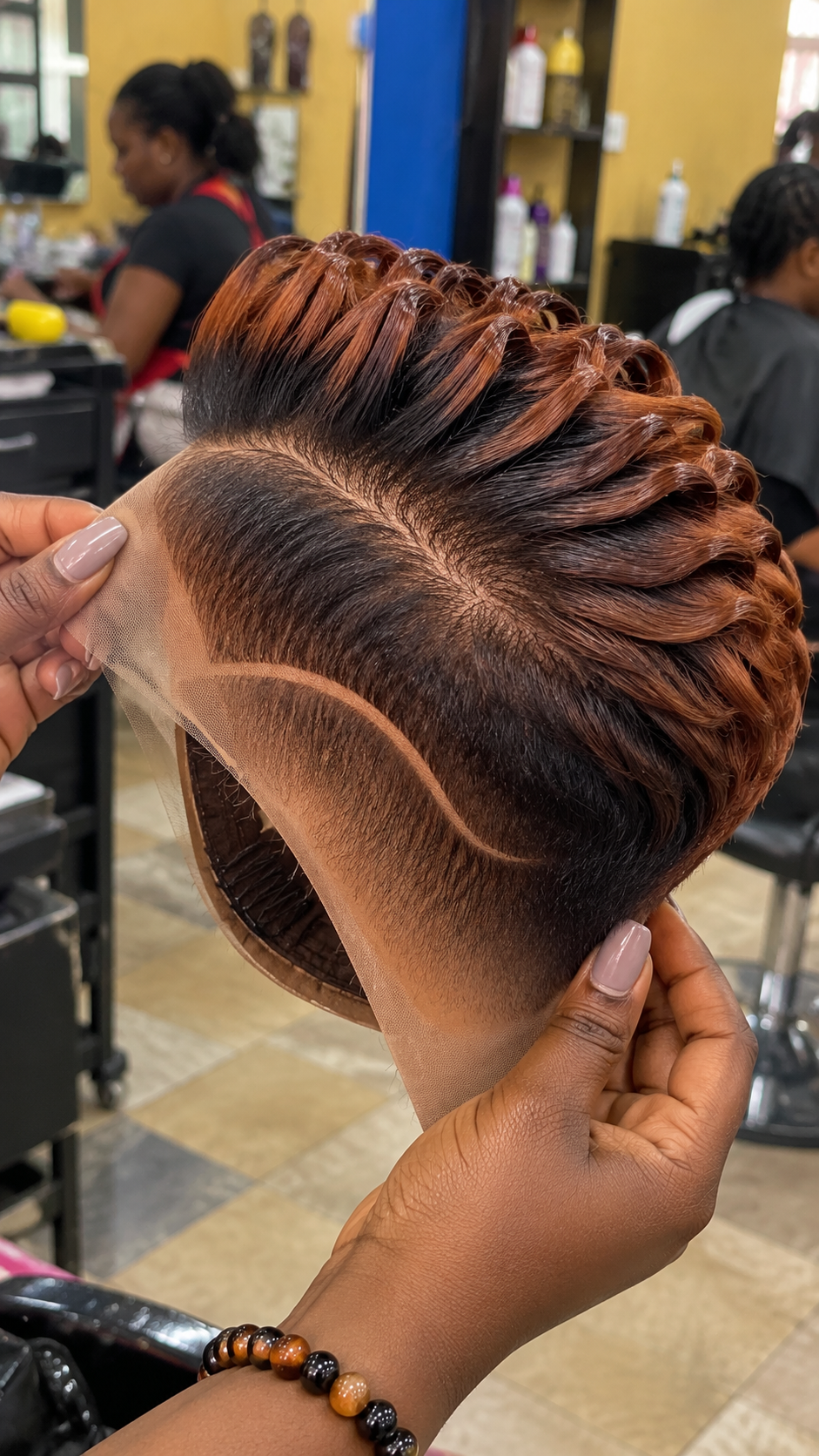
Copper color takes a completely different direction when it is paired with architectural hair placement rather than ordinary curls. This wig combines a rich auburn-copper upper section with a darker brown foundation, creating a layered color effect that follows the raised loop formation across the crown. The result is especially striking because the brighter copper is concentrated where the hair bends and catches the light, while deeper brown remains visible underneath and around the lower side.
The photograph also exposes several construction details that are valuable for anyone considering a custom order. The lace extends beyond the perimeter, the internal cap is partially visible, and the side has been shaped to include a long curved channel. Because the wig is being displayed before installation, the viewer can examine details that would normally become less obvious once the lace has been trimmed and the unit has been positioned on a wearer.
This is not simply a copper-colored wig with curls added on top. Its identity comes from the relationship between the color transition, the elevated loop sequence and the sweeping side design. Those three elements need to be considered together when requesting a similar piece from a wig maker or salon.
Copper Takes the Lead Without Erasing the Dark Foundation
The most noticeable color is a warm copper-auburn shade that covers much of the visible upper hair. Depending on the salon lighting and the angle of each loop, it shifts visually between burnt copper, cinnamon auburn and brighter copper-orange reflections. Beneath that warmer layer, however, a much deeper brown remains present.
That darker foundation matters. It prevents the entire unit from becoming one uninterrupted block of copper and gives the raised pieces stronger visual separation. Near the roots and lower sections, the deeper tone creates shadow. As the hair rises into the loops, the copper becomes increasingly prominent.
If this palette is being recreated, showing the wig maker the photograph is far more reliable than requesting a generic “ginger” shade. Ginger, copper, auburn and cinnamon can mean very different things from one supplier to another. The reference shows a richer result with visible brown depth rather than an extremely bright orange tone.
A client who wants this specific balance should ask to see the chosen colors together before construction begins. Comparing swatches under neutral lighting can prevent the copper from becoming too yellow, too red or significantly brighter than expected.
The Crown Is Built From Repeating Sculpted Arches
The upper construction relies on substantial curved sections that rise away from the base and fold backward. These pieces create a sequence of arches rather than a collection of independent ringlets. The front begins with taller movement, and the pattern continues toward the rear with increasingly interwoven bends.
This repetition is what gives the crown its recognizable direction. Each section visually hands the movement to the next one. From the angle shown, the loops appear almost like overlapping ribbons of copper hair traveling from front to back.
Density needs to be controlled carefully for this kind of styling. Too much hair packed into every section could make the loops bulky and hide their individual boundaries. Too little could leave large openings between them. The reference maintains enough substance for a strong profile while still allowing the viewer to distinguish one curved piece from another.
The ends are also incorporated into the construction rather than hanging freely. That keeps the silhouette concentrated around the head and makes the sculpted upper area the dominant element.
Auburn Reflections Change Across Every Bend
One reason this color works particularly well with raised loops is the way curved hair responds to light. A single section can appear dark mahogany near its base, copper through its middle and considerably brighter along the highest point of the bend. This variation is produced partly by the actual color distribution and partly by the geometry of the hairstyle.
That means photographs taken in different environments may not show exactly the same copper intensity. Daylight, warm salon bulbs and cooler indoor lighting can each shift the appearance. Buyers ordering online should request additional images or a brief video under ordinary lighting if precise color matching is important.
The goal should be to preserve the overall family of warm auburn and copper tones rather than expecting every strand to display one identical shade in every photograph.
The Sweeping Side Channel Changes the Entire Profile
The side of this wig deserves separate attention because it is much more than a supporting area beneath the crown. A long curved channel travels through the close side panel, beginning toward the front and sweeping downward before rising gently toward the rear.
Unlike designs that use several parallel lines, this version relies on one dominant curve. That restraint gives the channel more visual weight. The uninterrupted path can be seen clearly against the darker hair and creates a strong division through the side.
The curve also complements the upper construction. The crown moves backward through repeated arches, while the side channel follows a broader, lower trajectory. Both elements therefore communicate movement without copying each other.
For a custom request, describing this simply as a “line on the side” would leave too much room for interpretation. Ask for one extended sweeping curved channel and provide the photograph to demonstrate its direction and approximate placement.
The Lower Side Keeps the Silhouette Close
Below the curved channel, the hair remains very close to the base. This creates an important visual counterweight to the height above. If the lower portion carried the same volume as the crown, the distinctive upper architecture would lose much of its impact.
The close side also makes the copper crown appear taller without requiring extreme height. Contrast in length can create the impression of additional elevation even when the actual crown remains relatively compact.
This relationship should be preserved when requesting alterations. Increasing the density around the lower perimeter or covering the side with longer strands could change the entire profile. A stylist should understand that the exposed side is intentional and not an unfinished area that needs to be concealed.
The Parting Guides the Eye From Front to Crown
A visible parting runs between the upper construction and the side section. It begins near the frontal area and travels diagonally toward the crown, acting as a transition between the two different hair lengths.
Because this parting is so visible, placement becomes important during fitting. The wig needs to sit at the intended angle before the lace is permanently altered. If the unit is rotated too far in either direction, the parting and curved side channel may no longer occupy the expected position around the temple.
This is one reason custom measurements can be valuable for highly structured designs. The appearance depends not only on whether the cap fits but also on where the decorative elements land after the cap is fitted.
Lace Is Clearly Present but Its Grade Must Be Confirmed
The photograph clearly shows lace around the front and side perimeter. It extends beyond the hair and allows the construction underneath to remain visible while the wig is being held. What the photograph does not establish is the commercial grade or exact specification of that lace.
It would therefore be inaccurate to label the unit as HD lace based solely on this image. Buyers should ask the seller which lace material is actually used, what shades are available and how much coverage the cap provides.
The same caution applies to the fiber. Visual inspection cannot reliably confirm whether the wig is made from human hair or synthetic material. If heat styling, recoloring or long-term professional maintenance is planned, the material should be verified before purchase.
Ask the seller for a complete specification rather than relying only on promotional photographs. Useful information includes cap size, lace type, fiber or hair type, density, internal adjustment system and recommended care routine.
Cap Fit Determines Where the Side Curve Lands
With a conventional wig, a minor difference in cap position may not dramatically affect the overall hairstyle. Here, the side channel and diagonal parting make positioning much more noticeable.
Before ordering a custom version, provide accurate head measurements according to the maker’s instructions. Circumference is only one part of the process. Front-to-nape and ear-to-ear measurements may also affect where the side work sits.
If possible, tell the maker that the side design must remain visible in its intended location. This is particularly important if the unit is being made specifically for one wearer rather than produced as a general stock piece.
During the first fitting, evaluate the crown and side simultaneously. The unit should not be repositioned solely to improve the frontal area without checking what that movement does to the side channel.
A Salon Appointment Should Protect the Sculpted Formation
This type of wig deserves a different installation approach from a loose hairstyle that can simply be brushed and restyled after fitting. The crown has already been deliberately arranged, and unnecessary manipulation can disturb the sequence.
Send the reference photograph to the stylist before booking. Explain that the upper loops, diagonal division and curved side channel are central to the design. This gives the stylist an opportunity to determine whether the appointment requires additional time for careful positioning.
When the unit arrives, resist the temptation to comb through the upper sections immediately. If one or two loops have shifted during transport, targeted correction is preferable to dismantling the entire crown.
After the cap has been positioned, inspect both sides and the frontal area before the lace is trimmed. This is the best moment to correct alignment without permanently altering the unit.
Ordering the Copper Version as a Custom Piece
A clear order request can be divided into several specifications. First, establish the palette: warm copper-auburn through the upper hair with deeper brown remaining underneath. Second, identify the crown formation: large backward-moving sculpted arches rather than loose curls. Third, specify the close side panel with one extended curved channel.
Next, discuss the cap and lace independently. Provide measurements and ask which lace shades are available. If the seller offers different construction options, request photographs showing their interiors so you can compare them.
Progress photographs are particularly useful for a design like this. One image can be requested after the color has been established, another after the crown has been formed and a final side photograph can confirm the curved channel.
This staged approval process is much more effective than discovering after delivery that the copper is too bright or the side curve has been placed differently.
Color Matching Requires More Than Saying Copper
Warm hair colors are particularly sensitive to naming differences. One vendor’s copper may lean orange, another may lean red, and another may be much closer to medium brown. This image contains a richer auburn influence rather than a pale orange appearance.
If ordering remotely, send the reference photograph and ask the maker to identify the closest available shade. If a custom blend is possible, request a photograph of the blended hair before the wig is completed.
It is also worth specifying whether you want the darker foundation retained. Ordering the crown in one solid copper shade would eliminate much of the depth visible in the reference.
For clients who prefer a slightly quieter result, the copper intensity can potentially be reduced while preserving the structure. However, that becomes a new color interpretation rather than an exact recreation of the photographed unit.
Care Should Prioritize the Shape of the Crown
The loop sequence is one of the most labor-intensive visual components, so maintenance should be planned around protecting it. Frequent brushing is unnecessary and may separate sections that were intentionally grouped together.
Product use should also be conservative. Heavy oils or creams can weigh down the arches and encourage neighboring pieces to collapse into each other. The appropriate products will depend on whether the confirmed material is human hair or synthetic fiber.
Before washing, ask the maker whether the crown is expected to retain its form after cleansing or whether professional restyling will be required. Some sculpted units are intended to be maintained with minimal disturbance rather than routinely washed and restyled at home.
If professional servicing is recommended, keep the original reference photograph. It gives the stylist a visual map for rebuilding the crown if necessary.
Protecting Copper Color Between Appointments
If the unit is confirmed to contain color-treated human hair, repeated exposure to strong heat and inappropriate cleansing products may affect the copper tone over time. Follow the maker’s instructions rather than applying a generic routine intended for untreated dark hair.
For synthetic versions, ask whether the color is integral to the fiber and what temperature limits apply. Never assume that a fiber can tolerate heated tools simply because the loops appear professionally styled.
Storage away from prolonged direct sunlight is also sensible for maintaining the visual consistency of a colored wig. A dedicated stand in a protected area can help preserve both the palette and the upper formation.
Styling the Copper Palette Around Clothing and Accessories
Warm copper works particularly well beside black, cream, chocolate, olive, deep teal and muted beige clothing. These colors allow the auburn character of the wig to remain noticeable without competing with it.
Gold jewelry can echo the warmth of the copper, while darker accessories can connect visually with the brown foundation. Because the side channel is an important part of the design, earrings that do not completely cover the temple area can help keep that detail visible.
For photographs, a neutral background can make the color transition easier to appreciate. Very orange surroundings may reduce the distinction between the hair and the environment, while cooler or neutral settings can increase the perceived warmth of the copper.
Premium Custom / Standard Custom / Basic Human Hair / Premium Synthetic / Basic Synthetic
| Category | What to Request | What to Confirm |
|---|---|---|
| Premium Custom | Mapped copper-auburn color, fitted cap, sculpted loop crown and custom curved side channel | Measurements, hair source, lace specification, color approval and side placement |
| Standard Custom | Preselected copper palette with personalized cap and side detailing | Available shades, crown density, lace coverage and adjustment system |
| Basic Human Hair | Human-hair base prepared for professional crown formation | Hair authenticity, processing history, heat guidance and color treatment |
| Premium Synthetic | Pre-shaped fiber with an established copper crown pattern | Fiber quality, temperature limit, shape retention and lace material |
| Basic Synthetic | Budget interpretation using a similar warm palette and raised silhouette | Cap sizing, fiber sheen, crown durability and construction quality |
The photograph cannot establish a specific selling price. A quote should be based on the actual hair or fiber used, lace specification, cap construction, color processing, crown styling and the labor required to create the curved side detail. A custom-made version with mapped color placement and individualized measurements will generally involve more work than a stock unit, but the seller should provide the actual price before an order is placed.
A Pre-Purchase Checklist for This Copper Design
Before paying a deposit, confirm the exact color family and whether the dark foundation will remain visible. Ask for a photograph of the selected copper if possible. Next, establish whether the upper formation will use broad backward arches comparable to the reference.
Confirm the side separately. The photograph shows one dominant sweeping channel rather than several parallel decorative lines. If this detail matters to you, state it explicitly.
Request cap measurements, lace information and interior photographs. Ask whether the unit arrives fully styled and whether the crown can be restored after washing. Finally, confirm the seller’s alteration, return and maintenance policies before any lace is cut.
These questions make the ordering process more precise and reduce the likelihood of receiving a wig that shares the same general color but misses the structural details that give this particular piece its identity.
Why This Copper Construction Deserves Its Own Reference
This wig stands apart because its strongest elements reinforce one another. The auburn-copper color becomes brighter across the elevated arches, the dark foundation creates depth underneath them, and the single sweeping side channel gives the lower profile its own recognizable signature.
For anyone saving the image as inspiration, the most useful approach is to treat it as a complete construction reference rather than only a color reference. Show the wig maker the crown from this angle, discuss where the copper should become visible, point out the diagonal separation and identify the long side curve.
That level of specificity gives a stylist or wig maker far more useful information than requesting a generic copper wig. The beauty of this piece lies in the controlled relationship between its warm color, raised movement and close side work. Preserving those relationships is what will keep a custom recreation visually connected to the original inspiration.
Search Terms
Copper aub