
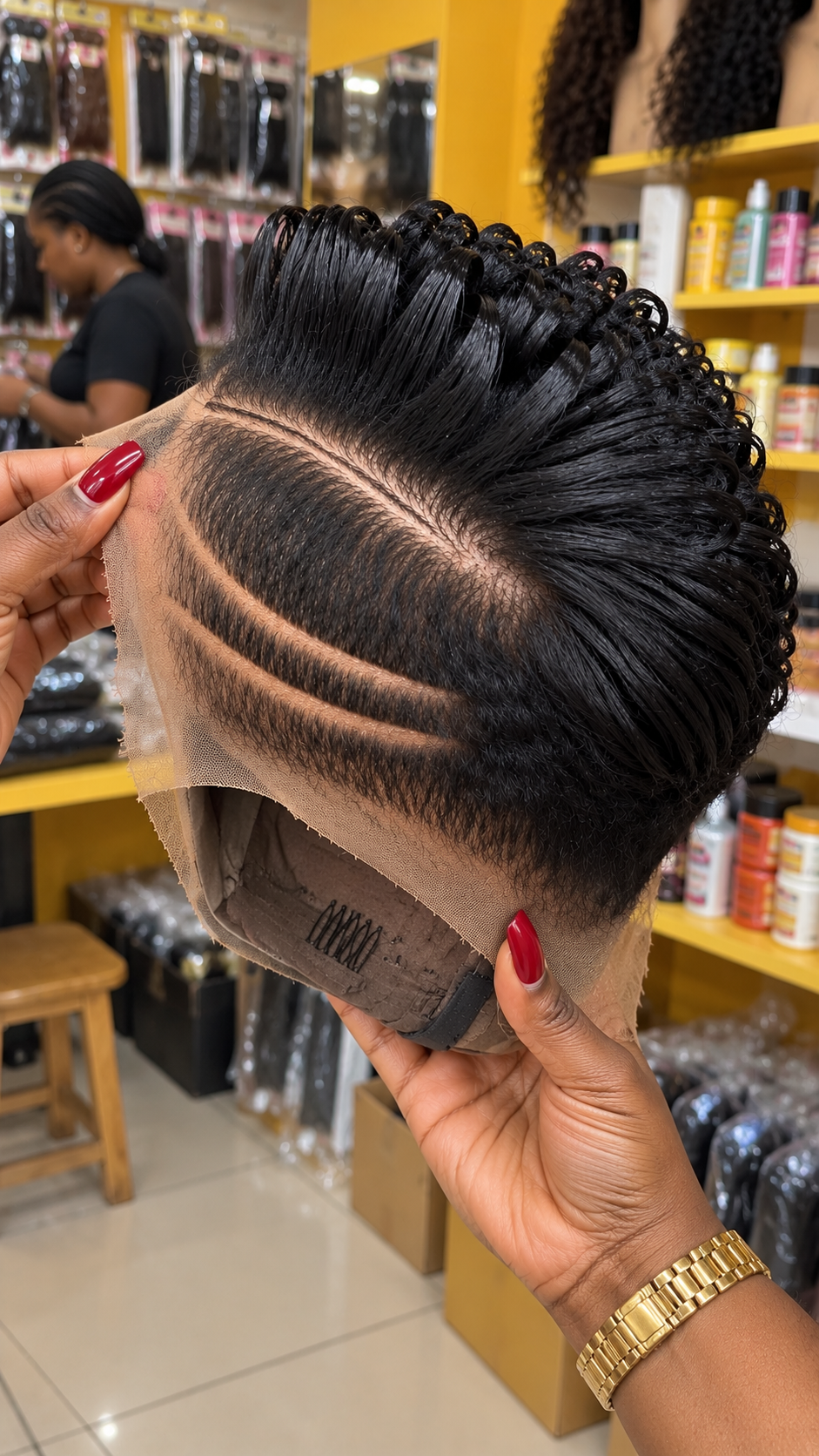
Some black wigs attract attention through length or dramatic color, but this piece takes a completely different route. Its strongest visual language comes from sculpted height, directional hair placement and two long curved lines running across the side. The photograph gives an unusually useful view of the construction because the unit is being held before installation, allowing the crown, side detailing, lace perimeter and part of the interior cap to be examined together.
The hair itself is deep black from root to end. Instead of introducing another shade, the stylist uses broad glossy loops to create contrast through reflected light. The front rises strongly from the base, then the hair travels backward through a sequence of large folded sections. Farther toward the rear, those sections become tighter and more compact. The result is a crown that has substantial height at the front without carrying the same height all the way to the back.
Below that crown is a very different zone. A long diagonal separation divides the elevated upper hair from the close-set side panel. Within the lower area, two parallel curved lines sweep backward. These lines are one of the clearest identifying details in this particular reference and should be treated as part of the design rather than as optional decoration.
A Crown That Uses Direction Instead of Loose Curl Volume
The upper section should not be confused with ordinary curls. The hair has been grouped into broad sections that rise vertically before folding backward. Each section has enough width to read almost like a ribbon. Light travels across the black surface of these sections, making their individual shapes visible even though the entire wig uses one dominant color.
The front portion has the greatest elevation. Several large loops stand upward from the root area, establishing a strong profile immediately behind the front perimeter. As the sequence progresses toward the rear, the loops gradually tilt farther backward. This creates movement rather than a crown that simply stands upright everywhere.
That progression is important for anyone asking a wig maker to reproduce the reference. Requesting “black curls on top” would be too vague. Small circular curls, finger coils or tightly packed ringlets would produce an entirely different result. The visual identity here comes from broad, elongated loop sections with a backward flow.
The rear also appears more compact than the front. This gives the silhouette a deliberate taper in height. A stylist recreating the piece would need to control the size and direction of each section so the crown does not become uniformly bulky.
The Long Diagonal Separation Organizes the Entire Side
One of the first structural details visible beneath the loops is the diagonal parting. It begins near the front portion of the wig and travels backward toward the crown. The exposed line creates a strong boundary between the elevated hair above and the lower dark panel beneath it.
This separation serves several purposes. Visually, it breaks up a large field of black hair. Structurally, it establishes where the upper styling ends and the side treatment begins. It also provides a directional guide that makes the backward movement of the crown easier to read.
When commissioning a similar unit, send the stylist a clear side photograph and specify that the main part should travel diagonally rather than vertically or horizontally. Even a small change in its angle could alter the proportions of the side panel and affect where the decorative lines sit in relation to the crown.
The photograph also shows the scalp-effect area of the part against the surrounding black hair. That contrast adds visual depth without introducing a second hair color.
Double Curved Lines Give This Version Its Own Identity
The lower side contains two long parallel channels. This is the detail that most clearly separates this reference from versions using a single curve, three narrow stripes or a geometric pattern. Both channels follow a similar sweeping direction, with the upper line tracing a path beneath the diagonal part and the lower line following underneath it.
The space between them remains filled with dark hair, so the channels do not merge into one wide opening. That separation matters. The eye reads two distinct curves moving together across the side.
The lines also become part of the overall flow of the hairstyle. They do not fight against the crown direction. Instead, they travel backward in harmony with the upper loops, creating a visual connection between the low side area and the elevated styling above.
For an accurate custom order, ask specifically for two elongated curved side lines with visible dark hair between them. A stylist should also be shown their approximate placement because positioning them too high could crowd the main diagonal part, while positioning them too low could change how the design frames the side of the head.
Why an All-Black Palette Works So Well Here
The absence of colored highlights allows the construction to become the main attraction. Black hair gives the wig a strong graphic appearance, especially where the bright separation lines interrupt the darker side panel.
On the crown, salon lighting produces narrow reflections across the looped strands. These reflections make each fold visible. Some sections appear almost charcoal where light hits them directly, while the deeper recesses remain rich black. This natural tonal variation is enough to reveal the architecture of the style.
The monochrome palette also makes the two curved side lines more noticeable. Their lighter scalp-like paths stand against the surrounding dark density, so they remain visible even from a moderate viewing distance.
Anyone ordering this color should communicate that the objective is a consistent black appearance rather than black mixed with brown, copper or blonde accents. If the seller uses a numbered color system, ask for an actual color sample before confirming the order because naming conventions can differ between suppliers.
The Side Density Is Deliberately Substantial
The area between the diagonal part and the lower perimeter is not sparse. A broad field of closely placed dark hair creates the visual foundation for the double-line design. Without that density, the channels would lose their graphic impact.
At the same time, the perimeter does not appear as one abrupt solid wall. The hair becomes finer as it approaches the lace edge. This helps the transition toward the mesh appear more gradual in the pre-installation state shown in the photograph.
Density should therefore be discussed in zones rather than with one general request. The upper crown needs enough hair to support the loop structure, the side panel needs enough coverage to carry the line pattern, and the perimeter needs a believable transition toward the lace.
If ordering online, request close photographs of the actual side before shipment. The double curves should remain visible and separated, and the surrounding density should still resemble the reference after the crown has been completed.
The Visible Lace Tells Us What Can and Cannot Be Confirmed
There is clearly lace extending beyond the hair perimeter in this photograph. Because the unit has not yet been installed, the excess mesh remains visible around the front and side. This gives the installer material to work with when positioning and preparing the wig for its wearer.
What the photograph does not establish is a specific commercial lace grade. It would therefore be inaccurate to automatically advertise this unit as HD lace. Lace terminology should be confirmed directly with the maker or seller before purchase.
The apparent shade of the mesh should also not be judged solely from this image. Lighting, the hand behind the lace, camera processing and the interior cap can all influence how the material appears in a photograph.
For a custom order, ask what lace material is used, what shades are available and whether tinting is included. If possible, choose the lace shade with the help of the stylist who will perform the installation.
Interior Construction Is Visible Beneath the Styled Exterior
The photograph offers a partial view inside the wig. A brown-toned cap foundation can be seen beneath the lace, and an interior comb is clearly visible near the lower section. Additional internal construction is partly hidden by the angle at which the wig is being held.
This is valuable information for a buyer because the exterior design is only one part of a wearable wig. Cap dimensions, adjustment hardware, comb placement and overall fit can determine whether the decorative side lines land where they are supposed to once the unit is on the head.
Before ordering, ask the seller for a separate photograph of the complete interior. Confirm cap size and the exact attachment components included with the unit. Do not assume that visible lace or an interior comb automatically means the wig is designed for a particular installation technique.
The intended wearing system should come from the maker’s specifications. If professional installation is planned, the installer can also evaluate whether any additional preparation is appropriate.
Placement Matters More With Decorative Side Work
A wig with a relatively simple exterior can tolerate small positioning differences without dramatically changing its appearance. This design is less forgiving because the diagonal separation and twin curved channels have intentional locations.
When the unit is first placed on the head, the stylist should check the front perimeter, crown direction and side lines together. The cap should not be rotated simply to make one element look correct while moving another element out of position.
The two curves should follow the side of the head naturally. Their relationship with the temple and ear area will depend on the wearer’s measurements and the way the original wig was constructed.
This is one reason accurate measurements matter for custom production. A photograph can communicate the design, but measurements help determine how that design translates to an individual head shape.
A Better Way to Request This Wig From a Stylist
Start with the reference photograph rather than relying on a generic hairstyle name. Tell the stylist that the crown should use broad upright black loops at the front, followed by progressively backward-moving sections through the middle and rear.
Next, identify the long diagonal separation underneath the crown. Explain that this line should remain visually prominent because it divides the upper structure from the side panel.
Then specify the most important side detail: two parallel curved channels, not one and not a group of several equal stripes. Ask for visible dark hair between the two channels so each line remains individually readable.
Finally, discuss lace, cap size, interior hardware and installation separately. This keeps construction requirements from being lost inside the styling request.
Questions Worth Asking Before Paying for a Custom Unit
Ask the wig maker which fiber will be used. The photograph itself does not reliably establish whether the unit is human hair or synthetic, and that distinction affects price, maintenance and what styling methods may be appropriate.
Confirm the exact black shade, cap measurement system, lace type, lace shade, interior comb arrangement and adjustment method. Ask whether the quoted price includes the sculpted crown work and double-line side customization.
It is also useful to ask whether installation is included. Some wig makers sell the completed unit only, while others provide fitting, lace preparation and final styling as separate services.
If the order is being shipped, request approval photographs before dispatch. A side view is particularly important for this design because a straight-on front photograph may not show the double curves clearly enough to evaluate them.
Photographs to Request During a Remote Order
For this particular design, one final photograph is not enough. Ask for a view from the decorated side so the two curves and diagonal part can be checked. Request a crown view to inspect the progression of the loops. A rear angle can reveal whether the elevated sections become compact enough toward the back.
Also request a front view before the lace is cut. This can help confirm the general perimeter and the relationship between the front loop height and the rest of the unit.
Finally, obtain an interior photograph. The inside view should show the cap and any combs, straps or other fitting components supplied by the maker.
These photographs create a practical approval process. If something differs significantly from the reference, it is much easier to discuss before the unit has been shipped or permanently altered.
Installation Should Preserve the Crown Architecture
The upper loops are already arranged into a deliberate sequence. Installation should therefore focus on fitting the unit without crushing or unnecessarily separating those sections.
Before any lace is trimmed, check the orientation of the wig. The main part should travel in the intended diagonal direction and the two side channels should sit naturally along the side.
Once alignment is established, the lace can be prepared according to the construction and the installer’s chosen method. Because the exact lace specification and attachment system cannot be established from the photograph alone, the final procedure should be based on the actual unit rather than assumptions made from its appearance.
After installation, only minor crown adjustments may be necessary if the loops have shifted during transport. Large-scale restyling could erase the controlled progression that gives this wig its character.
Keeping the Loop Pattern Intact After Purchase
Storage deserves special attention because pressure can alter the raised crown. A container that presses directly against the upper loops may flatten the front sections or force them sideways.
When possible, place the wig on an appropriately sized stand and leave sufficient space around the crown. Avoid stacking objects on top of it. The lace should also be protected from snagging or repeated folding.
Do not comb aggressively through the sculpted loops. Their broad grouped appearance depends on strands remaining together. Pulling individual hairs away from the sections can make the crown appear frizzy and reduce the ribbon-like effect visible in the reference.
Product and heat choices should depend on the actual fiber. Confirm the material before applying high temperatures or chemical products. Human hair and synthetic fibers can require very different care routines.
Custom Pricing Guide for This Type of Work
A sculpted unit with directional crown work and custom side detailing can require considerably more labor than a basic ready-made wig. Prices also change according to fiber, cap construction, lace choice, density and the amount of hand customization requested. These figures are broad planning estimates rather than a price quote for the photographed wig.
| Category | Typical Planning Range | What May Affect the Cost |
|---|---|---|
| Premium Custom | $450–$900+ | Higher-grade human hair, custom cap measurements, extensive crown setting and detailed side work |
| Standard Custom | $280–$450 | Personalized sizing, lace construction, loop styling and double curved side detailing |
| Basic Human Hair | $180–$300 | Human-hair foundation with customization or installation potentially priced separately |
| Premium Synthetic | $110–$220 | Higher-quality fiber with pre-shaped crown work and lace construction |
| Basic Synthetic | $60–$120 | Standard fiber and fewer personalized construction options |
Finding the Right Professional for This Design
Look for a wig stylist whose portfolio includes sculpted crown work, lace fitting and decorative side detailing. A professional who mainly installs long straight units may not necessarily specialize in maintaining this kind of structured loop formation.
When contacting a salon, send the reference image before booking. Ask whether the stylist can reproduce the broad loop progression and the double curved side lines rather than simply asking whether they make black wigs.
If the wig will be made by one person and installed by another, provide the reference to both professionals. The installer needs to understand that the position of the side channels is intentional and should not be shifted during fitting.
For online purchases, compare actual custom work from the seller rather than relying only on catalog photographs. Ask whether the displayed piece is their own work and whether they can provide current photographs during production.
The Details That Should Remain Non-Negotiable
The strongest version of this design preserves its hierarchy. The elevated crown should remain the largest visual element. The diagonal separation should clearly divide the crown from the side. Beneath it, the two curved channels should remain distinct and should follow a coordinated backward path.
The black color should stay consistent across the crown and side unless a color change is intentionally commissioned. Adding random highlights would shift attention away from the sculptural construction that makes this reference effective.
The loop scale should also remain broad near the front. Replacing those sections with small ringlets would fundamentally alter the silhouette. Likewise, filling in the two side channels or multiplying them into several stripes would create a different hairstyle.
Used as a custom-order reference, this photograph communicates much more than a black wig. It shows a carefully organized combination of crown elevation, directional loops, diagonal separation, substantial side density, twin curved channels and visible lace construction. Those are the elements worth documenting clearly when speaking with a wig maker or salon.
Search Terms
black loop crown lace wig · double curved side line wig · diagonal part sculpted black wig · broad upright loop crown · twin side channel hair design · glossy black backward loop wig · dense black side panel lace unit · black crown wig with parallel curves