
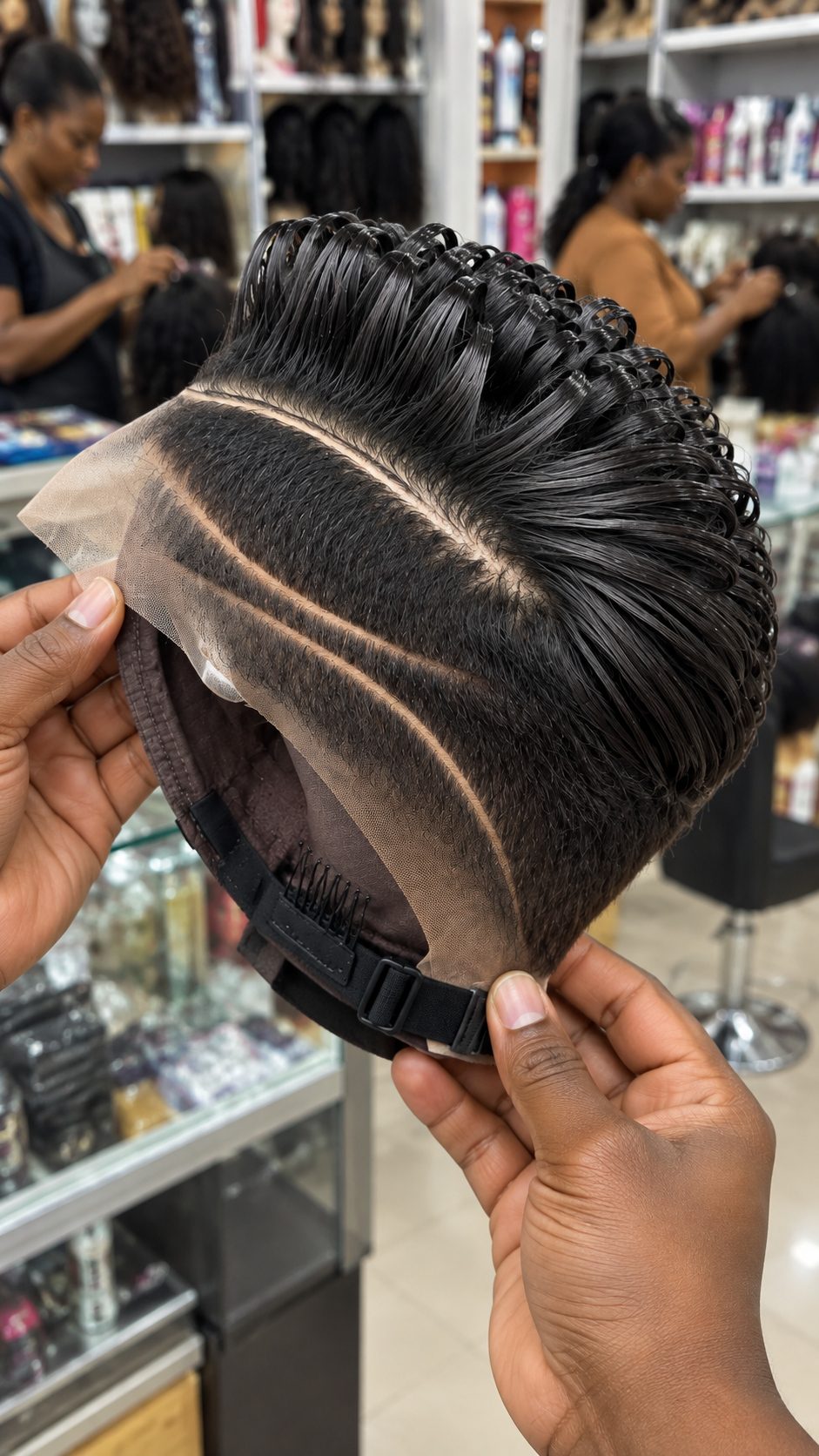
This black sculpted wig is built around a striking contrast between height and precision. The upper section rises into broad looped strands that travel backward across the crown, while the lower side stays compact and close to the cap. Between those two zones, a long diagonal parting establishes the direction of the hairstyle. A separate curved channel appears lower on the side, giving the dark panel a graphic contour without filling it with multiple decorative lines.
The photograph is particularly useful for anyone considering a custom order because the wig is shown before installation. The lace extends beyond the hair area, the internal cap can be seen underneath, and both an interior comb and an adjustable strap are visible. This makes it possible to examine not only the styling but also several practical construction details that would normally disappear once the unit is fitted.
Although the hair is entirely black, the design does not look visually flat. The shine across the sculpted loops produces alternating bands of light and shadow. Each raised section catches salon lighting differently, so the shape remains readable without relying on contrasting highlights. This is a strong example of a hairstyle in which architecture does most of the visual work.
The Crown Is Built From Broad Upright Loops
The upper hair does not behave like conventional loose curls. At the front, wide sections rise strongly from the root and bend backward into open loop formations. These sections resemble folded ribbons because several strands move together across a broad reflective surface rather than separating into small individual curls.
The largest loops appear toward the front and upper middle area. As the styling travels toward the rear, the pattern becomes progressively tighter. That change in scale is essential. It prevents the back from becoming as tall as the front and gives the wig a controlled forward emphasis.
A stylist attempting this design should therefore work from a size progression rather than creating identical loops from front to back. The first sections need enough elevation to establish the profile. The middle sections continue the backward motion, while the rear sections close the silhouette with smaller bends and tighter spacing.
The glossy black finish also makes section consistency important. Because there are no contrasting colors to distract the eye, uneven direction can become immediately noticeable when light passes over the surface. The repeated backward sweep is one of the main reasons the crown appears organized rather than bulky.
The Diagonal Parting Acts as the Main Structural Boundary
A prominent parting begins near the front and travels diagonally toward the crown. It separates the elevated loop system above from the lower side panel below. This is not merely a decorative part. Its position controls the proportions of the entire hairstyle.
The line is long enough to remain visible through much of the side view. Hair immediately above it rises into the sculpted crown, while the hair below it lies in a much lower direction. That difference creates a clear architectural boundary between the two areas.
For a custom order, the angle of this parting should be communicated with a photograph rather than described only as a “side part.” A conventional side part could produce a very different layout. Here, the parting has a deliberate diagonal path that helps pull the viewer’s attention from the front toward the back.
The exposed scalp-like area along the part also adds dimension to an otherwise monochrome hairstyle. Against the dense black hair, the narrow lighter path emphasizes the directional construction and makes the crown appear even more elevated.
One Curved Side Channel Changes the Character of the Lower Panel
The lower section deserves separate attention because this reference does not use a cluster of three or four parallel channels. Instead, one prominent curved channel sweeps through the side panel. Its path follows the general contour of the head rather than cutting across it as a straight horizontal stripe.
This single channel gives the hairstyle a quieter graphic detail. The surrounding dark hair remains substantial enough to form a broad side panel, so the carved-looking curve becomes an accent rather than the dominant feature.
The channel also complements the diagonal part above it. The upper boundary moves backward at one angle, while the lower curve follows a softer route. Together they create layered movement without making the side excessively busy.
When ordering this exact interpretation, specify that the side should contain one major curved separation rather than several evenly spaced lines. Adding additional channels would noticeably change the identity of the design shown in the reference.
Dense Black Hair Gives the Side Its Strong Visual Weight
Between the main part and the curved channel sits a substantial field of closely placed dark hair. Its density balances the large loops above. If this area were made too sparse, the crown could appear disconnected from the lower section. If it were made too heavy at the perimeter, the lace transition could look unnecessarily abrupt.
The image shows shorter hair gradually approaching the lace edge. That transition helps create a more believable boundary while preserving the strong dark shape farther inside the unit. Density planning therefore matters just as much as the sculpted crown.
A buyer requesting a similar wig should discuss side density with the maker instead of focusing only on the top. Sending this exact side view can help communicate how much dark coverage should remain between the parting, curved channel and lace perimeter.
Visible Lace Allows the Pre-Installation Construction to Be Examined
The lace is clearly visible around the front and side because the wig has not yet been trimmed for a wearer. Excess mesh extends beyond the hair area, leaving material available for fitting and final customization.
The photograph confirms the presence of lace, but it does not reliably establish a specific commercial lace category. In particular, there is not enough evidence to label the material HD lace. Sellers use different terminology for lace grades, so anyone ordering the unit should ask for the exact specification directly.
Lace shade should also be confirmed rather than judged entirely from a photograph. Lighting, camera processing and the background beneath the mesh can alter its apparent tone. A stylist can determine whether the supplied lace works for the wearer or whether tinting and additional preparation may be appropriate.
Trimming should normally occur only after the unit has been positioned correctly. The excess lace visible here provides useful fitting space; once removed, that adjustment margin cannot simply be restored.
The Interior Shows Practical Fitting Components
The open underside reveals several useful construction details. A dark cap forms the foundation beneath the styled hair. An interior comb is visible near the lower area, and an adjustable strap with a buckle-style component can also be seen.
Those features indicate that the wig includes built-in fitting hardware, but the image alone should not be used to promise a particular wearing method. Whether the finished unit can be worn without adhesive depends on the complete construction, fit, lace placement and the maker’s intended system.
Before purchasing, ask for a full interior photograph. Confirm the number and location of combs, the adjustment range of the strap, the cap size and whether any additional elastic is installed. These details can affect both comfort and stability.
A well-fitted cap is especially important for this design because the diagonal part and curved side channel have specific intended positions. If the wig rotates on the head, those elements can shift and the visual balance may no longer match the reference.
Why the Black Color Makes Shape More Important
With highlighted wigs, color placement can become the first thing people notice. Here, the black shade removes that distraction. The eye instead follows the physical movement of the hair: upward at the front, backward across the crown and downward into the compact rear section.
The reflective surface provides subtle tonal variation. Sections facing the salon lights appear almost charcoal along their brightest edges, while recessed areas remain deep black. These natural reflections outline each loop without introducing a second actual hair color.
This makes the style a useful option for someone who prefers a dark palette but still wants a visually elaborate crown. The drama comes from shape, separation and height rather than bright pigment.
Recreating the Front-to-Back Progression Requires Careful Sectioning
The crown should not be treated as one large mass. Its appearance depends on repeated sections arranged in sequence. Near the front, the hair stands higher and the loops are more open. Moving backward, the strands gradually lean farther toward the rear.
The change is subtle enough that the crown still looks continuous. There is no sudden point where large loops stop and small curls begin. Instead, the scale contracts gradually, allowing the rear to become compact without breaking the flow established at the front.
A wig stylist recreating the piece should map this progression before setting the final shape. Crown photographs taken during production can help a buyer check whether the direction is developing correctly.
This is particularly useful for remote orders. A finished front photograph may look convincing even when the rear transition is too bulky. Asking for side and crown views before shipment provides a much better assessment.
What to Tell a Wig Stylist Before Booking
Rather than requesting a generic black curly wig, describe the visible construction in specific terms. Ask for a monochrome black unit with elevated broad loops at the front, backward-swept crown sections, a long diagonal parting and a low dense side panel with one curved channel.
Show the stylist the reference image and point directly to the loop scale. The top should not become a collection of tiny ringlets. The broad sections are a defining characteristic, particularly near the front.
Discuss the side separately. Make clear that the curved channel should remain isolated rather than being converted into a set of repeated parallel stripes. This small instruction can make a major difference in the final result.
Also confirm whether the stylist will construct the wig, install it, or perform both services. If different professionals are responsible for production and installation, make sure both understand the intended orientation.
Ordering Remotely Without Losing the Original Design
A detailed reference package is useful when the wig maker is not local. Include this side photograph along with accurate measurements requested by the seller. Measurements may include head circumference, front-to-nape distance and ear-to-ear dimensions depending on the construction method.
Specify the black shade and state that no contrasting highlights are required. Then describe the crown height, loop direction, diagonal part and single curved side channel. These structural instructions are more important than using a long list of generic hairstyle terms.
Before final payment or shipment, request current photographs of the actual unit. Ideally, obtain a front view, the decorated side, the opposite side, the crown and the interior. This gives you an opportunity to identify obvious differences before the wig leaves the stylist.
Ask whether lace trimming, hairline customization and installation are included. Do not assume that a photographed pre-installation unit will arrive fully prepared for immediate wear.
Fitting the Wig Without Rotating the Design
The first fitting should focus on alignment. Place the unit so the front lace sits where intended and check whether the diagonal part reaches the correct side of the head. Then inspect the curved channel in relation to the temple and ear.
If the side feature appears too far forward or too far back, check the overall cap position before altering the hairstyle. Rotating the wig can also change how the upper loops sit, so adjustments should consider the entire construction.
Once the placement is correct, the installer can proceed with the attachment technique appropriate for the specific unit. Because the photograph does not establish the manufacturer’s recommended installation method, buyers should follow the instructions supplied with their wig or work with a professional installer.
Protecting the Raised Sections Between Wears
The broad loops need space during storage. Placing heavy items on the crown or forcing the wig into a small container can flatten the front elevation and disturb the gradual transition toward the rear.
A properly sized wig stand can help preserve the silhouette when the unit is not being worn. The crown should remain free from pressure, and the lace should not be folded sharply against the sculpted side.
Avoid brushing through the loop formation as though it were ordinary loose hair. The strands have been grouped intentionally. Pulling them apart can change both the reflective surface and the direction of the crown.
Heat and product recommendations depend on the actual fiber used. The image does not establish whether the wig is human hair or synthetic, so confirm the material with the seller before applying heat, oils, setting sprays or other products.
Custom Wig Price Guide
The final cost of a similar unit can vary significantly according to fiber quality, cap construction, lace specification, density, styling labor and customization. The figures below are general planning ranges rather than prices for the exact wig shown.
| Wig Category | Estimated Range | Typical Cost Factors |
|---|---|---|
| Premium Custom | $450–$900+ | High-grade human hair, custom measurements, advanced lace work and extensive hand setting |
| Standard Custom | $280–$450 | Custom cap sizing, sculpted crown work, side detailing and professional preparation |
| Basic Human Hair | $180–$300 | Human-hair base with customization or installation potentially charged separately |
| Premium Synthetic | $110–$220 | Higher-quality fiber, shaped crown setting and lace construction |
| Basic Synthetic | $60–$120 | Standard fiber with fewer personalized construction options |
Booking a Professional for the Final Fit
If possible, book with a wig stylist who has experience installing structured units rather than treating this like an ordinary loose-hair wig. The crown already contains a deliberate shape, so installation should preserve that work instead of rebuilding it unnecessarily.
Bring the reference photograph to the appointment. Ask the stylist to check cap position before trimming the lace and to preserve the location of the diagonal part and curved side channel.
If any reshaping is required, discuss it before products or heat are applied. A small adjustment to one loop can affect neighboring sections because the crown follows a continuous directional pattern.
What Makes This Version Worth Reproducing
This wig succeeds because it combines a bold upper silhouette with disciplined side work. The front loops create height, the crown carries that movement backward, and the long diagonal part separates the raised styling from a compact lower panel. The single curved channel introduces a distinctive side accent without competing with the crown.
The all-black color reinforces the structure. Instead of depending on highlights, the hairstyle uses reflection and shadow to reveal its form. The visible lace and interior hardware also make this reference valuable for buyers who want to understand what they are ordering before installation.
For the closest reproduction, concentrate on the details that actually define this unit: glossy black hair, broad upright front loops, progressively tighter rear sections, diagonal side separation, one sweeping lower channel, dense side coverage and a lace perimeter prepared for final fitting. Confirm lace type, fiber type and complete attachment system directly with the maker rather than assigning specifications that cannot be verified from the photograph.
Search Terms
black sculpted loop lace wig · diagonal part black crown wig · single curved side channel wig · glossy backward loop hairstyle · broad ribbon curl wig design · dense black side panel wig · elevated black crown lace unit · curved side separation hairpiece