
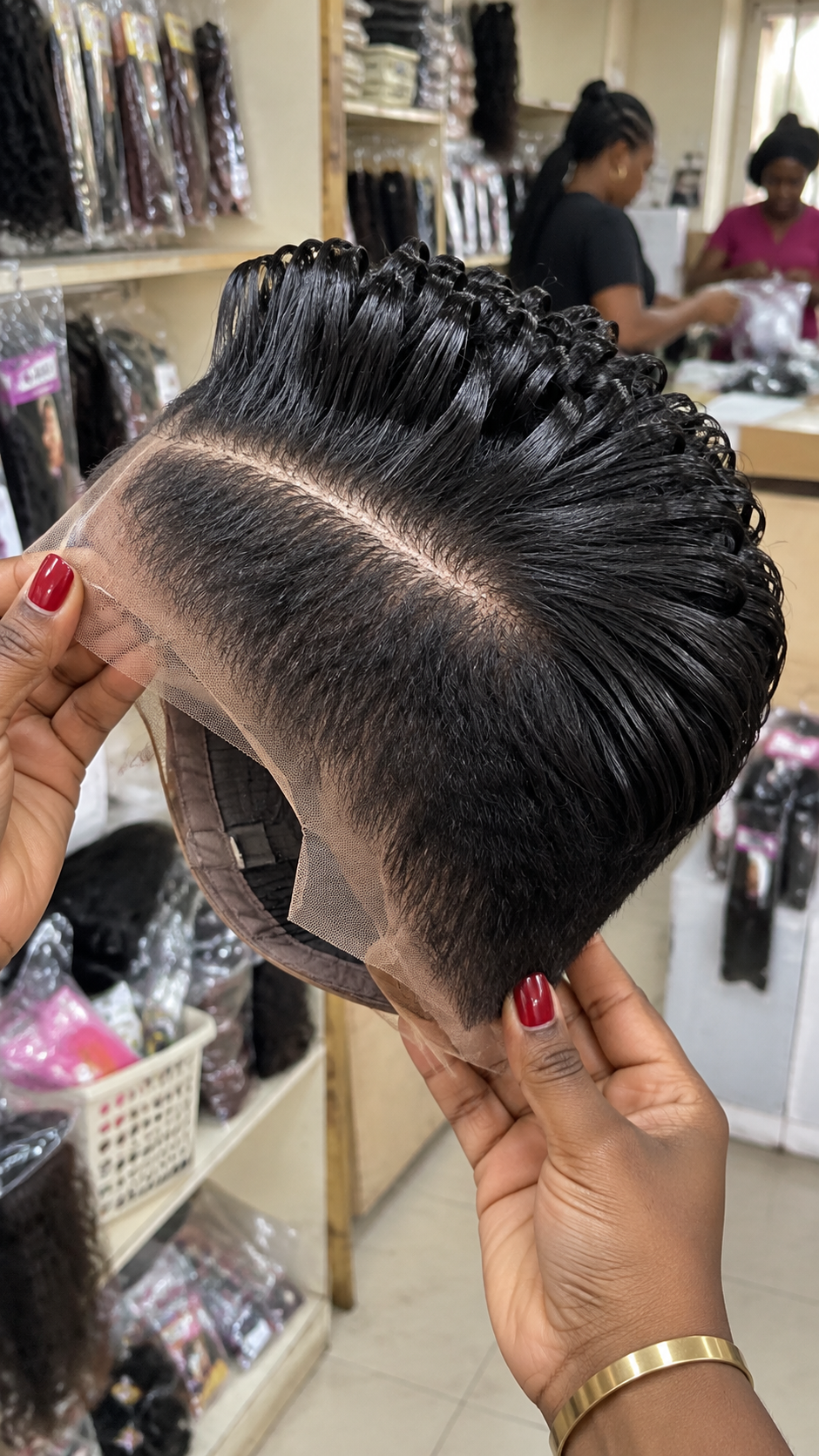
The first image in this batch is quiet in color and strong in construction. Its natural-black surface makes the diagonal part, raised loop rhythm and close side panel easy to judge without distraction. The right way to approach this unit is as a shape-led custom wig whose value comes from disciplined sectioning, fit and finish.
Black-on-black construction is unforgiving
A natural-black unit does not have bright color to distract from weak construction. That makes this reference especially useful for judging craftsmanship. The diagonal part has to remain readable, the loop widths need a deliberate rhythm, and the side panel must sit close enough to contrast with the lifted crown. A buyer should study the negative space between the raised sections, not just the shine on top. If those gaps collapse, the style becomes a generic slicked-back shape. If they are too wide, the crown looks sparse. For a salon recreation, ask the stylist to establish the part and loop map before adding finishing product. That sequence keeps the architecture visible and prevents product from being used to hide uneven sectioning.
A minimalist color story can broaden the client base
Natural black makes this design easier to offer to clients who work in conservative settings but still want a distinctive silhouette. The interest is concentrated in shape, so the unit can move from workwear to evening styling without requiring a color change. For a business, that makes it a strong core-menu option rather than a seasonal novelty. Photograph it against a light neutral background and include a profile shot; black hair photographed against a dark wall can swallow the detail that justifies the custom price. A short video under window light is even more useful because the surface reflections reveal each loop without altering the true color.
Density should support the loops, not inflate them
The crown needs enough hair to create broad folds, yet excess density would make the unit look helmet-like. That balance is a technical point worth discussing before ordering. Ask whether the maker can control density by zone: slightly fuller where the loops need structure and lighter where the side must hug the head. A uniform high-density cap is not automatically better. In this reference, the appeal comes from a compact profile with height placed strategically through the center. A wearer with a smaller head may need the loops scaled down rather than simply shortened. Proportion is more important than copying an inch measurement from another person.
Use the first fitting to set the visual center
Because the design is asymmetrical, the cap cannot be casually rotated until the front looks good. The diagonal part, temple area and side panel have to land together. At the first fitting, center the cap using the wearer’s natural landmarks, then evaluate the part from straight ahead and from above. Only after the position is stable should the lace be marked. This avoids a common problem in sculpted wigs: a beautiful side detail that sits too far forward because the unit was twisted to make the front hairline look symmetrical. The correct fit should make the asymmetry look intentional, not accidental.
Maintenance is mostly about preserving direction
This unit does not need constant restyling if the original direction is protected. Store it upright, keep the looped crest away from friction, and resist the urge to comb through the top after every wear. Small flyaways can be addressed section by section. If the unit is human hair, a stylist can re-form individual loops with controlled heat and setting product; if it is synthetic, use only methods approved for that fiber. The side panel should also be protected from rubbing against rough scarf fabric or high collars. A few careful habits will preserve the crisp contrast between close side and lifted crown far longer than frequent full restyling.
A black unit should be sold with evidence, not adjectives
For an online listing, show the exact unit from the top, side, front and inside. State what can be verified: natural-black appearance, diagonal parting, sculpted loop crown, close side panel and visible lace perimeter. Then separately list confirmed specifications such as cap size and hair material. Avoid claiming a premium lace grade or hair origin just because the unit looks refined in a photo. Accurate, evidence-based descriptions are more persuasive to serious buyers than exaggerated technical language, and they protect the page from repeating the same generic sales copy across every wig post.
Fitting the black silhouette
At consultation, start with head measurements and the diagonal part. Ask the stylist to mark where the part will sit before discussing shine or finishing spray. Once the cap is centered, compare the height of the first loops with the wearer’s forehead and profile. A smaller face may need slightly narrower loops, but the compact black silhouette should remain intact. Photograph the test position before trimming lace so there is a record of the agreed placement.
Remote proof for a one-color unit
When ordering the black version remotely, request five proof views: top, both sides, front edge and inside cap. The top view verifies loop spacing; the side views show whether the close panel stays close and even. Ask for one unfiltered daylight clip so the natural-black tone is not artificially blue or overexposed. Do not approve shipment from a single glamour photo.
Care built around direction
For black sculpted loops, maintenance is primarily mechanical: prevent crushing, preserve section direction and avoid heavy residue. Use a stand with enough head shape to support the crown. If a loop softens, refresh only that section. Frequent full restyling is unnecessary and can shorten the life of the unit.
Price Map for a Shape-Led Black Custom
| Option | Typical Range (USD) | Planning note |
|---|---|---|
| Premium Custom | $320–$520+ | High-grade hair, advanced color or detailing, fitting and precision shaping |
| Standard Custom | $220–$320 | Salon-built unit with controlled styling and moderate customization |
| Basic Human Hair | $150–$230 | Human-hair base with simplified finishing |
| Premium Synthetic | $95–$170 | Quality fiber with pre-shaped form and selected custom work |
| Basic Synthetic | $55–$95 | Entry interpretation with fewer custom stages |
These figures are planning ranges rather than fixed retail prices. Final cost depends on hair material, cap construction, color processing, labor, fitting and the complexity of the visible side work. Ask for a written breakdown before paying a non-refundable custom deposit.
Search Terms for the Natural-Black Reference
natural black sculpted loop wig · diagonal side part wig · glossy ribbon loop top · close side panel wig · visible lace perimeter · compact crown wig · swept loop hairstyle · salon custom wig
Final black-unit standard
Judge this black unit by proportion first: part placement, loop rhythm, side density and fit. When those four elements are right, the natural-black finish becomes a strength rather than a limitation.
Inside-cap questions before payment
Before paying the balance, ask to see the inside cap and confirm the exact adjustment system, cap circumference and lace specification. The exterior reference is built around broad natural-black loops, but comfort depends on what is underneath. A cap that is too large can rotate and move the uninterrupted close side panel out of position; one that is too tight can distort the front edge. Record the measurements on the invoice so a future remake starts from verified fit data rather than memory. If the seller cannot confirm a technical detail, leave it out of the public product description instead of guessing.
How to brief a second stylist
If another stylist will maintain the unit later, give that person a short technical brief. Note the natural black palette, the direction of the part, the scale of broad natural-black loops and the location of the uninterrupted close side panel. Include two or three unfiltered reference photographs. This is more useful than simply saying “make it like before,” because a sculpted wig can change quickly when a new stylist interprets the loops differently. A written brief also prevents accidental changes to the side design during a routine refresh.
Photographing black detail
For social content, shoot one image that prioritizes construction rather than glamour. Use neutral light, keep the camera close enough to show the part and uninterrupted close side panel, and include a second angle that reveals broad natural-black loops. Then capture a wider salon image for context. This combination gives buyers both proof and inspiration. Avoid filters that shift natural black, because the post may later be used as a color reference by a customer. Accurate images reduce repetitive questions and make the article’s search terms match what people can actually see.
Wear-test before an event
Before wearing the unit for a long event, test it for at least an hour at home. Check pressure near the ears, movement at the nape and whether the sculpted top changes when the wearer turns the head. The uninterrupted close side panel should remain in its intended position without over-tightening the cap. If adhesive will be used, follow the product instructions and do not make the event day the first fitting. A short wear test gives time to correct comfort or placement issues while the lace and styling are still easy to adjust.
What not to change in a remake
If this design is remade, protect its identity by deciding which elements are fixed and which can change. Keep the part direction, the relationship between broad natural-black loops and the side, and the recognizable uninterrupted close side panel. Color within the natural black family can be adjusted for the client, and loop scale can be tuned for head size. Treat those as controlled variations rather than redesigning every feature at once. This approach creates a recognizable salon signature while still allowing each order to feel personal.
Collection-day checklist
At collection, inspect the unit in ordinary light before leaving the salon. Look at the part from above, check the uninterrupted close side panel from a true profile, and make sure broad natural-black loops remains separated rather than compressed. Confirm care instructions for the actual hair material and ask when the first maintenance visit should happen. Take one final photo of the finished unit on the wearer or a correctly sized head form. That image becomes the baseline for future refresh work and makes any later change in shape or color easier to diagnose.