
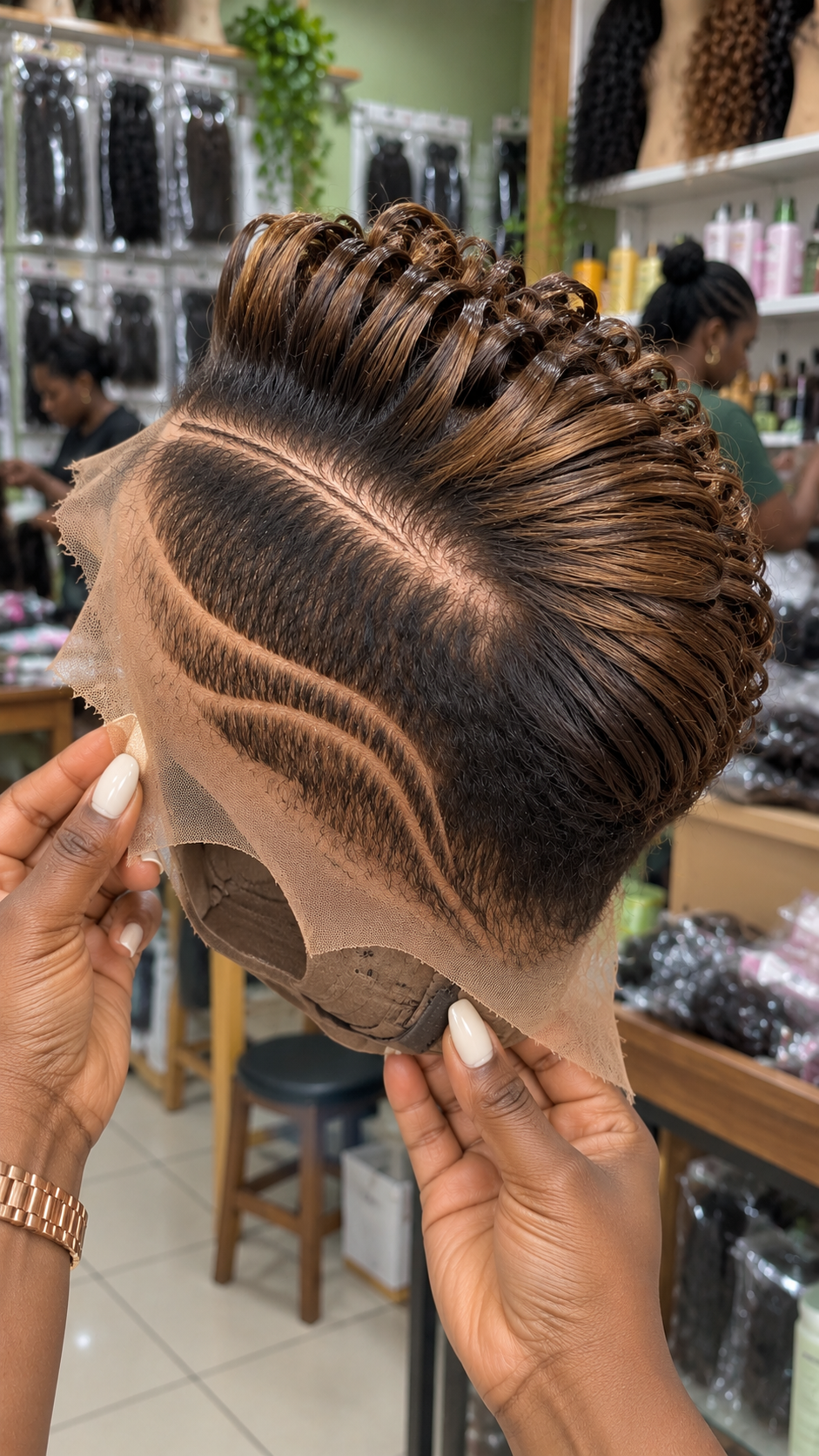
This mocha-toffee sculpted pixie wig combines a deep brunette foundation with warmer brown upper lengths, a long diagonal part, large looped crown sections and a layered curved design along the close side. The photograph gives an unusually useful view of the construction because the wig is being held away from the head. The lace extends beyond the perimeter, the interior cap is partly exposed, and the relationship between the dark base and warmer crown can be examined clearly. For someone ordering a similar wig, these visible details provide a much better specification than simply requesting a brown curly pixie.
The color is intentionally dimensional. Deep espresso and dark chocolate tones dominate around the roots, part and lower perimeter. The raised strands gradually reveal mocha, warm medium brown and toffee reflections as they travel through the crown. Because the lighter color follows the direction of the sculpted loops rather than appearing as isolated bright streaks, the entire upper section retains a rich brown appearance.
The side construction is another important part of the design. A pronounced diagonal part separates the raised crown from the close lower panel. Beneath it, two elongated curved lines travel through the darker hair and gradually converge toward the rear. Reproducing the wig successfully means preserving the relationship between these lines, the dark foundation and the direction of the upper loops.
Mocha And Toffee Tones Build A Rich Brown Gradient
The upper strands are warmer than the base but do not move into a bright blonde range. Instead, the color sits within a spectrum of mocha brown, toasted caramel and soft toffee. Salon lighting creates lighter reflections across the raised strands, particularly where the hair bends over the crown.
At the roots, the shade becomes substantially deeper. This darker foundation is especially visible around the long part and through the close side. The contrast gives the lighter lengths additional depth and prevents the wig from appearing uniformly medium brown.
When discussing color with a wig maker, send the photograph and request a dark espresso root transitioning into warm mocha-toffee lengths. Ask for photographs of the actual available hair because shade names vary considerably between manufacturers. The goal should be a warm dimensional brown rather than an orange copper or bright golden blonde.
Wide Crown Sections Create The Signature Loop Pattern
The upper styling consists of broad sections rather than small individual curls. Each group of strands rises from the root, bends backward and forms an elongated loop. These sections sit beside one another across the crown, creating a continuous sculpted sequence.
The front loops have greater height and a more upright direction. As the pattern progresses toward the back, the strands gradually lean farther backward. This changing angle allows the hairstyle to follow the rounded shape of the wig rather than creating a rigid row of identical loops.
If you are booking a stylist, emphasize the size of these sections. Asking only for curls can result in tight ringlets that look completely different. A useful instruction is to request broad ribbon-like loops with aligned strands and controlled backward movement.
The Long Part Establishes The Direction Of The Crown
A strong diagonal part runs from the front toward the rear and separates the two main styling zones. Hair above this part rises almost immediately into the sculpted crown. Hair below it remains much closer to the cap.
The part also exposes the darker root area, which strengthens the contrast against the warmer brown lengths. Keeping the root deep is therefore important not only for color but also for the visual structure of the hairstyle.
Before production begins, confirm which side should carry this part. Changing its direction later would affect the crown flow and the placement of the lower curved lines. For a custom order, mark the desired side directly on the reference photograph if necessary.
Layered Curves Give The Side Its Distinctive Identity
The lower panel contains two prominent exposed curves. The upper curve begins beneath the primary part and sweeps diagonally through the close dark hair. A second curve follows beneath it and bends toward the first as both move toward the rear.
This is different from a pair of straight parallel lines. The spacing changes gradually, producing a layered flowing shape. The design echoes the direction of the crown while remaining visually separate from the upper hairstyle.
Send the wig maker a close crop of this area if the side design matters to your order. Request two sweeping curved lines and specify that they should follow the direction visible in the reference. Adding extra lines or replacing the curves with geometric shapes would noticeably alter the design.
Keeping The Lower Section Dark Protects The Contrast
The close side remains primarily deep brunette. Although some warmer reflections are visible, it does not carry the same amount of toffee color as the crown. This creates a visual foundation underneath the lighter upper strands.
The reduced volume is equally important. The side sits close enough for the curved lines to remain clearly visible. Increasing the density in this area could partially conceal the design and make the overall silhouette heavier.
For a close recreation, request concentrated warmth through the upper loops while maintaining a darker, compact lower panel. This distribution gives the crown greater visual height without requiring excessive density.
The Exposed Lace Provides Useful Construction Clues
The photograph clearly shows lace extending beyond the hair around the perimeter. Lace construction can therefore be included when describing the visible unit. However, the image does not verify a specific commercial lace grade, so it should not automatically be described as HD lace.
Ask the seller exactly which lace material is used and which shades are available. The lace shade should be selected for the intended wearer rather than copied automatically from a reference photograph. Also confirm whether the lace will arrive uncut.
If a professional stylist will perform the fitting, ask whether they prefer to trim and prepare the lace themselves. Coordinating this before delivery can avoid unnecessary alterations later.
Interior Cap Information Should Be Confirmed Separately
Part of the brown-toned cap can be seen underneath the unit. The photograph gives useful evidence that internal construction is present, but it does not reveal every attachment or adjustment point.
Before purchasing, request photographs showing the complete interior. Ask whether the cap includes combs, clips, adjustable straps, elastic or another securing method. If you have a preferred installation method, discuss it before the wig is completed.
Cap stability is particularly important for a style with precise side detailing. If the unit moves significantly when worn, the diagonal part and curved lines may no longer sit where they were intended.
Density Should Support Shape Without Making The Crown Oversized
The crown has substantial structure but does not appear excessively bulky. Enough hair is present to create broad loops without large gaps between them, while the close side remains considerably flatter.
A stylist recreating this wig needs to balance those two density requirements. Too much upper hair can make the crown oversized and obscure the individual loops. Too little can leave visible spaces between sections.
When commissioning the unit, describe the desired result as a compact sculpted crown with clearly separated broad loops. If possible, ask the stylist to send a side-profile photograph before the final setting is completed.
Use This Specification List When Requesting A Quote
- Deep espresso or dark chocolate foundation around the roots and lower side.
- Warm mocha-toffee brown through the raised upper lengths.
- Broad ribbon-like loops rather than small spiral curls.
- Higher lift toward the front with progressively backward movement.
- Long diagonal part separating the crown from the close panel.
- Two sweeping curved lines beneath the primary part.
- Compact lower side with minimal added volume.
- Lace construction with the actual lace specification confirmed by the seller.
- Cap measurements matched to the maker’s sizing system.
- Interior securing method confirmed before production.
- Final styling included or quoted separately.
- Approval photographs supplied before shipping.
Premium Custom / Standard Custom / Basic Human Hair / Premium Synthetic / Basic Synthetic
The image does not provide a verified selling price or establish whether the visible hair is human hair or synthetic fiber. The ranges below are therefore general budgeting examples, not prices for this exact photographed unit. Color work, lace selection, cap construction, density and stylist labor can substantially change the final quotation.
| Category | General Planning Range | Possible Cost Factors |
|---|---|---|
| Premium Custom | $350–$750+ | Individual sizing, dimensional brown coloring, lace customization, precision loops and detailed side work |
| Standard Custom | $220–$450 | Selected mocha palette, custom part placement, crown sculpting and curved side design |
| Basic Human Hair | $140–$300 | Hair grade, density, cap type and additional salon styling |
| Premium Synthetic | $80–$180 | Higher-grade fiber, multi-tone brown color and stronger preset shape retention |
| Basic Synthetic | $45–$100 | Stock sizing, standard shades and fewer customization options |
Compare Real Hair Samples Before Choosing The Brown Shade
Brown shades are highly sensitive to lighting. Under warm salon lights, a medium brown can appear considerably more caramel than it does in daylight. Ask the seller to photograph the proposed shade near a window as well as indoors.
Pay attention to the difference between the root and upper lengths. The reference does not use one identical brown throughout. Preserving the deeper base is necessary for the dimensional effect.
If the seller is creating the color specifically for your order, ask to approve it before the final crown styling. Making major color changes after the loops have been formed could require the stylist to dismantle part of the hairstyle.
A Pre-Styling Consultation Helps Select The Correct Base Unit
If you intend to purchase a base wig and have a local salon recreate the look, show the photograph to the stylist before buying. The crown requires enough usable length for each section to rise and fold backward, while the side must be suitable for a close profile.
Ask whether the proposed density is appropriate. A unit designed for a very full hairstyle may require extensive thinning, while an extremely light-density base might not provide enough hair for the loop sequence.
Discuss color at the same appointment. Your stylist can advise whether starting with a dark-root brown unit or coloring a different base would be more practical for the desired mocha-toffee transition.
Request Production Photos At Key Stages
For a custom order, photographs taken during production can prevent misunderstandings. The first useful checkpoint is after the color has been prepared. Confirm that the base remains dark enough and that the upper brown has the desired warmth.
A second checkpoint should come after several crown loops have been formed. This lets you evaluate their width, height and direction before the entire crown is completed.
Finally, request a side view showing both curved lines. If the spacing or direction differs substantially from the reference, it is easier for the maker to correct the design before shipping.
Installation Should Preserve The Position Of The Side Design
The fitting process should keep the long part and curved lines in their intended positions. Before securing the unit, the installer can check how the cap sits in relation to the temple and side of the head.
A stylist should also avoid unnecessarily disturbing the crown while fitting the wig. The broad loops are already arranged in a deliberate sequence, so repeated handling can change their alignment.
Bring the original reference photograph to the appointment. It gives the installer a clear view of how the wig is supposed to sit and which details should remain visible after fitting.
Preserve The Loop Sequence During Storage
This crown should not be compressed between other wigs or stored underneath heavy items. Keep the unit on a suitable mannequin head or stand with sufficient space around the upper sections.
Avoid brushing directly through the sculpted loops. The aligned strands within each section are part of the design, and separating them can quickly turn the crown into a looser curl pattern.
When transporting the wig, use a container large enough to protect the crown. If one section shifts, use photographs of the original hairstyle as a guide rather than pulling neighboring loops apart.
Choose Care Products After Identifying The Hair Material
The photograph cannot establish whether the unit is made from human hair, heat-resistant synthetic fiber or another material. Ask the seller to identify it before selecting maintenance products.
Human hair may require conditioning and color-conscious maintenance, while synthetic fibers often need completely different products. The warm brown color should also be considered when selecting any cleansing or toning routine.
Use finishing products sparingly around the sculpted crown. Heavy product can collect between the grouped strands, reduce movement and make the dimensional brown color appear less vibrant.
Reforming A Loop Requires More Than Creating A Curl
If one of the crown sections eventually loses its shape, recreating it involves matching its original width and direction. A standard small curling technique will not reproduce the broad loop pattern visible here.
Before using heat, confirm that the material is heat-safe and obtain the recommended temperature range. Never assume heat tolerance based on shine or appearance.
If several sections have loosened, professional resetting may provide a more consistent result. Show the stylist the original crown from multiple angles so the progression from upright front sections to lower rear sections can be reconstructed accurately.
Search Terms
Mocha Brown Sculpted Pixie Wig · Toffee Brown Loop Crown Wig · Espresso Root Brown Pixie Wig · Double Curve Side Pixie Wig · Deep Side Part Brown Wig · Caramel Mocha Pixie Wig · Lace Front Loop Pixie Wig · Sweeping Brown Crown Wig
Final Checks Before Approving This Mocha Pixie Order
Before approving a custom version, compare the finished unit against the reference element by element. The root should remain noticeably deeper than the upper lengths. The mocha-toffee color should become more visible through the broad crown sections without turning the entire wig into one flat light-brown shade. The diagonal part should remain clear, and the loops should progress naturally from greater front lift into backward movement.
Inspect the lower side separately. The two curves should remain visible against the dark close section and should follow the same flowing relationship rather than becoming ordinary straight parallel lines. Check the crown from above and from the side, then request a rear photograph to see how the loops conclude.
Finally, confirm all details that cannot be established from the photograph itself: hair or fiber material, lace specification, cap measurements, securing system, total price, deposit requirement, production period, shipping arrangements and alteration policy. Ask whether the wig will arrive fully sculpted and obtain material-specific maintenance instructions. Combining these practical questions with the visible details in the reference gives the wig maker a precise production brief and makes it far easier to reproduce the deep-rooted mocha color, warm toffee crown and distinctive sweeping side design accurately.