
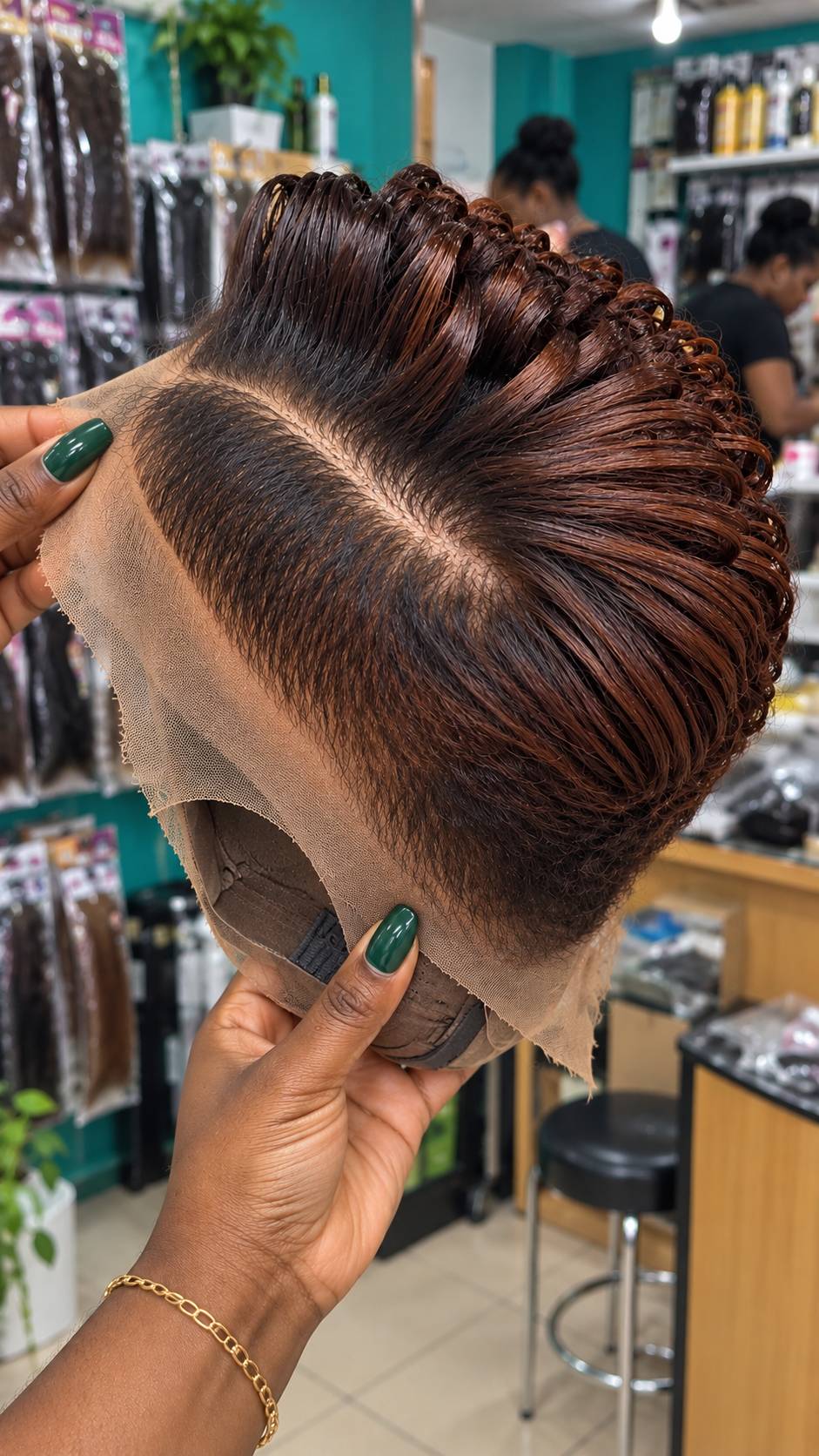
This chocolate brown pixie wig combines a compact close-fitting base with a dramatically sculpted upper section made from broad, glossy loops. The photograph gives a particularly useful view for anyone planning a custom wig order because the unit is being held away from the head, exposing the extended lace, parting area, internal cap and the transition between the dark roots and brown upper strands. The hairstyle is carefully controlled rather than loosely curled: each upper section rises from the base, curves backward and joins the next loop to create a continuous rounded crown.
The color is equally important to the finished appearance. The lower area and roots remain considerably darker, while the upper strands move through deep chocolate and warm chestnut-brown tones. Salon lighting catches the curved surfaces and produces lighter brown reflections without introducing a separate blonde highlight color. This combination gives the wig dimension while keeping the palette rich and wearable.
For someone ordering a similar unit, the best approach is to describe the hairstyle as a combination of several specific elements rather than simply asking for a brown pixie wig. The crown shape, deep diagonal part, dark-root transition, broad loop size, close perimeter and lace construction should each be discussed separately with the wig maker.
Chocolate Brown Creates Depth Across The Sculpted Crown
The visible upper section sits within a warm chocolate-brown family. Depending on how the salon light reaches each strand, some areas appear like dark cocoa while others reveal warmer chestnut and medium-brown reflections. The roots remain deeper, creating a gradual transition rather than an identical shade from base to ends.
This color placement works especially well with the sculpted loops because every curve reflects light differently. The raised sections appear brighter, while the recessed areas between them remain dark. That natural contrast makes the construction of the crown easier to see.
When ordering, avoid relying on a single color number unless the seller has shown you the exact shade. Different brands can interpret chocolate, chestnut and medium brown differently. Send the reference photograph and request photographs of the actual available hair in both indoor and daylight conditions.
The Crown Uses Wide Loops Instead Of Small Ringlets
The most recognizable styling element is the sequence of broad loops across the upper section. These are substantially different from compact ring curls. Each section contains multiple aligned strands that travel upward together before curving backward.
Near the front, the loops stand higher and have a stronger vertical direction. As the hairstyle moves toward the rear, the sections progressively lean backward and begin following the rounded contour of the wig. This gradual change prevents the crown from looking rigid or repetitive.
If a stylist interprets the reference as ordinary curls, the result could become too round, too small or too fluffy. When booking the service, specify broad ribbon-like loops with controlled separation. Showing the stylist a close crop of the upper section will communicate the required scale more effectively than a generic hairstyle name.
The Diagonal Part Controls The Flow Of The Entire Hairstyle
A long diagonal part is clearly visible between the raised upper section and the flatter side. The line begins near the front and continues toward the rear, providing a strong directional foundation for the hairstyle.
Hair immediately above the part rises into the sculpted loops. Below the part, the strands remain much closer to the cap. This difference in direction and volume makes the exposed line appear especially crisp against the dark root area.
Part placement should be confirmed before final styling. Moving it significantly higher or lower changes the available space for the crown and alters the proportions of the close side. If you prefer the part on the opposite side, tell the wig maker before the loops are constructed because the complete direction of the crown will need to be reversed.
Dark Roots Give The Brown Lengths A Natural Transition
The brown shade does not appear equally intense at the base. Around the part and lower perimeter, the hair is substantially darker. The warmer brown becomes more visible as the strands travel into the raised crown.
This root contrast has two advantages. First, it gives the upper loops additional visual depth. Second, it creates a softer transition into the close-fitting side instead of placing a bright brown shade directly against every exposed parting area.
Customers who want this effect should specifically request a dark-root chocolate-brown combination. Ask how far the darker root will extend before the brown becomes dominant. A root that extends too far could make the overall wig appear mostly dark, while a very narrow root could remove much of the depth visible in the reference.
The Close Side Keeps Attention On The Upper Structure
The lower side is considerably flatter than the crown. Instead of carrying large curls or additional volume, the strands follow the shape of the cap closely. This gives the wig a compact profile and emphasizes the contrast between the two styling zones.
The side also appears darker than the upper lengths, reinforcing the shadow-root effect. There are no obvious decorative shaved lines visible in this particular reference, so a close recreation should not automatically add graphic patterns that are absent from the photograph.
If you want the wig to remain faithful to this design, tell the stylist to keep the side understated. Additional lines, bright color panels or large perimeter curls would change the character of the unit considerably.
The Lace Perimeter Is Clearly Visible In The Reference
Lace extends beyond the hair around the visible perimeter of the wig. This confirms that lace is part of the photographed construction. However, appearance alone does not verify a specific commercial lace grade, so the unit should not automatically be described as HD lace.
Before ordering, ask the wig maker exactly what lace type is being offered and which shades are available. Also confirm whether the unit will arrive with the lace uncut. If you intend to use a professional installer, leaving the final trimming to the installation appointment may provide more control over the fit.
Request a close photograph of the actual lace before payment if this is an important part of your purchase. The photographed reference can demonstrate the general construction you want, but the seller should provide the technical specification of the material being supplied.
Inside The Cap Shows Useful Fit Details
The lower opening exposes part of the interior cap. A brown-toned cap structure and an internal securing component are visible. Because only one angle is shown, it would be unwise to assume that every internal attachment point can be identified from the photograph.
Ask the wig maker for a complete interior photograph before ordering. Confirm whether combs, clips, elastic or adjustable straps are included and where they are positioned. If you have a preferred securing method, communicate that before a custom unit is completed.
The internal construction is especially important with a sculpted pixie because the exterior shape is compact. A poorly fitting cap can shift the position of the part and change where the crown sits in relation to the face.
Getting The Crown Height Right Requires Careful Proportion
The upper section has noticeable height, but it does not extend excessively far from the head. The loops are stacked closely enough to create volume while maintaining a rounded pixie silhouette.
This balance should be discussed during a custom consultation. A stylist using larger amounts of hair could produce a much fuller crown, while reducing the density too aggressively could leave gaps between the sculpted sections.
Ask for a compact raised crown with visible individual loops rather than maximum volume. If possible, request a side-profile photograph during production so you can evaluate the height before the style is finalized.
What To Send A Wig Maker With Your Reference Photo
- Request a warm chocolate-brown upper section with noticeably darker roots.
- Specify broad backward-sweeping loops rather than tight ring curls.
- Confirm which side should carry the long diagonal part.
- Ask for a compact crown with controlled height.
- Keep the lower side close and darker than the upper lengths.
- Do not add decorative side lines if you want to follow this reference closely.
- Ask the seller to identify the actual hair or fiber material.
- Confirm the type and shade of lace rather than assuming a lace grade.
- Request photographs of the complete internal cap construction.
- Provide measurements using the wig maker’s own sizing guide.
- Confirm whether the unit will arrive fully sculpted.
- Ask for written care instructions for preserving the loop pattern.
Premium Custom / Standard Custom / Basic Human Hair / Premium Synthetic / Basic Synthetic
No verified retail price or material specification is visible in the photograph. The following figures are therefore general budgeting examples rather than prices for the exact photographed wig. Final quotations can vary according to material, cap construction, lace choice, coloring, density, customization and stylist labor.
| Category | General Planning Range | Possible Cost Factors |
|---|---|---|
| Premium Custom | $350–$750+ | Individual sizing, custom brown coloring, detailed loop setting, lace work and extensive hand finishing |
| Standard Custom | $220–$450 | Selected color, customized part direction, sculpted crown and perimeter preparation |
| Basic Human Hair | $140–$300 | Hair grade, density, cap construction and separate salon styling |
| Premium Synthetic | $80–$180 | Higher-grade fiber, dimensional brown color and stronger preset shape retention |
| Basic Synthetic | $45–$100 | Stock sizing, standard brown shades and limited customization |
Buying Online Starts With Matching The Brown Shade
Begin the ordering process by sending the complete reference photograph. Tell the seller that the color should remain darker around the root and lower side while transitioning into a warmer chocolate-brown crown. If the seller offers several brown shades, request photographs of them before choosing.
Next, confirm the hairstyle separately from the color. Explain that the upper strands should form broad backward-moving loops and that the diagonal part must remain clearly visible. Ask whether the seller will style the unit before shipment or whether it arrives as an unfinished base.
Before payment, confirm the total price, required deposit, production time, shipping method and alteration policy. Custom wigs may have different return conditions from ready-to-ship products, so read those terms before committing to the order.
A Salon Consultation Can Prevent Buying The Wrong Base Wig
If you plan to buy a base wig and have it styled locally, speak to the stylist before purchasing the unit. Show this photograph and ask what hair length, density and construction are necessary to create the crown.
The broad loops require enough workable length to bend backward while still maintaining the compact pixie silhouette. A base that is already cut too close may not provide sufficient hair for this arrangement. Conversely, an excessively long or dense unit may require substantial cutting and reshaping.
A stylist can also advise whether buying a pre-colored chocolate unit or coloring a darker base would be more appropriate for the desired result. Ask for the expected styling cost separately so you can compare the complete price with ordering a finished custom wig.
Request Progress Photos Before The Final Set
For a high-detail custom order, progress photographs can reduce misunderstandings. Ask to see the color after it has been prepared but before all of the crown sections are permanently arranged. This allows you to check the relationship between the dark root and chocolate lengths.
Once the loops are formed, request a side photograph showing the part and crown height. A slightly elevated image is also useful because it reveals whether the sections are distributed consistently across the top.
If the unit is being ordered remotely, make major corrections before shipment whenever possible. Reworking a heavily sculpted crown after delivery may require the loops to be taken apart and rebuilt.
Storage Should Preserve The Direction Of The Loops
This style depends heavily on controlled strand placement, so storage matters. Keep the wig on a suitable mannequin head or stand where the upper loops will not be compressed. Avoid placing it beneath another wig or inside a small container for extended periods.
The loops should remain grouped in their original direction. Brushing through them can separate the strands and remove the polished ribbon-like appearance. If dust or minor tangling develops, follow the care method recommended for the actual material rather than automatically brushing the crown.
For travel, ask the stylist how to support the upper section. A larger protective container may be worthwhile for a custom wig whose shape is a major part of its value.
Refreshing The Glossy Finish Without Losing The Shape
The photograph shows strong shine across the brown strands, but adding excessive product is not necessarily the best way to maintain that appearance. Heavy oils or sprays can cause grouped sections to separate or become weighed down.
Use only products appropriate for the wig material and apply them sparingly. Human hair and synthetic fibers may require different maintenance routines, so obtain the material specification before choosing cleansers, conditioners or finishing products.
If the crown begins to lose its loop formation, professional restyling may be preferable to repeatedly adding product. The shape comes primarily from controlled strand direction rather than from surface shine alone.
Confirm Heat Safety Before Trying To Rebuild A Loop
Do not assume that heated tools are safe based on the wig’s appearance. The photograph cannot determine whether the unit is human hair, heat-resistant synthetic fiber or another material. Ask the seller directly.
If heat is permitted, follow the recommended temperature range. Broad loops need controlled shaping; using excessive heat or creating a curl that is too tight can alter the original silhouette.
When several sections require repair, taking the wig back to a stylist may produce a more consistent result. Bring the original photograph so the stylist can compare the intended direction, height and spacing of the loops.
The Part And Crown Need To Be Checked From Several Angles
A custom wig should not be approved from one front-facing photograph. Request a side view that clearly shows the diagonal part, a slightly elevated angle that reveals the crown arrangement and a rear photograph showing how the loops finish toward the back.
Check whether the front sections have the expected lift and whether the loops gradually lean backward rather than changing direction abruptly. Also examine the transition between the dark lower section and the warmer brown crown.
These photographs are particularly valuable for remote orders because they allow you to evaluate the structure before shipping. Save the approved images along with the order details for future maintenance or reordering.
Search Terms
Chocolate Brown Sculpted Pixie Wig · Dark Root Brown Pixie Wig · Swept Loop Crown Wig · Deep Side Part Brown Wig · Chestnut Brown Pixie Wig · Sculpted Loop Pixie Wig · Lace Front Brown Pixie Wig · Glossy Brown Crown Wig
Turning This Chocolate Loop Pixie Into A Clear Custom Order
The strongest way to recreate this wig is to preserve the relationship between its visible elements. The dark roots provide depth, the chocolate-brown lengths introduce warmth, the long diagonal part controls the styling direction and the broad loops create the raised crown. The lower side remains compact and understated, allowing the upper structure to receive most of the attention.
The photograph also provides useful information about construction. Lace is visibly present around the perimeter, and part of the internal cap can be seen. Those details can be included in a consultation, while unverified specifications such as the exact lace grade and hair material should be obtained directly from the seller.
Before placing the order, confirm the brown shade, dark-root depth, part direction, loop width, crown height, cap measurements, lace type, internal securing system and whether the wig will arrive completely styled. Ask for photographs before shipment and obtain maintenance instructions for the specific material used. With those details agreed in advance, the reference becomes a practical custom-wig brief rather than simply an inspiration photo, giving the stylist a much clearer target for reproducing the chocolate-brown sculpted pixie appearance.