
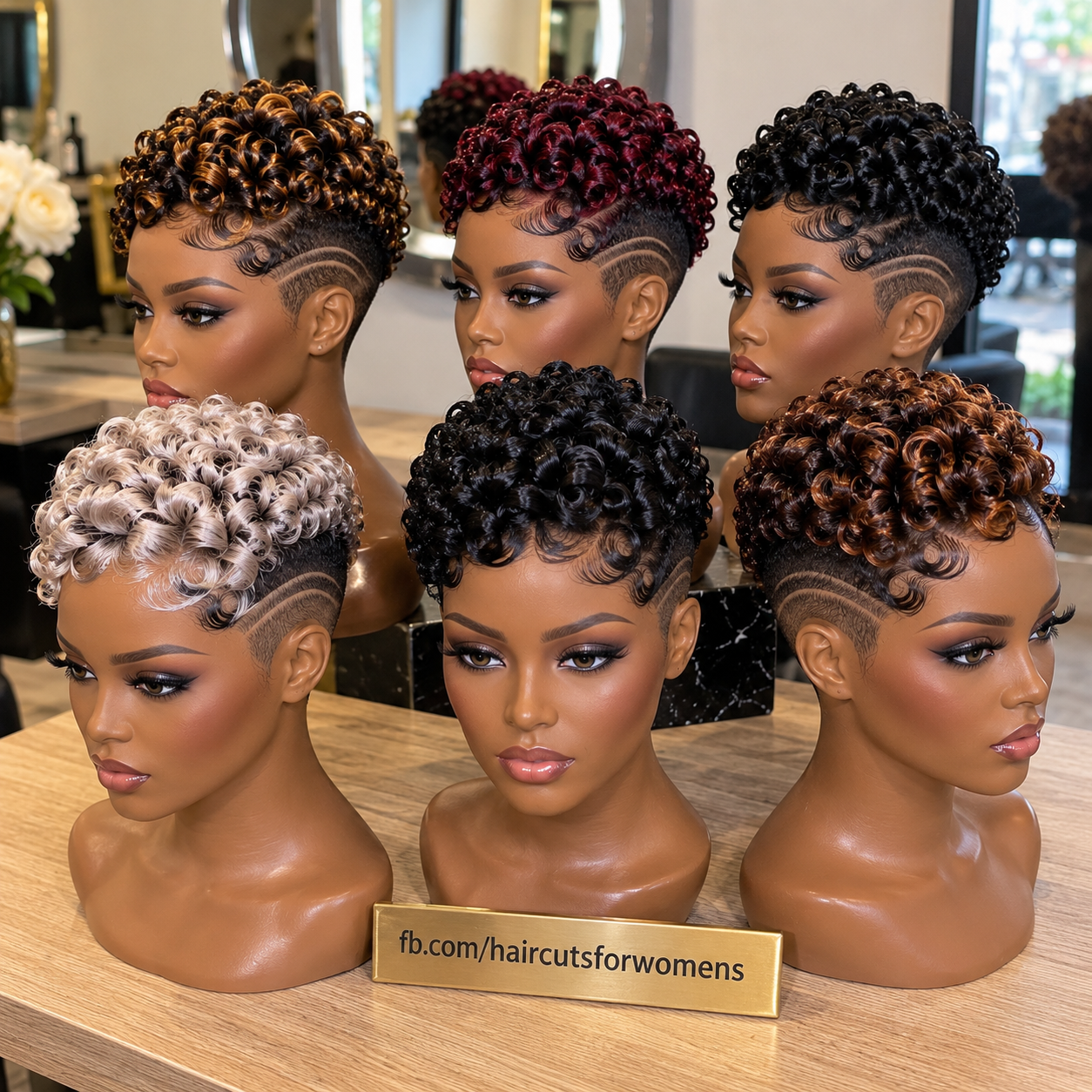
This coordinated pixie wig collection is built around one immediately recognizable idea: a compact crown of glossy ring curls paired with dramatic forehead waves, closely tapered sides and two curved side lines that follow the contour above the ear. The six displayed variations show how strongly the same hairstyle can change when the color moves from deep natural black into burgundy wine, pearl silver, warm copper brown and caramel-highlighted brown.
The curls are intentionally concentrated across the upper section instead of spreading outward. That controlled placement creates a rounded crown while leaving the side profile exposed. The open side area is important because it gives the curved line work enough space to remain visible. At the front, sculpted waves travel from the curl crown toward the temple, creating a striking transition between the fuller upper section and the close side.
For customers searching for a ready-to-wear or customized pixie wig, this is the kind of reference image that should be discussed in separate parts. The color, curl diameter, crown density, forehead wave direction, side-line placement and cap construction all need to be confirmed individually. Asking only for a “curly pixie wig” would leave too many important details open to interpretation.
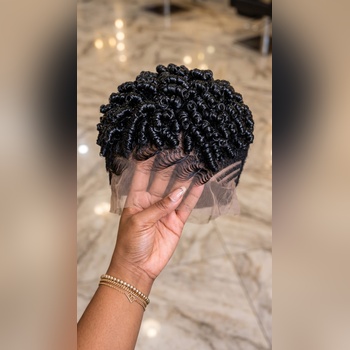
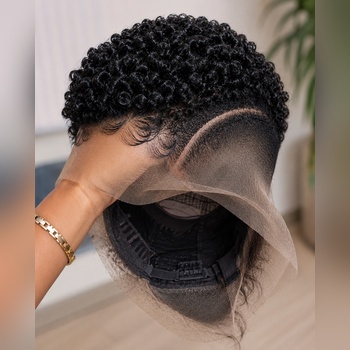
The Circular Crown Is The Foundation Of This Collection
The first element to notice is the repeated ring shape across every crown. These are not loose waves, fluffy coils or stretched spirals. The hair is arranged into numerous compact circular curls with visible centers. Because the loops sit closely beside one another, the crown appears full without losing the individual curl pattern.
The curl size is also important. Extremely small coils would create a very different surface, while oversized curls would reduce the number of visible rings and change the silhouette. Here, the curls are medium-small and tightly grouped, producing a dense rounded dome that remains proportionate to the close sides.
When placing a custom order, send a clear crown reference and ask for compact ring curls arranged into a controlled pixie dome. If possible, request a photograph of the finished curl setting before shipping. That gives you an opportunity to check whether the crown has enough volume without becoming too wide.
Double Curved Side Lines Give The Profile Its Identity
The side work is one of the most distinctive parts of the hairstyle. Two narrow curved lines travel backward from the temple area, creating a layered arch above the ear. Their direction follows the shape of the head rather than cutting across it horizontally.
This matters because the line work visually connects the forehead styling with the tapered side. The upper curve sits close to the sculpted temple waves, while the lower curve creates separation inside the close side area. From a three-quarter angle, the two lines become an important part of the overall silhouette.
Customers ordering this design should provide a side photograph rather than relying on a front reference alone. Tell the stylist whether the double-line design should appear on the left side, right side or both. Placement can also be adjusted according to the cap, head measurements and the amount of side coverage required.
Long Temple Waves Add Movement Beneath The Curls
The front perimeter has much more detail than a basic curled pixie. Several long wave sections sweep from the front toward the temple, creating a layered feather-like effect underneath the ring curls. These waves are arranged closely together but remain individually visible.
The waves also prevent the transition between crown and side from appearing abrupt. Instead of moving directly from dense curls into a close side, the hairstyle uses the sculpted perimeter as an intermediate section. This creates visual continuity around the forehead and temple.
If you are having this look customized, tell the stylist that the front waves need to remain visible after the crown is set. Too many curls placed near the forehead can hide them. The crown should therefore begin slightly behind the sculpted perimeter rather than covering the entire front edge.
Burgundy Wine Creates A Deep Red Statement
The burgundy variation gives the collection one of its richest color directions. The ring curls carry dark red and wine reflections while the spaces between the loops remain deeper. This contrast helps each curl remain visible rather than turning the crown into one flat red area.
Burgundy also works particularly well with the close side because the deeper base around the temple gives the red crown a clear boundary. The sculpted waves pick up the same wine tone, allowing the color to continue through the front without overwhelming the side design.
When ordering burgundy, do not rely entirely on a generic color name. Ask whether the available shade leans toward wine red, cherry burgundy, mahogany red or purple burgundy. A seller’s color chart or daylight photograph will usually provide more useful information than a shade number alone.
Caramel Highlighted Brown Makes Every Curl More Visible
The caramel-highlighted variation creates additional depth by placing lighter warm strands against a darker brown foundation. As the strands travel around each circular curl, the caramel sections catch the light and visually trace the shape of the loops.
This is particularly effective on a hairstyle with repeated ring curls because the color placement emphasizes the curl architecture. Instead of appearing as broad streaks, the lighter areas move through the crown in small curved sections.
For a similar result, ask for caramel or golden-brown accents over a deeper brown base. Explain whether you want the lighter shade scattered throughout the crown or concentrated around the upper curls. The percentage of lighter strands can significantly change the final appearance.
Pearl Silver Creates Strong Contrast Around The Crown
The pearl-silver version is the brightest option in the collection. Its pale curls reveal the individual loops immediately, while the darker side area provides strong separation underneath. Because the color is light, shadows inside the ring curls become particularly noticeable.
Silver shades can vary considerably depending on lighting. A unit that appears pearl silver under indoor lighting may look cooler, brighter or slightly greige in daylight. Customers should therefore request photographs under more than one lighting condition whenever accurate color matching is important.
It is also worth confirming whether the silver color extends throughout the entire unit or whether darker root and side areas are intentionally retained. The reference hairstyle relies on contrast, so completely removing the darker areas could create a noticeably different result.
Warm Copper Brown Gives The Ring Curls Extra Dimension
The copper-brown option sits between dark brown and brighter copper. It creates visible warmth without overpowering the sculpted construction. Highlights naturally appear along the outer edges of the loops while deeper brown areas remain between them.
This shade is especially effective for customers who want noticeable color but prefer something softer than vivid red. Under warm salon lighting it can appear richer and more copper-forward, while daylight may reveal more of the underlying brown.
When discussing this color with a wig maker, reference the photograph and ask for warm copper brown rather than assuming one standardized shade exists. If the seller works with multiple color blends, request samples or previous customer photographs before confirming the order.
Deep Natural Black Keeps Attention On The Hair Architecture
The darkest versions demonstrate that this design does not depend on bright color. The glossy ring curls reflect enough light to reveal their circular structure, while the deep natural-black tone keeps attention on the silhouette, forehead waves and double curved side lines.
This can be a useful option for customers who want the styling itself to provide the visual impact. It also makes the hairstyle easy to coordinate with different clothing colors and accessories without reducing the drama of the curl crown.
If purchasing online, confirm whether the seller describes the shade as natural black, soft black or very dark brown. Those shades can look similar in product photographs but become easier to distinguish in daylight.
Crown Placement Determines Whether The Side Work Stays Visible
A common problem when recreating this type of pixie is allowing the crown to become too wide. If curls extend too far toward the ear, they begin to cover the double curved lines and reduce the strong contrast between upper volume and close side.
The better approach is to keep the main curl concentration high enough to create a rounded dome while gradually reducing volume near the temple. The sculpted front waves can then connect the crown to the side without adding unnecessary bulk.
Ask the stylist to check the hairstyle from the front, side and three-quarter angles before considering the styling complete. A crown that looks balanced from the front may still project too far outward when viewed from the side.
Choosing A Color Based On The Detail You Want To Emphasize
Each color directs attention toward a slightly different element of the design. Pearl silver makes the ring construction highly visible. Burgundy emphasizes richness and contrast. Copper brown introduces warmth. Caramel-highlighted brown makes individual curls easier to distinguish, while natural black gives more visual priority to the shape and side detailing.
Customers who want the crown itself to dominate may prefer silver or highlighted brown. Those who want a deeper, richer appearance can consider burgundy or copper brown. Natural black works well when the curl architecture and line placement should remain the primary focus.
There is no need to choose a color solely because it appears in the reference collection. A custom wig maker may be able to recreate the same structure in another compatible shade. Confirm available colors and request a preview whenever custom coloring is involved.
What To Confirm Before Paying For A Custom Pixie Wig
Start by asking whether the seller can reproduce the actual styling details rather than simply providing a generic curly pixie. Send the reference image and identify the compact ring-curl crown, sweeping forehead waves and double curved side lines as the essential elements.
Next, confirm the material. Human hair and synthetic fiber can behave differently during restyling, washing and heat application. Ask what the unit is made from and follow the seller’s recommended care instructions for that material.
Cap construction and sizing should also be discussed before payment. The image alone does not establish a specific lace type, so do not assume that the displayed units use HD lace or another particular lace specification. Ask the seller directly what construction is available.
Finally, confirm turnaround time, deposit requirements, shipping, return or alteration policies and whether final styling is included. For customized units, ask whether photographs can be provided before dispatch.
Custom Order Notes To Send Your Wig Stylist
- Compact pixie silhouette with a rounded ring-curl crown.
- Medium-small circular curls with visible centers.
- Controlled crown width so the side profile remains exposed.
- Long sculpted waves across the forehead and temple.
- Two curved side lines positioned above the ear.
- Close tapered side area beneath the curl crown.
- Chosen color confirmed with a photograph or swatch.
- Cap size selected from accurate head measurements.
- Hair or fiber material confirmed before production.
- Finished styling included or clearly quoted separately.
- Side design orientation confirmed before cutting or shaping.
- Final photographs requested before shipping when available.
Price Guide For This Type Of Custom Curl Work
No price is displayed in the reference image, so an exact selling price cannot be determined from the photograph. The following figures are general planning ranges rather than quotes. Final cost can change according to material, coloring, cap construction, density, hand styling, customization and local stylist rates.
| Category | Estimated Price Range | Typical Cost Factors |
|---|---|---|
| Premium Custom | $350–$750+ | Advanced coloring, personalized sizing, detailed curl setting and extensive hand styling |
| Standard Custom | $220–$450 | Custom shade, sculpted perimeter, ring curls and side detailing |
| Basic Human Hair | $140–$300 | Hair quality, density, cap type and styling labor |
| Premium Synthetic | $80–$180 | Fiber quality, curl retention, color blend and customization |
| Basic Synthetic | $45–$100 | Standard fiber, preset cap and limited personalized work |
Salon Fitting Can Protect The Intended Side Profile
A professional fitting can be valuable for a sculpted pixie because the relationship between the crown, temple and ear is important. The stylist can check whether the side lines sit at the correct height and whether the front waves follow the wearer’s natural proportions.
Bring the original reference image to the appointment. Explain which details must remain unchanged before the stylist begins adjusting the unit. If trimming or additional side work is required, discuss exactly how much material will be removed because those changes may be difficult to reverse.
Customers purchasing remotely should ask the seller how measurements should be taken. Follow the seller’s own measurement guide instead of estimating a cap size. Accurate measurements can reduce the amount of adjustment required after delivery.
Protecting The Ring Curls After Styling
The circular crown needs careful handling because its appearance depends on individual loops staying intact. Avoid repeatedly pulling fingers or brushes through the curls. Separating the strands can gradually open the rings and reduce the compact appearance of the crown.
Store the wig where the upper curls will not be compressed. A suitable wig stand or mannequin head can help preserve the rounded silhouette between wears. Do not place heavy objects on top of the crown or store the unit tightly beneath other wigs.
Use care products appropriate for the actual hair or fiber. Heavy product buildup can make neighboring curls stick together, while inappropriate heat can damage synthetic fibers. The manufacturer’s care instructions should take priority over generic wig-care advice.
Creating A Coordinated Color Collection For Wig Customers
From a wig-business perspective, this type of collection provides a useful way to offer variety without changing the underlying hairstyle every time. One recognizable pixie construction can be presented in several carefully selected color families, allowing customers to compare color while keeping the curl pattern and silhouette consistent.
A seller could organize the collection around deep natural black, pearl silver, burgundy wine, copper brown and caramel-highlighted brown. Additional versions could use espresso-to-toffee or chocolate-to-golden-honey combinations while preserving the same ring-curl architecture.
Consistent photography is particularly useful when selling multiple colors online. Photograph every unit from the front, both sides, three-quarter angle and crown whenever possible. Customers can then compare the actual styling rather than trying to judge a sculpted pixie from one angle.
Search Terms
Double Line Curl Pixie Wig · Sculpted Ring Curl Pixie · Burgundy Curly Pixie Wig · Pearl Silver Pixie Wig · Copper Brown Curl Wig · Caramel Highlight Pixie Wig · Sweeping Temple Wave Wig · Natural Black Ring Curl Wig
Finding A Wig Maker Who Can Recreate The Side Detailing
When searching for a seller, look beyond general wig catalogs and review portfolios from wig stylists who regularly work with pixie units. The curl setting is only one part of this design. The stylist also needs experience controlling crown width, arranging the front perimeter and creating side details that remain visible when the wig is worn.
Send the reference photograph before booking and ask whether the stylist can reproduce the overall structure. Request examples of previous pixie work from several angles. If the seller offers customization, ask what portions of the design can be altered and which elements are determined by the available cap construction.
For online orders, obtain the complete quote before paying a deposit. The quote should clarify the unit material, color work, styling, sizing, production period and shipping. For local orders, a consultation with a wig stylist or salon can make it easier to discuss placement and final fit in person.
A Strong Pixie Collection Built Around Curls, Curves And Color
This collection succeeds because the same visual language is repeated across every color: compact circular curls on top, sculpted waves around the forehead, closely tapered sides and a double curved line that follows the profile. The result remains recognizable whether the crown is natural black, pearl silver, burgundy, copper brown or caramel highlighted.
The key to ordering a similar unit is specificity. Do not stop at requesting a curly pixie. Explain the curl diameter, crown concentration, front wave direction and side-line placement. Select the color using a photograph rather than a vague shade description, and confirm the cap construction directly with the seller instead of assuming details that cannot be verified from an image.
With those points established before production begins, customers and wig businesses have a much clearer reference for discussing the final unit. The color can change dramatically while the signature silhouette remains consistent, making this sculpted ring-curl pixie an especially useful design for a coordinated multi-color wig collection.