
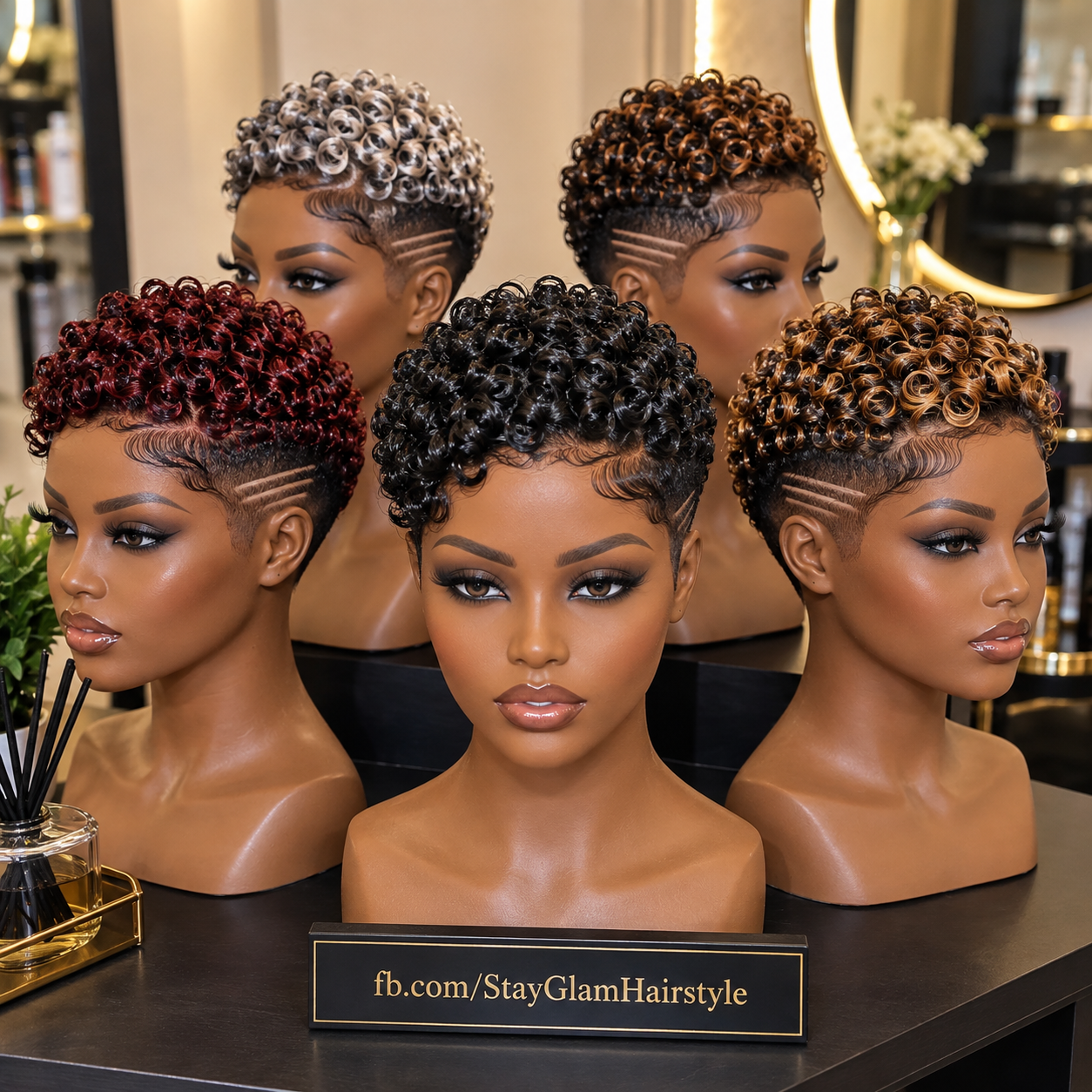
This five-piece pixie wig collection focuses on a highly recognizable combination of compact ring curls, sculpted finger-wave detailing and precisely spaced side lines. The display includes deep natural black, burgundy wine, pearl silver and warm caramel-brown variations, allowing the same basic silhouette to take on several different personalities without losing its signature structure. Each wig keeps the crown rounded and full while the sides sit much closer to the head, giving the circular curls a stronger visual presence.
The most noticeable element is the crown. Instead of loose waves or stretched spirals, the hair is arranged into numerous glossy ring curls with visible circular openings. These rings sit closely together and form a dense dome across the upper section. Around the forehead and temples, the styling changes direction. Longer strands are pressed into sweeping finger-wave curves that frame the front of the hairstyle before meeting the tapered side area.
Several wigs also show three narrow parallel lines above the ear. These lines add another layer of detail without competing with the curls. Their placement follows the direction of the head and visually connects the front wave to the tapered back section. For customers ordering this type of wig, the curl formation, side-line spacing and temple work should all be included in the customization request rather than simply asking for a curly pixie.
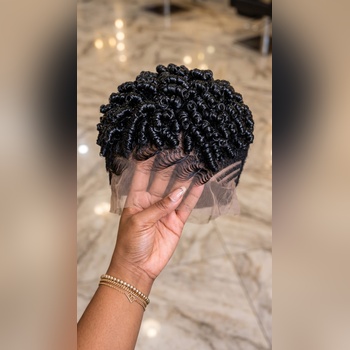
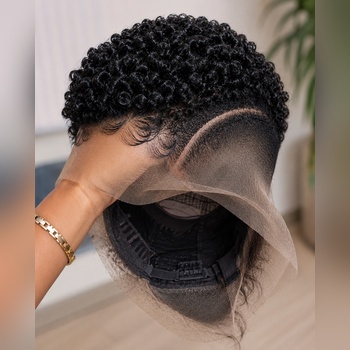
The Circular Crown Is The Signature Of This Collection
The crown construction gives these wigs their strongest identity. Every curl is shaped into a compact loop with a recognizable center. When dozens of these loops are positioned together, they create a rich three-dimensional surface while still allowing individual curls to remain visible.
The rings are not distributed randomly. More volume appears toward the upper center of the head, while curls closer to the hairline and sides gradually sit nearer to the scalp. This produces a rounded silhouette that follows the natural proportions of a pixie hairstyle. The controlled transition is important because an equally high curl pattern across the entire head would make the sides appear too bulky.
When requesting a similar custom unit, describe the crown as polished ring curls or loop curls rather than using a general phrase such as curly hair. A stylist needs to understand that the circular shape itself is essential. Loose curls, fluffy coils or elongated spirals would create a very different appearance.
Triple Side Lines Give The Tapered Area A Stronger Identity
The side design visible on several mannequins uses three parallel carved lines positioned above the ear. They begin near the temple and travel backward with a slight upward angle. The spacing between each channel is consistent enough for the three lines to read as one coordinated design.
This detail works particularly well because the surrounding side area is kept close to the head. The reduced density creates a contrasting surface where the narrow lines can remain visible. If the surrounding hair were much fuller, the line pattern could become difficult to recognize.
Customers commissioning this look should specify both the number of lines and their direction. A triple-line pattern can look completely different if the lines are horizontal, curved, widely separated or positioned too low. A side-profile photograph should therefore be included with the order.
Finger Waves Create The Transition Between Curls And Tapered Sides
The temple styling deserves as much attention as the crown. Wide finger-wave sections curve across the front and side hairline, creating a softer transition between the compact rings above and the close side section underneath. These waves are carefully directional and appear almost painted against the hairline because of their precise placement.
Near the forehead, several strands sweep outward before turning back toward the temple. The movement prevents the front from looking flat and provides a graceful frame around the face. On the side, the wave pattern gradually narrows as it approaches the carved lines.
When ordering, ask the stylist to preserve enough open space around the temple for this wave work. Bringing the ring curls too far down can cover the sculpted section and change the balance of the hairstyle.
Burgundy Wine Brings Depth To The Ring Curl Pattern
The burgundy variation creates one of the richest color effects in the collection. The deep red tone appears darker inside the curl openings and brighter across the raised outer surfaces. This natural variation in reflected light makes each ring easier to distinguish while maintaining a sophisticated wine-red appearance.
The darker base around the sides provides additional contrast. Rather than making the entire hairstyle one uninterrupted red block, the deeper side area visually anchors the colorful crown. The finger waves retain the same burgundy family, connecting the two sections.
For a custom order, use a reference photograph alongside terms such as burgundy wine, deep cherry or dark red. Color names vary significantly between suppliers, so a photograph is more reliable than a shade name alone.
Pearl Silver Turns Every Curl Into A Visible Detail
The pale silver wig stands apart immediately because its lighter color reveals the curl pattern with exceptional clarity. Individual rings can be followed from the crown toward the front, and reflected light emphasizes the circular construction throughout the hairstyle.
The silver shade also increases contrast between the crown and the darker tapered area underneath. This makes the side lines particularly noticeable. The pale finger-wave section around the forehead creates another focal point and gives the front profile a highly sculpted appearance.
Anyone ordering this color should confirm the exact undertone before production. Pearl silver, icy blonde, platinum and smoky silver can appear similar in bright photographs but may look noticeably different in person. Requesting a color swatch is particularly useful when ordering online.
Caramel Brown Adds Warm Light Through The Crown
The caramel-brown option combines a darker foundation with warmer strands distributed through the ring curls. The lighter sections catch the light and visually trace the direction of individual loops. This gives the crown extra dimension without turning the entire wig into a pale color.
Because the highlights follow the curl movement, they appear integrated into the hairstyle rather than placed as straight stripes. Darker sections remain visible between the caramel pieces, maintaining depth throughout the crown.
For customization, buyers should specify whether they want subtle caramel accents, stronger honey-brown pieces or a more evenly distributed brown blend. The width and placement of the lighter strands can significantly alter the final appearance.
Deep Natural Black Keeps Attention On Shape And Shine
The deepest-colored wig demonstrates how much impact can come from construction alone. With minimal color contrast, the circular curl pattern, glossy surface and sculpted hairline become the main points of interest. Light reflects around the edges of the rings, revealing their shape even though the crown remains consistently dark.
This option also allows the side design to stand out. The narrow exposed lines interrupt the dark tapered section and create a graphic contrast. Meanwhile, the finger-wave work provides movement along the forehead and temple.
Customers who prefer dark hair should still confirm the actual shade with the seller. Natural black, soft black and very deep brown can photograph similarly, especially under indoor salon lighting.
Curl Density Determines How Luxurious The Crown Appears
The wigs shown use a substantial number of ring curls, but the curls are not compressed into an unreadable mass. Small spaces and visible curl centers remain throughout the crown. This balance between fullness and separation is crucial.
If density is too low, large gaps may become visible between curls. If density is excessive, neighboring loops can overlap until their circular construction disappears. A successful version needs enough hair to create a rounded dome while preserving the identity of each ring.
When speaking with a wig stylist, request a dense crown with individually visible loops. Showing a close reference of the curl pattern can communicate this more effectively than describing density with percentages alone.
The Tapered Profile Keeps The Crown Visually Elevated
The close side profile creates contrast with the fuller crown. Hair around the ear and lower temple sits near the head, while the rings rise above it. This difference in volume gives the crown its elevated appearance without requiring excessive overall height.
The taper also creates space for the triple-line detail. Because the side section remains restrained, every carved channel can be seen clearly. The finger waves then act as a visual bridge between the close side and the ring curls.
A stylist recreating this look should consider the three sections together: ring-curl crown, sculpted transition and tapered side. Changing one section without considering the others can alter the proportions of the entire design.
What To Tell A Wig Stylist Before Production Begins
A good custom request should be specific. Start by explaining that you want a compact pixie silhouette with a rounded crown of glossy circular ring curls. Mention that the loops should remain individually visible and should not be brushed into a fluffy curl pattern.
Next, point out the finger-wave section at the front and temple. Ask for broad directional curves that remain visible underneath the crown. For the side, request a close tapered effect with three narrow parallel lines positioned above the ear.
Finally, choose the color. Burgundy wine, pearl silver, natural black and caramel-brown highlighting all work with this construction, but the exact shade should be confirmed before the wig is completed. If highlights are selected, discuss their placement as well as their color.
Cap Construction And Lace Details Should Be Verified With The Seller
The finished display allows the exterior styling to be evaluated, but it does not provide enough information to confirm every internal construction detail. Buyers should ask the seller directly about cap size, adjustment options, attachment method, hair or fiber type and the specific lace construction used for the product being purchased.
A realistic-looking hairline should not automatically be treated as proof of a particular lace grade. If lace type is important to your purchase, request written confirmation from the seller. The same principle applies to human-hair claims, fiber origin and heat resistance.
Customers should also ask whether the tapered side pattern is permanently incorporated into the unit or requires additional salon work after delivery. Knowing this before purchase makes it easier to budget for any finishing appointment.
Estimated Price Guide For This Detailed Pixie Wig Style
Actual prices depend on the seller, hair material, cap construction, color processing and the amount of hand styling involved. A customized ring-curl crown with sculpted temple work and side detailing can require considerably more labor than a basic factory-set pixie. The following ranges are general planning estimates rather than prices for the exact wigs in the photograph.
| Category | Estimated Price Range | Typical Considerations |
|---|---|---|
| Premium Custom | $350–$750+ | Custom sizing, detailed curl setting, advanced color work, side design and professional fitting |
| Standard Custom | $220–$450 | Selected color, crown density, finger-wave placement and personalized side pattern |
| Basic Human Hair | $140–$300 | Hair quality, processing history, included styling and customization limits |
| Premium Synthetic | $80–$180 | Fiber quality, preset curl shape, available colors and heat tolerance |
| Basic Synthetic | $45–$100 | Standard cap construction, preset styling and limited customization |
Ordering Steps That Reduce Customization Mistakes
- Choose the color variation you want before discussing secondary details.
- Send clear front, side and three-quarter reference photographs.
- Request compact circular ring curls across the crown.
- Specify that individual curl openings should remain visible.
- Show the stylist the swept finger-wave pattern around the temple.
- Request three parallel side lines if you want the carved detail shown in the reference.
- Confirm which side or sides should receive the line pattern.
- Provide accurate head measurements using the seller’s measuring instructions.
- Ask whether the unit uses human hair or synthetic fiber.
- Confirm cap construction and adjustment options.
- Verify lace type directly instead of assuming it from photographs.
- Ask whether the wig arrives fully styled.
- Confirm production time, shipping charges and adjustment policies before payment.
Keeping Ring Curls Intact Between Wears
The circular curls are the centerpiece of this hairstyle, so maintenance should focus on preserving their shape. Avoid repeatedly brushing through the crown because aggressive brushing can open the rings and change the compact arrangement. Follow the care method recommended for the exact material used in the wig.
When the unit is not being worn, place it on an appropriate wig stand or mannequin head. The crown should remain free from pressure so the loops are not flattened. Avoid storing the wig underneath other items or inside a container that compresses the upper section.
Product buildup can also affect curl separation. Heavy oils or excessive styling products may cause neighboring loops to stick together. Use only products that are suitable for the wig material and apply them sparingly.
Color Choice Can Change The Mood Without Changing The Construction
One of the strongest advantages of this design is its adaptability. The same ring-curl crown and side structure can appear dramatically different simply through color selection. Burgundy creates a rich red statement, pearl silver highlights every loop, caramel introduces warmth and natural black keeps the focus on shine and shape.
This makes the design particularly useful for wig businesses offering coordinated collections. Instead of creating completely unrelated hairstyles, a seller can offer several color interpretations of one recognizable construction. Customers can select the shade that suits their preference while keeping the same crown density, side lines and temple-wave arrangement.
For highlighted versions, placement is just as important as shade. Caramel pieces that follow individual curls enhance their circular direction. Random straight highlights would produce a different visual result and could distract from the loop formation.
Search Terms
Glossy Ring Curl Pixie Wig · Triple Side Line Pixie Wig · Burgundy Wine Curl Wig · Pearl Silver Ring Curl Wig · Caramel Brown Pixie Wig · Sculpted Finger Wave Wig · Tapered Side Curl Wig · Multi Color Pixie Wig Collection
Salon Fitting Can Refine Placement Without Changing The Design
A professional fitting is useful when a detailed wig needs precise positioning around the temples and ears. The stylist can check whether the crown sits at the intended height, whether the finger-wave section follows the wearer’s hairline correctly and whether the triple side lines appear in the right position.
Bring the same reference image used during ordering. Make it clear that the ring-curl structure and side detailing should remain intact. Any fitting adjustments should support the original design rather than replacing it with a different pixie shape.
If additional heat styling is necessary, the material must be confirmed first. Different synthetic fibers have different temperature limits, while human-hair units require their own care considerations. Never apply high heat simply because the curls appear glossy or professionally set.
Building A Precise Custom Order From This Reference
For the closest interpretation of the displayed collection, describe the wig from top to bottom. Request a rounded crown containing compact, glossy ring curls with clearly visible circular centers. Ask for the curls to remain dense through the upper section while gradually sitting closer to the head near the sides.
Below the crown, request a sculpted finger-wave transition across the temple and front hairline. On the side, specify a close tapered section with three evenly spaced parallel lines. If choosing caramel highlights, ask that lighter strands follow selected curls rather than appearing as unrelated streaks. For burgundy or silver versions, send an exact color reference.
Before approving the order, confirm the chosen color, material, cap size, crown density, side-design placement, production schedule and final price in writing. If the stylist provides progress photographs, ask for both crown and side views so the most important structural details can be checked before completion.
The appeal of this collection comes from consistency between several carefully coordinated elements. The rounded ring-curl crown provides volume, the sculpted finger waves add directional movement, the tapered sides control the silhouette and the triple lines create a distinctive side profile. Burgundy, pearl silver, caramel brown and deep natural shades then provide different interpretations of the same recognizable design. Preserving that relationship between curl shape, side work and color is the key to ordering a wig that captures the character of the reference rather than simply producing another curly pixie.