
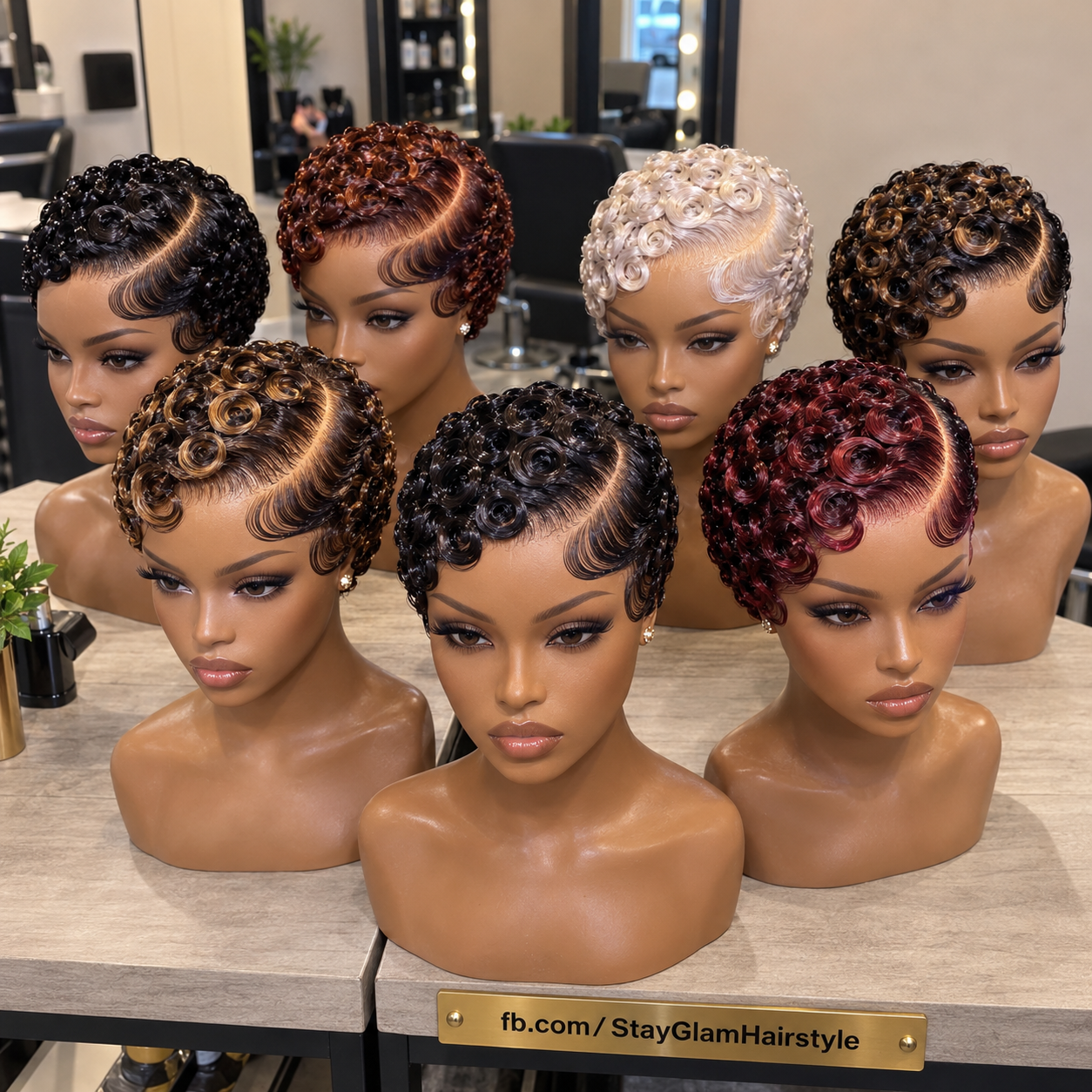
A carefully arranged ring curl pixie can make a compact hairstyle look remarkably detailed, and this collection shows exactly why. The wigs share a close, rounded silhouette built from glossy circular curls, pronounced diagonal side parts and sculpted finger-wave sections around the forehead and temples. Rather than relying on length for visual impact, each piece uses curl placement, parting direction and color contrast to create its identity. The collection includes deep natural black, espresso brown, caramel-accented brown, copper auburn, burgundy wine and pale pearl blonde variations, giving buyers several ways to interpret the same salon-inspired structure.
One of the strongest aspects of this design is the balance between the compact crown and the sweeping front section. The ring curls sit densely across the upper portion of the wig, while the side part creates an open visual path that separates those curls from the larger curved waves. This makes the hairstyle easy to recognize from the front, three-quarter view and side profile. For wig businesses and stylists, that consistency is useful because customers can select a preferred color while retaining the signature shape.
A Diagonal Part Gives The Pixie Its Signature Direction
The visible diagonal side part is the structural center of this hairstyle. It begins near the front hairline and travels backward, dividing the crown into two visually different areas. On the fuller side, tightly arranged ring curls create height and dimension. On the opposite side, the strands are directed into sweeping curves that lie closer to the head.


This contrast matters. Without the exposed part, the curls could appear like one continuous rounded cluster. The diagonal line gives the eye a clear starting point and makes the arrangement look intentional. It also provides room for the larger finger-wave sections to remain visible instead of disappearing underneath the crown curls.
When ordering a similar wig, the placement of this part should be discussed before styling begins. A stylist can position it closer to the temple for a stronger asymmetrical appearance or move it slightly inward for a more balanced crown. Showing a photograph is far more useful than simply requesting a “side part,” because the angle and depth of the part strongly influence the final silhouette.
Compact Ring Curls Build A Rounded Crown Without Excess Height
The upper portion of each wig is filled with circular curls that resemble polished rings. These curls are arranged close together, creating a dense surface while still allowing individual loops to remain visible. The crown has enough lift to display the curl formation clearly, but it does not rise excessively high above the head.
This proportion is especially important for a pixie silhouette. Too much height can turn the style into a taller curly cut, while insufficient volume can make the rings appear flattened. The wigs pictured sit between those extremes. Their crowns remain compact while maintaining enough dimension for the circular curl pattern to become the main visual attraction.
For a custom order, discuss curl diameter as well as density. Medium-small rings provide the closest visual relationship to the reference. Larger curls would create a more open pattern, while very tiny curls could make the crown appear considerably denser.
Sculpted Temple Waves Add A Second Layer Of Detail
The curls receive most of the initial attention, but the sweeping temple sections are equally important. Hair extending from the diagonal part is arranged into broad curved waves that travel toward the forehead and side of the face. Smaller curved pieces around the temple connect these larger waves to the rest of the hairstyle.
The contrast between circular curls and elongated waves creates visual movement. Instead of repeating the same curl shape everywhere, the wig transitions from compact loops at the crown into longer sculpted curves near the front. That transition gives the style its salon-crafted appearance.
If you are commissioning a custom unit, specifically mention that you want broad finger-wave styling around the part and temple. A generic curly pixie request may produce curls across the entire head without the directional front work seen here.
Deep Natural Black Keeps The Focus On Curl Architecture
The deepest color option creates a rich foundation for the ring pattern. Under salon lighting, reflections travel across each circular curl and reveal the separation between neighboring loops. Because the shade is dark, the hairstyle initially appears unified, but closer viewing reveals the detailed arrangement of the crown.
This variation is suitable for customers who prefer a classic deep shade while still wanting an intricate hairstyle. The diagonal part becomes especially useful here because it provides contrast against the dark hair and prevents the overall design from appearing visually heavy.
When discussing the color with a seller, ask whether the available shade is natural black, soft black, espresso-black or very dark brown. Those colors can appear similar in photographs but show noticeably different undertones in daylight.
Espresso And Caramel Accents Increase Curl Separation
The brown-highlighted versions bring additional depth to the same ring-curl structure. Dark espresso areas provide the base, while caramel and golden-brown accents appear through selected curls. Because the lighter strands follow the circular direction of the rings, the highlighting helps reveal their shape.
This placement is more effective for this hairstyle than a completely uniform light color when the goal is to emphasize individual loops. Each highlighted section catches the light at a different point around the curl, creating alternating bright and dark areas throughout the crown.
Customers ordering a similar combination should specify how much contrast they want. Subtle caramel accents produce a deeper overall appearance, while stronger golden sections make the curl pattern much more noticeable. A stylist can also concentrate highlights near the upper crown rather than distributing them equally throughout the wig.
Copper Auburn Adds Warmth To The Ring Curl Formation
The copper-auburn pieces introduce a warm color family without changing the basic construction. Copper reflections become particularly noticeable around the raised portions of the ring curls, while deeper brown undertones remain visible between them. This gives the crown a layered appearance under direct light.
The same color also changes the appearance of the front waves. On a darker wig, the wave pattern is primarily revealed by reflected shine and the visible part. Copper strands make the directional movement easier to see because individual sections catch warmer highlights as they curve toward the temple.
For custom coloring, discuss whether you want a brown-based copper, cinnamon copper, auburn or brighter orange-copper result. The reference sits within a rich warm family rather than appearing neon or extremely bright.
Burgundy Wine Creates Rich Red Depth Around The Crown
The burgundy variation offers a deeper red alternative. Instead of a bright primary red, the color carries wine and cherry undertones. Darker areas remain visible beneath the curls, allowing the circular pattern to retain depth.
Under bright salon lighting, burgundy can reveal several tones at once. Raised curls may appear brighter and more cherry-red, while recessed sections remain closer to deep wine. This natural variation in reflected light helps prevent the crown from looking like a single flat block of color.
If you are ordering burgundy, request a color reference from the seller whenever possible. Burgundy, cherry, wine, plum and red-brown are often used loosely in wig listings, yet they can look very different when the finished unit arrives.
Pearl Blonde Turns The Curl Pattern Into The Main Attraction
The pale pearl-blonde variation produces the strongest visual contrast within the collection. Because the strands are so light, each individual curl becomes immediately noticeable. The diagonal part is also highly visible, and the broad front wave stands out clearly against the surrounding rings.
This lighter option demonstrates how much color can change the perception of the exact same hairstyle. Where deep black creates a rich unified silhouette, pearl blonde exposes almost every curve and overlap. Buyers who want the styling work itself to attract attention may prefer this type of lighter shade.
Before ordering, determine whether you want pearl blonde, creamy platinum, icy blonde or silver-blonde. These neighboring shades can create different undertones against the skin, so requesting an actual color sample is useful.
The Front Hairline Should Be Planned With The Parting Pattern
A successful recreation requires the front sections and diagonal part to work together. The hairline should not be treated as an isolated detail after the crown has already been completed. The broad wave begins near the part and travels toward the forehead, so its placement affects the entire front presentation.
Ask the stylist to map the part and front wave before setting every crown curl. This allows enough space for the larger curved section and helps prevent nearby ring curls from covering it. Smaller temple curls can then be positioned to connect the front section with the side of the wig.
The goal is visual continuity. The part should lead naturally into the wave, and the wave should transition into the surrounding curls without appearing disconnected.
What To Tell A Wig Stylist Before Placing Your Order
A detailed consultation can prevent many misunderstandings. Begin by sending clear photographs of the hairstyle from the front and three-quarter angles. Explain that you want a compact pixie silhouette with polished circular ring curls rather than loose spirals or fluffy curls.
Next, point out the diagonal side part and the sweeping finger-wave section. Specify whether you want the part on the left or right side, since photographs may be mirrored when posted online. Discuss crown density, curl diameter and the amount of lift you want at the top.
Color should be treated as a separate decision. If choosing a highlighted brown version, indicate whether you prefer subtle caramel ribbons or stronger golden accents. For burgundy, copper or pearl blonde, provide a visual reference rather than relying only on a color name.
Confirm The Wig Construction Instead Of Guessing From Photos
The photographs clearly show the finished hairstyle, ring curls, visible side part, color choices and sculpted front waves. They do not provide enough evidence to confirm every technical specification of the units. The exact lace grade, fiber composition, hair origin, cap dimensions and attachment method should therefore be verified with the seller.
Before paying, ask whether the unit includes adjustable straps, internal combs or other securing options. Request the available cap sizes and follow the seller’s measurement instructions. If a specific lace type is important to you, ask for that specification directly rather than assuming it from the appearance of the finished hairstyle.
Human Hair And Synthetic Options Require Different Planning
Human hair may be useful for customers who expect professional restyling or want greater flexibility over time. Depending on the quality and previous processing of the hair, a stylist may be able to refresh the ring curls, alter their direction or perform certain color services. However, the exact possibilities should always be confirmed before applying heat or chemicals.
A quality synthetic unit can be attractive when preserving a preset curl pattern is the priority. Synthetic fibers may retain sculpted rings well, but heat tolerance varies considerably between products. Some fibers are heat-friendly while others can be permanently damaged by high temperatures.
Ask the seller what material is used and request specific care instructions. The value of this hairstyle comes from its carefully arranged curls, so maintenance should protect that structure rather than repeatedly rebuilding it.
Price Guide For A Custom Ring Curl Pixie Wig
Actual pricing depends on hair material, cap construction, coloring, stylist labor and local market rates. The ranges below are general budgeting estimates and should not be interpreted as prices for the exact wigs pictured.
| Category | Estimated Price Range | Details To Confirm |
|---|---|---|
| Premium Custom | $350–$750+ | Custom measurements, premium hair, color work, ring setting, part placement and fitting |
| Standard Custom | $220–$450 | Cap size, available colors, crown density, curl formation and styling service |
| Basic Human Hair | $140–$300 | Hair quality, processing history, included customization and final styling |
| Premium Synthetic | $80–$180 | Fiber type, heat tolerance, preset curl retention and adjustment options |
| Basic Synthetic | $45–$100 | Available shades, cap sizing, preset shape and recommended maintenance |
Ordering Steps For A Similar Salon-Inspired Wig
- Select the color variation that best represents the result you want.
- Send the seller clear photographs showing the crown, part and front wave placement.
- Request compact circular ring curls across the upper section.
- Specify the direction and position of the diagonal side part.
- Request broad finger-wave styling beside the part and around the temple.
- Confirm the desired crown height and overall density.
- Provide accurate head measurements according to the seller’s guide.
- Ask whether the wig is human hair, synthetic or another fiber.
- Confirm cap construction, lace specification and internal adjustment options.
- Ask whether the unit will arrive fully styled.
- Request the complete price including coloring, customization, styling and shipping.
- Ask for maintenance instructions before using styling products or heat.
Keeping The Ring Curls In Shape Between Wears
Storage is particularly important for this type of pixie because the curl arrangement can be disturbed if the crown is compressed. Place the wig on an appropriate mannequin head or wig stand when it is not being worn. Avoid storing it underneath clothing, boxes or other wigs.
Do not aggressively brush through the ring curls. Conventional brushing can separate the loops and change the carefully arranged crown. If a curl begins to lose its shape, follow the stylist’s recommended refreshing method based on the actual material used in the wig.
Product buildup can also affect tightly arranged curls. Heavy oils and excessive styling products may collect between the rings and reduce their movement. Use lightweight products recommended for the specific hair or fiber and apply only the amount required.
Salon Fitting Can Personalize A Finished Unit
A professionally styled wig may still benefit from a fitting appointment. The stylist can check the cap position, adjust the front placement and determine whether any curls need repositioning for the wearer’s head shape. This is especially useful with a directional style because even a small change in placement can alter how the side part and front wave sit around the face.
When booking, send the salon photographs of the wig before your appointment. Explain that you want to preserve the compact ring-curl crown and sculpted side section. If trimming or heat styling is required, confirm that the wig material can safely tolerate the planned service.
Search Terms
Ring Curl Pixie Wig · Side Part Curly Pixie Wig · Finger Wave Pixie Wig · Pearl Blonde Ring Curl Wig · Burgundy Wine Pixie Wig · Caramel Brown Curl Wig · Copper Auburn Ring Curl Wig · Sculpted Temple Wave Wig
Choosing Between Deep, Warm And Pale Color Families
The deep shades place the greatest emphasis on shine and silhouette. Natural black and espresso variations create a rich appearance where the ring formation becomes visible through reflected light. They are useful for buyers who want an intricate hairstyle without introducing a strong contrasting color.
Warm brown, caramel and copper variations emphasize individual curls more clearly. Highlighted strands trace the circular direction of each ring, making the crown appear especially dimensional. These colors can also make the sweeping side section more noticeable because the light follows the direction of the strands.
Burgundy creates a deeper statement with wine-red reflections, while pearl blonde produces the strongest separation between individual curls. There is no need to alter the underlying haircut to achieve a substantially different appearance; changing the color alone can shift which parts of the design receive the most attention.
Building A Precise Custom Order From This Reference
Start with the structure rather than the color. Tell the stylist that the foundation should be a compact pixie with a rounded ring-curl crown, a pronounced diagonal side part and sweeping front waves. Confirm the size and spacing of the rings and explain that individual circular openings should remain visible across the crown.
Once the structure is agreed upon, select the color. Decide whether you want a deep natural shade, highlighted espresso and caramel combination, warm copper, burgundy wine or pale pearl blonde. If multiple colors are involved, specify where the lighter tones should appear rather than leaving placement entirely undefined.
Then confirm all technical details directly with the seller: material, cap size, lace type, attachment system, adjustment options, processing time and maintenance requirements. These specifications cannot be reliably determined from a finished hairstyle photograph.
Finally, ask for confirmation of the complete order before production begins. A written summary containing the selected color, curl size, part direction, crown density and front-wave placement gives both the customer and stylist a clear reference. With those details established, this polished ring curl pixie can be recreated as a highly distinctive wig that combines compact proportions, glossy circular curls and sculpted side movement in one cohesive salon-ready design.