
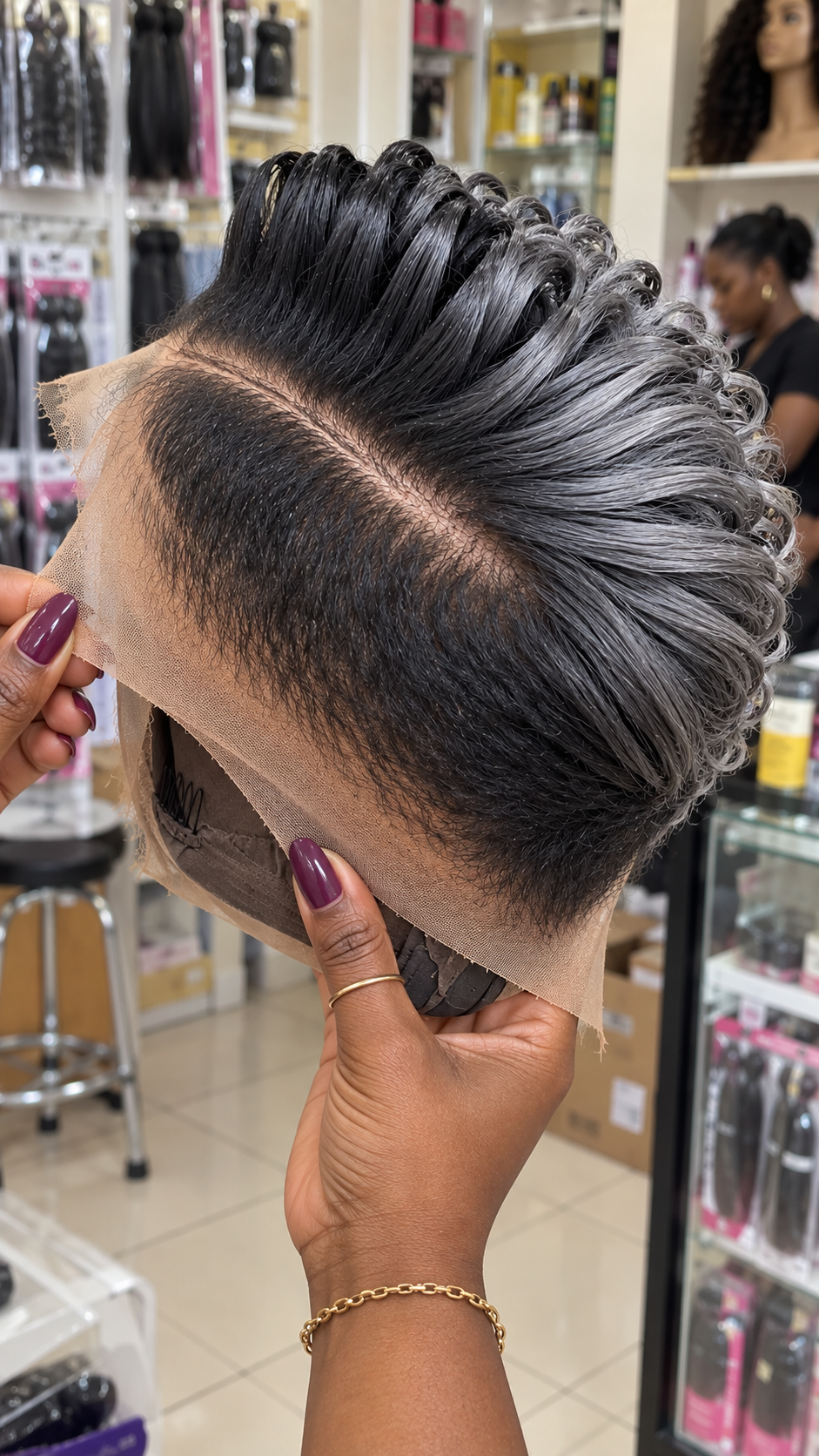
Smoky silver becomes far more striking when it is used as part of a controlled color transition rather than covering an entire wig in one flat shade. This pixie wig combines a dark natural-looking foundation with sweeping silver sections that become progressively lighter toward the outer lengths. The contrast is especially visible across the raised crown, where broad curved sections travel backward from a deep side part and create a layered, dimensional profile.
The photograph is also useful because the wig is shown before installation. The lace extends beyond the perimeter, the interior cap is partially visible, and the close side area can be examined without the distraction of a finished salon installation. Buyers interested in ordering a similar unit can therefore use this reference not only for the hairstyle but also for explaining the desired color placement, parting direction, crown structure and side proportions to a wig maker.
This is not a conventional loose-curly pixie. Its identity comes from broad sculpted sweeps that rise from the darker base and curve toward the crown. Some sections form open loops near the upper area while others lie in longer ribbon-like bends. The smoky silver placement follows these curves, making every raised section more visible against the dark foundation.
The Dark-to-Silver Transition Creates the Main Visual Contrast
The most noticeable detail is the gradual movement from a very dark base into smoky gray and silver. The roots and lower side remain dark, while the raised sections introduce increasingly visible silver tones. Because the lighter color follows the direction of the hair instead of appearing as random patches, the transition emphasizes the architecture of the hairstyle.
At the front and upper crown, several strands show a stronger silver presence. Toward the deeper sections, dark hair remains visible between the lighter ribbons. This prevents the style from becoming uniformly gray and gives the crown much greater depth. Under salon lighting, the silver areas reflect more strongly while the dark base creates natural shadow between individual sections.
When ordering this color combination, it is better to send the reference photograph than to rely only on a color name. Terms such as silver, ash gray, smoky gray, platinum and salt-and-pepper can describe very different results between suppliers. Ask for a dark foundation with concentrated smoky silver through the raised sweep sections rather than an all-over gray color.
Broad Sweep Curls Shape the Crown Without Excessive Length
The upper hair has been arranged into broad curved sections rather than small uniform curls. These sections rise from the parting area, bend backward and gradually form open loops toward the crown. The construction creates height without requiring long hair.
The front sweeps are elongated and directional. Farther back, the curves become more compact and begin to form tighter loop shapes. This change in size gives the wig a balanced profile. The front carries movement while the back maintains the rounded pixie silhouette.
A stylist recreating this look should pay close attention to the direction of each section. Curling all of the hair in identical circles would not produce the same result. The visible pattern depends on controlled placement, with the strands moving away from the side part before bending toward the rear.
For customers who want the reference reproduced closely, it is worth asking whether the wig maker will style the crown before shipping. A unit supplied only with loose curls would require additional professional work to achieve the same sculpted arrangement.
The Deep Side Part Separates Two Very Different Hair Zones
A prominent diagonal part is one of the strongest structural elements in the photograph. It separates the elevated silver-and-dark sweep section from a much closer dark side area. This difference in height makes the crown appear fuller and more dramatic without requiring excessive density.
The part travels diagonally toward the rear rather than running straight backward. That angle directs the eye through the hairstyle and creates an asymmetrical appearance. The hair immediately above the part rises sharply into the first broad sweep, while the area below remains close to the base.
This detail should be included when requesting a custom recreation. If the part is positioned too close to the center, the hairstyle can lose its strong side profile. If it is placed too low, there may not be enough visible close-cut area to create the contrast shown in the reference.
What the Visible Lace Reveals Before Installation
The lace around the perimeter is clearly visible because the unit has not yet been fitted to a wearer. Excess material extends beyond the hairline and is being held away from the cap. This allows a stylist to position the unit first and trim the perimeter according to the wearer’s hairline during installation.
The photograph does not provide enough information to identify a specific commercial lace grade, so buyers should confirm the lace material directly with the seller. Ask about lace color, coverage area, cap measurements and whether the unit is intended for adhesive installation, adjustable wear or another attachment method.
The interior cap can also be seen beneath the wig. That makes this image particularly useful when discussing a custom order because the buyer can clearly communicate that the desired result is a constructed wig rather than simply requesting a similar haircut.
Anyone unfamiliar with trimming lace should consider booking a wig stylist for the initial fitting. Removing too much material from the perimeter is difficult to reverse, while leaving the correct amount allows the installer to customize the fit more carefully.
The Close Side Area Makes the Silver Crown Look Taller
Although the smoky silver color attracts immediate attention, the dark side section is equally important to the overall design. It remains close to the base and follows the shape of the head, providing a visual foundation beneath the elevated crown.
This contrast between low and high areas is what gives the hairstyle its distinctive profile. Without the close side section, the broad upper sweeps could make the wig appear uniformly bulky. Keeping the lower area compact allows the crown to become the focal point.
The side also remains predominantly dark, which connects visually with the darker roots above. That continuity prevents the silver from overwhelming the entire unit and makes the lighter sections appear more intentional.
Search Terms
Smoky Silver Pixie Wig · Black and Silver Sweep Curl Wig · Silver Gradient Pixie Wig · Deep Side Part Lace Pixie Wig · Dark Root Silver Curl Wig · Sculpted Sweep Curl Wig · Smoky Gray Pixie Lace Wig · Silver Loop Curl Pixie Wig
Ordering This Wig From a Custom Wig Maker
Start by sending the reference image to a wig maker who has experience with sculpted pixie units. Explain that the most important details are the dark foundation, smoky silver transition, broad directional sweeps, deep diagonal part and compact side profile. These characteristics should be agreed upon before production begins.
Ask whether the maker can reproduce the color placement rather than simply supplying a generic silver wig. The lighter strands in this design are concentrated through specific sections of the crown, so random silver highlights may not create the same effect.
Next, provide accurate head measurements using the seller’s own measurement instructions. Wig makers may request circumference, front-to-nape length, ear-to-ear distance and other measurements depending on the cap construction they use.
Confirm whether the wig will arrive fully styled. A pre-shaped crown is valuable for this design because the broad sweeps require controlled placement. If the wig is shipped already styled, ask how the crown will be protected during delivery so the loops are not flattened inside the packaging.
Human Hair and Synthetic Options for a Sculpted Silver Design
A human-hair version may be preferable for customers who expect to refresh the sweeps professionally, adjust individual sections or modify the style later. Human hair generally gives an experienced stylist more flexibility with controlled heat and reshaping. Color-treated silver sections, however, can require careful maintenance to preserve their tone and appearance.
A premium synthetic version can be practical when the primary goal is retaining the original sculpted shape. High-quality synthetic fibers may hold pre-formed curves with less frequent restyling. Buyers should still confirm whether the specific fiber is heat resistant before using any heated styling tool.
Neither material automatically guarantees a better wig. Cap construction, fiber or hair quality, density, color work and the skill of the person forming the crown all contribute to the finished result. Compare actual examples from the wig maker rather than making the decision based only on the material label.
Premium Custom / Standard Custom / Basic Human Hair / Premium Synthetic / Basic Synthetic
| Wig Category | Estimated Price Range | Typical Service Level |
|---|---|---|
| Premium Custom | $320–$550+ | Custom measurements, detailed smoky silver coloring, advanced crown shaping, personalized part placement and professional finishing |
| Standard Custom | $200–$320 | Customized dark-to-silver color placement, styled sweep curls and selected cap sizing |
| Basic Human Hair | $130–$220 | Human-hair base that may need additional coloring, cutting and professional sculpting |
| Premium Synthetic | $85–$160 | Higher-grade fiber with pre-shaped crown sections and stronger style retention |
| Basic Synthetic | $45–$90 | Lower-cost construction with fewer customization options and simpler styling |
These are general shopping estimates rather than the confirmed selling price of the wig in the photograph. Actual pricing can vary according to hair material, cap construction, coloring process, lace coverage, customization, stylist labor, location and shipping. Request a complete written quote before ordering.
Preparing for the First Salon Fitting
When the wig arrives, inspect the crown before removing packaging or altering the lace. Compare the silver distribution, sweep direction, side part and overall proportions with the reference photographs used for the order. If the unit was custom made, documenting its condition immediately after delivery can also be useful if adjustments need to be discussed with the seller.
For installation, take both the wig and the original reference image to the appointment. The stylist should understand where the deep part is intended to sit and how the close side area should align with the wearer’s temple.
The excess lace can then be fitted before trimming. Correct placement should come first because cutting the lace while the wig is sitting too far forward or too far to one side can affect the final alignment.
Ask the stylist to preserve the existing crown structure whenever possible. If shipping has displaced only a few sections, those areas can often be refreshed individually instead of rebuilding every sweep.
Keeping Smoky Silver From Losing Its Visual Separation
The dark and silver strands are most effective when their contrast remains visible. Heavy products can cause adjacent sections to stick together and make the gradient appear less dimensional. Use lightweight products recommended for the specific hair or fiber type.
Silver and gray shades can also be sensitive to product residue and environmental discoloration. Human-hair units should be maintained with products suitable for color-treated hair, following the wig maker’s instructions. Avoid experimenting with strong toners or color treatments unless the fiber or hair type is known.
For synthetic units, use products specifically intended for synthetic wigs. Traditional hair products may leave unwanted buildup, and heat should only be applied when the manufacturer confirms that the fiber is designed for it.
Protecting the Raised Sweep Pattern Between Wears
Storage matters more with a sculpted crown than it does with many loose hairstyles. Place the wig on a stand that supports the cap without stretching it. Make sure the upper sweeps have enough space and are not pressed against a wall, shelf or storage container.
Avoid brushing through the crown as if it were ordinary loose hair. Broad sweeps and loops can lose their intended direction when repeatedly combed. If a section separates, work with that individual section rather than disturbing the entire crown.
When traveling, use packaging with enough internal room to prevent compression. A carefully styled pixie can lose much of its visual character if the raised sections are flattened for long periods.
How to Request the Silver Placement More Precisely
Instead of asking for a simple black-and-silver wig, describe the placement in zones. Request a dark root and lower side foundation, smoky gray through the transitional areas and brighter silver concentrated through selected raised sections. Mention that the silver should follow the sweep direction rather than appearing as scattered highlights.
You can also ask the colorist to keep enough dark hair between lighter sections to preserve contrast. This is particularly important around the front and crown, where individual silver ribbons need darker surroundings to remain visible.
Before production is completed, request photographs under ordinary salon lighting if the maker provides progress updates. Silver can look dramatically different under warm bulbs, daylight and flash photography. Seeing the actual unit before shipping can help confirm whether the tonal balance is close to the requested reference.
Details to Confirm Before Paying a Deposit
Ask whether the quoted price includes the smoky silver coloring and final crown styling. Confirm the cap size, lace coverage, processing time and whether the unit shown in promotional photographs is the actual product or only a styling reference.
If the wig is being recreated, ask whether the seller can reproduce the deep side part and directional sweep placement. Also confirm whether the lace will arrive uncut and whether any adjustable components are included inside the cap.
Customers ordering for a specific occasion should distinguish production time from shipping time. Custom coloring and sculpting may take additional time before the package is handed to the courier. Leave enough time for delivery and a professional fitting before the date the wig is needed.
From Reference Photo to Finished Installation
- Send the reference photograph to a wig maker experienced with sculpted pixie units.
- Specify the dark foundation and smoky silver gradient through the raised crown.
- Request the deep diagonal side part and broad backward-moving sweep pattern.
- Provide accurate head measurements using the seller’s measurement guide.
- Confirm hair material, lace coverage, cap construction and final styling service.
- Request a complete quote covering coloring, customization, styling and shipping.
- Ask for photographs of the completed unit before dispatch when available.
- Book an experienced wig stylist for fitting and lace customization.
- Store the wig upright with enough room around the crown after each wear.
What Makes This Smoky Silver Pixie Stand Apart
The appeal of this design comes from the relationship between color and structure. The silver is not simply added for brightness. It follows the direction of the raised sweeps and makes their curves easier to see. The dark foundation provides the necessary contrast, while the deep side part separates the elevated crown from the compact lower section.
That combination gives the wig a recognizable silhouette from several angles. From the side, the close dark base emphasizes crown height. From above, the diagonal part establishes direction. From the front, the lighter sweep sections can frame the upper hairline without turning the entire wig silver.
For buyers trying to reproduce this look, the safest approach is to treat the photograph as a complete design reference rather than selecting individual details separately. Matching only the silver color will not recreate the structure, and matching only the sweep curls will not reproduce the dramatic tonal contrast.
Work with a wig maker or salon capable of handling color placement and sculpted pixie styling together. Confirm the specifications before production, arrange a careful first fitting and maintain the crown section by section. With those details preserved, the finished unit can retain the same dark-to-smoky-silver movement, deep side separation and elevated sweep pattern that give this wig its distinctive appearance.