
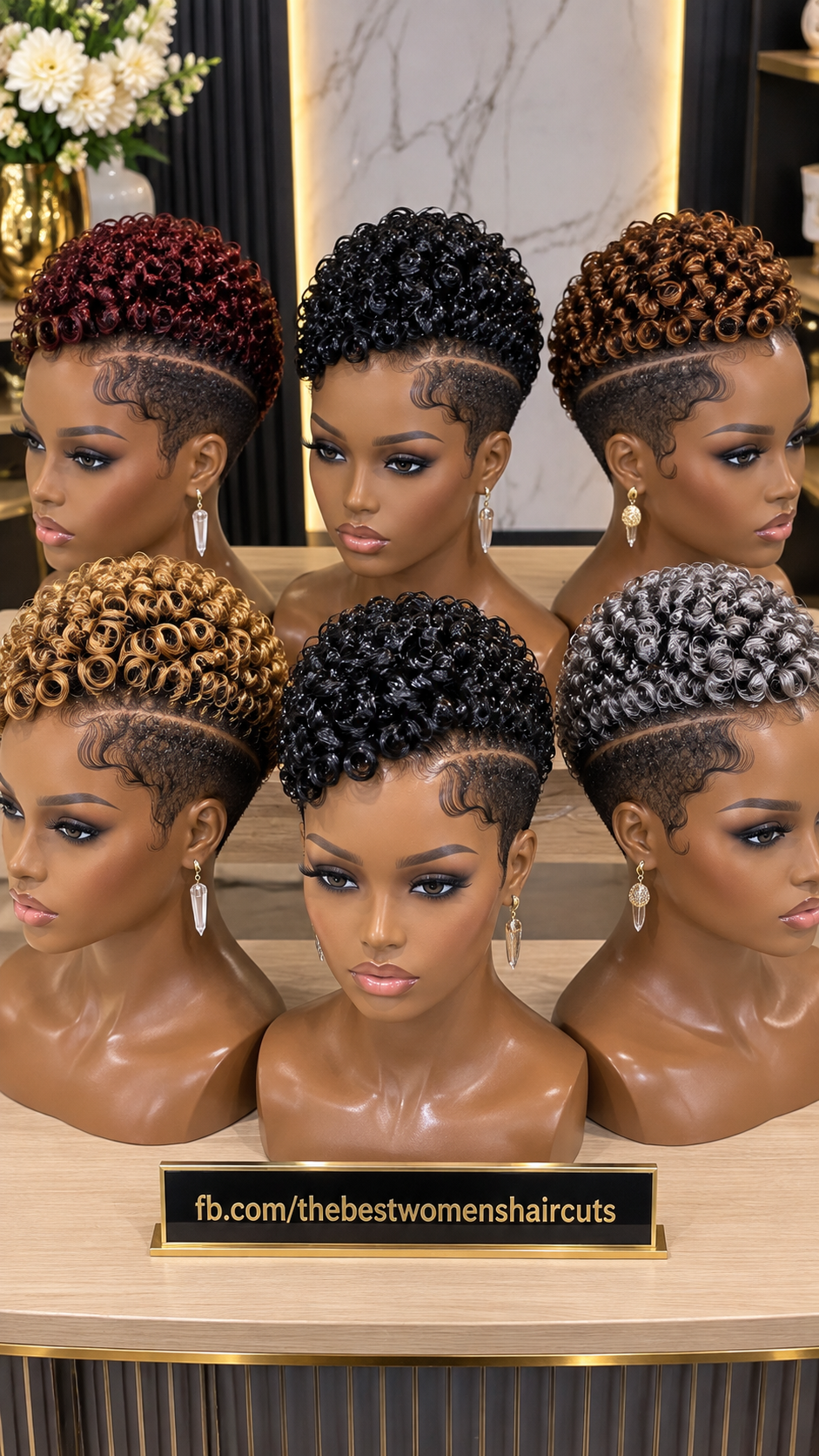
This reference centers on a dense dome of glossy pin curls, balanced by a long sweeping diagonal part above a close tapered side. The overall silhouette stays compact and close to the head, but the upper section still has enough height for every curl to read separately. What gives the style its identity is not simply the curl pattern; it is the controlled relationship between the rounded crown, the exposed side work and a softly sculpted temple edge.
The Crown Is Built Around Small Circular Curls
The top is arranged as a concentrated field of small curls rather than loose waves. Their openings remain visible, which creates a dimensional surface even though the hair is predominantly black. Strong reflected highlights run along individual strands and make the curl pattern readable from a distance.
For a recreation, ask the stylist to preserve the compact proportions. Increasing the curl diameter too much would change the silhouette, while flattening the set would remove the rounded crown seen in the reference. The goal is a dense but clearly separated curl arrangement.
The Side Detail Changes the Entire Profile
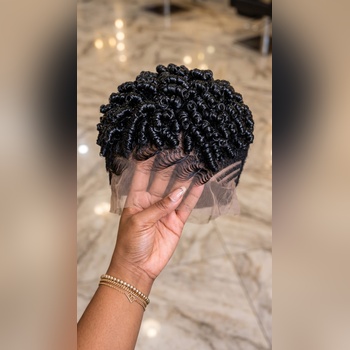
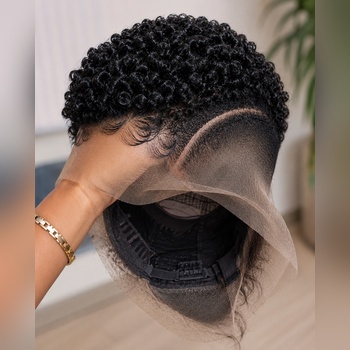
The defining side element is a long sweeping diagonal part above a close tapered side. This is precision work, so the placement should be discussed before cutting or customizing. The surrounding area is tapered closely enough to create contrast, while the upper curl section remains visibly heavier.
The transition is finished with a softly sculpted temple edge. This softer detail prevents the side from looking disconnected from the crown and gives the hairline a deliberately sculpted appearance.
What to Tell a Stylist Before the Appointment
Bring the reference image and describe the crown, side pattern and frontal work as separate requirements. Ask for a dense dome of glossy pin curls, a long sweeping diagonal part above a close tapered side, and a softly sculpted temple edge. Showing the photograph is particularly important because terms such as “pixie curls” can describe many very different shapes.
A stylist who regularly works with pixie cuts, molded curls and precision side designs is the most appropriate choice. If this look is being recreated as a wig rather than directly on natural hair, use a wig stylist who can preserve the same close tapered illusion and controlled perimeter.
Turning the Look Into a Custom Wig Order
When ordering a comparable wig, begin with cap size and preferred hair material. Then specify the compact crown, curl scale, side pattern and exact direction of the part or line work. Ask whether the side detailing is permanently incorporated into the unit or must be refined after delivery.
Request photographs from several angles before shipping whenever the seller offers approval images. A front photograph alone is not enough for this style. The side view confirms the line placement, and a top view confirms whether the crown has the required density and circular curl pattern.
Color and Finish Without Overcomplicating the Look
The dark color is important because it keeps attention on shine, curl geometry and the contrast created by the exposed side. A natural black or raven-black description is more useful here than adding unnecessary color claims. If ordering online, ask for an unfiltered daylight image when color accuracy matters.
The photographed curls have a high-gloss finish, but the strands remain individually visible. A heavy coating can make the curls merge together, so the desired result is reflective rather than greasy or stiff.
Price Guide for a Similar Custom Piece
| Option | Typical Range | What to Expect |
|---|---|---|
| Premium Custom | $450–$900+ | High-grade human hair, detailed hand setting, precision side work and customized fit |
| Standard Custom | $275–$500 | Human hair with professional curl setting and personalized finishing |
| Basic Human Hair | $150–$300 | Human-hair base that may require additional cutting and styling |
| Premium Synthetic | $90–$190 | Higher-grade fiber with a structured pre-set curl pattern |
| Basic Synthetic | $45–$105 | Entry-level construction with simpler customization |
These ranges are general planning figures rather than quoted prices. Hair material, cap construction, hand setting, location and the amount of precision work can change the final cost.
Booking, Consultation and Approval Steps
For salon work, book a consultation before the main appointment if the stylist has not created this pattern for you before. Show the side profile and ask whether the curl setting and line work can be completed in one appointment. For a custom wig, send the reference before paying the final balance and request written confirmation of the important details.
A useful approval checklist includes crown shape, curl size, side-line count, direction of the line work, perimeter styling and overall density. Correcting one of these details before shipment is much easier than rebuilding the finished style afterward.
Keeping the Curl Pattern Crisp
Avoid brushing through the crown. Individual curls should be lifted and reshaped with the fingers so their circular openings remain intact. Use lightweight compatible product sparingly and protect the style from compression while sleeping or storing the unit.
If this is recreated on natural hair, follow the stylist’s recommendations for protecting the molded sections and tapered sides between appointments. The side pattern will lose sharpness as hair grows, so maintenance timing depends on how crisp you want the lines to remain.
Search Terms
natural black pin curl pixie · sweeping diagonal side part · tapered undercut curls · glossy circular pin curls · sculpted temple edge · close cropped side panel · curved side part hairstyle · black pin curl crown