
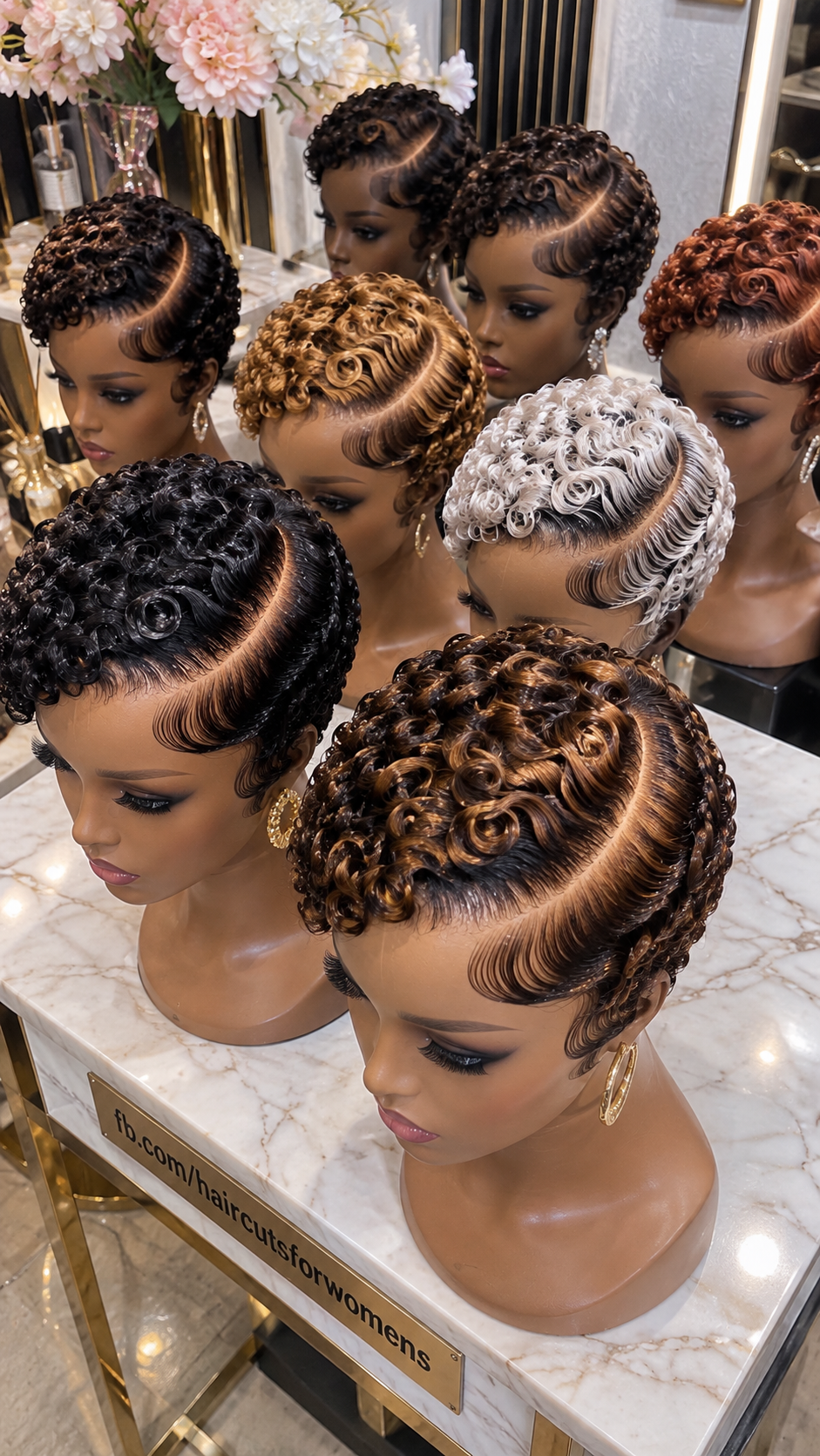
This seven-piece wig collection focuses on one highly recognizable construction: compact glossy ringlets concentrated through the crown, a pronounced curved side part and long sculpted finger-wave panels sweeping toward the temple. The display includes jet black, deep espresso, warm honey brown, copper auburn and icy silver variations, allowing the same basic structure to be viewed across both dark and light color families.
Unlike pixie wigs where curls are distributed evenly around the entire head, these units use the parting as an important architectural element. Dense circular curls occupy one side of the crown, while the opposite section is arranged into flatter, elongated waves. That contrast between ringlets and polished directional strands gives the collection its distinctive appearance.
The Curved Side Part Controls the Entire Layout
Each wig contains a clearly exposed part that begins toward the frontal area and travels diagonally backward through the crown. The line is slightly curved rather than perfectly straight, allowing it to follow the rounded contour of the head.
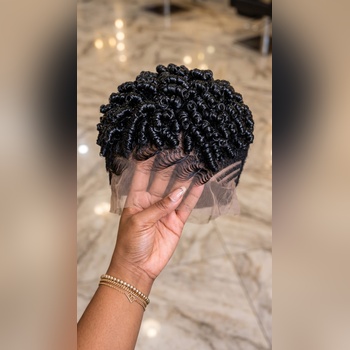
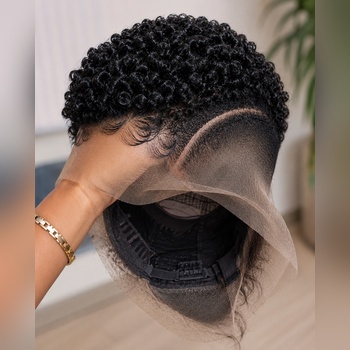
The hair on either side is styled differently. One side carries the dense ringlet formation, while the other immediately transitions into sleek strands that are molded away from the part.
When commissioning this style, the placement of the part should be discussed before the curls are formed. Moving it substantially can change the proportion of the ringlet section and the size of the sweeping wave panel.
Dense Circular Ringlets Fill the Main Crown
The curled portion contains many small and medium circular formations arranged close together. Some curls form almost complete rings, while others create tighter spiral shapes that fill the spaces between larger sections.
The crown remains full without becoming excessively tall. Most curls sit relatively close to the foundation, producing a rounded compact silhouette rather than an elevated dome.
For a custom request, describe the texture as densely packed polished ringlets with visible circular openings. Loose curls or long spirals would not reproduce the same structure.
Long Finger-Wave Panels Create a Dramatic Contrast
The flatter section beside the part is one of the strongest details in the collection. Numerous fine strands are arranged in parallel and swept into elongated curved panels that travel toward the temple.
These sections resemble sculpted finger waves rather than ordinary baby hairs. They occupy a substantial portion of the visible side and contain enough length to create broad feather-like curves.
The difference between these flattened strands and the raised ringlets gives the hairstyle much of its visual depth.
The Front Waves Follow a Layered Direction
Instead of using one single sweep, several curved sections sit beneath one another. Each follows a similar direction while remaining individually visible.
This layered arrangement creates a flowing transition from the exposed part to the temple. Fine strand separation is important because it allows the curves to remain readable rather than becoming one solid molded section.
A stylist recreating this design should work with the direction of the part first and build the wave sections outward from it.
Jet Black Makes the Sculpting Especially Visible
The black versions emphasize reflection and strand direction. Their circular curls contain deep shadowed centers surrounded by glossy outer surfaces, while the flatter side waves reflect light in long narrow lines.
Because the color is uniform, the eye naturally follows the shape of the hair. This makes jet black particularly effective for showing the difference between the ringlet crown and the sculpted side panel.
A high-gloss black finish works well here, but individual strands should remain visible rather than becoming saturated with styling product.
Espresso Brown Softens the Dark Color Direction
Several wigs read as very deep brown rather than absolute black. Under the display lighting, their ringlets reveal subtle chocolate and espresso reflections.
The deeper brown maintains strong shadow inside each curl while producing a slightly warmer overall appearance. This can be useful for buyers who want a dark wig without the intensity of jet black.
When ordering, provide the reference because dark brown shades can vary significantly between wig suppliers.
Honey Brown Highlights Every Circular Curl
The honey-brown version makes the individual ringlets particularly easy to distinguish. Light catches the raised surfaces and creates golden reflections around the circular formations.
Deeper brown remains visible inside the curls, giving them enough contrast to avoid appearing flat. The sculpted side waves also show strong tonal variation as their parallel strands bend toward the temple.
For a similar custom color, request a warm honey-brown direction with enough deeper tone to preserve definition.
Copper Auburn Brings Rich Warmth to the Same Structure
The copper-toned unit introduces red-brown warmth while retaining the same ringlet-and-wave construction. Raised sections reflect brighter copper, while shadowed areas appear closer to auburn or deep cinnamon.
This variation demonstrates how strongly lighting interacts with the sculpted curls. Every circular section contains several visible tones even though the wig belongs to one warm color family.
A color reference is especially important for copper because going too orange or too dark can significantly change the finished appearance.
Icy Silver Creates the Strongest Strand Visibility
The silver unit offers the clearest view of individual strands. Its pale color makes the circular curl construction, parting and sweeping side panels immediately visible.
Subtle darker areas between the curls provide contrast, while the brightest sections approach an icy pearl-silver appearance.
If ordering a human-hair version in this shade, ask the stylist about the starting hair quality and maintenance requirements associated with extensive lightening.
The Perimeter Remains Compact Around the Ear Area
Despite the detailed crown, the wigs retain close proportions around the lower side. Small curls and shaped strands finish the transition near the ear without creating long hanging sections.
This keeps the silhouette distinctly pixie-like and places visual emphasis on the upper ringlets and sweeping temple work.
During customization, avoid leaving excessive bulk around the perimeter because it can make the hairstyle appear heavier than the references shown here.
The Ringlets Need Variation Rather Than Perfect Uniformity
Although the curls share a common circular character, their diameters vary. Larger ringlets provide focal points while smaller curls fill gaps throughout the crown.
This variation creates a more natural arrangement and prevents the surface from looking like rows of identical coils. The curls should appear coordinated without being mechanically repeated.
When approving a custom unit, examine the crown from above as well as from the front to make sure the density remains balanced.
Gloss Separates the Curls and Finger Waves
The collection has a mirror-like glossy hair surface, silky reflective finish, healthy wet-look shine, individually visible strands and ultra-defined texture. This finish is important because the hairstyle contains two different forms of sculpting within a relatively small area.
The ringlets need reflections around their curved surfaces, while the side waves need long highlights that reveal the direction of their parallel strands.
Lightweight finishing products are preferable for maintenance. Heavy oils can cause neighboring curls or wave strands to merge visually.
How to Describe This Style to a Wig Stylist
Begin with the crown and request compact circular ringlets rather than loose curls. Explain that the curls should remain dense but individually recognizable.
Next, specify a pronounced curved side part. On the open side of that part, request several elongated finger-wave panels sweeping toward the temple with fine parallel strand separation.
Finally, choose the color and show the stylist the corresponding wig in the reference image. Keeping the construction instructions separate from the color request can make the consultation much clearer.
Where to Have a Similar Unit Made
Look for wig stylists and custom wig makers whose portfolios include pixie units, molded curls, finger-wave work and detailed parting. This style requires more precision than simply curling a cropped wig.
A salon experienced with sculpted pixie styling can also customize a suitable human-hair foundation. Send the reference before booking so the stylist can determine whether the existing hair length and density are appropriate.
Ask whether cutting, curl setting, wave molding and final finishing are included in the quoted service.
Buying a Comparable Wig Online
Custom wig boutiques and independent wig makers are useful places to search because this construction is relatively specific. Look for sellers who provide photographs of their units from several angles.
Send the reference and identify the elements you want preserved: compact ringlet crown, curved side part, elongated finger-wave panels and close perimeter.
Confirm whether the product will arrive fully styled or whether the seller is supplying a base unit that still needs professional customization.
Booking and Ordering Steps
Choose your preferred color first, then provide the measurements requested by the wig maker. Specify the side on which you want the exposed curved part and confirm whether the reference should be followed directly or mirrored.
Discuss curl size and density separately from the finger-wave section. If the seller offers different hair materials or cap constructions, request the specifications before completing the order.
For made-to-order work, ask for a clear frontal and side approval photograph before shipment whenever that service is available.
Price Guide for Comparable Custom Units
| Category | Estimated Range | Typical Configuration |
|---|---|---|
| Premium Custom | $475–$950+ | Premium human hair, custom color, hand-set ringlets, sculpted wave panels and precision parting |
| Standard Custom | $275–$525 | Human-hair pixie with customized ringlet crown, curved part and molded side sections |
| Basic Human Hair | $150–$310 | Human-hair foundation requiring additional curl setting and professional side sculpting |
| Premium Synthetic | $90–$195 | Higher-grade fiber with pre-set ringlets and stronger retention of molded shapes |
| Basic Synthetic | $45–$105 | Budget fiber option with simpler curl placement and limited customization |
These prices are broad estimates for comparable work rather than prices for the wigs shown. Hair material, color processing, cap construction, stylist location and the amount of hand sculpting can significantly change the final cost.
What to Inspect Before Approving the Wig
Check that the crown contains clearly separated ringlets rather than an undefined curly surface. The circular openings should remain visible across multiple sections.
Next, inspect the curved part. It should remain crisp and should create enough space for the sculpted side panel to be seen clearly.
Finally, examine the finger-wave sections. Their strands should travel together in controlled curves while retaining visible separation from neighboring waves.
Keeping the Ringlets and Side Waves in Shape
Avoid brushing directly through the crown or sculpted temple area. Both sections depend heavily on deliberate strand placement.
Store the wig upright on a suitable stand and keep other objects from pressing against the curls. If the side waves become disturbed, professional remolding can restore their original direction more accurately than aggressive home brushing.
Keep a copy of the original reference for future maintenance appointments so the stylist can reproduce the intended parting and wave placement.
Search Terms
Curved Side Part Ringlets · Sculpted Finger Wave Panels · Glossy Circular Pixie Curls · Honey Brown Ringlet Crown · Icy Silver Finger Waves · Copper Auburn Ringlets · Jet Black Side Part Curls · Compact Swept Temple Waves