
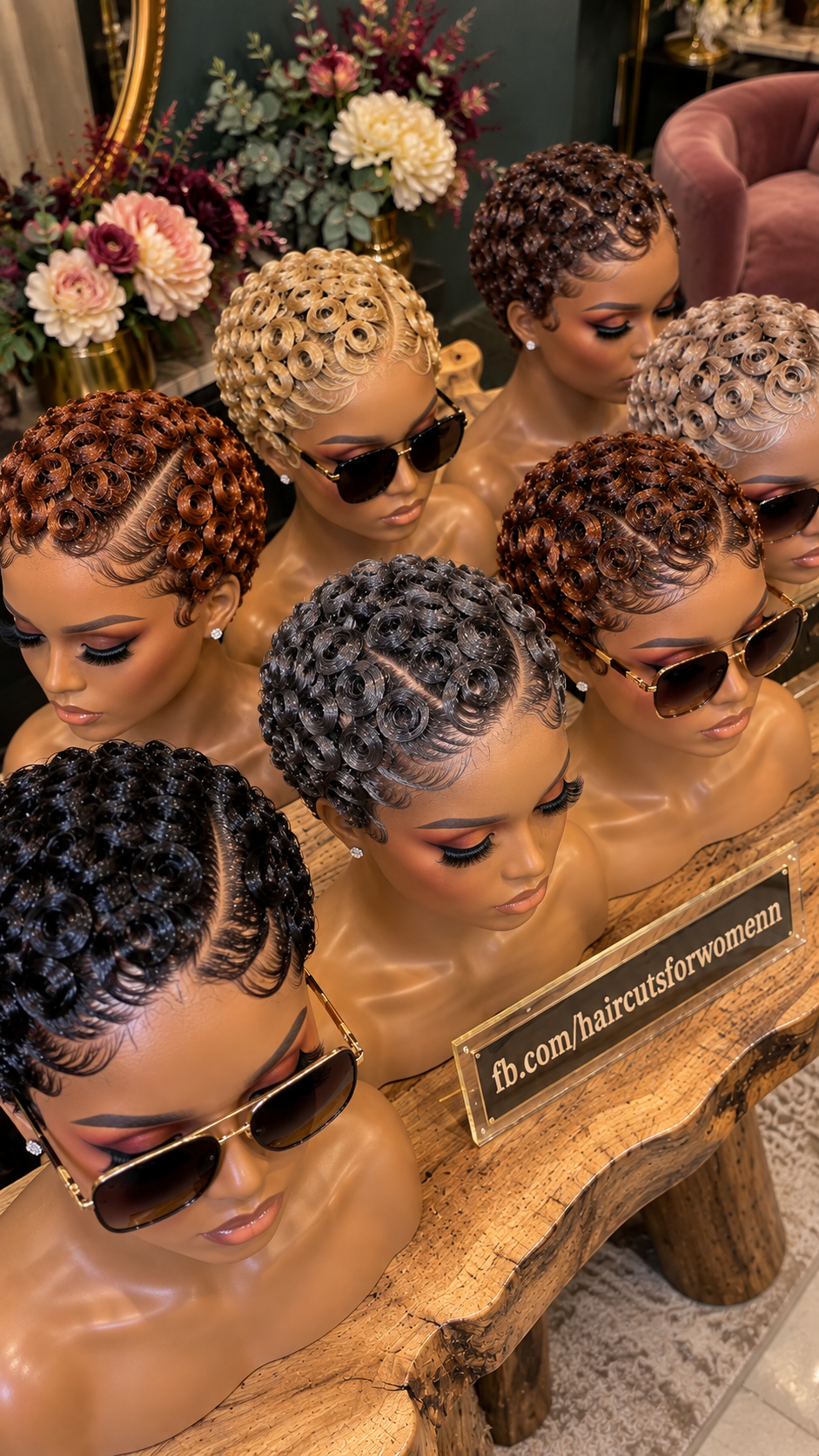
This smoky silver pixie wig combines densely arranged circular ringlets, a cool charcoal-to-silver color blend and carefully sculpted front waves. The compact crown stays close to the head while dozens of glossy loops create depth across the upper section. Around the forehead and temples, the circular pattern transitions into longer directional waves that give the style its distinctive profile.
The color is especially effective on this curl structure. Darker graphite tones remain visible underneath while silver reflections appear across the raised surfaces of the ringlets. Instead of looking uniformly gray, the hair develops several cool-toned layers as the light moves across it.
Smoky Silver Adds Contrast Without Losing Depth
The shade sits between charcoal gray, gunmetal and reflective silver. Dark roots and shadowed sections prevent the color from becoming flat or overly pale, while the lighter strands make individual loops easier to distinguish.
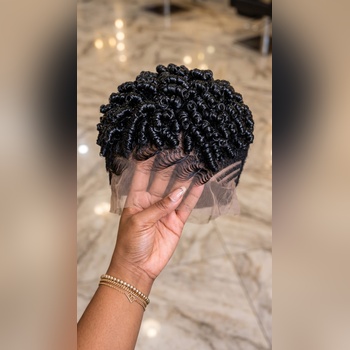
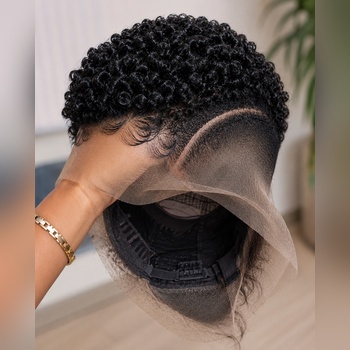
This balance matters on a densely curled pixie. If every strand were an identical light silver, much of the separation between neighboring curls could disappear. The darker undertone provides visual depth between the rings.
For a similar custom color, ask the stylist for smoky silver with charcoal depth rather than solid platinum. Reference photographs are useful because terminology for gray and silver shades varies considerably between wig sellers.
Closely Packed Ringlets Shape the Crown
The upper section consists of numerous small-to-medium circular curls placed tightly beside one another. Their centers remain visible, giving the crown an organized ringlet pattern rather than the appearance of loose curls.
The density is substantial, yet the silhouette remains compact. Most of the volume follows the contour of the head instead of rising vertically. This allows the pixie shape to remain recognizable even with extensive curl coverage.
When commissioning this style, specify dense circular ringlets with controlled crown height. Density alone does not describe the desired result because a stylist could otherwise create considerably taller curls.
The Front Waves Create a Different Rhythm
One of the strongest details appears around the forehead. The compact ringlets gradually transition into elongated strands that curve across the front and temple areas.
These sections are arranged in parallel sweeping motions before curling back toward the crown. The result creates contrast between the round shapes above and the longer wave pattern below.
This is an important element to mention during customization. A crown filled with ringlets but without the sculpted perimeter would produce a noticeably different hairstyle.
Side Parting Gives Direction to the Curl Placement
A visible side-oriented separation helps organize the curls. Instead of distributing every ringlet randomly, the part establishes a direction from which the surrounding pieces flow.
Near this separation, smaller curls sit closer to the scalp before transitioning into fuller rings farther across the crown. The construction gives the hairstyle a deliberate layout when viewed from above.
If ordering remotely, include an overhead photograph with your reference images. Front-facing photographs alone may not clearly communicate the parting position or crown arrangement.
Reflective Strands Highlight Every Circular Shape
The hair has a highly polished appearance with mirror-like glossy strands, a silky reflective finish, healthy wet-look shine and clearly visible strand separation. Light catches the upper edge of each loop, making the silver portions appear brighter while recessed areas remain smoky gray.
This type of finish is particularly photogenic because the ringlets create many small reflective surfaces. However, achieving shine should not mean saturating the hair with heavy products.
Excess oil can weigh down the loops and reduce separation. Lightweight finishing products applied sparingly are generally better suited to preserving the visual structure.
Temple Detailing Connects the Crown to the Hairline
The temple area contains finer curved sections that bridge the gap between the circular crown and the perimeter. Some strands form broad sweeping shapes while smaller pieces finish closer to the side of the face.
This detailing prevents the upper curls from appearing disconnected from the front. It also makes the hairstyle interesting from several angles rather than concentrating all of the styling on the crown.
For professional recreation, provide your stylist with close-up references of both sides. Small differences in temple placement can noticeably change the finished profile.
Finding a Stylist for Detailed Ringlet Work
Look for a wig stylist experienced with pixie units, finger curls, molded waves and detailed perimeter styling. These techniques require a different skill set from installing or styling long straight wigs.
Review portfolios before booking. Look specifically for compact hairstyles where individual curls remain separated and where the stylist has demonstrated controlled wave work around the forehead.
Send the reference image before confirming your appointment. Mention the smoky silver color, dense ringlet crown, side-oriented separation and sculpted front waves so the stylist can determine whether the requested result suits the proposed wig base.
Ordering a Similar Unit From a Wig Maker
When ordering online, describe the construction rather than relying on a broad phrase such as silver curly wig. A more useful request is smoky silver pixie with charcoal depth, circular crown ringlets and sweeping front waves.
Ask about the hair material, cap sizing and whether the wig will arrive fully styled. Also confirm whether the pictured curl setting is included or whether additional salon customization will be required after delivery.
For a custom order, request progress photographs when possible. An overhead photograph is useful for inspecting curl distribution, while side photographs reveal whether the temple waves have been formed correctly.
Human Hair or Synthetic Fiber?
Human hair is useful when future restyling is important. An experienced stylist can reset the ringlets and adjust the front sections as the hairstyle gradually loses its original formation.
Premium synthetic fiber can be suitable when maintaining a predetermined shape is the priority. Some synthetic constructions hold structured curls effectively, although heat tolerance and restyling options depend entirely on the specific fiber.
Never assume that a synthetic unit can tolerate heated tools. Check the manufacturer’s care instructions before attempting any heat-based curl adjustment.
Price Guide for a Sculpted Silver Pixie Wig
| Category | Estimated Price Range | Typical Specification |
|---|---|---|
| Premium Custom | $450–$900+ | Premium human hair, personalized sizing, multi-tone silver coloring and extensive hand-set curl work |
| Standard Custom | $250–$500 | Human-hair construction with customized ringlets, color work and sculpted perimeter styling |
| Basic Human Hair | $140–$300 | Human-hair pixie base that may require additional curl and hairline customization |
| Premium Synthetic | $85–$190 | Higher-grade synthetic fiber with structured curls and stronger shape retention |
| Basic Synthetic | $40–$100 | Lower-cost pre-shaped unit with simpler ringlet placement and limited restyling potential |
These figures are general market estimates rather than a price for the exact unit shown. Final pricing depends on hair material, cap construction, coloring process, stylist location and the amount of manual curl setting required.
Inspect the Silver Blend Before Accepting the Wig
Start by checking the color in neutral lighting. A well-balanced smoky silver should retain darker graphite depth between the lighter reflective strands rather than appearing uniformly pale gray.
Next, inspect the crown from above. Look for recognizable individual rings distributed across the surface and confirm that the curl pattern remains compact.
Finally, examine the front and temple areas. The elongated waves should connect naturally with the ringlets and follow a consistent direction around the perimeter.
Protecting the Ringlets During Storage
A detailed curl pattern can be distorted if the wig is stored under pressure. Place the unit on a suitable wig stand and keep other objects away from the crown.
Avoid routinely brushing through the circular curls. If one ring becomes displaced, gently reposition that individual section rather than combing through the entire crown.
When several curls begin losing their original formation, professional resetting is usually preferable to repeatedly manipulating every loop at home. Keeping photographs of the freshly styled wig can help the stylist reproduce the original arrangement later.
Booking the Final Styling and Fitting
If a purchased wig has the correct color and length but lacks the detailed ringlet pattern, search for salons offering pixie wig customization, finger-curl styling or molded wave services. Send photographs before booking so the stylist can evaluate whether the existing unit has enough workable hair for the requested construction.
Ask whether the appointment covers crown setting, part adjustment, temple detailing and final fitting. If smoky silver coloring is also required, mention this while making the appointment because color customization can add substantial preparation time.
After completion, photograph the crown, both sides and front. These views provide a practical reference for future maintenance and make it easier to commission another version in a different color while retaining the same curl structure.
Search Terms
Smoky Silver Ringlet Pixie · Charcoal Silver Circular Curls · Graphite Gray Ringlet Crown · Silver Sculpted Front Waves · Smoky Gray Side Part Curls · Glossy Gunmetal Ringlets · Silver Temple Wave Pixie · Charcoal Root Silver Curls