
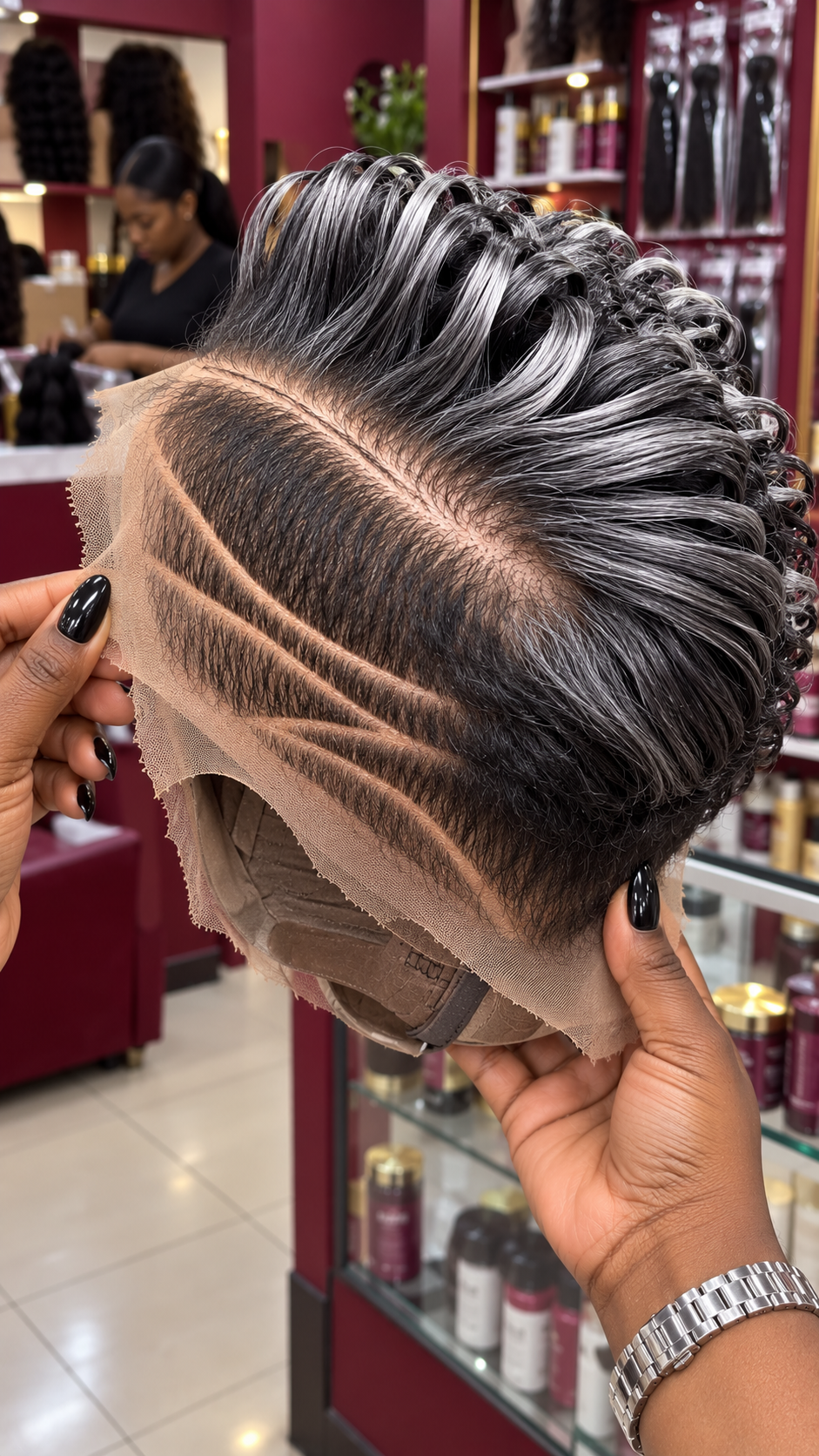
A silver smoke pixie lace wig like this stands out because the color, crown movement and precision side work all contribute to the final shape. The design uses a deep black foundation with cool silver strands concentrated through the longer upper sections. Instead of covering the entire wig in one pale shade, the silver follows the direction of the hair, creating visible contrast as the crown sweeps backward.
The side profile is equally important. Closely cropped dark hair creates a strong foundation beneath the longer crown, while several sweeping curved lines travel across the side. The untrimmed lace is clearly visible around the perimeter, showing that this is a custom-style wig before final installation rather than a finished hairstyle on a wearer.
For anyone ordering a similar unit, the useful details to communicate are the black root area, smoky silver upper strands, raised swept crown, dark cropped side and curved line design. Those details will give a wig maker much more information than simply requesting a black-and-silver pixie.
The Silver Is Blended Into a Dark Foundation
One of the strongest aspects of this color combination is that the black base remains visible throughout the crown. Silver strands sit beside and over darker sections rather than completely replacing them. This gives the hair a layered appearance and prevents the pale color from looking flat.
The front and upper crown contain some of the brightest silver sections, while darker hair remains visible near the roots and between the lighter strands. Toward the side and back, the color becomes more integrated with the black foundation.
When requesting this effect, describe it as smoky silver or pearl-silver ribbons over a dark root. Avoid asking for an entirely silver wig if this particular contrast is the goal.
Why Root Depth Changes the Appearance
The dark root serves several purposes. Visually, it creates separation between the individual silver sections. It also connects the lighter crown with the predominantly dark side, so the two areas feel like parts of the same design.
A wig made entirely from pale silver hair would produce a very different result. Here, the black foundation gives the style more depth and makes each sweep of silver easier to see.
If ordering remotely, ask the stylist to send a crown photograph before shipping. This allows you to check whether enough dark hair remains between the silver sections.
The Crown Uses Broad Swept Loops
The upper portion is styled into large sections that rise from the root and curve backward. These are not tiny ringlets. The hair forms broader loops and bends, particularly around the front and upper crown.
The sections gradually change direction as they move toward the back. The front stands higher, while the rear begins to settle into the rounded shape of the wig. This produces height without making every part of the crown equally elevated.
A stylist recreating the look should preserve sufficient length through the upper area before shaping. Removing too much hair early in the process can make these larger loops difficult to form.
The Side Creates a Completely Different Texture
While the crown is long, glossy and highly directional, the side is kept very close. This contrast gives the wig much of its character. The darker side also acts as a visual frame beneath the silver crown.
The hair has not simply been cut uniformly around the entire perimeter. Different lengths and sections are used to create a transition from the cropped area into the longer upper hair.
For a custom order, provide both side and crown references. A frontal photograph alone would not adequately communicate how much of this style depends on the side profile.
Sweeping Lines Shape the Lower Profile
Several curved channels are visible through the side. The longest line begins high toward the front and sweeps backward, following the natural direction of the overall silhouette. Additional lines sit beneath it and create a layered pattern.
The important characteristic is their curvature. Straight horizontal barber lines would produce a noticeably different result. These lines are designed to move with the contour of the wig.
Ask for sweeping curved side lines with separated dark sections between them. Showing the reference photograph is strongly recommended because the spacing and direction are difficult to communicate with words alone.
The Lace Is Intentionally Untrimmed
The photograph gives a clear view of the lace extending beyond the hairline and side. This excess material is normally dealt with during fitting and installation. It should not be interpreted as the final appearance of the wig.
The image also provides a partial view of the interior cap. However, the photograph alone does not confirm the precise lace type, cap dimensions or fiber composition. Those specifications need to come directly from the maker or retailer.
If you purchase a custom unit, avoid making major alterations to the lace before checking the fit. Once excessive lace has been removed, correcting the perimeter can be difficult.
What to Tell a Custom Wig Maker
Send the reference image and describe the order as a dark-root silver pixie lace wig with a raised swept crown and curved side-line design. Explain that you want the black base to remain visible through the silver rather than having an uninterrupted silver top.
Specify that the longer hair should be concentrated through the crown while the side remains closely shaped. The silver should follow the direction of the longer sections rather than appearing as random spots.
It is also useful to mention the desired amount of contrast. Some clients may prefer brighter pearl silver, while others may want a darker gunmetal or smoky gray result.
Finding a Stylist Who Can Recreate It
Look for a custom wig maker, pixie wig specialist or stylist experienced with precision lace wigs. Portfolios containing detailed side views are particularly valuable because they demonstrate whether the stylist can handle the combination of longer crown work and close side shaping.
Before booking, send this photograph and ask whether the stylist can create both the color placement and side pattern. Some wig makers specialize in coloring but outsource cutting, while others build and style the entire unit themselves.
If you already own a suitable wig, ask whether the stylist accepts customer-supplied units for customization. They may need photographs of the existing wig before confirming whether it has enough density and length for the desired transformation.
Buying a Similar Wig Online
When searching online, use specific phrases rather than broad terms such as “silver wig.” Search for silver pixie lace wig, black root silver pixie wig, custom sculpted pixie wig and similar descriptions.
Compare the actual construction carefully. A product can have the correct color but completely different crown length or density. Conversely, a black pixie with the right construction may be a better starting point if an experienced stylist can add the silver coloration afterward.
Before paying for a customized unit, confirm whether the seller’s photographs represent the exact product, a made-to-order example or merely styling inspiration.
Human Hair and Synthetic Options
A human-hair base generally provides more flexibility when extensive cutting, coloring or heat styling is required. It may therefore be useful for buyers who expect to have the unit customized locally after purchase.
A quality synthetic or heat-friendly synthetic wig can also work when the shape and color are already produced by the manufacturer. However, synthetic fibers vary considerably in their ability to tolerate heat and recoloring.
Never assume a synthetic wig can be processed in the same way as human hair. Ask the seller about the fiber and its permitted temperature range before using heated tools.
How Much It Costs
| Wig Category | Typical Price Range | Possible Services |
|---|---|---|
| Premium Custom | $450–$950+ | Premium hair, custom silver coloring, lace construction, crown sculpting and detailed side work |
| Standard Custom | $250–$500 | Custom shaping, dark-root color work, silver accents and side detailing |
| Basic Human Hair | $120–$300 | Human-hair base unit that may require separate cutting, coloring and installation |
| Premium Synthetic | $75–$190 | Higher-grade fiber with pre-styled crown and potentially heat-friendly construction |
| Basic Synthetic | $35–$95 | Lower-cost alternative with more limited customization possibilities |
These figures are general estimates rather than the selling price of the wig in the photograph. Hair source, lace construction, density, custom coloring, hand styling and the experience of the wig maker can all affect the final quote.
Booking the Installation
Search locally for salons offering lace wig installation and custom pixie wig services. Send the stylist photographs before booking and mention that the unit contains a sculpted crown and side-line pattern that should remain visible after fitting.
Ask what the appointment includes. Services can differ between salons, so confirm whether lace preparation, fitting, final crown adjustment and finishing are part of the quoted price.
If the wig needs additional cutting after fitting, try to book with someone who has experience shaping pixie units rather than treating the wig as a conventional long lace unit.
Protecting the Silver Color
Light silver tones can require more careful maintenance than dark shades. The appropriate routine depends on whether the wig is human hair or synthetic, so follow the care recommendations supplied for the specific unit.
For human hair, excessive heat and repeated processing can affect both the lighter strands and the overall condition of the hair. If the silver eventually needs refreshing, ask a professional to preserve the dark-root placement while adjusting the lighter sections.
For synthetic hair, use only products and temperatures approved for the fiber.
Maintaining the Raised Crown
The larger crown sections should be handled deliberately. Repeatedly brushing straight through them can remove the sculpted direction that gives the wig its shape.
Instead, separate and reposition individual sections when necessary. If the wig has been professionally set, avoid unnecessary manipulation between wears.
When significant restyling becomes necessary, taking the unit back to a pixie specialist may produce a better result than repeatedly attempting to reconstruct the crown at home.
Storage for a Sculpted Pixie Unit
Store the wig where the raised crown will not be compressed. A suitable wig stand can help support the cap while allowing the longer sections to retain their direction.
Keep other wigs, boxes and clothing away from the top of the unit. Constant pressure can flatten the loops and change the way the silver sections sit over the dark foundation.
For transportation, choose packaging with enough internal space to protect the crown instead of folding the unit tightly.
Details to Confirm Before Ordering
Before placing a custom order, confirm the base color, silver tone, crown length, cap size, lace construction, density, hair material and side-line design. Ask whether the unit will arrive fully styled or whether additional salon finishing is expected after delivery.
For made-to-order wigs, request photographs from more than one angle when possible. The side view should show the line work, while the upper angle should reveal the distribution of silver through the crown.
These checks make it easier to determine whether the finished unit actually follows the requested design before shipping.
Search Terms
Silver Smoke Pixie Lace Wig · Black Root Silver Pixie Wig · Pearl Silver Sculpted Pixie Wig · Swept Crown Lace Wig · Curved Side Line Pixie Wig · Black and Silver Lace Pixie · Smoky Gray Pixie Wig · Silver Highlight Precision Pixie Wig