
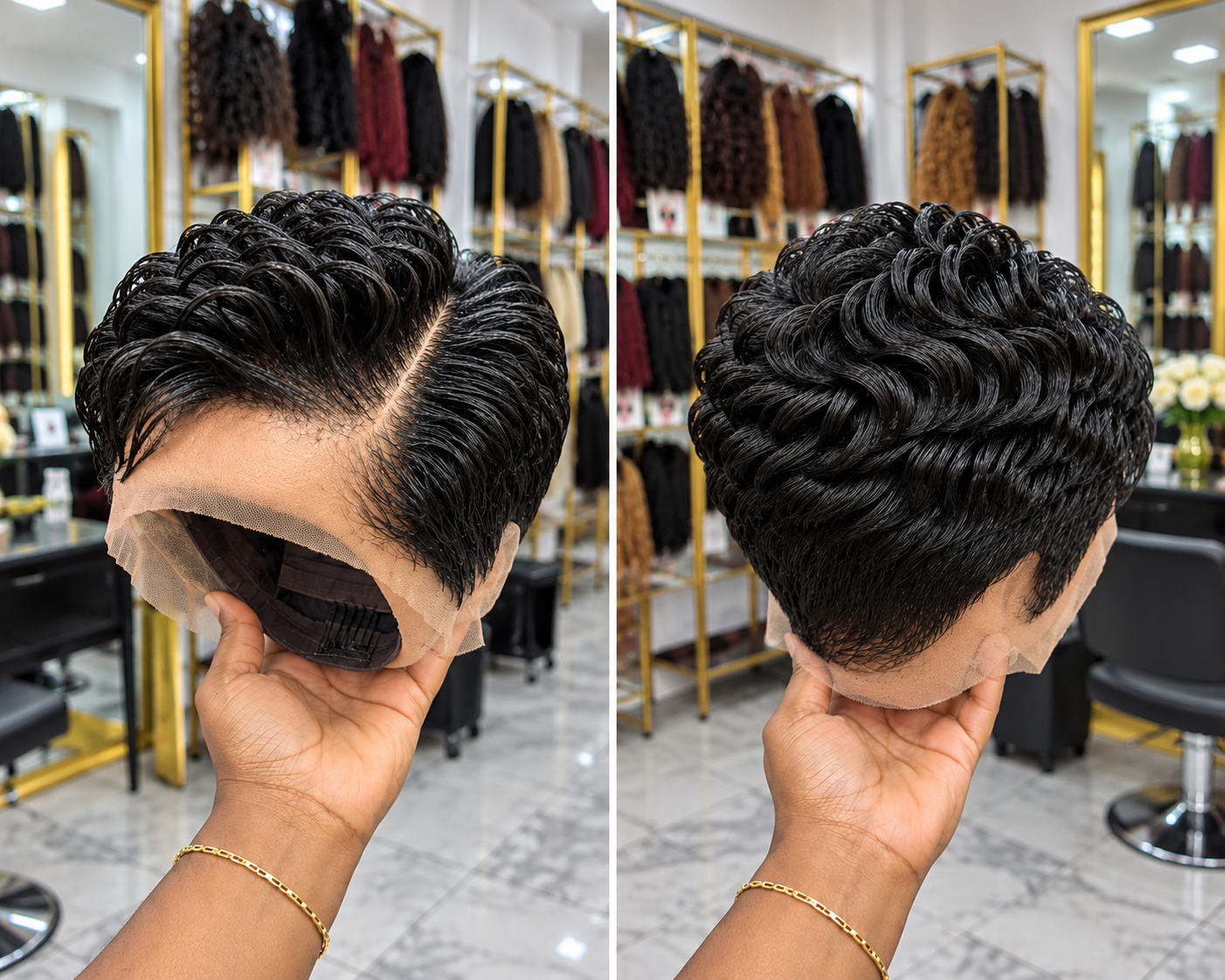
A glossy jet-black finish, pronounced side part and carefully layered wave pattern give this compact pixie wig its distinctive shape. The two-view presentation is especially useful because it reveals both the front construction and the way the hair transitions into a closely tapered back.
Unlike a ringlet-heavy pixie, this design relies primarily on wide sculpted waves and curved sections. The hair follows the contour of the head, but the upper portion retains enough height and movement to prevent the silhouette from appearing flat. The result is a polished cropped style with a strong directional flow.
The monochromatic black color also makes the construction easy to read. Light travels across the glossy strands and reveals each individual wave, particularly around the crown and side part.
The Deep Side Part Establishes the Direction
The most immediately recognizable feature is the long, clearly visible side part. It begins near the front hairline and extends backward toward the crown, dividing the hairstyle into two noticeably different sections.
On one side, the hair rises into larger sweeping waves. On the opposite side, it follows the head more closely before blending into the shorter perimeter. This asymmetry is essential to the overall appearance.
Anyone requesting a similar custom unit should specifically mention a deep side part sculpted pixie wig. Simply asking for a black pixie may produce a very different arrangement at the crown.
Broad Waves Replace Traditional Small Curls
The upper section is arranged into broad curved formations rather than tiny circular curls. Individual sections bend backward and overlap, producing a layered wave effect across the top.
Several strands near the front sweep upward before curving toward the side. Farther back, the waves become denser and more compact, allowing the upper section to transition naturally toward the shorter rear.
This distinction matters when searching online. Terms such as sculpted wave pixie wig, wet-look pixie wig and side-part wavy pixie wig are likely to describe the visible structure more accurately than searches focused on tight ringlets.
Jet Black Makes the Shine Especially Noticeable
The entire hairstyle appears consistently deep black, without visible blonde, caramel or burgundy sections. Because there is no contrasting color competing with the structure, attention stays on the shape and reflective surface of the hair.
The glossy finish is particularly visible along the upper waves. Highlights follow individual strands and curved sections, giving the hair a freshly styled appearance.
For a custom order, a useful description would be jet black glossy sculpted wave pixie. The reference images should still be supplied because words such as glossy or wet-look can produce different interpretations between stylists.
The Front Uses a Sweeping Asymmetrical Shape
The front is not arranged as a straight fringe. Instead, longer sections move diagonally away from the side part and form several overlapping sweeps.
This gives the front more height than the temple and nape while maintaining the compact dimensions expected from a pixie. The asymmetrical placement also prevents the hairstyle from becoming overly rounded.
A stylist reproducing the unit should preserve this directional front movement rather than cutting the upper hair to one uniform length.
The Sides Stay Close to the Head
The side sections provide contrast with the fuller crown. Hair immediately below the part is combed and shaped close to the head, gradually becoming shorter toward the ear area.
This close shaping gives the upper waves a stronger visual presence. If the sides were left equally full, much of the sculpted pixie silhouette would disappear.
When booking an appointment, describe the desired construction as a full wavy crown with close tapered sides. Showing both supplied views will make the proportion much easier for the stylist to understand.
The Back View Shows the Layering Clearly
The rear angle reveals details that cannot be understood from the front photograph alone. Larger waves remain visible through the upper back, while the lower section gradually becomes shorter and lies increasingly close to the head.
This creates a smooth progression from crown volume to a compact nape. There is no long tail or bob-like section extending below the main silhouette.
For shoppers comparing ready-made units, checking the rear photograph is therefore essential. Two wigs may have similar front styling while using completely different cuts at the back.
A Close Taper Keeps the Nape Compact
The lower rear section is cut significantly shorter than the crown. The taper follows the natural curve of the head and finishes neatly around the nape.
This construction keeps the wig visually lightweight despite the amount of hair used to create the upper waves. It also provides the characteristic cropped profile associated with this particular pixie design.
Useful search combinations include tapered back wave pixie wig and black pixie wig with close nape.
Why the Hair Texture Matters
The visible strands appear smooth and grouped into deliberate sections. This allows each wave to maintain its shape while still showing individual strand detail under the light.
A very fluffy or dry texture would create a noticeably different result. The style depends on controlled separation and reflective movement rather than large amounts of airy volume.
When discussing the finish with a stylist, provide the image and request glossy separated strands with structured sweeping waves. Product choice should then be adapted to the actual fiber or hair type used for the wig.
Where to Get This Wig Style Made
A stylist experienced with cropped wigs, pixie cutting and sculpted wave styling would be the most appropriate professional for recreating this look. Search locally for custom pixie wig stylists, wig salons or hair professionals whose portfolios contain similarly close-cut units.
Before booking, send both views and ask whether the stylist can reproduce the deep part, sweeping upper waves and tapered rear profile. These structural elements are more important than simply matching the black color.
If you already own a wig that you want converted into this style, provide photographs of its current length and density. A stylist will need to determine whether there is sufficient hair through the crown while still allowing the sides and nape to be shortened appropriately.
How to Book an Appointment
When contacting the salon, explain that the requested result is a jet black side-part pixie wig with sculpted waves and a tapered nape. Attach the reference image rather than relying only on a written description.
Ask whether the service includes supplying the wig, cutting, styling and final finishing. Some wig specialists sell complete custom units, while others provide styling services for customer-supplied wigs.
Confirm the estimated completion time and whether a consultation is required before paying a deposit. Precision cropped work may involve several stages of cutting and shaping.
Where to Buy a Similar Wig
Comparable styles may be available through custom wig boutiques, specialist online wig stores, independent wig makers and beauty supply retailers. Searching with multiple visible characteristics will usually produce more relevant results than using a broad phrase such as “black wig.”
Try combinations such as jet black sculpted pixie wig, deep side part wave pixie wig, glossy black tapered pixie wig and wet-look wavy pixie wig.
When comparing listings, check whether the seller provides front, side and back photographs. The rear construction is particularly important for this hairstyle because the compact tapered nape is a major part of the finished silhouette.
What to Send With a Custom Order
Send the complete two-view reference instead of cropping out one side. Tell the maker that the front image demonstrates the deep part and upper wave direction, while the second image shows the crown layering and tapered rear.
Also specify that the desired color is deep black throughout. If the seller uses numbered color systems, request a photograph of their actual black shade before confirming the order because color codes can vary between manufacturers.
Ask for progress photographs if the wig is being made specifically for you. A rear photograph before shipping can help confirm that the nape has been cut to the intended length.
How Much It Costs
The exact selling price of the wig shown cannot be determined from the photograph. The cost of a comparable unit depends on the fiber, cap construction, density, cutting work and amount of styling required.
| Wig Category | Typical Estimated Price Range |
|---|---|
| Premium Custom | $300–$750+ |
| Standard Custom | $175–$400 |
| Basic Human Hair | $100–$275 |
| Premium Synthetic | $60–$150 |
| Basic Synthetic | $30–$90 |
These ranges are general estimates for comparable wig categories rather than the confirmed price of the pictured unit. Precision cutting and extensive hand styling may increase the final cost.
Check the Cap and Construction Before Ordering
The photograph visibly shows lace extending beyond portions of the hairline, but the image alone does not establish every technical specification of the cap. Ask the seller exactly what construction is used and how much lace is included.
Confirm cap size, adjustment options and measurements before ordering. A cropped hairstyle follows the head closely, so an unsuitable cap fit may be more noticeable than it would be beneath a long, voluminous wig.
If purchasing remotely, follow the seller’s own measurement guide and return-policy requirements rather than relying on general sizing assumptions.
Maintaining the Sculpted Waves
This hairstyle depends on preserving the direction of individual sections. Avoid repeatedly brushing the entire crown because that can disturb the deliberate wave arrangement.
When necessary, work on individual sections and follow the direction already established in the hairstyle. Use only products compatible with the confirmed wig material.
Before applying heat, always verify whether the unit is human hair or a heat-compatible synthetic fiber. The fiber composition cannot be reliably determined from appearance alone.
Keeping the Glossy Finish Between Wears
Store the wig so the crown is not pressed against a wall, box or other wigs. Compression can flatten the upper waves and change the profile.
A suitable wig stand can help retain the crown shape. Avoid excessive styling product, since heavy buildup can make separated strands stick together and reduce the visible movement through the waves.
The goal is to preserve the reflective appearance while keeping the individual sections recognizable.
A Precision Pixie Built Around Directional Waves
The strength of this design comes from the relationship between its different lengths. The deep side part, elevated sweeping crown, close sides and tapered nape work together to create a clearly structured pixie silhouette.
Because the color remains consistently jet black, the eye is drawn directly to the styling itself. For anyone ordering a recreation, matching the direction and proportions of the waves will be just as important as matching the color.
Search Terms
Jet Black Sculpted Wave Pixie Wig · Deep Side Part Pixie Wig · Glossy Black Wave Pixie Wig · Tapered Nape Pixie Wig · Side Part Wet Look Pixie Wig · Swept Crown Black Pixie Wig · Close Tapered Wavy Pixie Wig · Black Sculpted Hair Pixie Wig