
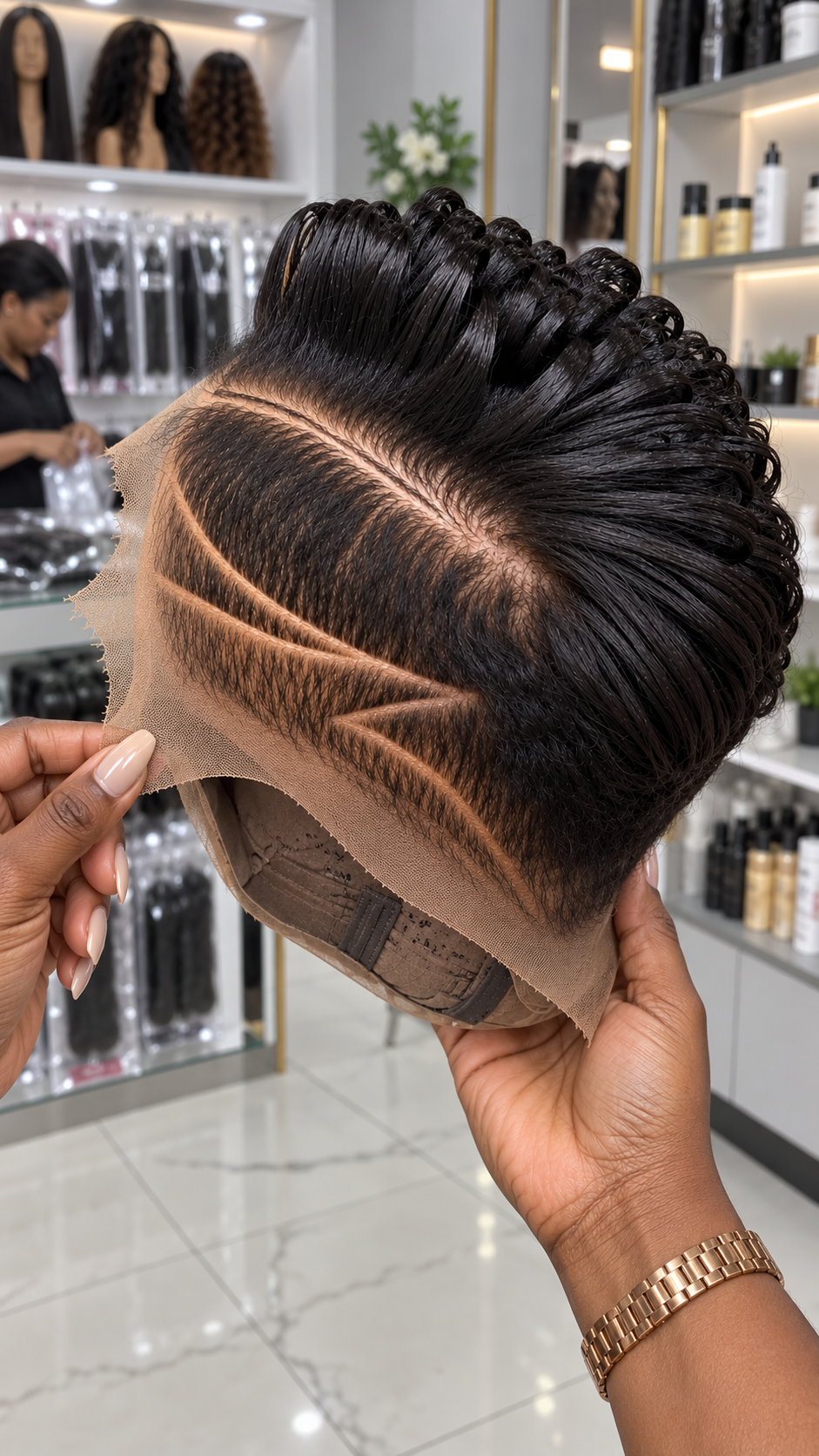
This jet black pixie wig combines a high sculpted loop crown, closely cropped side sections and two sweeping curved design lines in a compact lace wig construction. The photograph is especially useful for examining the workmanship because the unit is being held before installation, exposing the untrimmed lace, interior cap and detailed side styling.
Unlike a conventional curly pixie where small curls cover the entire head, this design uses much longer sections across the upper crown. The hair rises from the base and bends backward into large loops, while tighter curls gradually take over toward the rear. The lower side remains extremely close to the base so the curved pattern stays clearly visible.
The single jet-black color also changes the character of the hairstyle. Without contrasting highlights, attention moves directly toward the glossy strand structure, elevated crown and precision of the side design.
Jet Black Gives the Wig a Strong Uniform Appearance
The visible hair is consistently deep jet black from the compact lower sections through the longer crown. There are no obvious copper, blonde or burgundy color panels interrupting the design.
Under the bright salon lighting, individual strands produce silver-like reflections. These should not be mistaken for gray highlights. They are primarily light reflections created by the very dark, glossy surface of the hair.
This uniform color works particularly well with the sculpted construction. Every large loop can be distinguished through differences in direction and reflected light rather than through contrasting color.
For someone ordering a similar unit, descriptions such as jet black sculpted pixie wig, black loop curl pixie wig or black pixie wig with curved side design communicate the visible characteristics more accurately than a generic request for a curly wig.
Large Loops Create Height Across the Crown
The most prominent styling feature is the series of large elevated loops extending from the front toward the rear crown. These sections are substantially longer than the hair underneath them.
Near the front, the loops rise almost vertically before curving backward. Through the center, they become broader and begin leaning toward the rear. This gradual directional change creates a flowing crown rather than a row of identical curls.
Individual strands remain visible inside the loops, particularly where the salon lighting crosses their surface. The styling has enough separation to reveal each section without making the crown look sparse.
At the rear, the larger loops transition into tighter curled sections. This helps bring the volume back down toward the compact pixie silhouette.
Double Curved Lines Shape the Side
The side contains two long sweeping separations that are among the most recognizable elements of this wig. Rather than straight parallel lines, both curves follow the contour of the head.
The upper line begins near the front and sweeps backward beneath the crown. A second line follows underneath it before the two shapes visually converge toward the rear.
Between and around these lines, the hair is kept extremely close. This contrast allows the scalp-toned base of the unit to form crisp boundaries against the black strands.
Someone requesting a reproduction should specifically describe a double curved side design and provide the reference image. Simply requesting “two lines” could produce a completely different barber-style pattern.
A Pointed Rear Detail Completes the Pattern
Toward the back of the side section, the lower curve changes direction and forms a sharper pointed shape. This small detail gives the pattern a more deliberate finish than two curves that simply continue toward the nape.
The surrounding hair follows the geometry of this point, keeping the design visible even where the crown begins becoming fuller.
This area requires careful workmanship because the pattern depends on consistent spacing. If the two curves become too wide or narrow, the proportions of the entire side design change.
When commissioning the wig remotely, a close side photograph taken before shipping is one of the best ways to confirm that this detail has been reproduced correctly.
The Close Side Creates a Dramatic Length Contrast
The lower section is cropped very close to the wig base, but individual tiny hairs remain visible. It is not a completely bare or bald-looking panel.
This compact area contrasts strongly with the elevated crown. The transition from extremely close hair to long sculpted loops happens over a relatively small distance, which is a major part of the hairstyle’s visual impact.
The rear lower section becomes gradually fuller as it approaches the curled crown. That progression prevents the hairstyle from ending abruptly and maintains a rounded pixie profile.
The Lace Is Clearly Visible Before Installation
The photograph shows a substantial amount of untrimmed lace extending around the front and side perimeter. Because the unit is being held away from a head, the lace construction is easy to distinguish from the styled hair.
Fine hairs have been positioned close to the lace edge, while the sculpted side design begins farther inside the perimeter. This leaves material available for fitting and trimming during installation.
The image does not provide enough evidence to confirm a specific commercial lace classification such as HD lace. Buyers should ask the seller directly about the lace material, dimensions and color rather than relying only on appearance in a photograph.
The Interior Cap Is Also Exposed
Part of the wig’s interior construction is visible underneath the lace. A fabric cap structure and an adjustable-looking component can be seen near the lower interior.
Not every fastening element is visible clearly enough to state exactly how the unit is secured when worn. Anyone purchasing a similar wig should confirm whether the specific product includes adjustable straps, combs, clips or an elastic band.
Cap sizing is particularly important for this style. The decorative side section needs to sit at the intended position around the temple, and an incorrectly sized cap can shift the pattern forward or backward.
Why Placement Matters With This Side Design
A standard curly wig can sometimes tolerate small differences in positioning because longer hair conceals much of the perimeter. This sculpted pixie offers far less room for error.
The double curved pattern is designed to sit prominently along the side of the head. If the unit is positioned too far forward, backward, high or low, the relationship between the design and temple can change noticeably.
The lace should therefore be fitted before unnecessary material is removed. Someone unfamiliar with lace customization may prefer to have the initial trimming performed by an experienced wig stylist.
Gloss Is Essential to the Sculpted Effect
The jet-black strands have a highly reflective appearance. Bright highlights travel along the large loops, making their curvature visible even though the entire hairstyle uses essentially one dark color.
The desired finish is mirror-like glossy hair, silky reflective finish, healthy wet-look shine, individually visible strands and ultra-defined hair texture.
The effect should remain glossy without becoming heavily coated. Excess styling product can cause neighboring strands to merge visually, reducing the separation that makes the loops attractive.
A light application of an appropriate finishing product may help maintain shine, but the correct product depends on whether the wig is human hair or synthetic fiber.
Where to Get a Similar Wig Made
This design requires more specialization than an ordinary pixie wig. Look for a custom wig maker experienced with sculpted pixie units, close side work and precision pattern styling.
A portfolio containing similar compact wigs is particularly valuable. Long lace wig experience alone does not necessarily demonstrate the skills required to reproduce the extremely close side section and large structured crown loops seen here.
Some custom wig makers may collaborate with a barber or stylist for intricate side work. If the pattern is the main reason for choosing this design, ask who will create that portion of the unit before placing the order.
Useful searches include custom sculpted pixie wig maker, jet black pixie wig stylist, pixie wig with side design and loop curl pixie wig specialist.
How to Order This Style
Begin by sending the stylist clear reference photographs. Identify the elements that matter most: jet-black color, elevated loop crown, compact sides, two sweeping curved lines and the pointed rear detail.
Ask whether the stylist can reproduce the overall construction rather than assuming that sending the image automatically includes every feature.
Next, confirm whether the quoted price includes the base wig, cutting, sculpting and lace customization. Custom wig services are often divided into separate stages, so understanding exactly what is included prevents confusion later.
If the wig will be made remotely, provide measurements using the maker’s own measurement guide. Before final payment or shipment, request front, side and rear photographs of the completed unit.
Finding a Similar Wig Online
Broad searches such as “black pixie wig” will return many units that share the length but not the construction. More descriptive search phrases can narrow the results considerably.
Try combinations such as jet black sculpted loop pixie wig, black pixie wig with double curved lines, loop crown lace pixie wig and black sculpted pixie wig with side design.
When comparing listings, inspect the side photographs carefully. Many pixie wigs have curled crowns, but far fewer combine an elevated loop structure with a close patterned side.
If a retailer provides only a front photograph, request additional images before purchasing. The side and rear contain too much of this hairstyle’s design to judge the unit from the front alone.
What to Confirm Before Paying
Ask whether the unit being sold is identical to the photographed example or whether the photograph represents a customized version. Confirm the fiber type, cap size, lace type and included fastening system.
Also ask whether the sculpted crown arrives fully styled. A base pixie wig that requires additional salon work after delivery is not equivalent to a ready-styled unit.
For handmade designs, determine whether minor differences in the curved side pattern should be expected. If exact placement matters, send a marked reference image showing which details should remain consistent.
Return and exchange conditions should be reviewed before trimming the lace because customization commonly affects return eligibility.
Human Hair or Synthetic Fiber?
The photograph alone cannot reliably establish whether this particular wig is human hair or synthetic. High shine and strand separation can occur with either material depending on fiber quality, styling and lighting.
A human hair pixie wig may provide more flexibility when future restyling is important. High-quality synthetic options can be useful when the primary goal is preserving a carefully preset sculpted shape.
For synthetic hair, confirm whether heat tools can be used and the maximum permitted temperature. The large crown loops may eventually require reshaping, so heat compatibility can become relevant later.
How Much It Costs
No price is visible in the photograph, so the exact selling price of this unit cannot be determined from the image. Pricing for comparable wigs depends on hair material, lace construction, cap quality and the amount of hand styling required.
| Wig Category | Typical Estimated Price Range |
|---|---|
| Premium Custom | $350–$800+ |
| Standard Custom | $180–$425 |
| Basic Human Hair | $100–$275 |
| Premium Synthetic | $60–$160 |
| Basic Synthetic | $30–$90 |
A design with a precisely sculpted crown and detailed curved side work may cost more to customize than a basic ready-made pixie. Installation, lace trimming and later restyling may also be charged separately.
Instead of comparing prices only by wig length, compare what each seller includes in the finished product.
Keeping the Crown Loops in Shape
The wig should be stored upright on a suitable stand so the elevated crown is not compressed. Placing heavy objects against the top can flatten the loops and change their direction.
Avoid brushing straight through the sculpted sections. The large loops have been arranged individually, and conventional brushing can quickly dismantle that structure.
Loose strands are better addressed section by section. If substantial reshaping becomes necessary, professional restyling may produce a result closer to the original construction.
Cleaning methods should always match the confirmed fiber type. After washing, avoid allowing the weight of saturated hair to stretch the loops while drying.
Why This Jet Black Pixie Stands Out
The strength of this wig comes from its structure rather than multiple colors. A deep jet-black palette keeps the appearance cohesive while the reflective finish reveals every bend and direction in the crown.
The tall front loops gradually flowing toward tighter rear curls create the upper silhouette. Beneath them, the close-cut side provides a contrasting surface for the two sweeping curved lines and pointed rear accent.
For a close reproduction, those proportions matter more than simply finding another black curly pixie. The height of the crown, spacing between the curved lines and placement of the side pattern need to work together as one design.
Search Terms
Jet Black Sculpted Pixie Wig · Black Loop Curl Pixie Wig · Double Curved Side Pixie Wig · Jet Black Lace Pixie Wig · Sculpted Crown Black Wig · Black Pixie Wig With Side Lines · Close Side Loop Crown Wig · Jet Black Curved Design Pixie Wig