
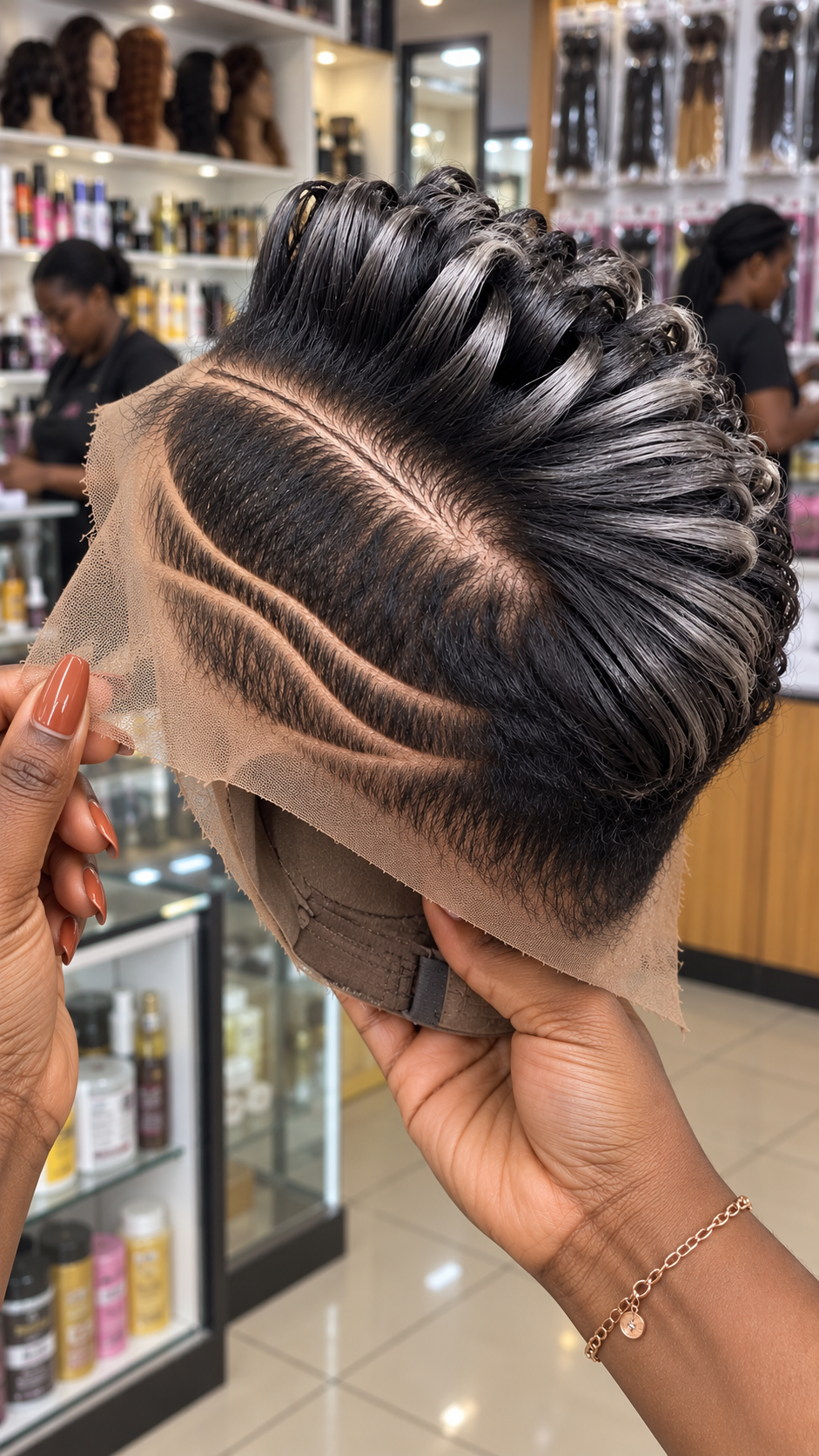
This jet black pixie wig combines a close-cut side structure, two sweeping curved lines and large sculpted loops across the crown. The hairstyle has a strong contrast between the very compact lower section and the longer hair above it, where glossy strands are shaped into raised loops that travel backward toward the crown.
The photograph gives a particularly clear look at the wig before installation. The lace remains extended around the perimeter, part of the interior cap is visible underneath, and the unit is being held in both hands. That makes the construction easier to examine while also showing how precisely the side design has been incorporated into the hairstyle.
Unlike a conventional curly pixie covered with small curls, this design relies on elongated sections of hair. Each section rises from the base, bends over itself and joins the curled structure farther back. The result is a compact pixie with considerably more movement through the upper portion.
Jet Black Color Emphasizes the Sculpted Shape
The hair appears predominantly deep jet black. There are no obvious contrasting color panels or warm highlights competing with the structure, so attention stays on the direction of the strands and the curved side pattern.
Under the salon lighting, the black hair produces silver-like reflections along the surfaces facing the light. These reflections should not be confused with a separate gray color; they are primarily highlights created by the highly reflective hair surface.
The darker areas remain extremely rich, while individual strands become visible wherever the light crosses a loop. This combination gives the hairstyle substantial depth even though the color itself is relatively uniform.
For someone shopping for a similar appearance, useful descriptions include jet black sculpted pixie wig, black loop curl pixie wig and glossy black pixie wig with side lines.
Large Loops Create Movement Across the Crown
The most noticeable feature above the side section is the arrangement of long, polished loops. Rather than forming small circular ringlets, the strands have been gathered into broader sections and curved backward.
Several loops begin almost vertically near the upper side before bending toward the crown. Others lie at a lower angle and sweep farther toward the back. This change in direction creates movement without requiring additional length around the perimeter.
The loops also vary slightly in width. Some contain narrow groups of strands, while others are noticeably broader. That variation prevents the top from looking like a repeated mechanical pattern.
Toward the rear, the hairstyle transitions into tighter curls. This gradual change helps connect the elevated crown sections with the compact back of the wig.
Two Curved Lines Shape the Side Design
The side contains two prominent curved lines. The upper line begins near the front perimeter and travels diagonally toward the rear. A second line follows underneath it with similar curvature.
The dark strip of hair between the two lines remains visible throughout most of the design. That spacing is important because it keeps the lines visually separate instead of allowing them to merge into one wide section.
The upper curve also works with the natural direction of the crown. As the line rises toward the back, the longer hair above it begins sweeping in the same general direction.
When ordering a custom version, the reference image should be sent directly to the stylist. Asking only for “two lines” would not communicate the exact curvature, placement and spacing shown here.
The Close Side Creates a Strong Length Contrast
Hair underneath and around the curved lines is kept extremely close to the base. The individual short strands remain visible, especially along the lower portion near the lace.
Above this compact area, the hair gradually becomes longer before entering the sculpted crown. This transition gives the wig a convincing pixie silhouette rather than making the longer top appear disconnected from the sides.
The compact side also allows the curved line design to remain clearly visible. If this area were significantly longer, the surrounding strands could partially conceal the pattern.
When comparing similar wigs, always request a side photograph. Front-facing product images alone will not show whether this important section has been constructed in the same way.
The Extended Lace Shows the Wig Before Installation
A generous section of lace is visible around the front and lower perimeter. It has not yet been trimmed close to the finished hairline, which indicates that the wig is being displayed before final fitting or installation.
Fine hairs extend toward the lace edge, while denser hair begins farther inside the unit. The photograph also reveals part of the cap underneath.
This is useful for shoppers because it distinguishes the unit from a hairstyle photographed directly on a person’s natural scalp. It is clearly presented as a wearable wig.
However, the image does not provide enough evidence to confirm a specific commercial lace category. Terms such as HD lace, transparent lace or a particular lace dimension should only be used if the maker or retailer confirms them.
The Interior Cap Is Partially Visible
Because the wig is being held upward, part of its interior construction can be seen underneath. The cap appears close to the color of the lace, and a darker adjustable section is visible near the lower interior.
This view can be useful when discussing a custom order because the stylist can understand that the desired result is a complete wearable pixie unit rather than simply a hairstyle reference.
The photograph does not reveal every part of the cap, so assumptions should not be made about all of its fastening methods or exact construction.
If cap security is important, ask the seller directly about adjustable straps, combs, clips, elastic bands and sizing before purchasing.
Hairline Placement Is Especially Important
A hairstyle this close exposes a large portion of the perimeter. That means the final trimming and positioning of the lace can strongly affect the appearance of the finished wig.
The front-to-side transition should preserve the direction of the sculpted hair while keeping the curved lines correctly positioned around the temple area.
Someone installing the unit should avoid trimming into the styled hairline or disturbing the short hairs surrounding the side design.
For a first installation, professional fitting can be useful because there is less surrounding hair available to disguise placement differences than there would be with a longer wig.
Reflective Shine Makes Individual Strands Visible
The hair has a pronounced polished appearance. Light reflects strongly from the upper loops, revealing the direction of individual strands even within the darkest sections.
The visual target is mirror-like glossy hair, silky reflective finish, healthy wet-look shine, individually visible strands and ultra-detailed hair texture.
This level of reflection works particularly well with the large loops because highlights travel continuously along their curved surfaces.
At the same time, the hair should retain strand separation. Excessive styling product can turn reflective hair into a heavy coated surface and reduce the fine detail visible in the reference.
Where to Get This Wig Made
A close reproduction will usually require a custom pixie wig stylist or wig maker experienced with sculpted styling and decorative side patterns. This is more specialized than purchasing a standard curly pixie and wearing it directly from the box.
Review the stylist’s portfolio for comparable close-cut units. Look for photographs that show both the crown and sides rather than only frontal portraits.
The stylist should be comfortable controlling the transition between extremely close side hair and longer sculpted crown sections. Precision around the two curved lines is equally important.
Useful local searches include custom pixie wig stylist near me, sculpted pixie wig maker, black curly pixie wig salon and custom wig stylist with side designs.
Booking a Custom Wig Appointment
Send the stylist the reference photograph before paying a deposit or confirming the appointment. Explain that the essential characteristics are jet black color, elevated loop curls, a close side section and two long curved side lines.
Ask whether the service includes the base wig, cutting, styling and final fitting. If you already own a suitable wig, confirm that the stylist accepts customer-supplied units before booking.
For a remote custom order, use the wig maker’s own measurement guide. Do not rely on generic measurements if the seller requests a particular sizing method.
Before shipping, ask for photographs from the front, side and rear. The side photograph is particularly valuable for confirming the line pattern before the unit reaches you.
Finding a Similar Wig Online
A broad search for a black pixie wig will produce many styles that have little resemblance to this one. More specific combinations will narrow the results considerably.
Search around the visible characteristics: jet black, sculpted loops, close sides, double curved lines and glossy pixie styling.
When reviewing listings, inspect the upper hair carefully. Loose curls or conventional waves will not create the same silhouette as the elongated loops visible in this reference.
Likewise, confirm whether decorative side lines are actually part of the purchased unit. If they appear only in styled promotional photographs, ask whether the delivered wig includes that detailing.
What to Ask the Seller Before Ordering
Request the exact fiber specification, available cap sizes, current photographs and information about how much styling is completed before shipment.
Ask whether the loop pattern arrives already set. A unit that requires complete restyling after delivery may need professional work to resemble the reference.
Because the hairstyle is extremely dark and reflective, photographs under ordinary lighting can be helpful. Bright salon lights can produce silver-looking reflections that may appear different in natural daylight.
Also confirm return and exchange conditions before any lace is cut. Many wig retailers restrict returns after lace trimming, styling or other alterations.
Human Hair Versus Synthetic Options
The image does not provide enough evidence to reliably identify the fiber used in this specific wig. Material should therefore be confirmed directly with the seller rather than inferred from shine or strand appearance.
A human hair unit may provide greater flexibility for repeated professional reshaping. A quality synthetic unit can offer strong curl retention, which may be useful for maintaining an intricate sculpted crown.
Heat tolerance varies significantly between synthetic fibers. If heat tools are required, follow the manufacturer’s stated temperature limits rather than assuming that the unit is heat resistant.
The best material choice depends on how frequently the wearer plans to restyle the loops, the expected lifespan and the desired maintenance routine.
How Much It Costs
No price is visible in the photograph, so the cost of this particular wig cannot be determined from the image. Similar units vary according to fiber type, cap construction, styling complexity and the amount of customization required.
| Wig Category | Typical Estimated Price Range |
|---|---|
| Premium Custom | $350–$800+ |
| Standard Custom | $180–$425 |
| Basic Human Hair | $100–$275 |
| Premium Synthetic | $60–$160 |
| Basic Synthetic | $30–$90 |
The sculpted crown and precise side-line work can add labor compared with a basic pixie wig. A fully styled custom unit should therefore be compared with other finished custom units rather than with an unstyled base wig.
Before accepting a quote, confirm whether it covers the wig itself, cutting, line detailing, curl setting and final styling.
Protecting the Loop Pattern Between Wears
Store the wig on a stand with enough clearance around the crown. Compressing the top against a shelf, box or another wig can flatten the elongated loops.
Avoid brushing directly through the sculpted sections unless the intention is to reset the hairstyle completely. Individual disturbed strands can usually be addressed without dismantling every curl.
Cleaning methods should match the confirmed fiber type. The curls should be supported during washing and drying so unnecessary tension does not pull them out of position.
Use styling products sparingly. Maintaining the visible separation between individual strands is important to preserving the polished appearance shown in the reference.
A Dramatic Pixie Built Around Shape Rather Than Color
This wig demonstrates how much visual interest can be created with a predominantly black palette. Instead of relying on contrasting highlights, the design uses large glossy loops, changing strand direction, close-cut sides and two sweeping curved lines.
The elevated crown gives the wig movement, while the compact lower section keeps the silhouette controlled. The line pattern provides an additional focal point without overwhelming the curls above it.
For someone commissioning or shopping for a similar unit, the most important characteristics to match are the loop construction, the close side proportion and the double curved pattern. Those details are what distinguish this design from a standard black curly pixie wig.
Search Terms
Jet Black Sculpted Loop Pixie Wig · Double Curved Line Pixie Wig · Glossy Black Loop Curl Wig · Close Side Curly Pixie Wig · Black Sculpted Crown Pixie · Double Side Line Wig · Jet Black Curved Design Pixie Wig · Glossy Loop Curl Pixie Wig