
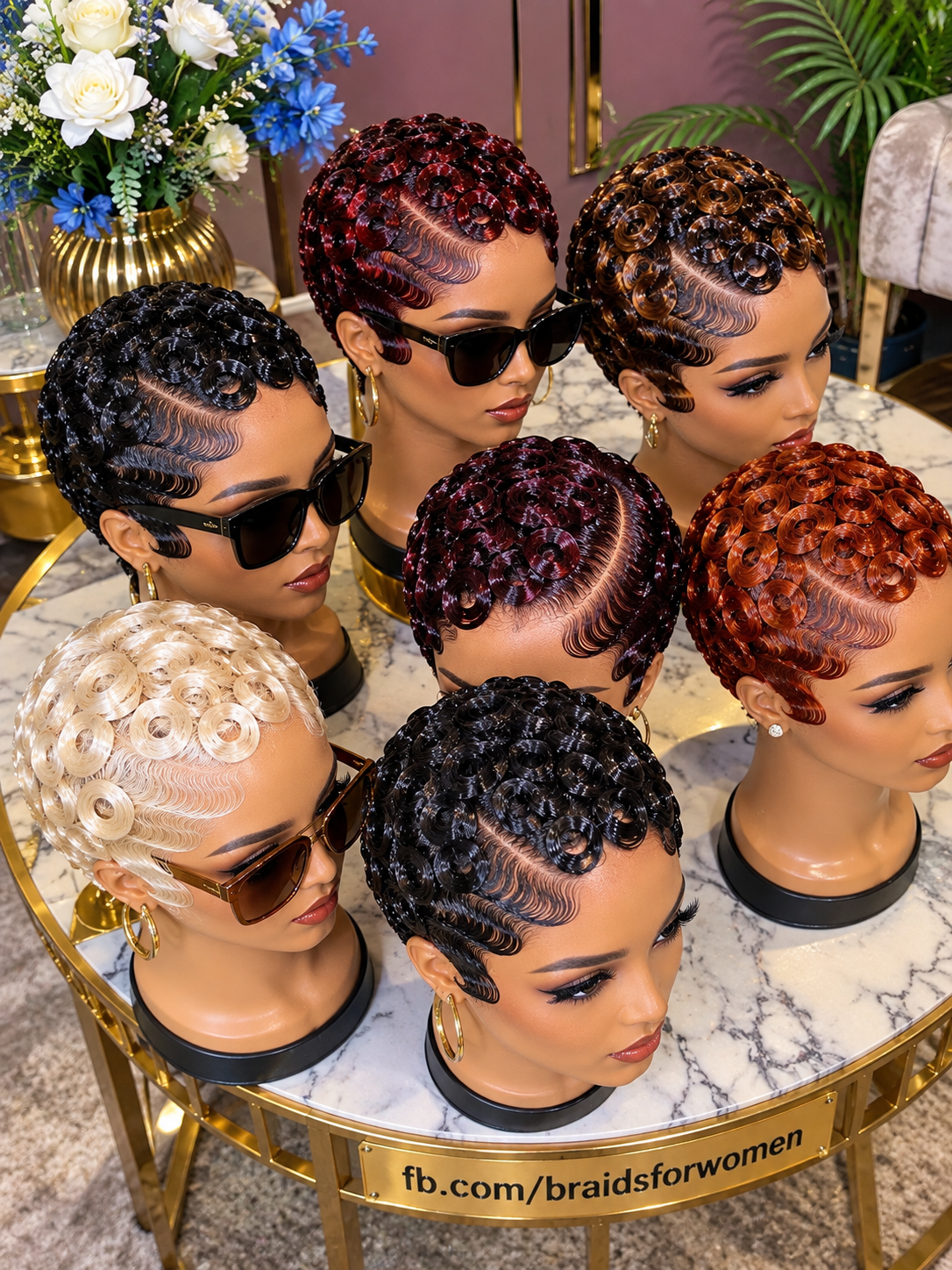
A collection like this shows exactly why the finger curl pixie wig continues to stand out among close-cropped wig styles. Seven wigs are displayed together, sharing a similar compact silhouette while using different colors and slightly different curl placement. The visible shades include glossy black, deep burgundy, black mixed with warm brown, copper, pale blonde and other rich red-brown variations.
The most distinctive detail is the combination of small circular curls across the crown and carefully molded waves around the forehead and temples. Instead of relying on volume, these wigs get their character from precision. Every loop, curve and side section contributes to the finished shape.
The collection also demonstrates how dramatically color changes the appearance of the same basic styling concept. Jet black makes the sculpted pattern look bold and highly reflective, while blonde exposes more of the individual strand work. Burgundy and copper introduce warmer tones that become especially noticeable along the curved surfaces of the curls.
Why the Circular Finger Curls Stand Out
The crown is built from numerous compact loops rather than loose conventional curls. Many of them form almost complete circles, creating the recognizable finger curl pixie appearance seen throughout the collection.
These curls remain close to the head. That matters because excessive height would turn the hairstyle into a fuller curly crop and change its character. Here, the loops create detail without sacrificing the close pixie silhouette.
The glossy surface makes the construction even easier to see. Light catches the outer edge of each curl while the center remains darker, producing natural visual depth. This effect is particularly strong on the black, burgundy and copper versions.
A stylist attempting this look needs to pay attention not only to curl size but also to placement. The loops should overlap naturally instead of appearing as perfectly repeated circles arranged in rows.
Sculpted Waves Give the Front Its Signature Shape
The crown curls are only part of the design. Around the forehead, the hair transitions into sleek sculpted finger waves. These sections follow long curved paths before disappearing into the surrounding curls.
That contrast is important. Dense circular curls provide movement on top, while the flatter wave sections create visible direction around the face. The result is a hairstyle that appears detailed without becoming visually chaotic.
The waves are especially visible on the blonde wig because the lighter strands reveal the fine combed pattern. On the darker units, reflected light creates thin highlights along each molded section.
When ordering a similar wig, reference both elements separately. Asking only for a curly pixie may not communicate the need for these long sculpted sections around the temple and forehead.
Deep Side Parting Creates Structure Between the Curls
Several wigs in the collection show a pronounced diagonal side part. The part creates a clear boundary between the curled crown and the molded front section.
This exposed line is visually important because it prevents the hairstyle from becoming one continuous mass of curls. It introduces a lighter scalp-toned line between darker sections and makes the styling direction immediately recognizable.
The exact position varies slightly across the displayed units, which is useful when commissioning a custom version. A stylist can move the part according to the intended front presentation while preserving the same overall concept.
For a close recreation, provide a reference showing the top of the hairstyle rather than relying only on a straight-on photograph. The overhead angle makes the curl placement and parting direction considerably easier for a stylist to understand.
Jet Black Gives the Curls Maximum Contrast
The black versions are among the strongest examples of the hairstyle’s reflective character. Their glossy jet black curls produce bright highlights around the individual loops while maintaining deep shadows between them.
Black also creates strong contrast against the visible part and molded wave sections. This makes the detailed comb work around the forehead particularly noticeable.
For buyers who want a similar appearance, photographs are more reliable than simply requesting “black.” Some suppliers distinguish between natural black, soft black and jet black, and those shades can look noticeably different under salon lighting.
Burgundy Adds Depth Without Losing the Curl Pattern
Deep burgundy appears repeatedly in this collection. The shade ranges visually from dark wine tones in shadow to brighter cherry-red reflections where the light strikes the curls.
This tonal variation works especially well with circular finger curls because every loop reflects light at a slightly different angle. The result is more dimensional than a flat red surface.
A burgundy finger curl pixie wig can therefore look substantially different under daylight, warm indoor lighting and direct photography. Buyers ordering online should ask for photographs or video taken under more than one lighting condition when exact color matching matters.
Copper Creates the Warmest Look in the Collection
The bright copper version introduces a stronger orange-red direction. Its circular curls remain highly visible, while the warm shade emphasizes the shine across the upper surface.
The darker roots and shadows visible between the curls also create greater depth than a completely uniform bright copper color would provide.
Anyone requesting this variation should provide the actual image rather than asking simply for “ginger” or “copper.” Those names can cover everything from muted auburn to vivid orange depending on the wig supplier.
Brown and Golden Accents Offer Another Direction
One of the wigs combines a darker foundation with warm brown and golden tones across the curled areas. This produces a more varied appearance than the solid-color units.
The lighter sections naturally attract attention to individual loops, helping reveal the circular construction across the crown. Darker strands underneath maintain depth and prevent the hairstyle from appearing uniformly light.
This type of coloring can be useful when someone likes the drama of the sculpted curls but wants more tonal movement than a single black or brown shade provides.
The Pale Blonde Version Reveals Fine Styling Details
The pale blonde unit creates the brightest interpretation of the design. Because the hair is light, the individual strands forming the waves around the forehead are especially easy to see.
Its curls still retain visible separation. Small shadows inside the circular loops provide enough contrast to preserve their shape despite the lighter color.
If purchasing a similar blonde unit, examine the root color as well as the ends. A warm blonde, pale golden blonde and cooler platinum-oriented blonde can produce substantially different results even when the haircut and curl arrangement remain identical.
A Close Pixie Shape Keeps the Style Wearable
All seven wigs maintain a relatively compact profile. There are no long hanging sections, oversized bangs or high crown areas. The curls stay close to the underlying head shape.
This is an important characteristic to mention when requesting a custom unit. Simply asking for finger curls does not establish the desired length or volume.
A useful description for a stylist would be close-cropped pixie proportions with dense circular crown curls and flat sculpted waves around the front and sides.
The perimeter should also remain compact so the curl pattern continues naturally around the head rather than abruptly ending beneath an oversized crown.
What to Ask a Wig Stylist For
When commissioning this look, send several reference photographs if possible. A front photograph shows the molded wave pattern, while an overhead or three-quarter view communicates the crown curl placement and diagonal part much more accurately.
Describe the desired hairstyle as a sculpted finger curl pixie wig with small circular loops, a diagonal side part, glossy molded waves and close-fitting sides.
Specify the color independently. For example, request the same construction in jet black, deep burgundy, copper or blonde rather than assuming the stylist will interpret a general color description exactly as intended.
Ask whether the wig will arrive completely styled and ready to wear. Some wigs are sold in a basic cut and require additional salon setting to achieve this level of curl placement.
Where to Get a Similar Pixie Wig Made
The most suitable professional is usually a custom wig maker or pixie wig stylist experienced with molded finger curls. A general wig installer may specialize primarily in long straight or curly lace units and may not regularly create this type of precision setting.
Review the stylist’s portfolio before booking. Look specifically for compact pixies, finger waves, circular curls and detailed molded styling.
Useful local searches include finger curl pixie wig stylist near me, custom pixie wig maker, finger wave wig salon and sculpted pixie wig stylist followed by your city or neighborhood.
Send the reference photograph when asking for a quotation so the stylist can evaluate the required cutting and styling work before giving a price.
How to Shop for Similar Wigs Online
Searching with descriptive terms is more effective than using a broad phrase such as curly wig. Combine the haircut, curl type, parting and color in the search.
For example, shoppers looking for the darker styles can search for a black finger curl pixie wig with side part, while someone interested in the red versions can use burgundy or copper as the color modifier.
Before ordering, verify the photographs carefully. The crown should show individual circular loops rather than generic curls, and the forehead should contain the long molded sections visible in this collection.
Also ask whether the photographs show the product exactly as shipped. Highly styled display wigs may have received additional salon finishing before photography.
Human Hair and Synthetic Options
The photograph itself does not reliably establish whether these particular wigs are human hair or synthetic, so fiber composition should be confirmed directly with the seller.
A human hair pixie wig may offer greater flexibility when future restyling is important. The curl pattern can potentially be reset by an experienced stylist, depending on the unit’s construction and condition.
A suitable synthetic wig can offer strong shape retention, which can be advantageous when the goal is to preserve one precise finger-curl arrangement. However, heat tolerance varies considerably between synthetic fibers.
Never assume a synthetic wig is heat-safe. Check the manufacturer’s care instructions before using heated styling equipment.
How Much It Costs
The selling prices of the exact wigs shown cannot be determined from the photograph. Comparable pixie wigs vary significantly according to fiber quality, cap construction, coloring and the amount of custom styling involved.
| Wig Category | Typical Estimated Range |
|---|---|
| Premium Custom | $350–$800+ |
| Standard Custom | $180–$425 |
| Basic Human Hair | $100–$275 |
| Premium Synthetic | $60–$160 |
| Basic Synthetic | $30–$90 |
Custom finger curling can increase the price because much of the appearance depends on detailed finishing work. Coloring, cutting and resetting may also be priced separately.
When requesting a quotation, ask what is included rather than comparing the base wig price alone. A cheaper unfinished unit may ultimately require additional professional styling.
Booking an Appointment for Custom Styling
Contact the stylist before purchasing a base wig if you intend to have one customized. The stylist may have specific recommendations regarding length, density or fiber type for this curl pattern.
Send the reference image together with the preferred color and explain that you want the compact circular curls and molded forehead waves retained.
Ask whether coloring, cutting, curl setting and final finishing can be completed during one service or require separate appointments.
For remote custom orders, request photographs from multiple angles before shipment. A front view alone will not show whether the crown and side part have been constructed correctly.
Keeping the Finger Curls in Shape
These carefully arranged loops should not be treated like ordinary loose curls. Brushing through the crown could quickly disturb the circular pattern.
Handle individual curls gently and avoid compressing the top during storage. A suitable wig stand can help maintain the shape between wears.
Use only products compatible with the confirmed fiber type. Heavy product buildup can reduce strand separation and make the compact loops appear stuck together.
If several curls lose their original shape, professional resetting may produce a better result than repeatedly manipulating the entire hairstyle at home.
Seven Colors Show the Versatility of One Sculpted Pixie Concept
This collection succeeds because the underlying hairstyle remains recognizable even as the colors change. The combination of circular finger curls, diagonal parting, molded side waves and close pixie proportions provides a strong visual identity.
Jet black emphasizes contrast and shine. Burgundy creates rich wine-red reflections. Copper brings brighter warmth, brown and golden accents introduce tonal variation, and pale blonde makes the fine styling work especially visible.
When searching for or commissioning a similar wig, concentrate on these structural details first. Color can transform the mood of the finished piece, but the precise curl placement and sculpted front sections are what give this pixie its distinctive appearance.
Search Terms
Finger Curl Pixie Wig · Sculpted Finger Wave Pixie Wig · Deep Side Part Curly Pixie Wig · Burgundy Finger Curl Wig · Copper Finger Curl Pixie Wig · Jet Black Circular Curl Wig · Blonde Finger Curl Pixie Wig · Brown Highlight Finger Curl Wig