
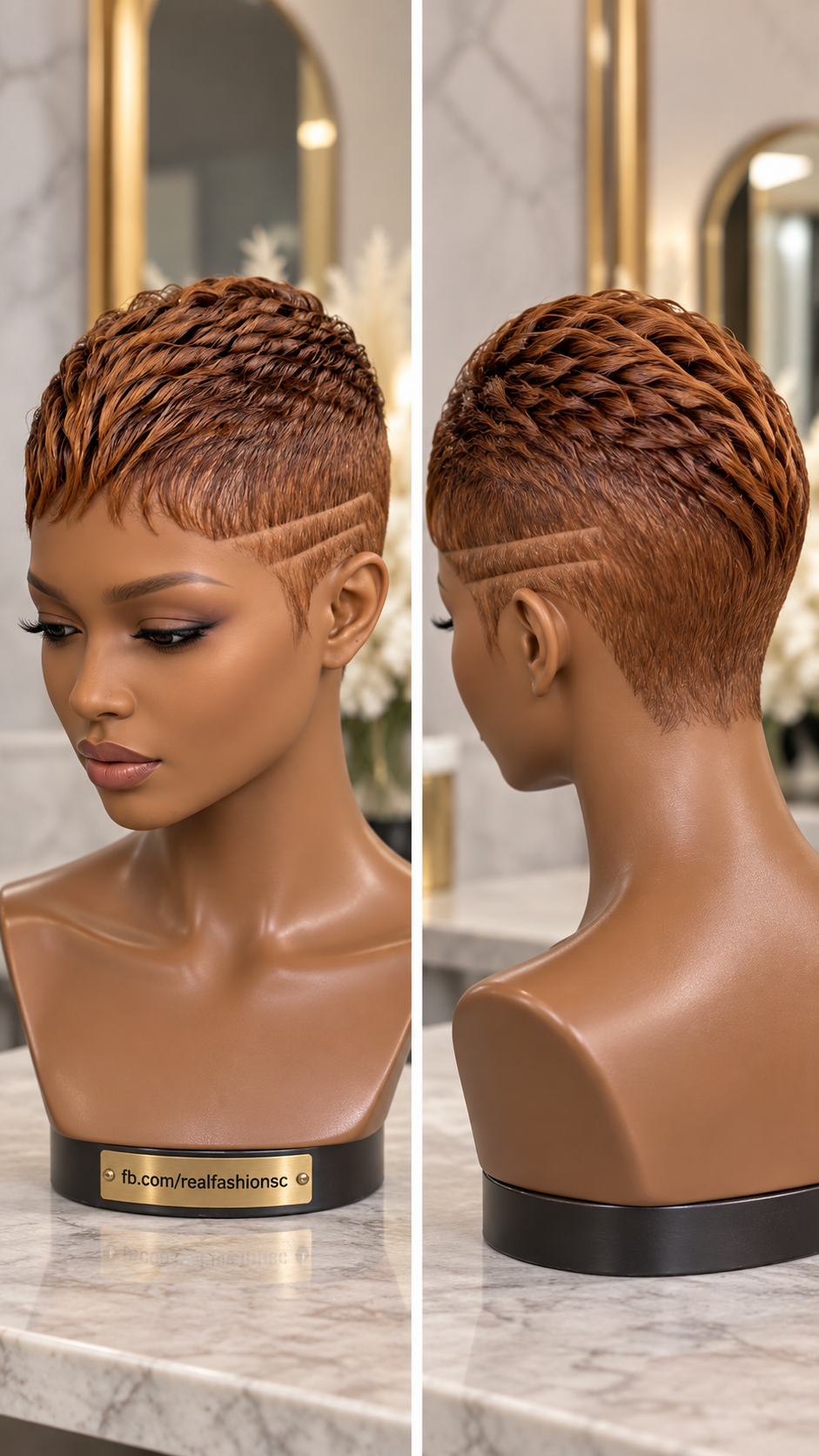
This copper brown pixie wig combines a closely tapered silhouette with longer sculpted layers across the crown. The warm copper-brown shade runs consistently through the style, while the short sides expose two precise shaved-line details above the ear. From the front, the longer top is swept diagonally across the head; from the rear angle, the layered construction and tapered neckline become much easier to see.
The hairstyle is especially suited to anyone looking for a compact pixie that still has visible movement on top. Instead of relying on large curls or heavy volume, the design uses narrow separated sections that overlap across the crown. This creates dimension without making the hairstyle appear bulky.
The two-angle presentation is also useful when ordering a similar unit because it shows that the hairstyle is not simply a cropped wig with a long fringe. The crown, sides, temple area and nape have all been shaped differently to create the complete silhouette.
Warm Copper Brown Gives the Pixie Its Character
The most noticeable feature is the warm copper brown color. It sits between a medium brown and a richer copper tone, producing visible warmth without becoming a very bright orange shade.
Because the hairstyle contains many separated strands, the color catches the light differently across each section. The raised crown pieces appear brighter along their edges, while the closely cropped sides look slightly deeper because the hair lies flatter against the base.
For a custom order, reference photographs are preferable to relying only on a generic color name. Terms such as copper brown, cinnamon brown and warm auburn can vary considerably between wig suppliers. Sending the image gives the seller a clearer target.
Swept Crown Layers Create Direction
The crown contains noticeably more length than the sides. Narrow sections are directed diagonally across the head and layered over one another, producing a swept pixie crown rather than an upright spiky effect.
Some pieces bend gently as they approach the front, while others continue across the upper section. This variation keeps the top from looking like a single solid block of hair.
The rear view shows the construction particularly well. The upper strands overlap in rows and gradually shorten as they approach the back. That progression helps the fuller crown connect naturally with the tapered lower section.
The Front Uses a Light Piecey Fringe
The fringe is relatively light and separated. Several narrow strands fall toward the forehead, but they do not create a heavy straight bang. The result keeps the forehead visible and maintains the compact proportions of the pixie.
This detail matters when commissioning the style. Requesting only a “pixie with bangs” could produce a much denser fringe. A better description is a piecey swept pixie fringe with narrow separated sections connected to the longer crown.
The fringe also follows the same diagonal movement as the upper layers, making the front and crown appear to belong to one continuous design.
Double Side Lines Add a Distinctive Detail
Two narrow parallel lines are visible above the ear. They run diagonally toward the rear and create a strong contrast against the closely cropped side section.
The lines are spaced apart rather than forming one thick channel. They also follow the natural direction of the haircut, which allows them to complement the silhouette instead of dominating it.
When requesting a similar design, specify double parallel side lines and provide a side-view reference. The angle, spacing and length of these lines have a significant effect on the final appearance.
If the wig is being custom constructed, ask the stylist how this detail will be created and maintained on the unit. Precision line work on a wig requires careful control of density and strand placement to remain convincing.
Close-Cropped Sides Balance the Longer Top
The side area remains very close to the head. This reduction in volume is what allows the longer crown to stand out without requiring extreme height.
Around the temple and ear, the perimeter is carefully shaped into a compact contour. The hair becomes progressively shorter-looking as it moves downward, producing a tapered appearance rather than an abrupt transition.
This contrast between the longer swept crown and closely fitted sides is one of the defining characteristics of the hairstyle. If the sides are left too dense, the entire pixie will become rounder and the double-line detail will lose visibility.
The Rear Tapers Into a Soft Point
From the rear three-quarter angle, the neckline narrows into a subtle point. The hair does not end in a heavy horizontal edge. Instead, the density gradually decreases toward the lower center of the nape.
This tapered pixie nape gives the back a salon-cut appearance and helps maintain the slim profile of the hairstyle.
Anyone ordering a similar wig online should request photographs of the back before purchasing. Many pixie wigs can look comparable from the front while having completely different nape construction.
What to Ask for at a Wig Salon
Show the stylist both front and rear reference views and request a copper brown pixie wig with diagonal swept crown layers, close tapered sides, double side lines and a pointed tapered nape.
The stylist should preserve additional length through the upper section while removing enough density around the sides and lower back to reproduce the compact silhouette.
Explain that the top should contain individually visible sections rather than one heavily combed mass. The styling needs enough separation for the layered direction to remain noticeable.
For the front, request a light separated fringe that connects with the crown instead of a thick bang. For the side, show exactly where the two lines should begin and how far they should travel toward the back.
Finding a Stylist for This Type of Pixie
A stylist experienced specifically with custom pixie wigs is preferable for this design. The cut depends heavily on tapering, density control and detailed perimeter work, so experience with longer lace wigs alone may not provide the same result.
When reviewing salon portfolios, look for cropped wigs photographed from multiple angles. Pay particular attention to the nape, ear area and sides rather than evaluating only the front.
Useful local searches include pixie wig stylist near me, custom cropped wig salon, tapered pixie wig stylist and pixie wig customization followed by your city or neighborhood.
Contact the salon before making an appointment and send the reference image. Ask whether they can reproduce both the crown layering and the double-line side detail.
Buying a Similar Wig Online
Searching only for a copper wig will return many unrelated lengths and constructions. More descriptive phrases such as copper brown tapered pixie wig or swept crown pixie wig are more useful starting points.
Check whether the wig shown in the seller’s photographs arrives pre-cut and pre-styled. Some sellers photograph units after additional salon customization, while the product delivered to the customer may require further cutting and shaping.
Ask for current photographs or video when ordering a custom unit. Ideally, the seller should show the front, both sides and back before shipping so that the silhouette and line placement can be checked.
Cap measurements should also be confirmed before ordering. A pixie has less hair available to disguise an incorrect fit, so accurate sizing is particularly important around the ears and nape.
Human Hair and Synthetic Options
The photograph itself does not reliably establish the fiber used, so it would be inappropriate to describe the displayed unit as definitely human hair or synthetic.
For buyers who expect to reshape the crown frequently, a quality human hair pixie wig can provide greater styling flexibility. Individual pieces can generally be redirected and reset more easily when appropriate styling techniques are used.
A quality heat-friendly synthetic unit may also be suitable when the main objective is maintaining a consistent pre-set shape. Synthetic fibers can hold sculpted styling well, although heat limits and maintenance instructions differ between manufacturers.
Before purchasing, confirm the fiber type directly with the seller rather than relying on appearance alone.
How Much It Costs
No price or verified seller information for the exact displayed unit is visible in the image. The following ranges are therefore general estimates for comparable customized pixie wigs and should not be interpreted as the price of this particular piece.
| Wig Category | Typical Estimated Range |
|---|---|
| Premium Custom | $350–$800+ |
| Standard Custom | $180–$425 |
| Basic Human Hair | $100–$275 |
| Premium Synthetic | $60–$160 |
| Basic Synthetic | $30–$90 |
Custom coloring, precision cutting and side detailing can increase the final price. When requesting a quote, ask whether the amount includes the base wig, coloring, cutting, styling and final customization.
Booking the Appointment
Send the reference photograph before confirming your appointment. Tell the stylist that the most important elements are the copper-brown shade, diagonal crown movement, compact sides, two parallel side lines and tapered rear.
If you already own the wig you want customized, send photographs showing its current length and density. The stylist can then determine whether the existing unit has enough hair through the crown to create the layered upper section.
If the wig will be constructed specifically for you, follow the maker’s measurement instructions carefully. Circumference, front-to-nape and ear-to-ear measurements can all influence how naturally a close-cropped wig sits.
Maintaining the Separated Crown Sections
The upper layers should not be aggressively brushed together because their visible separation is part of the design. Instead, reposition individual sections carefully when the crown begins to lose its direction.
Use only products appropriate for the wig’s confirmed fiber type. A lightweight finishing product can help control flyaways, but excessive product may cause the narrow sections to stick together and reduce the layered effect.
When the wig is not being worn, store it so that the crown is not compressed. Maintaining the direction of the upper strands will reduce the amount of restyling needed before the next wear.
Professional maintenance can also be useful after repeated use, particularly if the tapered perimeter or double-line detail begins to lose its original precision.
Why the Shape Works So Well
This pixie relies on proportion rather than excessive volume. Additional length is concentrated exactly where movement is needed, while the sides and nape remain narrow and controlled.
The warm copper-brown color makes the individual crown sections easy to see, and the double parallel lines introduce a graphic element without overwhelming the haircut. From behind, the tapered nape completes the compact silhouette.
For anyone commissioning a similar piece, the most important details to preserve are the swept layered crown, copper brown color, double side lines, close sides and tapered nape. Together, those characteristics create the specific appearance shown in the reference.
Search Terms
Copper Brown Pixie Wig · Swept Crown Pixie Wig · Double Line Pixie Wig · Tapered Nape Pixie Wig · Copper Pixie Cut Wig · Piecey Fringe Pixie Wig · Layered Crown Pixie Wig · Warm Brown Tapered Wig