
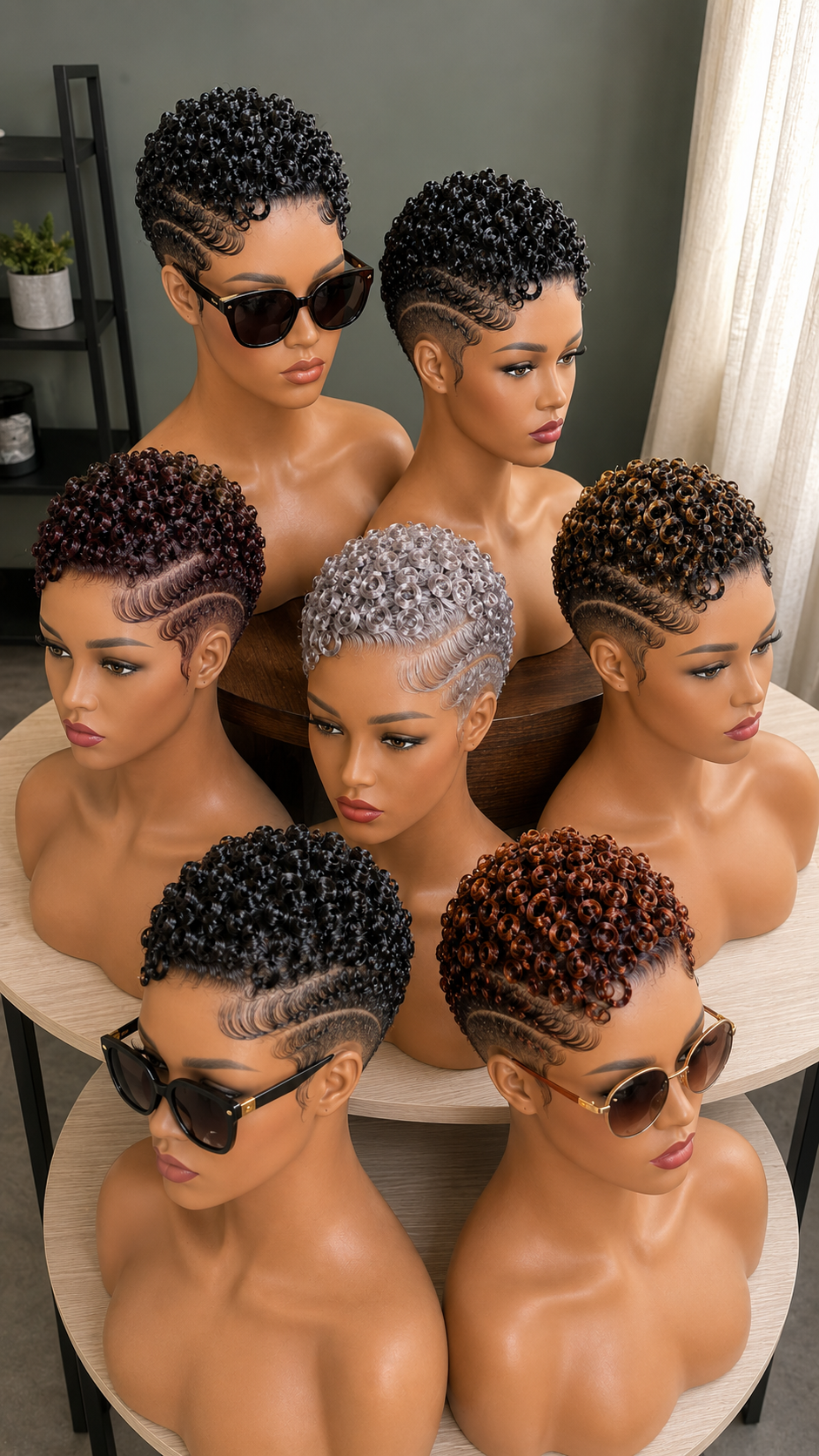
Seven heads. Fourteen styled zones. The colours are the easy part.
Every tight coil pixie wig on this table is doing two jobs at once: a laid S-wave along the hairline and a track panel on the temple. Black, wine, silver, honey and copper only change how loudly those jobs show. If you shop the photo as a colour picker, you will take home a dual-maintenance haircut you did not budget time for.
What This Photo Is Actually Showing
Two tiers of mannequins sit on round wood tables against a grey wall. Sunglasses sit on three heads. That is styling. It is also a problem, because two of those three are a black unit and a copper unit — the heads that would have shown lace and fade most clearly next to the silver one in the centre.


The shared cut:
A compact spring-coil lid
Finger-wave or S-wave work flattened onto the front
Two or three temple tracks dropping into a short fade
A low, rounded silhouette with no spare length
The dye book:
Jet black, three times
Burgundy / wine
Silver / icy grey in the middle
Honey-and-black highlight
Copper / ginger
Art108 said seven swoops were one family and colour was not the test. Art127 said seven colours were still one three-track temple. Art134 isolated the front wave on a single hold. This grid is those two graphics stacked on the same cap, seven times. That stack is the SKU.
You cannot treat the front like a TWA hairline and the side like a plain fade. They were shot as a pair. They will fail as a pair if you wash them as one texture.
Two Zones Means Two Failure Points
The lid is the easy third. Tight coils can look acceptable a little frizzy. The front wave cannot. The temple tracks cannot.
After one wash, three different things can happen on the same tight coil pixie wig:
Coils open and gain height
S-waves melt into a straightish fringe of short hair
Tracks collapse into one fuzzy panel above the ear
Any one of those changes is visible on a short unit. Two at once makes the photo look like a different product. That is why a range shot like this is persuasive and why it is dangerous. The shop styled fourteen edges. You will have to restyle fourteen edges, or accept a plainer cap than the listing sold.
Built-in versus product is the only question that matters, and it must be asked twice.
Front: are those waves knotted to fall forward in an S, or only gelled onto the lace for the camera? If they are knotted directionally, a softer wave can come back. If they are gel, the first rinse returns a coil hairline.
Side: are the tracks cut or braided into short density, or combed for the afternoon? Two or three even parts that match on all seven heads is a point in favour of a mould. Two or three parts that sit at different heights — look at the wine head versus the back-row black — is a point in favour of a stylist with a comb.
Ask for one dark unit and the silver unit dry, no glasses, temple and hairline in the same frame. If the seller only has this tiered display, they have shown the finished salon hour, not the cap.
Silver Is Still The Inspection Camera
Place the icy head in the centre and you are being told where to look. Do that.
On silver you will see:
Mesh in the front wave
Gaps between springs
Whether the tracks are hair or drawing
Product lines the black units swallow
Art116 and art130 used pale fibre the same way. The difference here is you are auditing two graphics at once. If the silver front is a film of gel and the silver side is a sketch, the black sisters on this table are wearing the same sketch under better lighting.
Honey-highlight and copper do a smaller version of the same reveal. Highlight lids make the dark tracks look like a separate piece — because they are a separate dye and a separate length. That split will drift. The lid warms. The side stays dark. You will own a two-tone head even if you did not order one.
Sunglasses on the front-row black and copper hide the exact join you need. Ask those two without eyewear.
A Two-Tier Table Is Not A Fit Test
Height in the photo is furniture. Every mannequin skull is still the same size.
A dual graphic is directional twice. The wave has to sit on your forehead. The tracks have to sit above your ear. Wrong circumference throws both landmarks at once. A cap that is slightly large lifts the lace and smears the first wave. A cap that is slightly small pushes the fade onto the ear and makes the tracks look like a mistake.
Measure your head. Write the number down before you pick wine because it photographs well on the middle shelf. Straps fine-tune two to three centimetres. They do not slide a wave and a panel onto two landmarks at the same time.
Glueless only works if the base already matches. Dual styling does not glue a loose cap down. If anything, product weight on the front and a slick temple make slide more obvious.
Care Has To Split Or The Photo Dies
Treat the lid like a short wash-and-go: cool water, leave-in on the springs only, press, do not rake.
Treat the front like a molded set: expect to rebuild it with a small amount of product and a comb after most washes, unless the seller proved directional knotting.
Treat the side like a fade or a mini braid panel: rinse, do not fluff, keep parts clean, almost no cream in the grooves.
That is not “high maintenance” as a slogan. It is three small jobs. Skip two of them and you still have coils. You no longer have this listing.
Sleep on satin. A dual graphic rubs off on cotton faster than a plain TWA. Storage on a form keeps the lid from flattening into the wave. Art25 was storage for shape; it applies harder when two edges have to stay sharp.
How Much A Dual-Graphic Coil Range Costs
Human-hair tight-coil pixie wigs with a lace front commonly sit between $160 and $280 in black. Wine, copper and honey often add $30 to $80 because of dye. Silver, if lifted human hair, can sit $60 to $140 above black and will need toning. Synthetic versions of this coil-plus-wave-plus-track look usually sit between $45 and $120.
Price the graphics, not the shelves.
A plain black coil cap with no wave and no tracks is the control. This SKU should cost more than that control if the side is cut in and the front is densely knotted. If every colour on this table is the same price as a no-design TWA, you are paying for a photoshoot. If silver costs a jump, make the seller show why — even fibre and a clean part, not only a central placement on a wooden riser.
Do not pay a human-hair premium for silver or copper unless you have seen those two dry. Synthetic ice and synthetic ginger often hold the contrast against the dark temple with less work. That is the same honest exception this series keeps finding on pale and fashion shades. The cut can still be human-grade or cheap; fibre and dye are separate bills.
Where To Buy This Tight Coil Pixie Wig
Buy from a seller who will name both graphics — laid front and temple tracks — and will shoot them dry on at least two colours.
[WhatsApp: +XX XXX XXX XX XX]
Ask whether the tracks are built in on every SKU or only on the display heads.
Ask how deep the lace panel is. A dual look that sits on a sliver of mesh will lose the wave when you trim.
Ask cap size against your tape, not against the mannequin row.
Ask human versus synthetic on silver, copper and wine separately. Shops mix fibre inside one photo.
If you only intend to wear the coil lid and you do not want to rebuild waves or parts, buy the plain dome instead. This table is not that product.
Shipping And What Arrives
Coils crush. Waves flatten into commas. Tracks smear. The box look is closer to a smashed TWA than to this display.
Put the cap on a form the day it arrives. Let the springs lift. Then look at the forehead and the temple before you touch scissors. If either graphic is gone, it was product. Use the return window. A trimmed tight coil pixie wig is rarely returnable, and a dual graphic you have already cut cannot be sent back as “not as pictured” with much leverage.
Do not copy the sunglasses or the two-tier styling at home and call that a test. Daylight on the silver head, no extra gel, is the test.
Before You Pay
Count zones, not heads. Front wave and side tracks are two specs.
Use silver as the audit. Then look at copper and wine.
Ask for dry frames without glasses.
Decide if you will restyle two edges after a wash. If not, pick a plain coil cap.
Measure your head. Two landmarks have to land.
Search Terms
coil pixie wig wave and tracks
tight coil temple cornrow range
silver coil pixie laid swoop
black burgundy copper TWA cap
glueless tight coil pixie wig
finger wave coil pixie fade
two zone curly pixie haircut
short spring coil colour set
Final Thoughts
This table is one haircut sold in seven dyes. The haircut is a coil lid plus a molded front plus a tracked temple.
Buy it if you want that full graphic and you will maintain both edges. Buy black if you want the same cut with less noise. Buy silver only after it has been shown dry. Do not buy the riser, the glasses, or the idea that colour was the decision. Colour is what you notice first. The two zones are what you live with.