
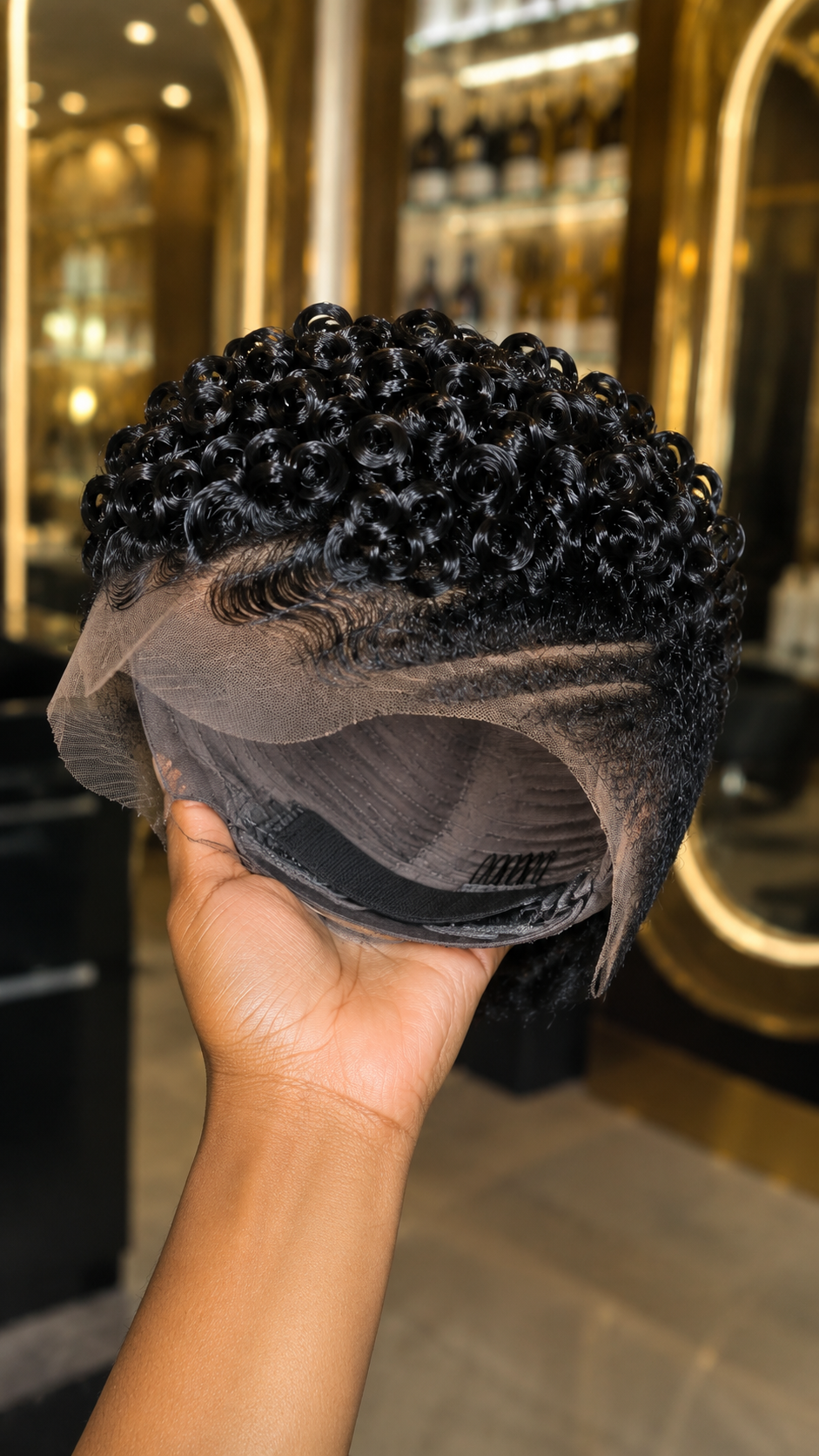
A dense curly pixie wig needs enough hair to create a rich, complete crown, but simply adding more curls does not automatically produce a better result.
The black pixie wig shown here has a very compact crown made from numerous small glossy curls. The curls sit close together, creating strong coverage across the top while the sides remain significantly shorter. Even with that fullness, the crown does not extend outward like a large rounded cap.
That difference is important.
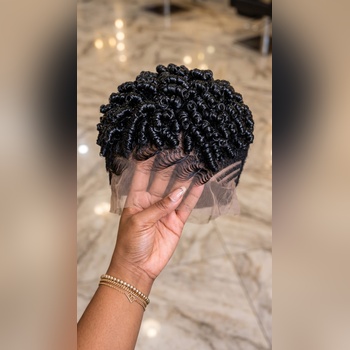
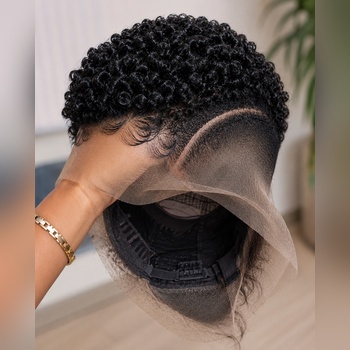
A good short curly pixie needs density in the right places rather than maximum density everywhere.
Too little hair can expose large gaps between curls. Too much hair can make the crown oversized, hide the short-side detailing, increase weight, and completely change the intended pixie silhouette.
When ordering this type of wig, crown density should therefore be considered together with curl size, curl placement, crown height, side length, and cap construction.
Where To Buy A Dense Short Curly Pixie Wig
Custom wig makers. Custom construction is one of the best choices when crown proportion matters. Send several reference angles and explain that you want a compact, densely curled crown rather than a tall or oversized curly top.
Local wig boutiques. Shopping in person lets you inspect the crown from above, from the side, and from the back. This is especially useful because frontal product photos can hide excess bulk.
Instagram and TikTok wig sellers. Ask for a slow 360-degree video of the exact unit. Pay attention to the crown when the seller is not touching or fluffing the curls.
Etsy wig makers. Independent makers may allow you to select human hair or synthetic fibre, cap measurements, lace type, crown density, curl size, and side detailing.
Online wig stores. Search for short curly pixie wig, compact curly pixie wig, black pixie wig for black women, glueless curly pixie, short human hair pixie wig, or tapered curly wig.
Amazon, AliExpress, and Temu. Budget units are widely available, but compare customer photos carefully. Two wigs advertised under the same style name can have very different crown density.
Professional wig salons. A stylist may also be able to reshape an overly full existing wig by redistributing or carefully reducing unnecessary bulk.
Wholesale wig suppliers. For resale orders, request density consistency across several sample units before purchasing a large quantity.
Order inquiries: WhatsApp [WhatsApp: +XX XXX XXX XX XX]
What Does A Dense Curly Pixie Wig Usually Cost?
Premium Custom Human Hair: approximately $280–$550+. Premium construction can include high-quality human hair, custom cap measurements, HD or Swiss lace, bleached knots, hand-set curls, side detailing, combs, and an adjustable strap.
Standard Custom Human Hair: approximately $190–$380. This range can provide good human hair with custom crown shaping and professional finishing.
Basic Human Hair: approximately $130–$260. The basic silhouette may already be present, although additional crown shaping can sometimes improve the finished result.
Premium Synthetic: approximately $70–$170. High-quality synthetic fibre can be particularly effective for small structured curls because it maintains its shape well.
Basic Synthetic: approximately $30–$90. Affordable units can reproduce the general look, but density and curl placement may be less consistent.
Custom coloring, cap construction, lace upgrades, hand-tied ventilation, bleached knots, professional fitting, shipping, and additional styling can increase the final price.
Fullness And Bulk Are Not The Same Thing
A full wig looks complete.
A bulky wig looks unnecessarily large.
The difference often comes from where the hair is concentrated.
On a short pixie, the crown should provide enough coverage to prevent obvious gaps while still following the compact shape of the head.
If excessive hair is stacked vertically, the crown becomes taller rather than simply fuller.
That can transform a pixie into an entirely different silhouette.
Small Curls Can Create Fullness Without Extreme Height
Numerous small curls naturally fill visual space.
Because each curl contributes its own shape and highlight, the crown can appear very rich even when the individual strands are relatively short.
This is one reason small curls work so well on compact pixie wigs.
You do not necessarily need long hair or extreme density to create a visually full crown.
Curl Diameter Changes Perceived Density
Small curls create more visible curl units across the same area.
Larger curls create fewer, broader shapes.
Two wigs can therefore contain a similar amount of hair while looking completely different.
If your reference contains many small curls, ordering the correct curl diameter may be just as important as specifying density.
Uniform Curl Size Can Look Too Artificial
Realistic crown construction does not require every curl to have exactly the same diameter.
Slight variation creates depth.
Some curls can be tighter while others open slightly.
The important thing is that they remain within the same general curl family.
Extreme random variation can make the crown look messy rather than natural.
Density Should Follow The Head Shape
The crown should not look like a separate ball of curls attached to the cap.
Hair placement should follow the curvature of the head.
That means the highest concentration of visible curls can sit through the central and upper crown while the perimeter gradually connects with the shorter sections.
This transition is what keeps a dense wig looking compact.
The Perimeter Needs Less Bulk
The outer edge of the crown is particularly important.
If it contains the same heavy volume as the center, the hairstyle can develop a mushroom-like silhouette.
Slightly reducing visual bulk near the perimeter allows the crown to transition into the short side more naturally.
The center can remain rich without making the entire wig equally thick.
Visible Scalp Is Not Automatically A Problem
Some buyers assume that no base should ever be visible between curls.
That is not always necessary.
Tiny controlled glimpses of the underlying base can create depth and separation.
The problem begins when the gaps become large enough to look like missing hair.
There is a difference between intentional visual separation and obvious sparse patches.
Large Empty Areas Are A Warning Sign
Inspect photographs of the crown from above.
You should not see large irregular openings between curl clusters.
If one area has strong coverage while another exposes a significant amount of base, the ventilation or curl placement may be inconsistent.
This becomes particularly noticeable under bright overhead lighting.
Flash Is A Useful Density Test
Phone flash can reveal gaps that softer salon lighting hides.
Dark curls reflect strongly while exposed lace or cap material can become much brighter.
Ask the seller for one flash photograph from slightly above the crown.
It is a simple way to inspect coverage before buying.
Daylight Gives A More Realistic Impression
Flash is useful for detecting problems, but daylight gives a better idea of everyday appearance.
Ask for both when purchasing an expensive custom wig.
A crown that looks balanced under direct flash and natural daylight is usually easier to photograph in different environments.
The Front Should Not Carry All The Density
Some wigs are heavily packed around the frontal area to create an impressive product photo.
The rear crown may then be noticeably thinner.
Ask for an overhead and rear view.
Density should feel intentional across the complete crown rather than concentrated only where the camera normally sees it.
Rear Crown Coverage Matters
The back is easy to overlook when ordering online.
Yet it is highly visible when the wearer turns around.
The rear crown should maintain enough curl coverage before transitioning into the shorter nape.
Large gaps at the back can make an otherwise expensive wig look unfinished.
Side Density Should Transition Gradually
The crown and cropped side should not look like two completely unrelated pieces.
There needs to be a transition zone.
The outer curls can gradually become shorter or sit closer to the head as they approach the side.
This makes the change in length feel intentional.
Too Much Overhang Can Hide Side Details
If the crown curls extend too far over the short section, carved lines or other side detailing can disappear.
That defeats one of the most distinctive features of this pixie style.
The lowest curls should frame the upper edge of the side without covering the entire design.
Crown Height Needs To Stay Controlled
A dense crown naturally creates some height.
That is fine.
The issue is excessive vertical stacking.
Look at the wig from the side rather than judging height from a frontal photograph.
The top should remain proportionate to the short sides.
Compact Curls Photograph Well
Small glossy curls catch light from many different angles.
This creates numerous highlights across the crown.
The result can look extremely rich in social media photographs without requiring excessive hair volume.
Good curl placement often contributes more to the visual effect than simply increasing density.
Shine Can Make A Crown Look Fuller
Glossy strands create separation between individual curls.
Each reflected highlight helps define another curl.
A completely matte crown can visually collapse into one dark mass.
Healthy shine therefore contributes to the perception of density.
However, the hair should look polished rather than greasy.
Excessive Product Can Reduce Visible Detail
Too much gel, mousse, or oil can cause neighboring curls to stick together.
Several individual curls then begin looking like one large clump.
Ironically, a heavily styled dense wig can appear less detailed.
Use enough product to maintain shape without eliminating separation.
Curl Openings Should Remain Visible
Many of the curls in a compact pixie have small visible centers.
Those openings help communicate the curl structure.
If every curl is compressed flat, the crown loses dimensionality.
If every curl is opened excessively, the style can become loose and oversized.
The goal is controlled three-dimensional shape.
Density Needs To Work With Hair Type
Human hair and synthetic fibre behave differently.
Human hair may relax slightly after washing and require restyling.
Synthetic curls can maintain their factory structure longer but may offer less freedom for major reshaping.
The ideal density depends partly on how the chosen fibre behaves after repeated wear.
Human Hair Can Expand After Washing
A compact human-hair wig may become slightly larger after washing if the curls are not reset in their original direction.
That does not necessarily mean the wig contains too much hair.
The curl pattern may simply need to be re-established.
Photograph the wig before washing so you have a reference for restyling.
Synthetic Curls Can Hold A Compact Shape Longer
Quality synthetic fibre can be useful for highly structured pixie curls.
The loops often remain consistent through repeated wear.
However, always check the manufacturer’s heat limitations before attempting adjustments.
Excessive heat can permanently damage synthetic fibre.
The Cap Should Not Be Used To Fake Fullness
A poorly fitting cap can make the crown appear distorted.
If the cap is too large, excess material underneath may create uneven height.
If it is too small, tension can flatten sections of the crown.
Correct cap size is part of achieving the intended density.
Check The Wig Without Hand Support
Handheld product photos are useful for showing construction.
But the seller’s hand can squeeze or reshape the crown.
Ask for the wig on a mannequin or model.
You need to see how the curls sit when nothing is manually controlling the silhouette.
Look At The Wig From Above
The overhead view is one of the best density checks.
It reveals whether the crown has even coverage.
It also shows whether the curls follow a deliberate distribution rather than forming random dense and sparse areas.
For a short wig, this angle is extremely valuable.
Look At The Wig From Eye Level
Overhead photographs tell you about coverage.
Eye-level photographs tell you about bulk.
Use both.
A crown can look perfect from above but surprisingly tall from the side.
Density Should Match The Intended Curl Pattern
Do not copy a density percentage from an unrelated wig.
A long straight wig and a short curled pixie behave completely differently.
The same nominal density can produce dramatically different visual volume.
Use the finished appearance as the main reference rather than relying only on a percentage.
Ask For Visual Density Instead Of Only A Number
Sellers frequently describe wigs using percentages such as 130%, 150%, or 180%.
Those numbers can be useful, but they are not perfectly standardized across every manufacturer.
When ordering a highly specific pixie, send reference photographs in addition to discussing percentages.
Visual targets are often more reliable.
Crown Density Should Support The Side Design
This pixie includes a very short side with carved detailing.
The crown should complement that structure.
If it becomes too large, the balance shifts entirely toward the top.
If it becomes too sparse, the short side may visually dominate.
The strongest result keeps both elements readable.
Dark Hair Can Hide Small Density Differences
Black hair absorbs more light than very pale hair.
Small inconsistencies can therefore be less obvious under ordinary lighting.
Flash and overhead lighting reveal them more clearly.
Inspect dark pixie wigs under several lighting conditions before approving custom work.
Very Light Colors May Need Different Visual Density
Platinum, silver, and pale blonde fibres reflect considerably more light.
Individual strands can become easier to distinguish.
A density that looks compact in black may appear visually busier in a very light color.
If changing the reference color, evaluate the complete silhouette again rather than assuming the same construction will produce an identical effect.
Custom Coloring Can Affect Curl Condition
Human hair that has undergone significant lightening may behave differently from untreated dark hair.
Ask whether the wig is colored from darker hair or constructed using pre-colored hair.
The answer can affect maintenance expectations and curl longevity.
Do Not Thin A Dense Crown Randomly
If a finished wig feels too bulky, avoid cutting random curls from the top.
That can create permanent holes.
A professional stylist should evaluate where the excess visual weight actually sits.
Often the perimeter or internal volume needs adjustment rather than the visible top curls.
Do Not Cut The Curl Centers
Randomly shortening individual loops can destroy the repeating shape.
Short pixie curls depend heavily on their finished ends and direction.
Any density reduction should preserve the visible curl architecture.
A Stylist Can Redistribute Visual Weight
Sometimes the wig does not actually contain excessive hair.
The curls may simply be concentrated in the wrong direction.
Repositioning several curl clusters can lower the crown and spread coverage more evenly.
Try styling adjustments before removing hair permanently.
Maintenance Should Preserve Separation
When refreshing the wig, work through small sections.
Do not compress the entire crown together.
Allow individual curl groups to remain visible.
This maintains the detailed appearance that makes a dense short pixie attractive.
Store The Wig Without Crushing The Crown
Do not place heavy objects on top of a structured pixie wig.
A mannequin head or suitable wig stand can help maintain the silhouette.
If the crown is repeatedly flattened during storage, restoring dozens of small curls can become time-consuming.
How To Find A Stylist For This Look
Search for a short pixie wig stylist, custom curly wig maker, pixie wig specialist, short human-hair wig salon, or custom wig stylist near me.
Check portfolios for short wigs specifically.
A stylist who mainly works with long lace fronts may not necessarily specialize in compact pixie construction.
Send the reference image before booking and ask whether they can reproduce the crown density and small curl scale.
Appointments can normally be arranged through phone, WhatsApp, Instagram DM, Facebook, or the salon’s booking system.
What To Tell The Wig Maker
Explain that you want a dense but compact curly crown.
Ask for many small curls with visible individual separation rather than a few oversized curls.
Specify that the crown should remain close to the head and should not become excessively tall.
Ask for good coverage from the front through the rear crown.
If the wig contains carved side details, explain that the outer curls should not hang low enough to hide them.
Send front, side, rear, and overhead reference images whenever possible.
Before You Pay
- Can you show the crown from directly above?
- Can you show the wig from eye level?
- Does the rear crown have the same quality of coverage?
- Can you show the exact unit under phone flash?
- Can you show it in natural light?
- What curl size is used on the crown?
- Is the crown hand-set?
- Is the wig human hair or synthetic?
- What density specification does the maker use?
- Will the curls sit this compactly without hand support?
- Can you show the wig on a mannequin or model?
- Will the crown hide any of the short-side design?
- What cap sizes are available?
- Are combs and an adjustable strap included?
- Can I approve the finished crown before shipping?
Search Terms
dense curly pixie wig · compact curly pixie wig · short black curly wig · curly pixie wig for black women · short human hair pixie wig · glueless curly pixie wig · small curl pixie wig · tapered curly pixie wig · short lace pixie wig · black curly wig with shaved sides · pixie wig with side design · custom short curly wig · compact curl wig · short curly human hair wig · wig shop near me
Final Thoughts
A dense curly pixie should look full without becoming oversized.
That balance comes from much more than the amount of hair used. Curl diameter, placement, crown height, perimeter control, side transition, cap fit, and styling direction all influence how dense the finished wig appears.
Small curls can create impressive coverage because many individual shapes occupy the crown at once. This allows the wig to look rich while remaining relatively compact.
When ordering online, do not judge density from one frontal photograph. Request overhead, side, rear, daylight, and flash views of the actual unit.
Pay particular attention to the outer crown. It should connect naturally with the short sides rather than creating a heavy shelf of curls above them.
For custom work, the clearest request is not simply “make it very full.”
Ask for a crown that is densely covered, compact in height, evenly distributed, and still separated enough for the individual curls to remain visible.
That is what gives a short curly pixie richness without unnecessary bulk.