
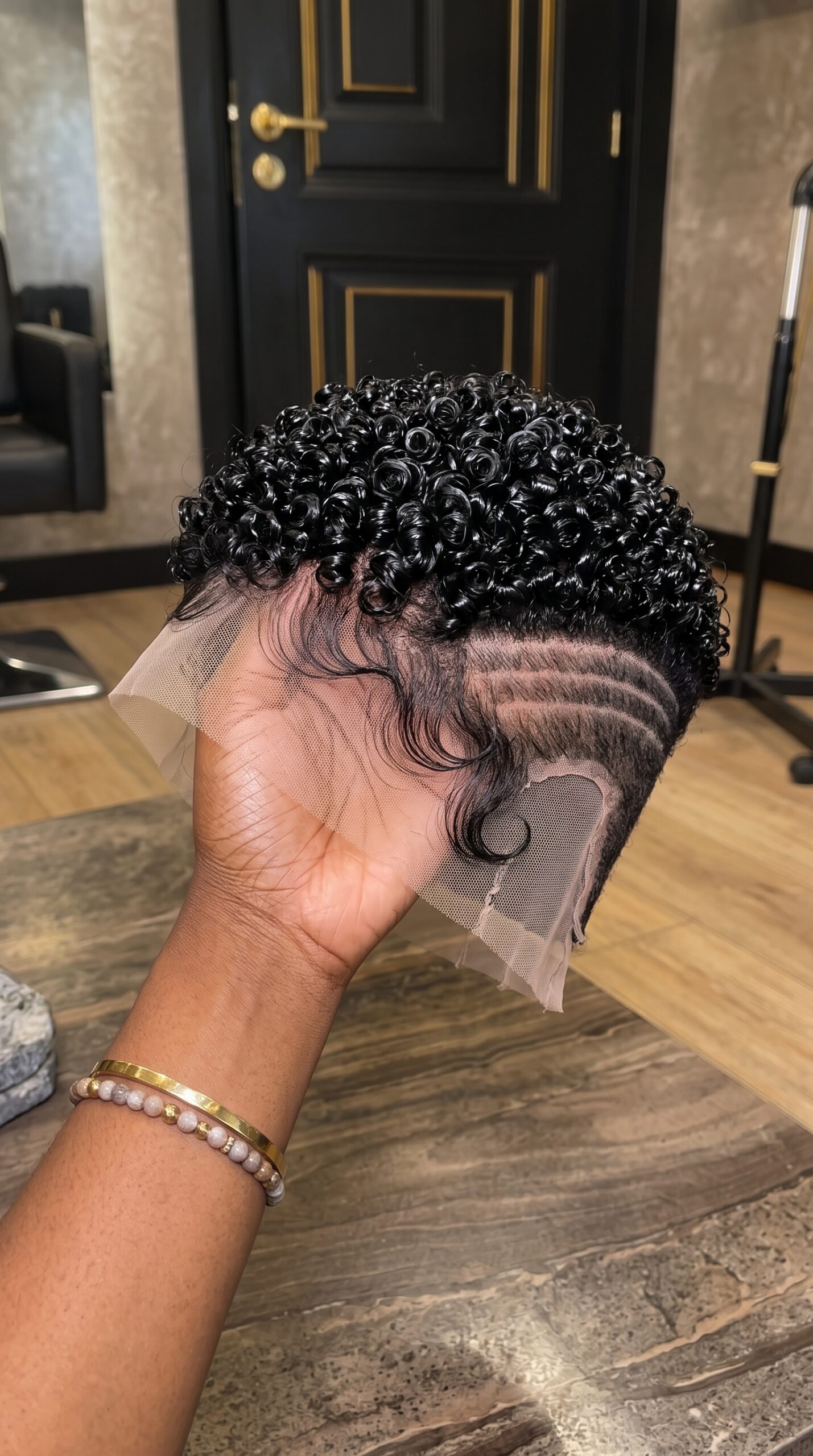
A lace frontal can disappear beautifully across the forehead and still leave one difficult area behind: the temple. On a short curly pixie like this one, the frontal eventually has to meet the much shorter side construction. That junction sits almost completely exposed because there is no long hair available to fall over it.
This makes the temple one of the most unforgiving areas on a short wig. The lace can be thin, the ringlets can be glossy, and the faded side can be beautifully shaped, yet a bulky or badly positioned transition between those sections can immediately interrupt the illusion.
Before buying a pixie like this, look beyond the center of the frontal. Find the exact point where the lace hairline becomes the short side panel and judge whether those two constructions appear to belong to one haircut.
Where To Buy A Curly Pixie Wig With A Better Temple Transition
Custom wig makers. A custom maker is usually the strongest option when the temple area matters. Send a close side reference and ask specifically how the frontal will connect with the faded section around the temple and ear area.
Instagram and TikTok sellers. Ask for a close side video with the hair left in its normal position. Sellers often focus on the center hairline, but this style needs a slow view across the temple where the lace and short side meet.
Etsy. Independent makers may allow more control over frontal width, temple shape, cap size, short-side construction, and the amount of lace extending around the side.
Marketplaces like Amazon, AliExpress, and Temu. Listing photos often hide the transition under carefully arranged baby hairs. Compare customer side photos and look specifically at the area immediately above and in front of the ear.
Local beauty supply shops and salons. Local buying gives you a major advantage with this type of pixie. Hold the unit at eye level and inspect the temple from only a few feet away. Do not judge it solely from directly in front.
Vendors and wholesalers direct. Ask whether the short side is ventilated into lace, attached as a separate panel, machine constructed, or combined with another cap section. The construction method affects how obvious the junction may become.
Regionally. Wig makers in Lagos, Accra, Atlanta, London, and major South African hair markets may build short faded pixies differently. Instead of asking only whether the wig is lace frontal, show the exact temple area you want reproduced.
Vet the seller. Favor sellers who can show the wig without fingers covering the side and without a thick layer of edge product sitting over the temple.
Red flags. Be cautious if the frontal suddenly changes colour or thickness near the side, if a hard ridge is visible beneath the hair, if the short panel begins too abruptly, or if the seller never provides a true side view.
When you order, send. Provide your cap size, temple-to-temple measurement, ear position if requested by the maker, frontal reference, side profile, and the exact amount of short-side exposure you want.
Contact / order inquiries: WhatsApp [WhatsApp: +XX XXX XXX XX XX]
How Much It Costs
Premium custom human hair. A carefully built human-hair curly pixie with refined frontal lace, controlled temple construction, a short faded side, and hand-styled ringlets can commonly range from around $240–$470 depending on hair quality, lace, cap construction, and labour.
Standard custom human hair. Around $180–$330 can cover many good short units. At this level, a well-handled temple junction can make a bigger visual difference than adding unnecessary density to the crown.
Basic human hair. Around $150–$240 may buy a simpler unit with a more generic frontal shape, heavier temple construction, or less customized side placement.
Good synthetic. Around $60–$150 can work well when the cap pattern is thoughtfully manufactured. The fibre itself may hold the ringlets easily, but the temple still needs accurate geometry.
Basic synthetic. Around $25–$70 is common for budget units. Check for thick seams, obvious mesh changes, rigid side tabs, and frontal edges that stop too abruptly near the temple.
What the price may exclude. Custom cap sizing, lace tinting, temple customization, carved side work, knot work, and professional fitting may all cost extra.
Shipping and duty. International shipping, customs charges, and local taxes can significantly increase the final cost. Compare the delivered total rather than only the listing price.
Ongoing costs. The temple receives frequent contact from fingers, glasses, adhesive cleanup, and removal. That means even a well-built junction deserves careful handling.
First-year total. Include lace care, curl products, possible side repairs, and professional fitting if the temple requires adjustment after repeated wear.
Cost per wear. A more expensive wig that sits correctly through the temple can provide better value than a cheaper unit that needs constant baby-hair styling to disguise a poor side connection.
What a very low price may signal. It can indicate a generic frontal attached to a generic short cap without enough attention to how those sections meet around the side of the head.
Deposit structure. Custom makers commonly request around 30–50% upfront and the remaining balance before shipping. Keep your temple reference with the order because front-facing photographs alone do not specify this area.
Shipping, Delivery, And What To Expect After Ordering
When the wig arrives, inspect the temple before cutting the lace.
Place the cap in its intended position and look at where the frontal edge travels from the forehead toward the side. Follow it until the lace construction begins meeting the shorter faded section.
Do this on both sides. Even if the haircut is intentionally asymmetrical, both temple junctions should still look deliberately built.
The Center Hairline Is The Easy Part
The middle of a frontal sits across a relatively broad, flat section of the forehead.
There is enough lace area for density to transition gradually, and there is usually more hair available to soften the edge.
The temple is different.
The head begins curving sharply, the ear is nearby, the short side may begin immediately, and the available construction space becomes much smaller.
That combination makes the temple a more difficult engineering problem than the center hairline.
The Junction Has To Solve Two Opposite Looks
The upper frontal wants to appear like hair growing naturally from skin.
The faded side wants to appear extremely short and close to the head.
Those two zones use very different amounts of hair.
Where they meet, density has to fall rapidly without looking as though one piece of the wig was attached to another.
That is the challenge.
A Hard Density Change Can Reveal The Construction
Imagine a dense curly frontal suddenly meeting an extremely sparse short panel.
If there is no intermediate zone, the eye sees a sharp boundary.
Even when you cannot identify the seam itself, you may feel that something looks disconnected.
A stronger construction usually introduces a small transition area where longer temple hairs, shorter edge hairs, and the faded section overlap visually.
That helps the two zones read as one haircut.
The Transition Should Not Need A Giant Swoop To Hide It
Baby hairs can soften a temple, and there is nothing wrong with using them.
The problem begins when one thick swoop is doing all the work of hiding the construction underneath.
If lifting that swoop reveals a hard cap boundary, obvious seam, or sudden density change, the styling is masking the issue rather than solving it.
Ask to see the area with the edge hair moved gently aside.
The Lace Can Be Excellent And The Junction Can Still Be Poor
Buyers sometimes assume expensive HD lace automatically solves every realism problem.
It does not.
Thin mesh can disappear beautifully against skin, but it cannot correct a frontal that ends in the wrong place or meets the side panel awkwardly.
Material quality and construction geometry are separate things.
You need both.
A Thick Seam Creates A Ridge
Where two cap sections are joined, extra material may overlap.
If that overlap becomes too thick, it can create a small raised ridge beneath the short hair.
Long wigs can often hide that ridge under several inches of hair.
A faded pixie cannot.
Light hits the short side directly, making even small changes in surface height easier to notice.
Touch Can Reveal What A Photo Hides
If you can inspect a wig in person, run one finger lightly across the inside of the temple construction.
You are feeling for an abrupt thick step between materials.
Some change in construction may be completely normal.
The concern is a prominent ridge that will push outward against the short exterior once the cap is stretched onto the head.
A visually thin seam from the outside can become more noticeable under tension.
Cap Tension Changes The Temple Junction
A wig photographed while being held in a hand is not under the same tension it experiences on a real head.
Once worn, the cap stretches.
That can flatten some junctions nicely.
It can also pull others open, expose a seam, or change the angle where the frontal meets the faded side.
This is why proper cap sizing matters especially around the temple.
A Cap That Is Too Small Pulls The Junction Upward
When the cap is too tight, the side construction can be pulled upward toward the crown.
The temple may then appear higher than intended, and the ear area can feel exposed.
The frontal may still look correct at the center, so the fit problem can be easy to misdiagnose.
If both temples feel unnaturally high, check cap size before blaming the haircut.
A Cap That Is Too Large Can Make The Temple Buckle
Too much cap space creates the opposite problem.
The side may not remain under enough tension to lie close to the head.
Small folds can form near the temple or ear area.
On a long wig, hair may disguise them.
On a shaved-side pixie, those folds can be much easier to see.
The Ear Tab Must Not Fight The Fade
Many wigs include structured material or an ear-tab area along the side.
That can help the unit sit securely, but on a very short pixie it also has to remain visually compatible with the fade.
If a stiff tab sits directly beneath extremely short hair, its outline may become visible.
The stronger construction either integrates the support discreetly or positions it where the styling can naturally soften it.
Temple Placement Determines Where The Side Design Begins
This wig also carries curved carved lines within the short side.
Those lines have a relationship with the frontal junction.
If the temple construction sits too far forward or backward, the carved design shifts relative to the face and ear.
The design itself has not changed, yet it may suddenly appear misplaced.
This is why carved pixies demand especially accurate cap orientation.
A Good Junction Creates A Visual Gradient
You should be able to follow the hair from the frontal toward the side without encountering one obvious stop point.
The longer curl area reduces.
The temple hair becomes shorter.
The fade takes over.
The transition can happen within a very small distance, but it should still feel progressive rather than assembled.
The Temple Hair Should Follow A Logical Direction
Hair direction matters too.
The frontal hairs near the temple should usually begin turning with the contour of the side rather than continuing to point straight forward.
If long hairs cross awkwardly against the faded section, they can expose the construction even when the density is correct.
The strands should visually guide the eye from frontal to side.
Too Much Temple Hair Can Hide The Fade
A maker may try to solve junction realism by leaving more hair around the temple.
That can disguise the connection, but it creates another problem: the faded section becomes smaller.
On a wig where the carved side is an important feature, too much temple hair can begin covering the upper part of the design.
The transition has to be convincing without simply burying the fade underneath longer hair.
Too Little Temple Hair Can Expose The Cap
The opposite approach can be equally risky.
If the frontal density drops too quickly and the fade begins immediately, cap material may become visible between those sections.
This can create a tiny bare-looking corner at the temple.
Small as it is, that area receives a lot of attention because it sits beside the face.
The goal is controlled reduction rather than sudden disappearance.
The Temple Is More Visible When The Crown Is High
A full ringlet crown pulls attention upward and exposes more of the short side beneath it.
That makes the temple junction easier to inspect than it would be on a lower, fuller side style.
The more contrast there is between crown and fade, the more important the connection becomes.
Highly sculpted pixies therefore demand strong side construction.
Jet Black Hair Makes Surface Changes Easier To Notice
Black hair creates strong reflections under direct light.
If the short side changes angle because a seam sits underneath it, the reflected light may change suddenly at that point.
This can reveal a ridge even when the actual cap material is not visible.
Inspect black short units under both soft and brighter lighting.
Different light angles reveal different construction flaws.
Makeup Should Not Be Used To Paint Over A Junction
Lace tint or makeup can help the visible mesh match skin tone.
That is useful when the underlying construction is already appropriate.
It cannot make a thick seam physically disappear.
It also cannot correct a side panel beginning in the wrong position.
Use colour correction for colour problems and structural correction for structural problems.
Adhesive Placement Matters Around The Temple
If you install the wig with adhesive, the temple often needs more precision than the center forehead.
The surface curves, moves with facial expression, and sits near the ear.
Too little hold can allow the lace to lift.
Too much adhesive extending beyond the intended boundary can create visible residue around the short side.
Follow the installation method recommended for the actual lace and cap rather than coating a large area automatically.
Glueless Units Still Need Temple Contact
A glueless cap does not mean the temple can float away from the head.
Straps, cap tension, comb placement, silicone grip, and the overall cut of the cap all contribute to how closely the side sits.
If the center hairline lies beautifully while the temple lifts, the glueless fit is incomplete.
Judge the whole frontal perimeter, not only the middle.
Glasses Put Repeated Pressure Near The Junction
The arm of eyeglasses travels directly through the temple area.
Repeatedly sliding glasses underneath a short pixie can rub against lace, edge hairs, side tabs, and the transition seam.
If you wear glasses regularly, test how the unit behaves with them before committing to a highly delicate temple construction.
You want the frame to pass naturally without repeatedly lifting the edge.
Temple Damage Can Begin Before The Center Hairline Shows Wear
The side experiences a surprising amount of handling.
People grab the temple while adjusting the wig.
They lift it during removal.
They slide glasses underneath it.
They clean adhesive from it.
That repeated contact can make the temple show wear before the center frontal does.
Gentle handling is especially important on fine lace.
Do Not Pull The Wig Off From One Temple
This is a simple habit that can protect the junction.
When removing a glueless wig, avoid grabbing one side and peeling the entire cap across the head from that point.
That concentrates tension through the temple construction.
Release the unit evenly and support the cap with both hands whenever practical.
A few seconds of care can reduce unnecessary stretching at one of the most vulnerable areas.
Inspect Both Temples Even On An Asymmetrical Pixie
One side may carry carved lines while the opposite side uses a simpler finish.
That does not mean only the decorative side matters.
Both sides still contain a frontal-to-side transition.
The plain side may actually reveal construction flaws more easily because there is no graphic design distracting the eye.
Ask for both side profiles whenever possible.
The Junction Should Survive A Gentle Hair Lift
A useful inspection method is to move the nearest curl slightly away from the temple.
You should still see a logical transition underneath.
If the entire illusion collapses as soon as one curl moves, the junction may be relying too heavily on strategic coverage.
Every wig uses styling to improve appearance, but ordinary movement should not expose a completely unfinished connection.
The First Wash Can Change The Amount Of Coverage
After washing human hair, curls may reset into slightly different positions.
A temple curl that previously covered part of the junction may move upward or backward.
That can suddenly reveal more of the construction even though nothing structural changed.
Before assuming the wig has developed a defect, compare the new curl placement with your original photos.
You may only need to restore the temple styling.
But Styling Should Not Be The Only Solution
There is an important limit.
If every wash requires one specific curl to be glued or frozen over the temple to hide a ridge, then the underlying construction is probably doing too little.
Good styling should improve the junction.
It should not be required to conceal a major structural boundary every single time.
Temple Repair Is Harder Than Central Lace Repair
Small lace damage in a broad frontal area may sometimes be patched or reinforced relatively discreetly.
The temple offers much less working space.
A repair there sits beside short hair and a strong side silhouette, so additional stitching or reinforcement can become easier to notice.
This makes prevention particularly valuable.
Avoid excessive pulling, adhesive scraping, and repeated tension on the same point.
Wholesale Buyers Should Ask For Side Photos
If you buy short pixies for resale, front-view batch consistency is not enough.
Request at least a few representative side photographs from the production batch.
Temple placement can vary if cap construction or frontal attachment differs between units.
A group of wigs can look almost identical from the front while producing noticeably different side fits.
For a short style, that difference matters.
Before You Pay
- Can you show exactly where the frontal lace meets the short side construction at the temple?
- Can you move the temple curl aside so I can see the junction without edge styling hiding it?
- Is there a thick seam, ear tab, or overlapping cap material underneath this short area?
- Can you show both side profiles while the wig is sitting on a head or correctly sized mannequin?
- Does the temple remain flat when the cap is worn glueless, or does it require adhesive to stay down?
Trimming The Lace
Do not trim the center frontal first and assume the side will automatically work.
Place the entire unit correctly, check both temples, identify where the ear area should sit, and make sure the short side is positioned naturally.
Then trim gradually from the front toward the temple.
Near the side, work slowly because removing too much lace can shorten the available transition zone and make the junction more difficult to blend.
If the cap has a specific ear-tab or side construction, follow that geometry rather than forcing the lace into an artificial straight line.
Search Terms
curly pixie wig temple construction · lace frontal pixie side transition · short curly wig temple seam · shaved side lace pixie wig · black ringlet frontal pixie · pixie wig ear tab construction · tapered pixie lace side · curly wig frontal side junction
Final Thoughts
The center of a lace frontal gets most of the attention because it sits directly above the face. On a short pixie, however, the temple may be the harder test.
That is where thin frontal lace, edge hairs, cap structure, the faded side, and sometimes an ear-tab area all have to meet within a very small space. There is almost no long hair available to hide the connection.
When you inspect a short wig like this, follow the hairline all the way to the side. A beautiful frontal should not suddenly stop looking believable when it reaches the temple.
The strongest pixie construction makes that transition feel like part of the haircut rather than the place where two pieces of the wig were joined together.