
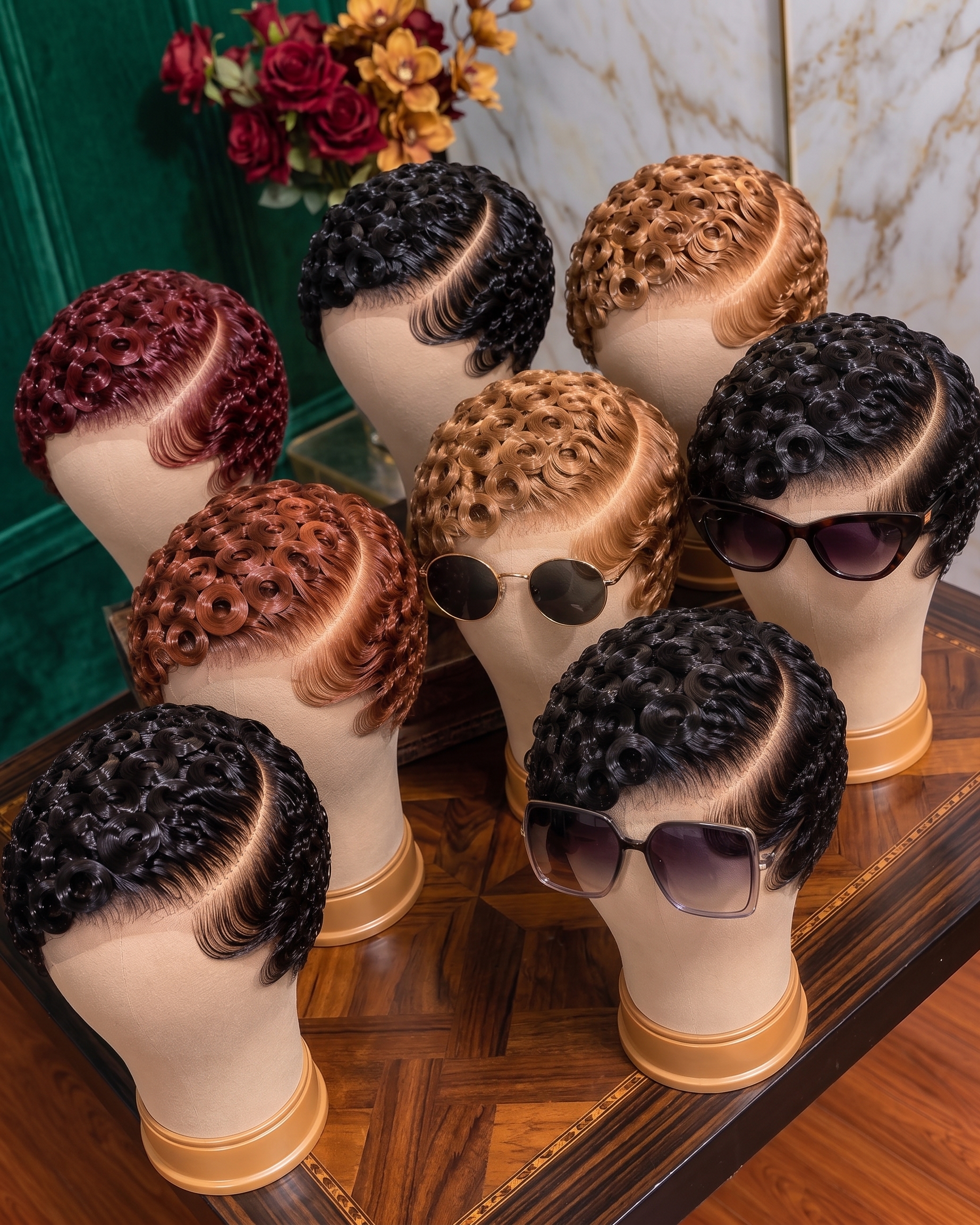
A clean side part can make a short curly pixie look remarkably realistic, but a visible scalp line is not automatically a good scalp line. On this collection, the curls change from black to burgundy, copper, brown, and golden blonde, yet the strongest construction detail remains the same: a narrow curved part running from the front toward the crown.
That narrowness matters. If the part becomes too wide, the wig can begin looking as though a strip of hair is missing. If it becomes too narrow, the scalp effect disappears and the curls crowd together until the part becomes difficult to read. The strongest result sits between those two extremes.
Before ordering a side-part pixie like this, do not ask only whether it has a realistic part. Ask how wide the visible scalp line is and whether that width remains controlled from the front all the way toward the crown.
Where To Buy A Curly Pixie Wig With A Natural-Looking Part Width
Custom wig makers. A custom maker is usually the best option when you care about the exact amount of scalp exposure. Send a close reference and ask for a narrow, intentional side part rather than simply requesting a side-part pixie.
Instagram and TikTok sellers. Ask for a close video following the part from front to back. The camera should move slowly enough for you to see whether the line suddenly becomes wider near the crown.
Etsy. Independent makers may offer more control over part depth, direction, lace area, and density around the part. Ask whether the part width can be customized instead of assuming every unit uses the same spacing.
Marketplaces like Amazon, AliExpress, and Temu. Product photos can hide a wide part with curls arranged over the edges. Customer images are useful because ordinary wear may reveal more scalp than the seller’s original styling.
Local beauty supply shops and salons. Local shopping gives you the easiest test. Look at the part from normal eye level, then from directly above. A line that looks natural from the front may appear excessively wide when viewed from the top.
Vendors and wholesalers direct. Ask for close-up photos of the actual part and confirm whether the unit uses hand ventilation, a closure, frontal lace, or another construction method in that zone.
Regionally. Wig makers in Lagos, Accra, Atlanta, London, and major South African hair markets may describe side parts differently. Use a reference image and talk about visible scalp width rather than relying only on the phrase “deep side part.”
Vet the seller. Favor sellers who show the part without heavy concealer, powder, or editing. You want to know how the line looks before cosmetic correction.
Red flags. Be cautious if the part becomes dramatically wider toward the crown, if the seller applies a very bright line of makeup through the part, or if one edge of the part is significantly denser than the other.
When you order, send. Provide your cap size, desired part side, preferred part depth, scalp-tone reference, and a close photo showing approximately how much scalp exposure you want.
Contact / order inquiries: WhatsApp [WhatsApp: +XX XXX XXX XX XX]
How Much It Costs
Premium custom human hair. A carefully constructed short human-hair pixie with refined lace, controlled part density, sculpted curls, and custom colouring can commonly range around $230–$450 depending on the hair and cap work.
Standard custom human hair. Around $180–$320 can cover many strong short human-hair units. At this level, inspect the part carefully because a clean scalp line can make a relatively simple wig look much more expensive.
Basic human hair. Around $150–$240 may buy a simpler cap with heavier knots, more generic spacing, or less control over how the part widens toward the crown.
Good synthetic. Around $60–$150 can provide an attractive short side-part pixie. Synthetic units may maintain their curl shape easily, but the scalp line still needs to look proportionate.
Basic synthetic. Around $25–$70 is common for budget units. At this price, part lines may be very straight, very wide, or created by a fixed skin-like strip rather than refined ventilation.
What the price may exclude. Custom part placement, lace tinting, knot work, cap sizing, colour, and professional fitting may all be separate charges.
Shipping and duty. International shipping, customs fees, and local taxes can significantly increase the final cost. Compare the landed price rather than only the listing amount.
Ongoing costs. Parts may need occasional cleaning because concealer, powder, oils, and styling products can collect along the scalp line and change how wide or dark it appears.
First-year total. Include lace care, curl products, colour maintenance, and possible professional ventilation or repair if the hair around the part begins shedding.
Cost per wear. A slightly more expensive unit with a balanced part may give better value than a cheaper one that needs makeup and constant curl repositioning every time you wear it.
What a very low price may signal. It can indicate a generic fixed part, excessive scalp exposure, dense knots, low-grade lace, or a part designed primarily to photograph well from one angle.
Deposit structure. Custom makers commonly request around 30–50% upfront and the balance before shipping. Keep your part reference and requested width in writing.
Shipping, Delivery, And What To Expect After Ordering
When the wig arrives, inspect the part before cutting the lace or adding concealer. Look at it in its untouched state.
Follow the line from the front hairline toward the crown. Notice whether it stays approximately controlled in width or begins opening noticeably farther back.
Then view it from normal wearing distance. A part does not need to look microscopically perfect at three inches away; it needs to read naturally when someone is actually looking at you.
A Natural Part Is Not A Large Strip Of Visible Scalp
One common misunderstanding is that more visible scalp automatically means more realism.
It does not.
Natural hair parts usually expose a relatively narrow line. Individual hairs leave either side of that line and quickly create density around it.
If a wig shows a broad pale strip through the top, the viewer may stop reading it as a natural separation and start reading it as empty space.
The lace can be excellent and the knots can be beautifully finished while the part itself still looks too wide.
The Front Of The Part And The Back Of The Part Have Different Jobs
The section closest to the hairline is highly visible because it connects directly with the front edge of the wig.
Farther back, the part enters the denser crown where curls begin surrounding it from more directions.
That means the part does not have to behave like a perfectly identical ruler line from beginning to end.
But changes should be gradual.
If a narrow front part suddenly opens into a large triangle near the crown, the transition can look artificial.
A Part That Widens Too Quickly Can Look Like Hair Loss
This is particularly important on short wigs because the entire top remains visible.
On long hair, layers may fall over a widening part and soften it. Compact pixie curls provide much less coverage.
If the scalp line expands rapidly, the viewer sees a large exposed section between two dense groups of curls.
That can unintentionally resemble thinning rather than deliberate parting.
When evaluating a seller video, watch the width rather than being distracted only by the curl shine.
A Part That Is Too Narrow Can Disappear Completely
The opposite extreme causes another problem.
If hairs are packed too closely across the separation, the visible scalp becomes little more than a dark crease.
The eye can no longer understand where the style is divided, particularly on black hair where neighbouring curls visually merge.
The wig then loses some of the sharp directional styling that makes a side-part pixie attractive.
You need enough scalp visibility to explain the hairstyle, but not so much that the scalp becomes the hairstyle.
Dark Hair Makes Part Width Easier To Judge
The black units in this collection create very strong contrast against the mannequin’s scalp-like tone.
That makes the edges of the part easy to identify. Even a small increase in width becomes obvious because the dark curls sit directly beside a lighter line.
This is useful when inspecting construction, but it also means black units are less forgiving if the part is inconsistent.
The line has nowhere to hide.
Blonde Can Make The Same Part Look Wider
Lighter hair changes the visual relationship.
Golden blonde and scalp-like tones are closer to one another than jet black and scalp. Because of that reduced contrast, the edges may become softer.
Yet bright hair also reflects more light around the part, sometimes making the whole scalp region appear visually larger in photographs.
Do not compare perceived width across colours unless the units are shown under similar lighting.
Burgundy And Copper Sit Between The Extremes
Warm red and copper shades keep enough depth to define the part clearly while producing softer contrast than solid black.
That can make the scalp line appear slightly less graphic.
Again, the actual physical width may be unchanged.
This is why colour collections are useful: they show how much of what you are noticing comes from construction and how much comes from visual contrast.
Part Width And Density Are Connected
A part is created partly by where hair is absent and partly by how much hair surrounds that empty line.
If the density immediately beside the part is very low, the exposed area can appear wider than the actual lace gap.
If density is extremely high, curls may collapse over the part and make it appear narrower.
So when a part looks wrong, do not automatically blame the lace opening itself.
Inspect the first few rows of hair on both sides.
Unequal Density Can Make The Part Lean
A good side part has directional asymmetry by design, but the edges still need control.
If one side is packed with heavy knots while the other is sparse, the visible scalp line may look as though it bends or leans even when the lace separation underneath is correctly shaped.
That can make a curved side part appear unstable.
Look for an intentional curve, not a line that changes direction because one side is overwhelming the other.
The Curve Should Look Planned
The parts in this collection are not perfectly straight. They follow the rounded geometry of the head and support the swept side styling.
That curvature can look more natural than an unnaturally rigid ruler line on a short pixie.
But there is a difference between a smooth planned curve and a wandering part.
A good line changes direction gradually. A poorly executed line wobbles, narrows, widens, and changes direction without any visual reason.
Concealer Can Fix Tone But Not Width
Makeup is useful when the visible lace or scalp line needs a small tonal adjustment.
But concealer cannot truly repair a part that is physically too wide.
In fact, applying a bright stripe through an already wide part can make the problem more obvious by increasing contrast.
Use makeup to improve tone, not to redraw the construction.
Do Not Over-Pluck A Part That Already Looks Good
Another common mistake is assuming that every lace part needs additional plucking.
Removing more hair can make a dense artificial line look better when done carefully.
But once a part is already balanced, unnecessary plucking permanently increases the visible scalp area.
On a short pixie there is very little neighbouring length available to disguise an over-plucked section later.
Start conservatively.
Shedding Can Slowly Widen The Part Over Time
Part width is not always fixed for the entire life of a wig.
Hair immediately beside the part is handled frequently during washing, styling, and curl refreshing. If those hairs begin shedding, the exposed line gradually becomes broader.
You may not notice the change from one wear to the next.
Compare the wig with an early photograph every few months and widening becomes easier to spot.
This is another reason not to over-pluck a brand-new unit.
Protect The Hairs Closest To The Part
The rows immediately beside the scalp line deserve gentler handling than the middle of a dense curl section.
Avoid repeatedly scraping them with comb teeth or pulling tightly when re-forming curls.
Detangle with fingers or a suitable small tool and work away from the lace instead of dragging force directly across the part.
Those few rows help determine how narrow the part remains over time.
A Curved Part Must Work With The Curl Placement
The scalp line itself is only half of the visual design.
The curls on both sides need to leave the part in directions that make sense.
If large curls repeatedly fall directly across the line, the part disappears. If every curl is pushed too aggressively away, the scalp exposure may look broader than necessary.
The best arrangement allows the part to remain readable while curls still soften its edges.
Look At The Part Before And After The Curls Are Refreshed
A freshly styled pixie can make its part look narrower because curls are intentionally placed close to the edges.
After several wears, those curls may move and expose more lace.
That does not necessarily mean the construction changed.
It may simply mean the surrounding curls need to be returned to their intended position.
Before plucking, tinting, or altering the lace, refresh the curl placement first and reassess the width.
Part Width Should Be Judged On The Head, Not Only On A Stand
A wig cap changes shape slightly when placed on a real head.
Lace can stretch and the curve across the crown can open differently than it does on a small mannequin.
That means a part that looks very narrow on a display form may appear slightly broader once the cap is tensioned for wear.
This is why seller videos on an actual head can be more informative than product photos alone.
Before You Pay
- Can you show a close video tracing the part from the front hairline all the way toward the crown?
- Does the visible scalp line stay relatively controlled in width, or does it become much wider farther back?
- Has the part been heavily plucked or filled with concealer for the product photos?
- Can you show the exact colour I am ordering without makeup added through the part?
- What should I do if the hairs beside the part begin shedding and the line becomes wider over time?
Trimming The Lace
Set the wig in its correct wearing position before judging the part or cutting the lace.
A side-part pixie has a strong directional shape, so rotating the cap can change where the part appears to start and how it travels toward the crown.
Once the hairline, temples, and part all sit correctly together, trim the excess lace gradually.
Do not shift the wig just to make the part look narrower. If the visible scalp area is genuinely too wide, that is a density or construction issue rather than a cap-position fix.
Search Terms
narrow side part curly pixie wig · natural scalp part pixie wig · deep side part ringlet wig · black side part pixie wig · burgundy curly pixie wig part · copper side part pixie wig · blonde finger curl pixie wig · realistic part short curly wig
Final Thoughts
A convincing pixie part is not simply a visible strip of scalp. Its width has to be controlled. Too little exposure and the part disappears beneath the curls; too much and the wig can begin looking over-plucked or thin.
The collection here shows why this small measurement matters. Different colours change how strongly the line appears, but the structural question stays the same: does the part remain narrow, clean, and intentional from its beginning toward the crown?
When you shop for a short side-part wig, inspect that line as carefully as you inspect the curls. A few extra millimeters of exposed scalp can change the realism of the entire top.