
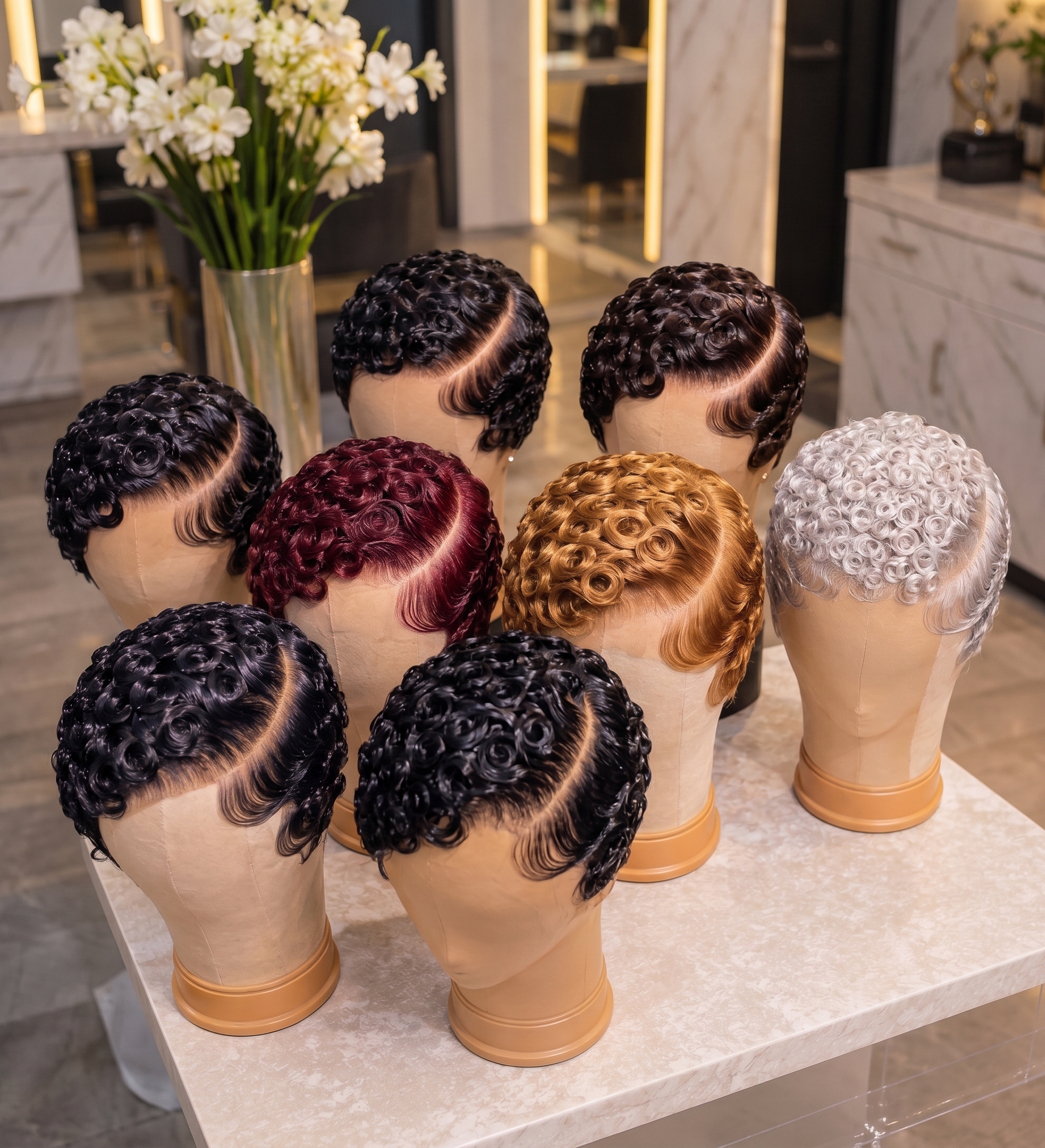
A carved side design does not look equally strong on every hair colour. This collection makes that obvious because the same general short ringlet pixie idea appears in black, burgundy, copper, golden blonde, and very pale platinum tones.
The carved lines and sculpted side details are similar in spirit, but the contrast around them changes dramatically. On black hair, the pale scalp-like lines cut through a very dark field and appear sharp immediately. On blonde or platinum hair, the difference between the carved line and surrounding hair becomes softer. Burgundy and copper sit somewhere between those extremes.
That means colour is doing more than changing the mood of the wig. It is changing how strongly the carved side design reads from across the room.
Where To Buy A Carved Curly Pixie Wig In The Right Colour
Custom wig makers. If the carved side is important to you, ask the maker to show the design on the exact colour you are considering. Do not approve a black reference and assume the same carving will have identical visual impact on blonde or copper.
Instagram and TikTok sellers. Look for side-view videos under ordinary lighting. The carved detail should remain visible without the camera being pushed extremely close to the wig.
Etsy. Independent makers may allow you to select both colour and side design. Ask for previous examples showing a similar carved pattern on light, medium, and dark bases if available.
Marketplaces like Amazon, AliExpress, and Temu. Listings may show one colour prominently while offering several other shades from a menu. Check customer photos of the exact shade you want because contrast can make the design look much stronger or weaker than the hero image suggests.
Local beauty supply shops and salons. Local buying gives you the easiest comparison. Place two differently coloured units side by side and step back several feet. Notice which carved line remains readable without close inspection.
Vendors and wholesalers direct. Ask whether every colourway uses the same fade depth, carved-line width, and side density. If the side construction changes between colours, you are no longer comparing only colour contrast.
Regionally. Wig makers in Lagos, Accra, Atlanta, London, and major South African hair markets commonly produce short carved pixies, but colour naming and side-design terminology vary. A clear reference image is safer than relying on words alone.
Vet the seller. Favor sellers who show several colourways from the same side angle. That makes it easier to judge whether colour is the real difference or whether the construction itself changes from unit to unit.
Red flags. Be cautious if only the darkest colour shows a visible carved design, if lighter versions are always photographed from above, or if the seller cannot show the side of the exact colour you are ordering.
When you order, send. Provide your cap size, exact colour reference, desired carved-line width, fade height, and a side-profile example showing how bold you want the pattern to appear.
Contact / order inquiries: WhatsApp [WhatsApp: +XX XXX XXX XX XX]
How Much It Costs
Premium custom human hair. A short carved human-hair pixie with refined lace, dense ringlets, colour work, and detailed side shaping can commonly range around $230–$450 depending on the construction and amount of customization.
Standard custom human hair. Around $180–$320 can cover many strong short units. Dark natural colours may require less processing, while platinum or bright copper may increase the final price.
Basic human hair. Around $150–$240 may buy a simpler version with less refined fade work, heavier lace, or a more basic carved design.
Good synthetic. Around $60–$150 can work very well for this type of style because synthetic fibre can preserve both vivid colour and a compact preset curl pattern without chemical lifting.
Basic synthetic. Around $25–$70 is common for budget pieces. Check whether the carved area looks like believable short hair or like a flat printed or heavily molded panel.
Colour premium. Human-hair platinum, pale blonde, copper, or vivid burgundy can cost more because of lifting, toning, and additional processing.
What the price may exclude. Custom cap sizing, lace tinting, detailed carving, colour correction, curl resetting, and professional fitting may all be separate.
Shipping and duty. International shipping, customs charges, and local taxes can increase the final cost substantially. Compare the delivered total rather than only the listed price.
Ongoing costs. Dark black usually needs the least colour maintenance. Burgundy and copper may fade. Platinum and pale blonde may need toning and more careful conditioning.
First-year total. Include colour-safe products, possible toning or refresh treatments, lace care, and any professional touch-up needed to preserve the short side and crown curls.
Cost per wear. A colour that keeps the side design visible at the intensity you actually like may give better value than choosing a shade that looks attractive alone but makes the carved detail disappear.
What a very low price may signal. It can indicate generic colouring, low-grade fibre, simplified side construction, or a carved effect designed to succeed only in close-up photographs.
Deposit structure. Custom makers commonly request around 30–50% upfront and the remainder before shipping. Keep both the colour and side-design reference in writing.
Shipping, Delivery, And What To Expect After Ordering
When the wig arrives, inspect the carved side before cutting the lace. Look at it close up first, then step farther away.
The close view tells you whether the lines are clean. The distant view tells you whether the colour provides enough contrast for the design to remain visible in normal wear.
Also check the side in warm and cool lighting because both the hair colour and the mannequin or skin tone underneath can change how strong the line appears.
Dark Hair Creates Maximum Carved-Line Contrast
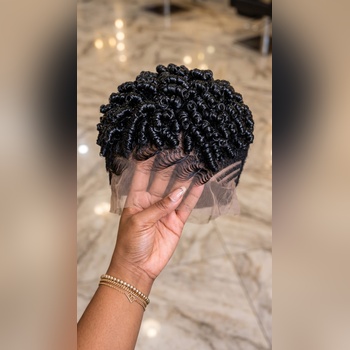
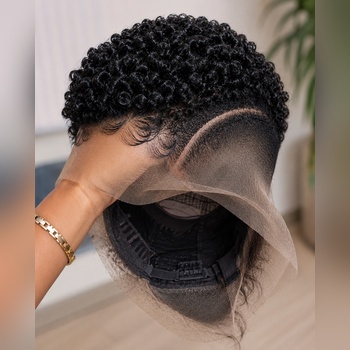
Black hair creates the strongest possible background for a pale carved line.
The short surrounding hair absorbs light and reads as a solid dark field. The exposed lighter strip immediately separates from it.
That makes the pattern appear precise and graphic even when the line itself is relatively narrow.
If you want the carved side to be one of the first things people notice, deep black is one of the strongest colour choices.
Burgundy Keeps Strong Contrast But Adds Warmth
Burgundy remains dark enough to preserve a strong difference between the carved line and surrounding short hair.
But unlike black, it catches red and wine reflections under direct light.
That can make the side feel slightly less severe while still keeping the design readable.
For buyers who want a bold carved pixie but do not want solid black, burgundy can sit in a useful middle ground.
Copper Changes The Graphic Effect
Copper reflects much more warm light than black.
Because the surrounding short hair is brighter, the carved line does not always separate as aggressively. The side can therefore feel softer and more integrated with the crown.
This is not a flaw. It simply changes the personality of the design.
A carved copper pixie may attract attention first through the colour and curls, with the side pattern acting as a second detail rather than the main focal point.
Blonde Can Make Fine Lines Look More Subtle
Golden blonde reduces the dark-light difference even more.
If the carved line exposes a scalp-like tone that is relatively close to the hair colour, the pattern may become less obvious from a distance.
To preserve visibility on a blonde unit, the maker may need slightly stronger line width, cleaner separation, or a darker root area around the carving.
That is why simply copying the exact same side design from a black wig does not guarantee the same visual result on blonde.
Platinum Is The Most Difficult Contrast Case
Very pale platinum or silver-white hair creates an interesting challenge.
The hair itself is already light, so a pale carved strip has less contrast to work with.
The pattern can still look beautiful at close range because texture and shadow define it, but from farther away the design may soften dramatically.
If you want a platinum pixie with a highly visible carved side, ask the seller to show the real unit from normal viewing distance before approving the design.
Line Width And Hair Colour Work Together
Carved-line width should not be judged independently from colour.
A very thin line on black can look strong. The same width on pale blonde may nearly disappear.
A slightly wider line can restore visibility on lighter colour, but there is a limit. If it becomes too wide, the side begins looking like a large shaved gap instead of a refined detail.
The best width depends partly on how much contrast the colour already provides.
Fade Density Changes The Contrast Too
The short side around the carved pattern also matters.
If that area is very dense, the surrounding colour appears stronger and the exposed line stands out more clearly.
If the fade is extremely sparse, more scalp-like tone already shows through the surrounding area, reducing the difference between the carving and the background.
So what looks like a colour issue may sometimes be a density issue.
Ask to see both the line and the fade around it.
The Mannequin Or Wearer’s Skin Tone Also Changes The Result
A carved line does not exist against hair alone. It also reveals the tone underneath the short section.
That means the same wig can look slightly different on different wearers.
If the exposed area closely matches the surrounding skin, the carved pattern can look natural and integrated. If the cap or lace tone underneath is noticeably different, the line can look artificial even when the carving itself is precise.
This is particularly important on pale hair because the colour contrast is already reduced.
Do Not Choose Colour From The Crown Alone
Most buyers choose a colour by looking at the top curls.
That makes sense for ordinary wigs, but carved pixies have a second colour decision happening at the side.
The shade you select changes how much attention that short graphic area receives.
A black crown and black fade may make the carved lines dominant. A blonde crown and blonde fade may make the curls dominant instead.
Choose according to which part of the wig you want the eye to notice first.
Strong Contrast Can Reveal Imperfections Too
Maximum visibility is not always an advantage.
On black hair, every uneven edge, inconsistent line width, or rough transition becomes easier to see because the contrast is so strong.
Lighter colours can sometimes visually soften small irregularities.
This means dark carved pixies demand especially precise workmanship.
If you are paying a premium for a black unit with a detailed side, inspect the line carefully rather than assuming high contrast automatically means high quality.
Colour Fade Can Change The Carved Design Over Time
Human-hair colour does not remain visually identical forever.
Burgundy may become softer red-brown. Copper may lose intensity. Blonde may warm. Platinum may yellow.
As the surrounding hair colour changes, the contrast against the carved line changes too.
The side design itself may not have changed at all, yet it can look stronger or weaker several months later.
Colour maintenance therefore affects the visual life of the carving.
Synthetic Colour Can Keep Contrast More Stable
For vivid or pale shades, quality synthetic fibre can offer a useful advantage: the colour is manufactured into the fibre rather than repeatedly lifted and toned.
That can keep the black, burgundy, copper, or platinum contrast more stable across many wears.
The tradeoff is that the fibre may offer less flexibility for major recolouring later.
If the side design and colour combination are exactly what you want, that stability can be valuable.
Compare All Colours From The Same Distance
A common seller mistake is showing black close up because the carving looks impressive, then photographing blonde farther away because the colour looks attractive as a whole.
That makes comparison almost impossible.
Ask for the colourways to be photographed from the same side, same distance, and same lighting.
Only then can you judge how much the colour itself is changing the visibility of the side design.
Before You Pay
- Can you show this same carved side design on the exact colour I want?
- Will the carved-line width stay the same across black, burgundy, copper, blonde, and platinum versions?
- Can you show the side from normal viewing distance, not only in a close-up?
- Does the fade density around the design remain consistent across different colourways?
- If I want the design to stay very visible on a light colour, should the line be adjusted slightly?
Trimming The Lace
Place the wig in its correct position before trimming the lace. The carved side has a fixed relationship with the temple and ear, so incorrect cap placement can make the design sit too far forward or backward.
Check the side pattern, front edge, crown position, and opposite side first.
Once everything aligns correctly, trim the lace gradually.
Do not rotate the wig simply to make the carved line appear more visible. If the design disappears because of low colour contrast, that is a styling and colour decision rather than a cap-position problem.
Search Terms
carved curly pixie wig colors · black burgundy blonde pixie wigs · shaved line curly pixie wig · copper carved pixie wig · platinum carved pixie wig · short ringlet pixie wig designs · shaved side finger curl wig · curly pixie wig color collection
Final Thoughts
The same carved pixie design does not have one fixed visual strength. Hair colour changes the contrast around it. Black can make the lines look sharp and graphic, burgundy keeps strong depth with warmer reflections, copper softens the effect, and pale blonde or platinum can make fine carving much more subtle.
That is why colour should not be chosen from the crown alone when the side design matters. Decide how loudly you want the carved pattern to speak.
If you want it bold, choose enough contrast. If you want it quieter, a lighter colour can make the same basic design feel much softer without removing it.