
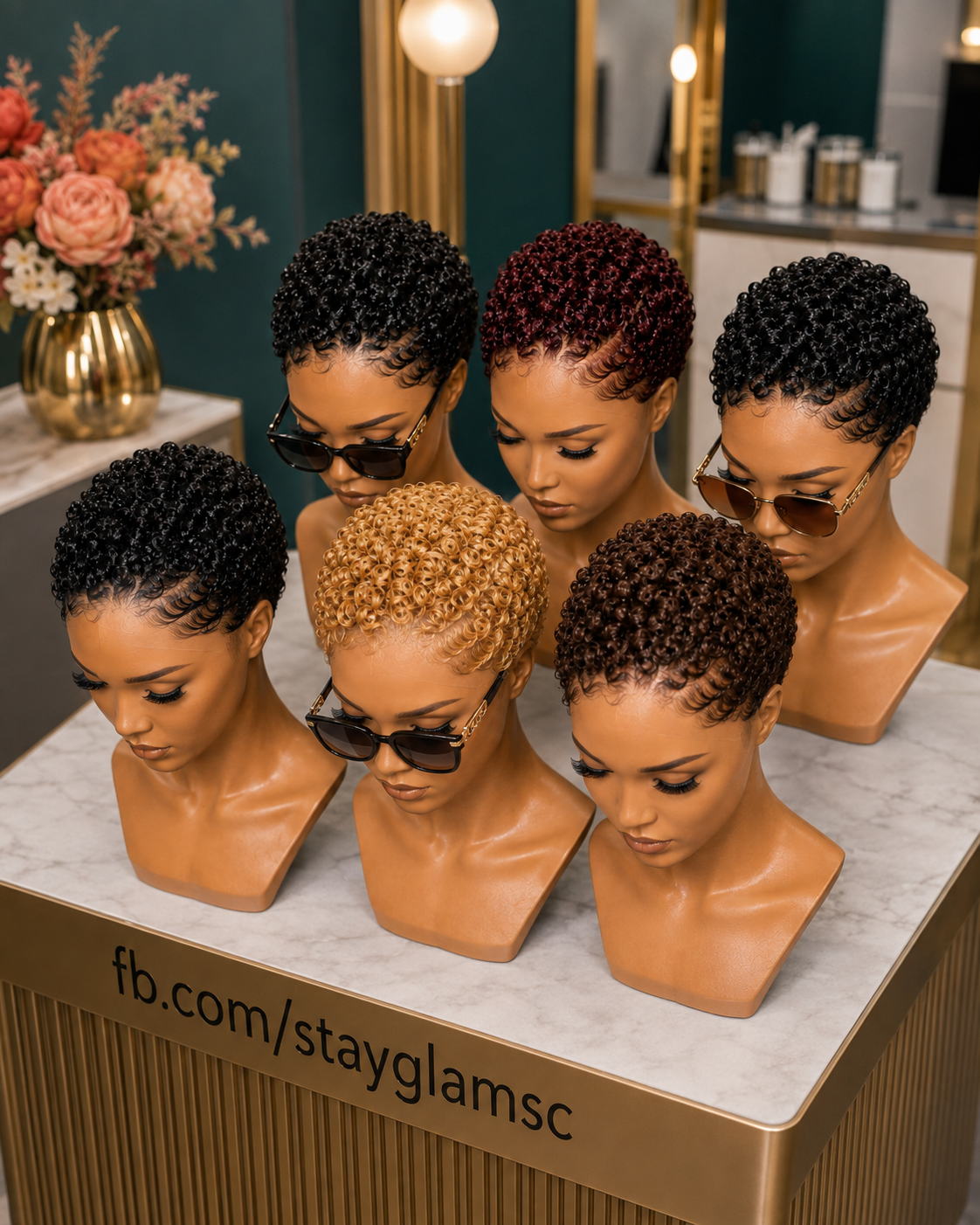
One beautiful pixie wig can be a lucky sample. Six similar pixie wigs sitting together tell you something much more useful: whether the seller can repeat the same result.
This collection shows several short ringlet pixies in black, burgundy, blonde, and brown. The colours are different, but the basic styling idea remains remarkably similar: compact curls, a close-fitting silhouette, sculpted front edges, and a short crown that follows the shape of the head.
That makes this kind of display useful for quality control. Instead of asking only, “Do I like this wig?” you can ask a harder question: if I order one of these, how likely am I to receive the same curl size, density, hairline shape, crown height, and overall silhouette shown in the seller’s best photograph?
Where To Buy A Consistently Made Curly Pixie Wig
Custom wig makers. Ask the maker to show several examples of the same style instead of one hero unit. A skilled maker should be able to reproduce the general curl scale, crown shape, edge placement, and cap proportions while still allowing small handmade differences.
Instagram and TikTok sellers. Scroll farther than the pinned videos. Look for the same pixie appearing on different days, customers, mannequins, or colourways. Repeated results are stronger evidence than one viral post.
Etsy. Independent makers often show previous orders in reviews. Compare several customer units with the listing image and look for consistency in silhouette rather than expecting every individual curl to occupy exactly the same position.
Marketplaces like Amazon, AliExpress, and Temu. Customer reviews become especially important because the listing sample may be much more carefully styled than ordinary stock. Look for several recent buyers showing similar crown density and curl size.
Local beauty supply shops and salons. If several units of the same model are available, place them beside one another. This is one of the easiest ways to detect batch variation before buying.
Vendors and wholesalers direct. If you are buying more than one unit, request batch photos before shipment. Ask the vendor to place several finished wigs together rather than photographing only one selected piece.
Regionally. Wig makers and beauty suppliers in Lagos, Accra, Atlanta, London, and major South African hair markets may produce short pixies in repeated batches, but production methods vary. Ask to see multiple finished examples from current stock.
Vet the seller. Consistency across different photographs is more valuable than perfection in one photograph. Look for the same general hairline, crown height, curl diameter, density, and perimeter quality appearing repeatedly.
Red flags. Be cautious if the seller shows one exceptional sample repeatedly, if every customer unit looks noticeably different, or if the style name stays the same while curl size and crown shape change dramatically between orders.
When you order, send. Provide the exact reference image and identify the features that must remain consistent: curl size, crown height, overall density, hairline shape, colour, and cap size.
Contact / order inquiries: WhatsApp [WhatsApp: +XX XXX XXX XX XX]
How Much It Costs
Premium custom human hair. A carefully made short human-hair ringlet pixie can commonly range around $220–$430 depending on lace, hair quality, colour, ventilation, cap construction, and styling labour.
Standard custom human hair. Around $170–$300 can cover many strong short human-hair units. At this price level, repeatability can be a better indicator of workmanship than elaborate marketing language.
Basic human hair. Around $150–$230 may buy a simpler unit. Expect some handmade variation, but the basic silhouette should still resemble the sample you ordered.
Good synthetic. Around $60–$150 can provide excellent consistency because factory-set curl patterns can be reproduced more easily across several units.
Basic synthetic. Around $25–$70 is common for budget pieces. Factory production may keep the curl pattern relatively consistent, but lace, density, fibre finish, and cap shape can still vary between batches.
Custom colour. Burgundy, blonde, copper, or brown versions may cost more than natural black in human hair because additional processing is required.
What the price may exclude. Custom sizing, lace tinting, bleached knots, colour correction, individual hairline work, and professional fitting may be separate.
Shipping and duty. International shipping, customs charges, and local taxes can increase the final cost. Compare the delivered total rather than only the advertised unit price.
Buying multiples. If you are ordering several units for resale, do not negotiate only for the lowest wholesale price. A small saving becomes meaningless if half the batch looks noticeably different from the approved sample.
Cost per usable unit. For a reseller, consistency changes the real cost. Ten inexpensive wigs are not truly inexpensive if several cannot be sold under the same listing because their shape or quality is too different.
What a very low price may signal. It can mean loose quality control, mixed fibre batches, inconsistent density, less careful finishing, or significant differences between the photographed sample and ordinary stock.
Deposit structure. For custom or wholesale orders, keep an approved sample photograph and specification sheet before paying the final balance.
Shipping, Delivery, And What To Expect After Ordering
When several units arrive together, do not open one, approve it, and assume the rest are identical.
Place the wigs beside one another before cutting lace or adding styling product. Compare them under the same lighting and from the same angle.
Small variations are normal, especially with hand-finished human-hair wigs. What you are looking for is not clone-level perfection. You are looking for the same product identity.
One Perfect Sample Does Not Prove A Repeatable Product
A stylist can spend extraordinary time perfecting one unit for a photo shoot. Every curl can be repositioned, every baby hair adjusted, and every small flaw hidden before the camera turns on.
That proves the seller can make one beautiful wig.
It does not automatically prove that ordinary customers receive the same standard.
A collection like this gives you better evidence because several units must succeed simultaneously. If six wigs share a recognizable silhouette, the maker is demonstrating a process rather than only a single successful result.
Compare The Silhouette Before The Individual Curls
Do not expect every curl to sit in exactly the same place.
Human-hair styling is not industrial printing, and even synthetic sets can shift slightly during packing. Instead, compare the broader shape.
Is the crown equally compact?
Does each unit sit close to the sides?
Is the top height similar?
Does the front curl area occupy approximately the same amount of space?
If those proportions remain stable, the seller is reproducing the style even though individual ringlets naturally vary.
Curl Diameter Is One Of The Best Consistency Checks
Look across the units in this display and notice how small the ringlets remain.
If you order this style, curl diameter matters because larger curls would change the entire identity of the wig. The crown would appear looser, taller, and less compact.
A seller who repeatedly produces approximately the same curl size demonstrates better process control.
Watch for batches where one unit has tiny coils and another suddenly has much larger barrel curls even though both are sold under the same product name.
Crown Height Should Stay Within The Same Range
Another useful comparison is how far the curls rise from the mannequin head.
One unit may naturally sit a little higher than another, but major differences suggest inconsistent density, hair length, or setting technique.
This matters because crown height changes how the pixie frames the face.
If you ordered a compact low-profile pixie and receive a much taller crown, the colour may be correct while the hairstyle itself feels wrong.
The Hairline Should Follow The Same Design Language
These wigs use sculpted front edges and short face-framing curls.
Again, they should not be identical down to every swoop. But the general approach should repeat.
If one unit has a soft sparse front while another has a heavy straight line, the seller may not have a stable hairline standard.
For short pixies, that difference is particularly visible because there is no long fringe available to cover the front.
Colour Variants Should Not Quietly Change The Construction
A seller may offer black, burgundy, blonde, brown, and copper under one product listing.
Buyers naturally assume they are choosing the same wig in different colours.
That assumption should be verified.
Sometimes different colourways use different hair sources, fibre blends, processing, or even separate factories. The blonde unit may therefore behave differently from the black one despite sharing the same product name.
Ask whether all colour options use the same cap, density specification, curl size, and hair length.
Lighter Colours Can Make Variation Look Bigger
The blonde unit in a collection like this may appear slightly more separated than the black units because lighter colour reveals shadows and gaps more clearly.
That does not automatically mean the blonde contains less hair.
Compare the actual crown coverage and curl count before judging density.
Likewise, black can visually merge small curls together and make a crown appear more compact. Colour affects perception, so consistency should be judged structurally rather than only visually.
Human Hair Will Never Be Perfectly Identical
For custom human-hair wigs, some variation is normal and even desirable.
Hair is a natural material. Curl behaviour, strand thickness, colouring response, and hand styling all introduce small differences.
The goal is not six copies that look computer-generated.
The goal is a controlled range: similar silhouette, similar density, similar curl scale, similar cap quality, and similar finish.
That is realistic repeatability.
Synthetic Production Can Be More Consistent
Synthetic fibre has a practical advantage when repeatability matters.
Factory-created fibres can arrive in standardized colours and predetermined curl patterns, making it easier to manufacture many similar units.
That can be valuable for sellers who need dozens of pieces that photograph consistently.
The tradeoff is less styling flexibility and, at lower quality levels, a more artificial fibre finish.
Consistency alone does not prove premium quality. It simply tells you the production is controlled.
For Resellers, Sample Approval Is Critical
If you buy wigs to resell, never assume that the first sample automatically represents a large order.
Ask whether the production batch will use the same fibre, same cap construction, same colour formula, same curl size, and same density.
Ideally, approve one sample and keep its photographs and written specifications.
When the batch is finished, request a group photo similar to this display.
A group image allows you to detect large inconsistencies before international shipping makes correction expensive.
Batch Photos Are More Useful Than One Close-Up
A close-up tells you detail.
A batch photograph tells you repeatability.
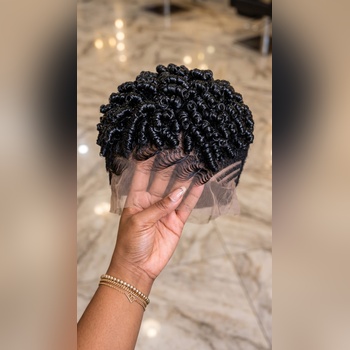
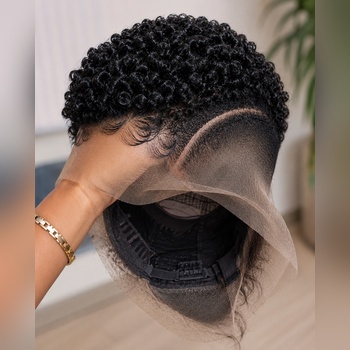
For wholesale orders, both are useful. Ask for one close view of lace and construction, then one wider photograph showing multiple finished units together.
If all units are hidden in boxes and the supplier only photographs one chosen sample, you have less evidence about what the rest of the shipment looks like.
Compare The Outliers, Not Only The Best Unit
When several wigs sit together, your eye naturally goes toward the prettiest one.
Do the opposite.
Find the unit with the lowest crown. Find the one with the largest curls. Find the one whose hairline looks densest.
Those outliers tell you the range of variation in the seller’s production.
If even the weakest unit still looks acceptably close to the best one, that is strong quality-control evidence.
Consistency Is Different From Quality
A seller can consistently manufacture a mediocre wig.
Repeatability therefore should never replace your normal checks for lace, fibre, cap construction, hairline quality, and fit.
Think of consistency as a second question.
First: is the sample good?
Second: can the seller reproduce that good sample reliably?
You need both answers before making a confident purchase, especially when buying multiples.
Before You Pay
- Can you show at least three finished units of this same pixie style together?
- Do all colour options use the same curl size, crown height, density, and cap construction?
- If I order the black version shown in the listing, will my unit come from the same current batch?
- For a wholesale order, can I approve a sample before the full batch is completed?
- Can you send a group photograph of my finished units before the final balance or shipment?
Trimming The Lace
When your unit arrives, compare it with the approved sample before cutting the lace.
Check curl size, crown height, hairline design, colour, side profile, and overall density while the wig is still returnable.
Only after you confirm that it belongs to the same product family should you trim the excess mesh.
If you ordered several units, inspect all of them before altering the first one. Once lace has been cut or products added, resolving a batch-consistency dispute can become more difficult.
Search Terms
curly pixie wig collection · pixie wig batch consistency · short ringlet wig collection · black burgundy blonde pixie wigs · wholesale curly pixie wigs · repeatable pixie wig quality · short curly wig supplier · curly pixie wig bulk order
Final Thoughts
The most valuable thing about seeing six short pixie wigs together is that the display stops being only about colour choice. It becomes evidence of the seller’s ability to repeat a product.
A single perfect unit tells you what is possible. Multiple similar units tell you what is normal.
When you are buying one wig, that difference helps you judge whether the listing sample is realistic. When you are buying wholesale, it becomes even more important because consistency determines whether all of your units can honestly be sold under the same product photograph.
Do not ask a seller only, “Can you make this?” Ask the stronger question: “Can you make this repeatedly?”