
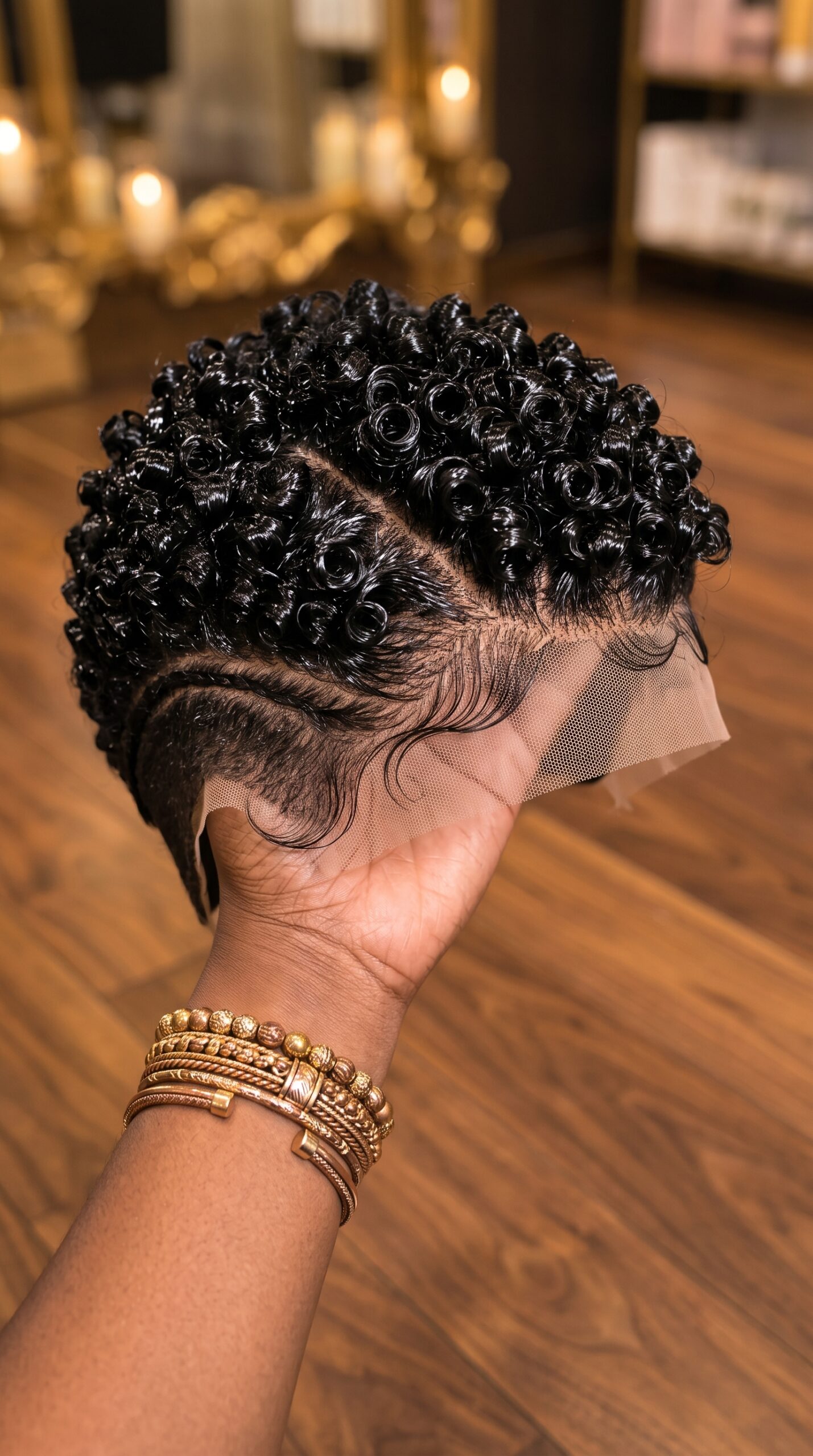
A side part hides a multitude of small sins, letting the longer side drape over and cover a slightly thinner patch or an uneven curl underneath. A dead-centre part, like the one running straight through this unit, offers no such cover. Split exactly down the middle, both halves are on equal, simultaneous display, so any difference in density, curl size, or fullness between the left and right sides is visible the moment you look at it, not hidden by hair falling one direction. This is the trade a centre part makes: it looks striking and symmetrical when both sides genuinely match, and it exposes the unit immediately when they do not.
The reason is simple geometry. With a side part, more hair falls on one side than the other by design, so the eye already expects asymmetry, and small differences blend into that expected imbalance. With a centre part, the expectation flips entirely: the whole point is that both sides mirror each other, so the eye is primed to compare them directly, left against right, and even a modest mismatch reads as a mistake rather than a natural feature. A centre part is, in effect, a symmetry test that the unit either passes or visibly fails.
This means judging a centre-part unit requires a different kind of scrutiny than a side-parted one. Do not just check that the curls look full and even in general, check that the left side genuinely matches the right, curl for curl, in density and size, right along the parting where the comparison is unavoidable. A unit can have gorgeous curls overall and still look off-balance in a centre part if one side was set slightly fuller than the other, a flaw a side part would have quietly hidden.
Where To Buy A Centre-Part Pixie Wig
Custom makers can set curls with deliberate attention to left-right balance for a centre part, so ask specifically how they ensure both sides match when the style calls for an even parting. A maker who understands centre-part symmetry will talk about balancing both sides; one who does not may set curls without checking they mirror each other.
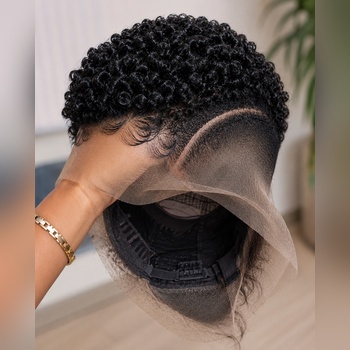
Instagram and TikTok sellers show centre-parted units from flattering angles, so look at a straight-on shot where both sides are visible together, not just a three-quarter view that favours one side. A pixie wig with a centre part needs to be judged from directly in front or behind, where the comparison is honest.
Etsy works with makers who show centre-parted styles from multiple angles, including straight on. The risk is a listing photographed at an angle that hides a slight imbalance. Read reviews for anyone mentioning whether the style looked even and symmetrical.
Marketplaces like Amazon, AliExpress, and Temu carry centre-part styles, but symmetry in mass production can be inconsistent, so check straight-on photos closely for any visible difference between the two sides. A cheap unit can still be symmetrical, but it is worth verifying rather than assuming.
Local beauty supply shops and salons let you check the symmetry yourself in a mirror, looking directly at the part from the front, which is the clearest way to judge balance. You pay a premium in-store, but a centre part is exactly the kind of detail that benefits from checking in person.
Vendors and wholesalers direct ship standard styles, so inspect the parting symmetry closely on arrival rather than assuming it from a catalogue photo. For a centre part specifically, balance matters more than on most other partings.
Regionally, well-balanced centre-part curl styles are common across Lagos, Accra, Atlanta, London, and South Africa, and symmetry is easy to check in straight-on video.
Vet the seller the usual way: check the account age, look for real buyer photos taken straight on, time a plain question for a genuine reply, and ask directly whether the curl density is balanced on both sides of the part. A seller who shows a straight-on view without being asked is confident in the symmetry.
Red flags: only angled or three-quarter photos of a centre-part style, no straight-on shot available, and any visible thinning or curl-size difference between the two sides in the photos you can see.
When you order, send your measurements and ask for balanced density and curl size on both sides of a centre part, and request a straight-on photo before shipping if possible. That tells the maker symmetry is what you are checking for.
Contact / order inquiries: WhatsApp [WhatsApp: +XX XXX XXX XX XX].
How Much It Costs
A centre-part unit costs the same as an equivalent side-parted one, but achieving genuine symmetry takes more careful setting, so it is worth valuing that attention rather than assuming any curl unit will part evenly down the middle.
Tiered pricing. Human hair, full build with a balanced spiral curl and a centre part, glueless with a fine lace, in black: roughly $180 to $400. Human hair, mid build: about $140 to $300. Human hair, basic cap: around $70 to $170. Good synthetic: $60 to $140, and synthetic often holds a symmetrical set more reliably since the pattern is fixed into the fibre. Basic synthetic: $25 to $60.
What that includes and excludes. The price covers the unit as set. It excludes shipping, any customs, and any request for a straight-on verification photo before shipping, which a good maker should provide at no extra charge.
Shipping and duty. These sit outside the price and change with where you live, so plan a realistic band and confirm your own country’s import rate.
Ongoing costs. A centre part does not add ongoing cost, but maintaining the symmetry over time means re-setting both sides evenly as the curl relaxes, so a little more care to keep both sides matched than a side part would need, where an uneven relax is naturally less visible.
First-year total. A centre-part human unit plus shipping plus any customs plus balanced upkeep tends to land in the same range as any similar curled unit, since symmetry is a matter of construction quality rather than added cost.
Cost per wear. A genuinely symmetrical centre part looks intentional and polished every time you wear it; an unbalanced one draws attention to the flaw every single time, since the comparison is unavoidable with this parting. Getting it right at purchase pays off on every wear after.
What a very low price signals. A very cheap unit is not necessarily less symmetrical, but it is worth checking closely, since less careful construction sometimes shows first in balance and evenness rather than obvious flaws.
Deposit structure. For custom work, thirty to fifty percent down with the balance before shipping is standard. Use a method you can dispute, and ask for a straight-on symmetry photo before releasing the last part.
Shipping, Delivery, And What To Expect After Ordering
A centre-part unit arrives with its part already set, so check the balance immediately in a mirror, straight on, before assuming it is even. Ask that it ship so the curls are not crushed unevenly on one side, choose a tracked service, and confirm your country’s import charge before it lands. When it arrives, stand directly in front of a mirror and compare both sides of the part side by side. What you unbox is a symmetry decision already made, and confirming it early means no surprises once you are wearing it out.
A Centre Part Removes The Place To Hide
The core difference from any other parting is that a centre part gives both sides equal visual weight, so there is no longer hair on one side to soften or cover a discrepancy on the other. This is precisely what makes a well-balanced centre part look so clean and deliberate, and precisely what makes an unbalanced one look off in a way a side part would never reveal.
Judge It Straight On, Never At An Angle
Because the whole point of a centre part is left-right comparison, judging it from an angle defeats the purpose, since one side will naturally look more prominent than the other in an angled shot regardless of how the unit was actually set. Always judge, and ask to see, a centre part from directly in front or behind, where both sides are honestly on display at once.
Curl Size And Density Both Need To Match
Symmetry is not only about how much hair is on each side, it is also about whether the curls themselves are a similar size and definition on both sides. A centre part with equal volume but visibly larger curls on one side than the other still reads as unbalanced, so check both density and curl pattern together when comparing the two halves.
Before You Pay
- Have I seen this centre part from directly in front, not at an angle?
- Do both sides match in density, not just overall volume?
- Are the curls a similar size on the left and right?
- Would I notice any imbalance immediately, given how exposed a centre part is?
- Has the seller offered or can they provide a straight-on symmetry photo?
Trimming The Lace
The lace comes off the front the usual way, and with a centre part, trimming evenly on both sides matters more than usual, since any unevenness at the hairline will be just as visible as any unevenness in the curl. Trim in small offset steps and leave a shallow margin rather than cutting flush, in daylight, checking both sides against each other as you go. If this is your first centre-part unit, let a stylist handle it, since keeping both sides balanced while trimming takes a careful, symmetrical eye.
Search Terms
centre part pixie wig · symmetrical spiral curl short wig · middle part black curl unit · balanced curl pixie lace · straight part curl short wig · even curl pixie wig · black spiral curl centre part · defined curl symmetrical wig
Final Thoughts
The straight, deep centre part running through this unit’s spiral curls looks striking specifically because both sides mirror each other, and that mirroring is the entire challenge a centre part sets for a unit. Unlike a side part, which naturally covers minor imbalances with its longer side, a centre part puts both halves on equal, simultaneous display, so any difference in density or curl size between them is visible immediately rather than hidden.
Buy a centre-part unit by judging it straight on, comparing both sides directly for density and curl size rather than assuming general fullness means balance. A unit set with genuine care for left-right symmetry looks clean and deliberate every time you wear it; one that was not shows its imbalance the moment anyone looks straight at it. A centre part gives a curl style nowhere to hide, which is exactly why it looks so good when it is done right.