
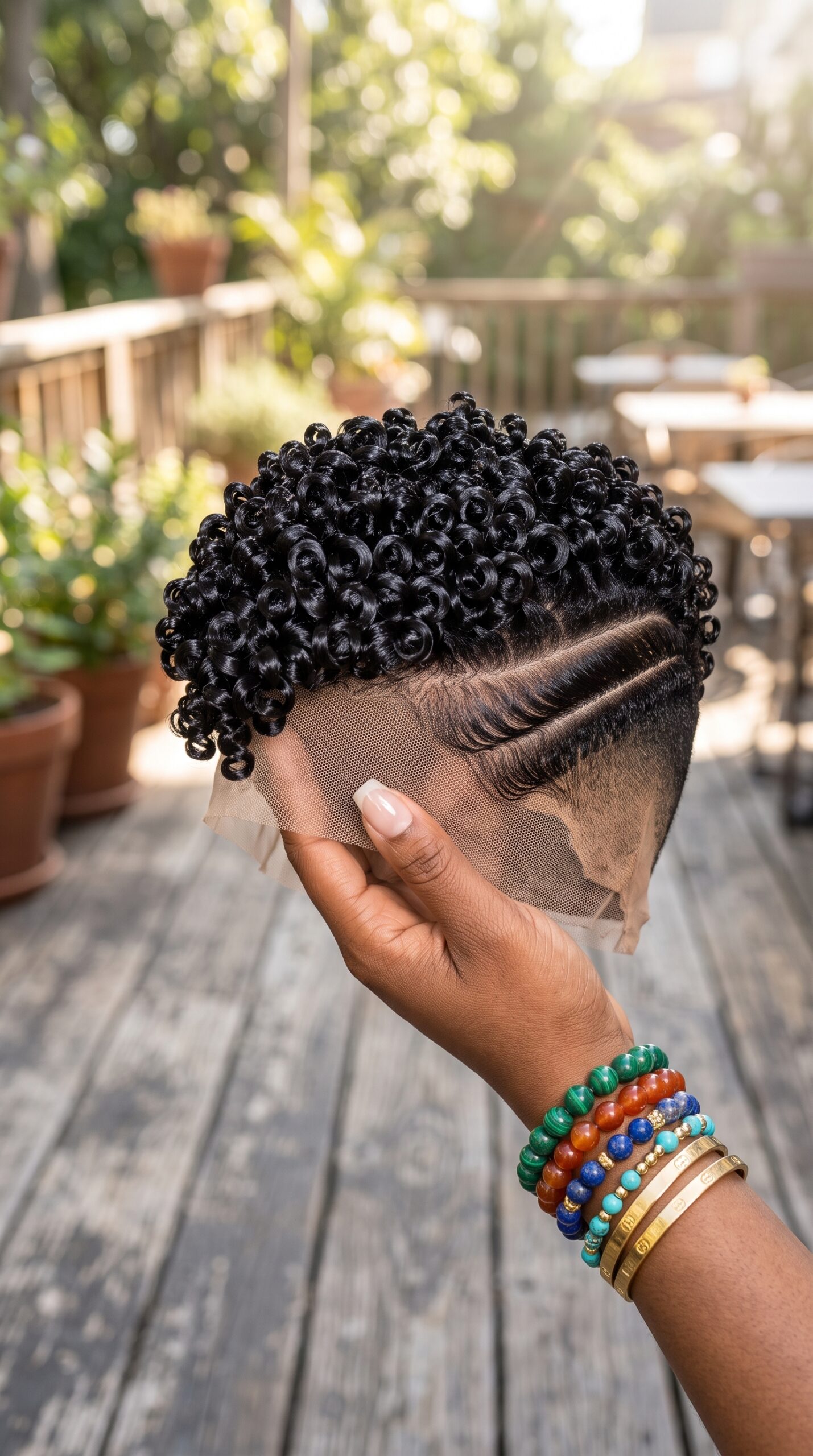
Look closely at where this unit’s hairline meets the main crown of curls, and you will notice the tiny hairs right at the front are not a different texture doing their own thing, they are small versions of the exact same spiral pattern as the curls above them. That continuity is what makes the whole hairline read as one head of hair rather than a wig sitting on a separate front piece. Baby hairs get judged constantly on whether they exist and whether they are fine or coarse, but the detail that actually sells the illusion is simpler and easier to miss: do they match the curl pattern growing out of the rest of the unit, or do they look like a different kind of hair altogether.
This matters because real hair does not change texture abruptly at the hairline. If your own hair is curly, the finest hairs right at your edges are still curly, just smaller and less defined, not suddenly straight or wavy. A unit that gets this right mirrors that: the baby hairs here are miniature versions of the same tight spiral seen across the crown, so the eye reads unbroken continuity from root to hairline. A unit that gets it wrong might have beautifully laid, soft baby hairs that are nonetheless straight or loosely wavy against a tightly coiled crown, and that mismatch, even if each part looks good on its own, breaks the illusion the moment someone looks closely.
So when you are judging a hairline, look past whether baby hairs exist at all and ask the sharper question: do they echo the main curl above them, scaled down, or do they belong to a different texture entirely. A perfectly laid set of edges in the wrong curl pattern is still a tell, just a subtler one than no baby hairs at all. Matching pattern, not just presence, is what makes a hairline look like it grew that way.
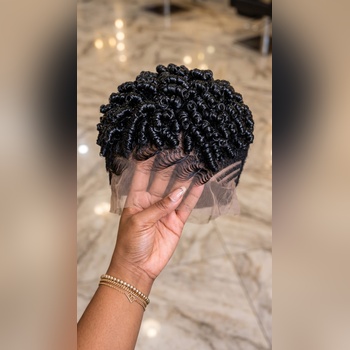
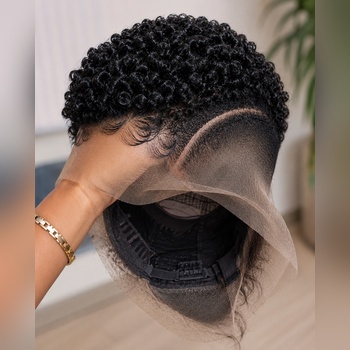
Where To Buy A Pixie Wig With Matching Baby Hair Texture
Custom makers can set baby hairs to echo the main curl pattern rather than a generic soft wave, so ask specifically whether the baby hairs match the crown’s curl type. A maker who thinks about pattern continuity will confirm this; one who does not may attach a standard soft baby hair regardless of the main texture.
Instagram and TikTok sellers show baby hairs laid beautifully, so look closely at whether those hairs share the same curl pattern as the crown, not just whether they are neatly styled. A pixie wig can have gorgeous edges and still mismatch the texture above them, so zoom in on the pattern, not just the styling.
Etsy works with makers who can describe how the baby hairs relate to the main curl. The risk is a listing showing beautifully laid edges that do not actually match the crown’s spiral or coil pattern up close. Read reviews for anyone mentioning how natural or continuous the hairline looked.
Marketplaces like Amazon, AliExpress, and Temu vary in how carefully the baby hair texture is matched to the main curl, and mismatches are common at lower price points where the front and crown may be made with less coordination. Check close-up photos for whether the tiny hairline curls echo the bigger pattern above.
Local beauty supply shops and salons let you inspect the hairline closely against the crown in person, which is the clearest way to judge texture continuity. You pay a premium in-store, but this kind of close matching is exactly what benefits from seeing it in person rather than in a photo.
Vendors and wholesalers direct ship standard units where baby hair texture may or may not be coordinated with the main curl, so look closely at construction photos. For a matched pattern, ask directly rather than assuming.
Regionally, makers who deliberately match baby hair texture to the main curl pattern are found across Lagos, Accra, Atlanta, London, and South Africa, and this level of detail is easy to spot in close video.
Vet the seller the usual way: check the account age, look for real buyer photos with close hairline shots, time a plain question for a genuine reply, and ask whether the baby hairs are set to match the crown’s curl pattern. A seller who understands this distinction is paying attention to what actually makes a hairline convincing.
Red flags: baby hairs that are noticeably straighter or looser than the main curl, hairline photos shown only from a distance, and no mention of how the front texture relates to the rest of the unit.
When you order, send your measurements and ask for baby hairs that echo the main curl pattern, not a generic soft edge. That tells the maker you are judging continuity, not just presence.
Contact / order inquiries: WhatsApp [WhatsApp: +XX XXX XXX XX XX].
How Much It Costs
Matching the baby hair texture to the main curl does not typically raise the price on its own, but it reflects a level of attention worth paying for, since a mismatched hairline undermines an otherwise good unit.
Tiered pricing. Human hair, full build with a tightly matched spiral curl from root to hairline, glueless with a fine lace, in black: roughly $180 to $400. Human hair, mid build: about $140 to $300. Human hair, basic cap, where texture matching may be less precise: around $70 to $170. Good synthetic: $60 to $140. Basic synthetic: $25 to $60, where hairline texture is often generic regardless of the main curl.
What that includes and excludes. The price covers the unit including however the baby hairs were set. It excludes shipping, any customs, and any request for closer texture matching, which is usually included at no extra charge if you ask for it upfront.
Shipping and duty. These sit outside the price and change with where you live, so plan a realistic band and confirm your own country’s import rate.
Ongoing costs. Matched baby hairs need the same gentle care as any fine hairline hairs, a little edge control and a soft touch, nothing beyond the ordinary. There is no extra maintenance for matched texture over mismatched, only a one-time construction difference.
First-year total. A unit plus shipping plus any customs, with well-matched baby hair texture costing the same as a mismatched default, tends to land at the same total either way, so there is no financial reason to accept a poor match.
Cost per wear. A hairline that reads as continuous with the rest of the unit gets you compliments on looking like your own hair, every single wear, at no extra cost. A mismatched one is a subtle flaw that a close look reveals, wear after wear.
What a very low price signals. A very cheap unit is more likely to use a generic baby hair texture regardless of the main curl, so if pattern matching matters to you, check closely rather than assuming it comes standard.
Deposit structure. For custom work, thirty to fifty percent down with the balance before shipping is standard, and use a method you can dispute.
Shipping, Delivery, And What To Expect After Ordering
A unit arrives with its baby hairs already set in whatever pattern the maker chose, so check right away whether they echo the main curl or diverge from it. Ask that it ship so the curl is not crushed, choose a tracked service, and confirm your country’s import charge before it lands. When it arrives, look closely at the hairline against the crown in daylight, comparing the tiny front curls to the bigger ones behind them. What you unbox is a texture decision that was made for you, and checking it early tells you whether the hairline will read as continuous or not.
Real Hair Does Not Change Texture At The Edge
The reason pattern matching matters is that natural hair keeps its curl type all the way to the finest, wispiest strands at the hairline, just smaller and softer, never suddenly a different texture. A unit that mirrors this looks grown rather than attached. This is the standard to judge against: not whether baby hairs exist, but whether they behave like the same hair as everything behind them.
A Mismatch Is A Subtler Tell Than No Baby Hairs At All
A blunt hairline with no baby hairs is an obvious sign of a wig, but a hairline with lovely, well-laid baby hairs in the wrong texture is a quieter one, easy to miss at a glance and obvious up close. Because it is subtler, it is also easier for a seller to get away with and easier for a buyer to overlook, which is exactly why it is worth specifically checking rather than assuming good baby hairs automatically mean a good match.
Compare Close-Up Photos Of Both Together
The clearest way to judge this before buying is a photo or video that shows the hairline and the crown curl close together in the same frame, so you can compare the pattern directly rather than judging each in isolation. A seller confident in the match will show this naturally; one who only shows the crown from a distance and the hairline in a separate flattering close-up may be hoping you will not compare the two.
Before You Pay
- Do the baby hairs echo the same curl pattern as the main crown, just smaller?
- Have I seen both close up together, not judged separately?
- Is the texture continuous from hairline to crown, or does it change abruptly?
- Am I asking specifically about pattern matching, not just baby hair presence?
- Does the seller show close comparison shots, or only flattering distant ones?
Trimming The Lace
The lace comes off the front the usual way, and cutting it carefully preserves the baby hairs so their matched pattern stays intact rather than getting trimmed away with the excess lace. Trim in small offset steps and leave a shallow margin rather than cutting flush, in daylight where you can see how the tiny curls sit against the crown. If this is your first unit, let a stylist make the first pass, and ask them to keep an eye on preserving the texture match while they work.
Search Terms
matching baby hair pixie wig · continuous curl hairline short wig · black spiral curl lace unit · natural hairline texture pixie · seamless curl pattern short wig · tight ringlet baby hair pixie · realistic curl hairline lace wig · matched texture pixie wig
Final Thoughts
The tiny curls right at this unit’s hairline are not a separate detail from the crown above them, they are miniature versions of the same spiral pattern, and that continuity is what makes the whole front read as real hair rather than an attached piece. Baby hairs get judged on whether they exist and how well they are laid, but the sharper, more revealing question is whether they match the curl type growing out of the rest of the unit.
Buy by comparing the hairline and the crown together, in close photos or in person, checking that the pattern carries through rather than assuming good baby hairs mean a good match. A mismatch is a quieter tell than no baby hairs at all, which is exactly why it deserves specific attention. A pixie wig where the baby hairs echo the main curl, scaled down, looks like it grew that way, and that continuity is worth more than laid edges alone.