
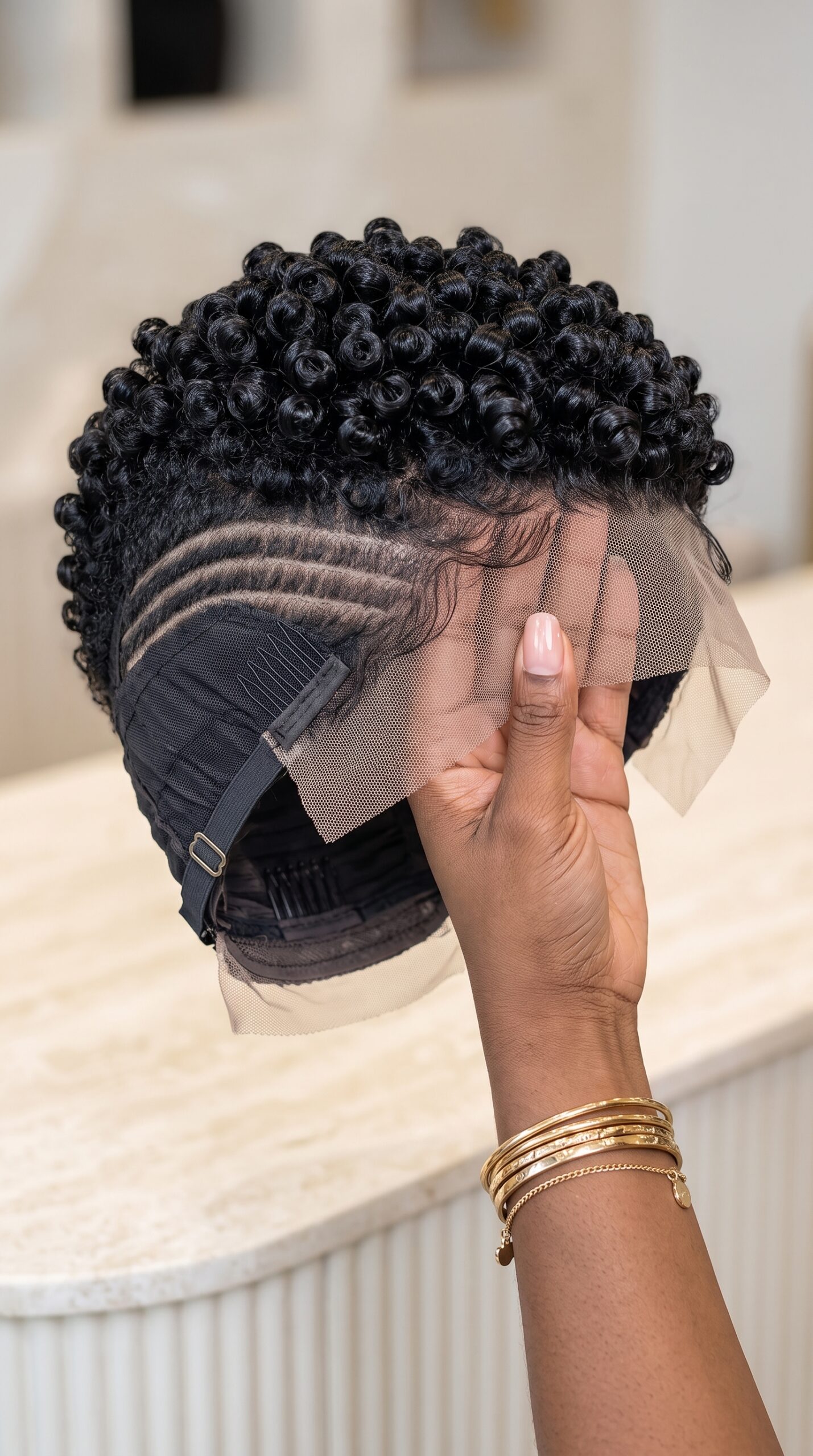
Sellers talk endlessly about matching lace colour to skin tone, but the cap fabric underneath the hair gets almost no attention, and it should. This unit’s cap is black, not the tan or brown base so many units default to, and that is a deliberate match for a deeper skin tone, not just a colour choice. The cap is the solid material the hair is built onto, and wherever it shows, at a parting, near the edges, or through any thin spot, its colour matters just as much as the lace does. Get it right and it disappears against your scalp; get it wrong and it creates a visible mismatch no amount of good lace can fix.
The reason this matters is simple: lace handles the very front hairline, but the cap is what sits under the rest of the hair, and on a short, dense unit like this one, glimpses of that base are more likely than on a longer style with more hair to cover it. A tan or brown cap under deep brown skin can read as a lighter patch wherever it peeks through; a cap too dark for a lighter skin tone can do the reverse. So the cap colour is not a background detail, it is part of how convincingly the whole unit reads against your particular skin.
This is why offering cap colour options, as this black-based unit does, is a meaningful sign of quality, not just variety for its own sake. A seller who thinks about cap colour alongside lace colour is thinking about the whole picture of how a unit disappears on real skin, not just the front inch of it. When you buy, ask about the cap base colour the same way you would ask about the lace, and choose the one that matches you, not just whichever is the default in stock.
Where To Buy A Pixie Wig With A Cap Colour That Matches You
Custom makers can often offer a choice of cap base colour alongside lace colour, so ask specifically whether the cap comes in different shades and which suits your skin tone. A maker who offers this understands that matching does not stop at the hairline; one who does not may only stock a single default cap colour.
Instagram and TikTok sellers rarely mention cap colour at all, focusing on the hair and the lace, so ask directly what the cap base colour is and whether options exist. A unit that looks perfectly matched in a photo may still have a cap colour that was never actually chosen for the model’s skin tone.
Etsy works with makers who sometimes list cap colour as an option alongside lace colour. The risk is assuming one size fits all when it comes to the cap. Read listings carefully for any mention of base or cap colour choices.
Marketplaces like Amazon, AliExpress, and Temu typically ship a single default cap colour, often tan or brown, so if your skin tone is significantly darker or lighter, expect to check closely whether that base will show and in what way. This is worth judging in close photos before buying.
Local beauty supply shops and salons let you hold a unit’s cap against your own scalp and see immediately whether it disappears or stands out, which is the clearest test there is. You pay a premium in-store, but this is exactly the kind of match that benefits from seeing it against your actual skin.
Vendors and wholesalers direct usually stock a standard cap colour, so ask whether alternatives exist for different skin tones. For a closer match, a custom maker who offers choices is more reliable.
Regionally, makers who offer cap colour options alongside lace matching are increasingly common across Lagos, Accra, Atlanta, London, and South Africa, reflecting a wider range of skin tones being served well.
Vet the seller the usual way: check the account age, look for real buyer photos showing the cap against different skin tones, time a plain question for a genuine reply, and ask directly whether cap colour options exist. A seller who answers this specifically is paying attention to the detail that many overlook.
Red flags: no mention of cap colour at all, only one cap shade offered regardless of skin tone, and photos that never show the cap base clearly enough to judge the match.
When you order, send your measurements and a note on your skin tone, and ask for a cap base colour that matches, not just the default. That signals you want the whole unit considered, not only the front lace.
Contact / order inquiries: WhatsApp [WhatsApp: +XX XXX XXX XX XX].
How Much It Costs
Cap colour options do not typically add much, if anything, to the price, so there is little reason to settle for a mismatched default when a better match is often available for the same cost.
Tiered pricing. Human hair, full build with a defined curl, glueless cap available in a matched base colour, fine lace, in black: roughly $180 to $400. Human hair, mid build: about $140 to $300. Human hair, basic cap, where colour options may be more limited: around $70 to $170. Good synthetic: $60 to $140. Basic synthetic: $25 to $60, where cap colour is often fixed with no choice.
What that includes and excludes. The price covers the unit including whichever cap colour is built or chosen. It excludes shipping, any customs, and any request for a colour outside the maker’s standard offerings, which may carry a small custom charge.
Shipping and duty. These sit outside the price and change with where you live, so plan a realistic band and confirm your own country’s import rate.
Ongoing costs. A well-matched cap needs no ongoing spend at all, it is a one-time construction choice rather than something you maintain. This is one of the cheapest things to get right, since it costs nothing extra to ask for the correct match, only the asking.
First-year total. A unit plus shipping plus any customs, with a properly matched cap costing the same as a mismatched one, tends to land at the same total either way, so there is no financial reason to accept a poor match.
Cost per wear. A cap that disappears against your skin lets you wear a unit with full confidence in any lighting or angle, so it adds real value at no extra cost. A visible mismatch is a flaw you notice every single wear, for free.
What a very low price signals. A very cheap unit is more likely to ship with only one default cap colour and no options, so if matching matters to you, budget units may not accommodate it. Ask before assuming.
Deposit structure. For custom work, thirty to fifty percent down with the balance before shipping is standard, and use a method you can dispute.
Shipping, Delivery, And What To Expect After Ordering
A unit arrives with its cap colour already built in, so check it against your skin as soon as it lands, at the partings and anywhere the base might show. Ask that it ship protected, choose a tracked service, and confirm your country’s import charge before it lands. When it arrives, part the hair in a few places and see whether the cap disappears or stands out against your scalp in daylight. What you unbox includes a cap colour decision that was made for you or by you, and checking it early tells you whether it was the right one.
The Cap Shows More Than People Expect
On a short, curl-defined unit like this, with less hair volume than a long style, the cap has more chances to peek through at partings, thin spots, or where the curl pattern separates. This is why cap colour matters especially on shorter or less dense styles, since there is less hair to hide an unmatched base. The shorter and more textured the style, the more the cap colour choice actually shows.
A Matched Cap Extends The Lace’s Work
Good lace matching handles the hairline, but a matched cap extends that same realism to everywhere else the base might be visible, so the two work together rather than one covering for the other. A perfectly matched lace on top of a poorly matched cap still leaves a visible seam of mismatch further back. Treating both as part of the same matching job is what makes a unit convincing from every angle, not just the front.
Ask For It, Because It Rarely Costs Extra
Because cap colour options usually do not raise the price, the only reason to end up with a mismatched cap is not asking. This is one of the easiest wins in buying a unit: it costs nothing to request the right shade, only the awareness that the option exists and is worth asking about specifically, separate from the lace conversation.
Before You Pay
- What is the cap base colour, and does it match my skin tone?
- Does the seller offer cap colour options, or only one default?
- Have I seen the cap against skin close to my own tone in photos?
- Am I asking about the cap separately from the lace, not assuming one covers both?
- Does matching the cap cost extra, or is it available at no added price?
Trimming The Lace
The lace comes off the front the usual way and is separate from the cap colour underneath it, so a well-matched cap still needs a properly trimmed lace hairline to complete the realistic look. Trim in small offset steps and leave a shallow margin rather than cutting flush, in daylight. If this is your first unit, let a stylist handle the lace, and check the cap match yourself in the mirror at the same time, since both details work together for a convincing finish.
Search Terms
black cap pixie wig · matched cap colour curl unit · black spiral curl lace wig · skin tone matched cap short wig · glueless black cap pixie · dark cap base curl wig · comb strap black cap unit · natural match pixie wig cap
Final Thoughts
Lace colour gets all the attention, but the cap fabric underneath the hair matters just as much, and this unit’s black cap base, built for a deeper skin tone rather than the default tan, is a reminder that matching does not stop at the hairline. Wherever the cap shows, at a parting, an edge, or through the curl, its colour decides whether the unit disappears against your skin or creates a visible mismatch no lace can fix.
Buy by asking about the cap base colour as deliberately as you ask about the lace, since the two work together rather than one covering for the other, and because a proper match rarely costs anything extra, there is little reason to settle for a default that does not suit you. A pixie wig with a cap colour actually matched to your skin tone looks convincing from every angle, not just the front, and that is worth asking for by name.