
Sellers quote density as a percentage. The number was never designed for hair this short.
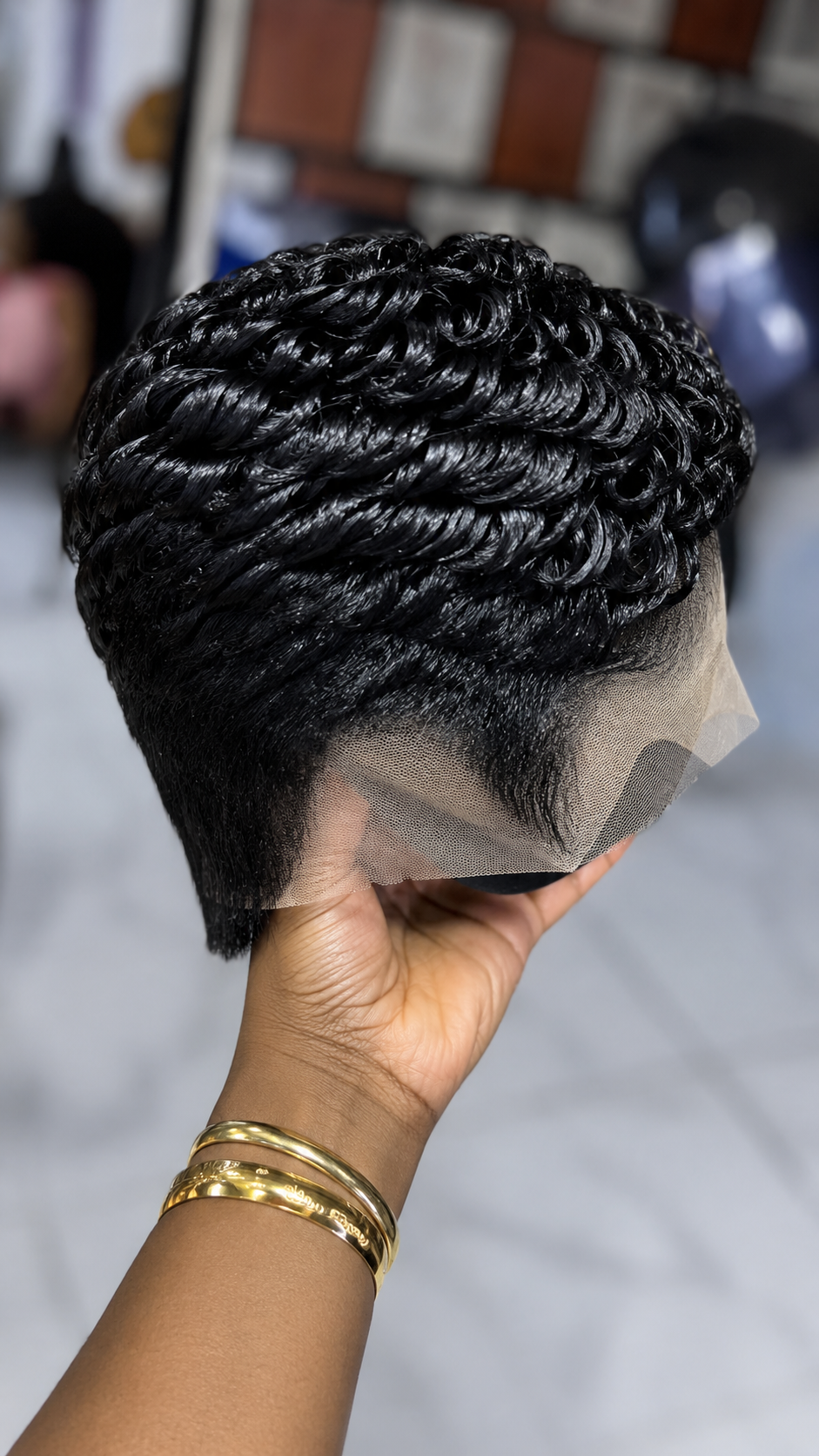
This black finger wave pixie wig shows the problem clearly. Deep S-ridges run in rows across the crown, the side is pressed smooth and swept back, and the lace hangs untrimmed at the front with the knot spacing visible through it. Ask what density it is and you will get a figure. Ask what that figure is measured against and most sellers cannot tell you.
Where To Buy A Wig Like This
Density is one of the few specifications that gets stated openly, which makes it worth understanding rather than ignoring.
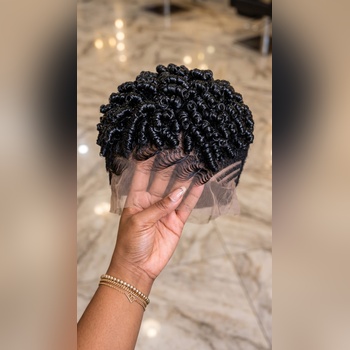
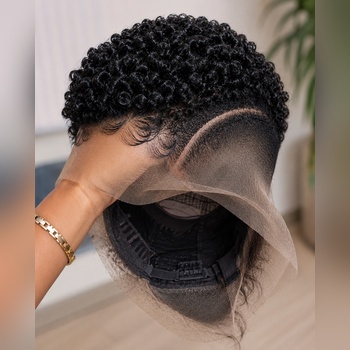
Independent makers and lace studios quote it and can usually justify it. Search phrasing that finds them: “finger wave pixie wig,” “black deep wave pixie wig human hair,” “130 density pixie wig,” “short wig density guide,” “sculpted wave pixie wig glueless.” Sellers who recommend a density for the style rather than quoting one blanket figure across their whole range are paying attention.
Instagram and TikTok makers rarely mention density at all on short pieces. Ask, because the answer separates a considered build from a stock one.
Etsy listings quote density constantly, often copied from long wig templates in the same shop.
Contact / Order Inquiries: WhatsApp is where most independent makers take orders. [WhatsApp: +XX XXX XXX XX XX] — ask what density this is, and what they consider standard for a short sculpted piece specifically.
Where The Percentage Comes From
The scale was built around long wigs. One hundred percent is meant to approximate an average head of hair at length, and everything else is expressed relative to that.
One hundred and thirty percent became the common default for long units because hanging hair separates and looks thinner than it is, so extra weight compensates.
None of that reasoning applies to a pixie. Short hair does not hang, does not separate under its own weight, and is not viewed as a falling mass. The compensation built into the standard figure is compensating for something that is not happening.
What The Numbers Do On A Short Unit
Roughly, and makers vary.
One hundred percent on a short sculpted piece is usually enough. The hair sits close to the head, the curl or wave fills the space between strands, and the cap is covered.
One hundred and thirty percent gives a fuller, rounder silhouette. On a waved or curled short unit this is often already more than the style needs, and it starts adding bulk at the crown.
One hundred and fifty percent and above is heavy for this length. It produces a helmet outline, it stops the waves sitting flat against the head, and it makes the piece obviously thicker than growing hair would be at the same length.
The common mistake is a buyer reading long wig advice, ordering one hundred and fifty, and receiving something that looks like a wig for exactly that reason.
Why Style Changes The Right Number
Density interacts with what the hair is doing.
A pressed or finger waved piece like this one needs less, because flat hair covers ground efficiently. Every strand lies against the head and blocks the cap.
An open curl needs more, because the spirals leave gaps between them and light passes through to the base.
A tight coil sits in the middle. The coils fill space but they also stand away from the cap.
So a sensible question is not what density is high quality. It is what density this particular style needs.
How Much It Costs
Density is one of the few specifications where the price difference is directly proportional to the material.
Human hair black finger wave pixie wig at 100 percent, sheer lace, glueless cap: $200–$420
The same short wave pixie wig at 130 percent: $240–$490
The same piece at 150 percent: $280–$570
Quality synthetic finger wave pixie wig, standard density: $70–$150
Basic synthetic short wave wig: $25–$60
Every additional band is more hair and more knotting hours. Unlike lace grade or cap type, there is nothing subjective about it, which makes density the clearest thing to compare between two sellers once you know what you actually want.
Judging Density From A Photo
Look at the base rather than the hair.
Hold any photo where the lace is visible and check whether the cap or lace shows between the strands at the crown. On a well-judged short unit it should not, but you also should not see hair standing thickly away from the base.
Look at the perimeter, at the edge of the knotted area. Density usually tapers there, and a piece that is uniformly dense right to the boundary looks blunt.
Compare the crown to the sides. Makers sometimes load the crown for photographs and thin the sides, which shows immediately in profile.
Shipping, Delivery, And What To Expect After Ordering
Three to four weeks. Higher densities take longer because every extra strand is another knot.
The piece will look denser in the packet than on a head. Compression closes the gaps between waves.
Check your own country’s duty on hair before agreeing a total, and ask for a tracking number rather than assuming there is one.
Establish the returns position before paying.
Send your head measurement, and mention if you have a small head, since density that suits an average cap can look overloaded on a smaller one.
The Wave Set
The ridges here run in rows rather than as a single sweep, which is a full-crown finger wave rather than a side panel.
Judge them on whether each ridge holds the same depth across its width. Ridges that shallow out toward the sides mean the tension dropped as the maker worked outward.
Also check that the row spacing stays even. Uneven rows read as a mistake rather than a pattern, and there is no length here to disguise it.
Before You Pay
What density is this, and what do you consider standard for a short sculpted piece?
Does the density taper at the perimeter?
Is the crown denser than the sides?
What density would you recommend for this style specifically?
Do you quote the same density across all your wigs or vary it by length?
Trimming The Lace
Follow your own hairline with short angled cuts and keep a margin rather than trimming flush.
On a dense unit the hair at the front sits closer together, so it is easy to cut into hair rather than lace on the first pass. Comb the front section back and hold it away before cutting.
If you have not done this before, get the first cut done by someone who has, with the piece on a block.
Search Terms
finger wave pixie wig · black deep wave pixie wig human hair · 130 density pixie wig · short wig density guide · sculpted wave pixie wig glueless · wig density percentage · low density pixie wig
Final Thoughts
Density is the most quoted number in short wig listings and the least examined. The scale it sits on was built for hair that hangs, and none of the reasoning behind the standard figure survives being cut to two inches.
More is not better here. Past a certain point it stops looking like a lot of hair and starts looking like a wig, which is the exact opposite of what the money was spent on.
Ask what density the style needs rather than what density is available. On a sculpted short piece the honest answer is usually lower than you were expecting.