
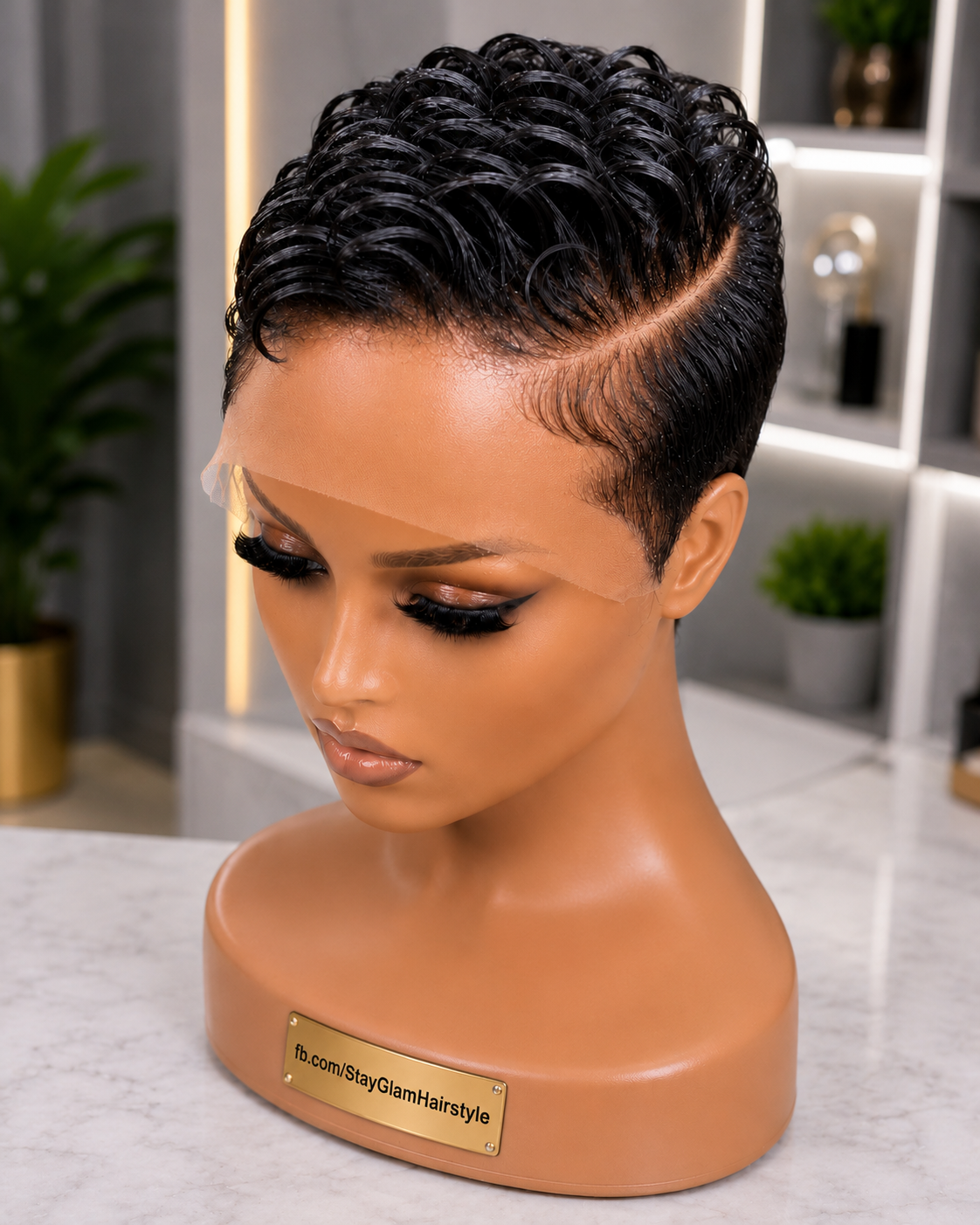
Sunlight falls on the top of a head. It does not reach the nape.
That single fact explains the colour on this unit and contradicts almost every ombré short wig on the market. The crown here carries warm golden blonde. Follow it back and down and the shade deepens steadily into a medium brown at the nape, where the hair is smoothed into a swept point finishing in a small curl.
Light at the top, dark underneath. On a long wig that arrangement would look wrong. On a short one it is the only version that makes sense.
Where To Buy A Wig Like This
Most coloured short units borrow their colour placement from long hair, which is why so many of them look subtly off without the buyer being able to say why.
Independent makers and lace studios build to a colour map if you give them one. Search phrasing that finds them: “blonde to brown pixie wig,” “honey blonde crown dark nape wig,” “two tone short wig human hair,” “reverse ombre pixie wig,” “tapered nape pixie wig glueless.” Sellers who describe where the colour sits rather than naming two shades are working from a plan.
Instagram and TikTok makers photograph short colour from the front, where the gradient is invisible. The back is where this design either works or does not.
Etsy listings will call this ombré. Send a reference image rather than relying on the word, because ombré on their side usually means dark to light in the other direction.
Contact / Order Inquiries: WhatsApp is where most independent makers take orders. [WhatsApp: +XX XXX XXX XX XX] — ask which section is lightest and how the tone changes toward the nape. If they describe roots and ends, they are thinking in long hair.
Why The Direction Matters
On long hair, colour placement copies regrowth. Dark at the root because that is new growth, light at the ends because those have been coloured and have had the most exposure over time. Everyone reads that instantly because everyone has seen it.
A pixie has no ends. There is nothing hanging down to be older or more processed. Regrowth logic has nothing to attach to, so a short unit built dark at the scalp and light at the tips just looks like the colour ran out.
What a short head actually shows is light exposure. The crown catches sun and lightens. The nape sits in permanent shadow and stays darkest. Sides land somewhere in between.
Copy that and the colour reads as something that happened to the hair. Copy long hair ombré and it reads as something that was done to the wig.
How Much It Costs
Two tones on one short cap means two processes and a controlled transition between them.
Human hair blonde to brown pixie wig, graduated crown to nape, sheer lace, glueless cap: $280–$580
The same two tone short wig with a hard boundary instead of a gradient: $240–$490
Human hair pixie wig, single blonde throughout: $290–$600
Human hair pixie wig, single brown, no colour work above natural: $180–$380
Quality synthetic blonde to brown pixie wig: $90–$190
Basic synthetic two tone short wig: $30–$70
The third line surprises people. Blonde throughout costs more than blonde-to-brown, because lifting the nape as well means processing hair that sits in shadow and will barely be seen. Leaving it dark saves real money and looks more convincing.
Shipping, Delivery, And What To Expect After Ordering
Allow four to five weeks. The blonde section needs multiple lifting stages and the transition has to be built while the hair is wet, then dried before anyone can judge it.
Expect the gradient to look softer in the packet than in the listing. Compression flattens the hair and the two tones sit closer together until the crown is opened out.
Check what your country charges on imported hair before you agree a price, and get a tracking number rather than assuming one.
Custom colour is almost never taken back. Have that in writing.
Along with your head circumference, send the distance from your crown to your nape. On a graduated piece the transition has to land in the right place on your head, not on an average one.
Judging The Gradient
Follow the change from the crown backwards. It should shift continuously, with no point where you can put a finger on a line.
The lightest point should sit at the highest part of the crown rather than at the front hairline. Light at the very front reads as a money piece, which is a different design and a different price.
The darkest point should be at the lowest part of the nape, not partway up. A gradient that stops early leaves a band of mid-tone at the bottom that looks unfinished.
Check the sides against the back. On a properly mapped piece the sides sit between the two, not matching either.
The Smoothed Nape And The Point
The back section here is pressed flat rather than curled, and cut into a swept point with a small curl at the tip.
Smoothing the darkest section is a deliberate pairing. Curl scatters light and makes dark hair look lighter, so a curled nape would work against the gradient. Flat hair holds its depth.
Check that the smoothing was done by cut and set rather than product. A nape held down with gel lifts within a few hours and the shape goes with it.
The curl at the tip is the finishing detail. It should be a deliberate hook rather than hair that simply ran out.
Living With Blonde At The Crown
The lightest section is the most processed and it sits where the most sun, handling and product ends up.
Toning every few weeks will be needed to stop it going brassy, and the brown at the nape will need nothing at all, which means you are maintaining half the piece on a schedule.
Ask what the crown was lifted to and whether it has any lifting left in it. On a graduated piece the answer is usually no.
Before You Pay
Which section is the lightest, and where exactly does it sit?
Is the change continuous or is there a boundary?
How far down does the darkest tone extend?
Was the nape smoothed by cut or held with product?
What was the crown lifted to, and can it be toned again?
Trimming The Lace
Follow the shape of your own hairline with short angled cuts and keep a margin of lace rather than going flush.
Worth knowing on this build: the lace meets the lightest hair at the front, so a lace tone that suits your skin may look darker than usual against blonde. Match it to your forehead and accept the small contrast rather than choosing a paler lace to suit the hair.
Get the first cut done by someone experienced if you have not done it before. The margin for error at the front of a pale unit is smaller than on a dark one.
Search Terms
blonde to brown pixie wig · honey blonde crown dark nape wig · two tone short wig human hair · reverse ombre pixie wig · tapered nape pixie wig glueless · graduated colour short wig · blonde crown pixie wig where to buy
Final Thoughts
Colour on a short unit has to answer a different question than colour on a long one. There are no ends to have been processed and no regrowth to show, so the only story available is where light falls.
Crown lightest, nape darkest, sides in between. That arrangement costs less than lifting the whole piece and looks more like hair than any ombré borrowed from a long style ever will.
Ask where the lightest section sits before you ask anything else about the colour. If the answer is the ends, the maker is building a long wig short.