
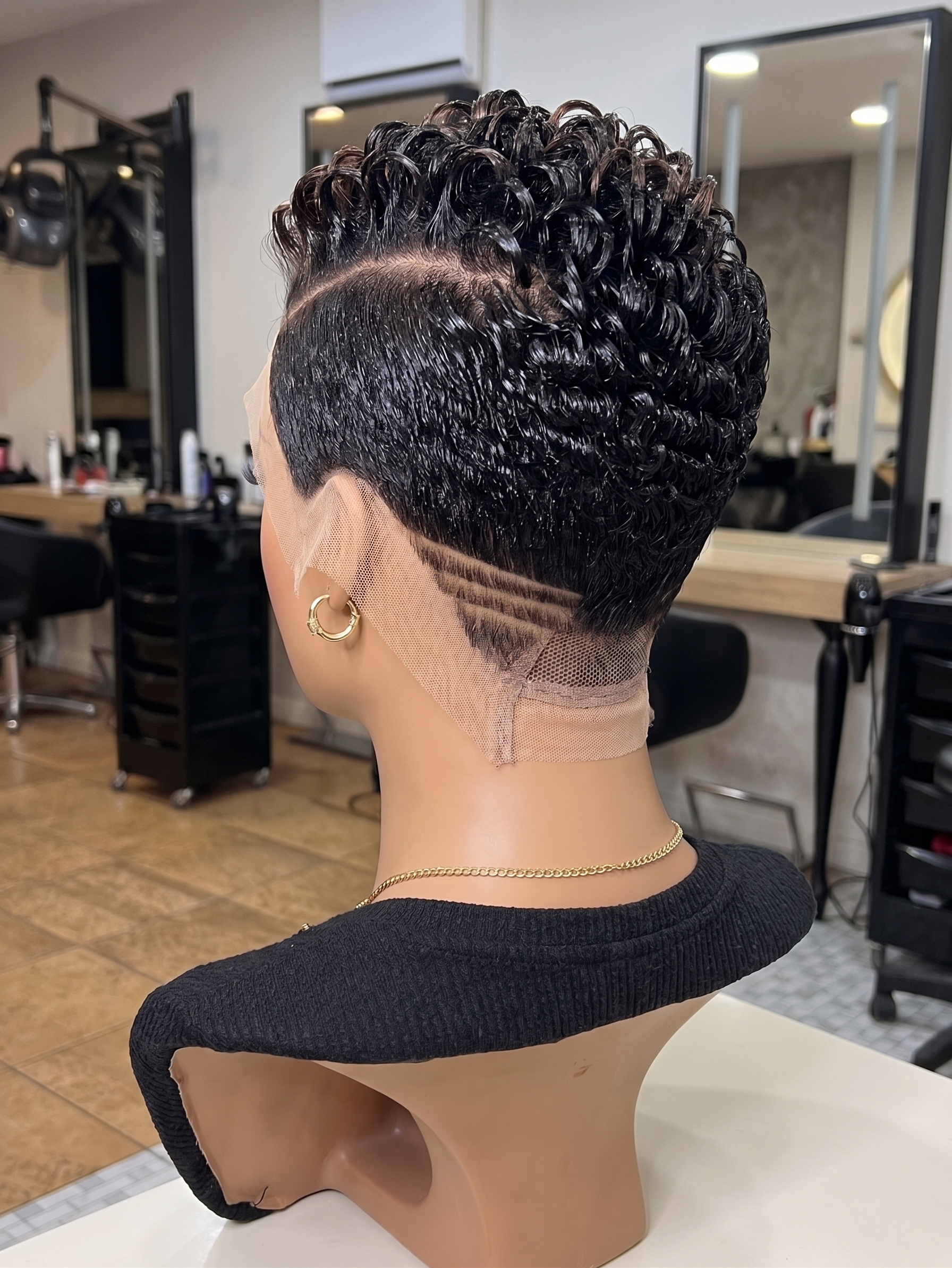
Side-back view on a salon mannequin. Tight glossy black curls across the crown, a smoothed sweep running down the side, carved lines cutting through the nape. And below all of it, a wide sheet of lace hanging loose down the back of the neck, untrimmed, extending far past where the hair stops.
Most pixie units end at the nape with a fabric cap edge. This one carries lace all the way around and down, which is a meaningfully different build — more expensive, more versatile, and carrying one practical problem nobody mentions in the listing.
Where To Buy A Wig Like This
Back lace is a specialist build. Most short-unit makers finish the nape with cap fabric because it is faster and no one usually sees it.
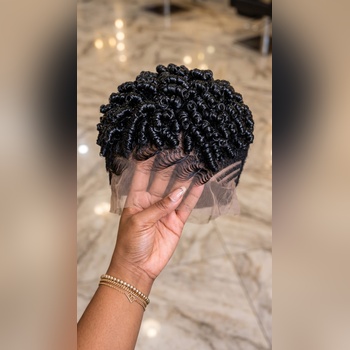
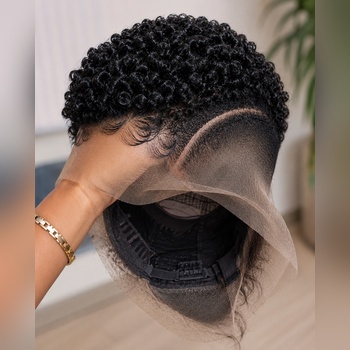
Independent lace studios and custom builders are the source. Search terms that surface them: “full lace pixie wig,” “360 lace short wig,” “nape lace curly pixie,” “back lace pixie human hair.” Sellers who mention lace placement around the perimeter rather than just “lace front” are describing this build.
Instagram and TikTok makers who do this tend to photograph the back deliberately, because it is the selling point. If a seller only ever shows the front on a piece they call full lace, ask why.
Etsy is workable, but read carefully. “Lace front” and “full lace” get used loosely, and some listings say full lace when they mean a slightly deeper front panel.
Contact / Order Inquiries: WhatsApp handles most independent orders. [WhatsApp: +XX XXX XXX XX XX] — ask exactly how far the lace extends at the back and whether the nape knots are bleached to the same standard as the front. Those two answers separate real back lace from marketing language.
How Much It Costs
Lace around the full perimeter roughly doubles the knotting area compared with a front-only build. That is where the money goes.
Human hair, black curls, lace running front to nape, carved nape lines, bleached knots throughout, glueless cap: $290–$600
The same piece with lace at the front only and fabric at the nape: $210–$440
Human hair, front lace, no carved detail: $150–$310
Quality synthetic with a full lace perimeter: $110–$220
Basic synthetic, front lace only: $25–$60
Two things drive the premium. The first is hours — every strand across the nape has to be individually knotted rather than sewn onto a fabric base. The second is bleaching, because nape knots on a back-lace unit will be visible in any updo, ponytail, or brushed-up style, so skipping them there is not an option the way it is on a hidden fabric nape.
Shipping, Delivery, And What To Expect After Ordering
Four to six weeks is realistic. Perimeter knotting is slow work and rushing it produces exactly the uneven density that makes back lace look worse than a fabric nape would have.
The lace arrives untrimmed at the back exactly as shown here, hanging well below the hairline. That excess is intentional and it is not a defect.
Confirm tracked shipping and check import duties for your country.
Ask about returns before paying. Custom perimeter work is almost never refundable.
Send a full head measurement, and for this build also send a nape-to-crown measurement, since the lace has to sit correctly at the back rather than riding up or bagging.
The Trimming Problem
Here is the part sellers skip. Front lace you can trim yourself in a mirror. Nape lace you cannot.
You cannot see the back of your own neck, you cannot judge the curve of your own hairline back there, and you cannot hold tension on lace you are cutting blind. Attempting it with two mirrors produces a reversed image that most people cut backwards on the first try.
Realistic options, in order of how well they work: have a stylist trim it once and keep that shape on future trims; have someone at home do it with clear instruction; or ask the maker to pre-trim the nape to a measurement you send, accepting that they are estimating.
Budget for the stylist visit when you price this piece. It is a real cost of ownership on a back-lace unit and it is not optional.
What Back Lace Actually Buys You
Exposed nape styling. On a fabric-nape unit, brushing the hair up or wearing it pushed back reveals a hard cap edge. On this build there is no edge to reveal — the hairline continues as knots in lace, so the nape reads as skin and hair rather than as a boundary.
Neck movement without a visible line. Fabric nape edges shift when you turn your head. Lace moves with the skin.
Comfort in warm weather, since lace breathes and fabric does not.
If you never wear short hair pushed up or off the neck, none of this matters and you are paying a large premium for something you will not see.
Judging Nape Knot Quality
This is where corners get cut, because most buyers never inspect the back.
Ask for a close-up of the nape lace held against light. Knots should be as pale and as evenly spaced as the ones at the front hairline. A noticeable jump in knot darkness or density between front and back means the maker treated the nape as the cheap side.
Look at where the carved lines cross the lace boundary. That junction should be clean, with the line reading continuously rather than stopping abruptly where the knotting ends.
The Carved Lines At The Nape
The lines here run through the fade at the back, which is the hardest placement to keep even because the hair is shortest there and there is the least material to work with.
Check that they hold width to their ends rather than tapering into nothing, and that they sit level relative to each other rather than drifting.
Before You Pay
How far does the lace extend at the back, measured from the hairline?
Are the nape knots bleached to the same standard as the front?
Can you send a close-up of the back lace against light?
Will you pre-trim the nape if I send a measurement, and what does that cost?
What nape-to-crown length is this built to?
Trimming The Lace
Trim the front yourself, slowly, following your own hairline with small staggered cuts and a shallow margin.
Do not attempt the nape alone on your first unit. Have it done once by someone who can see what they are cutting, then photograph the finished shape so any future trim can copy it.
Lace at the nape tears more easily than lace at the front because it sits over a curved surface under more tension. Handle it with light hands when putting the piece on and taking it off.
Search Terms
full lace pixie wig · 360 lace short wig · nape lace curly pixie · back lace pixie human hair · perimeter lace short wig · curly pixie wig exposed nape
Final Thoughts
Back lace is one of the few genuine upgrades in short-wig construction rather than a cosmetic add-on. It removes the hard cap edge that gives most pixie units away the moment the hair moves off the neck.
It also doubles the knotting cost, extends the build time, and hands you a trimming job you realistically cannot do yourself. Whether that trade is worth it depends entirely on how often you wear the back of your hair exposed.
Ask for the nape close-up before you commit. That patch of lace is most of what the price difference is buying.