
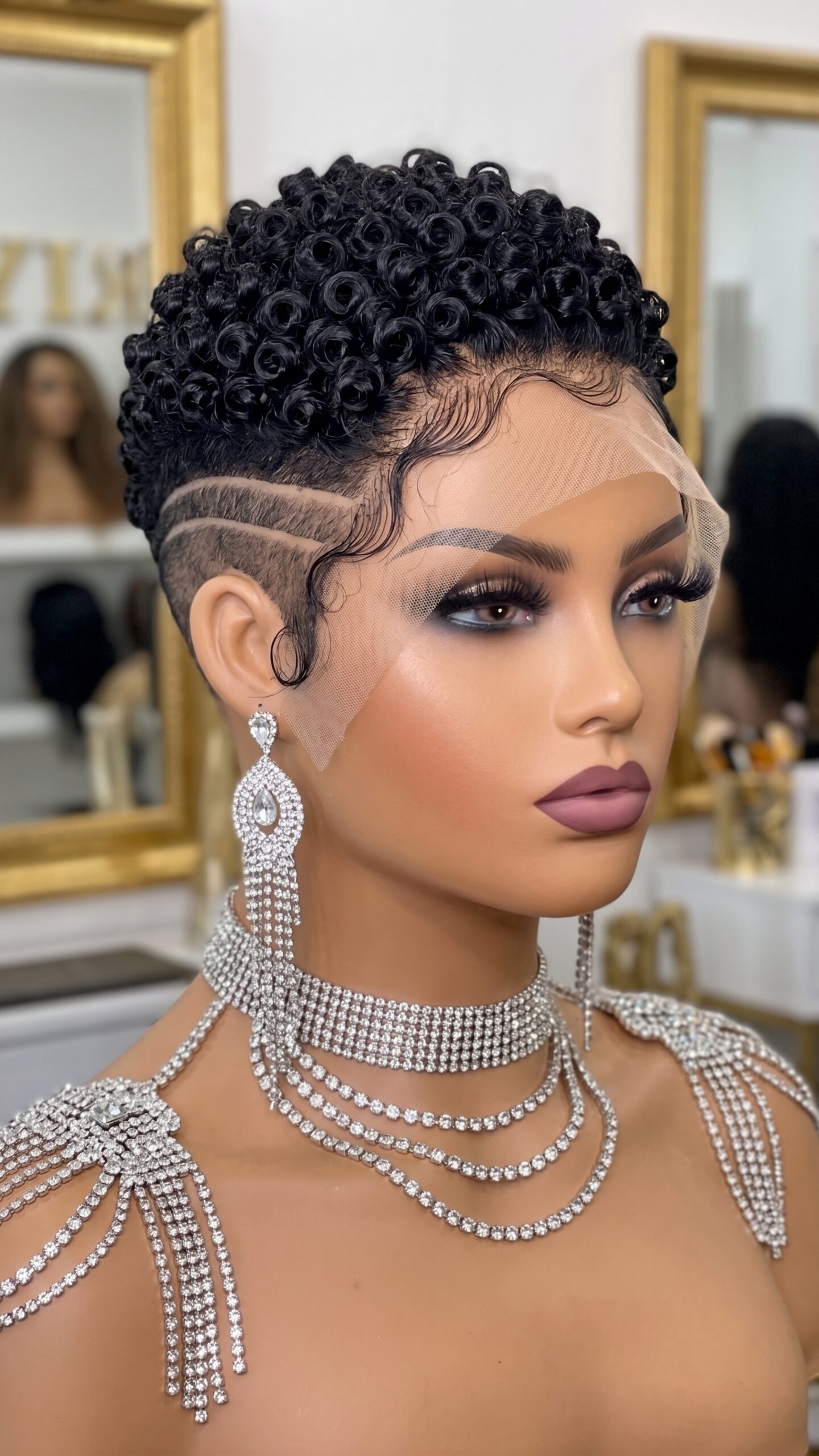
This jet black pin curl pixie wig combines a dense crown of tiny spiral curls with dramatically tapered sides, two curved shaved-line details, and delicate finger-wave styling around the temple. The visible lace at the forehead also shows how the hairstyle can be constructed as a realistic custom wig rather than simply recreated as a salon haircut.
The strongest feature is the contrast between the compact, highly polished curls on top and the extremely close side section underneath. Instead of covering the entire head with curls, the design keeps the volume concentrated through the crown while exposing the architectural details along the side.
Compact Spiral Curls Across the Crown
The upper section consists of dozens of small circular pin curls arranged closely together. Each curl forms a recognizable loop, producing a dense pattern without creating excessive height.
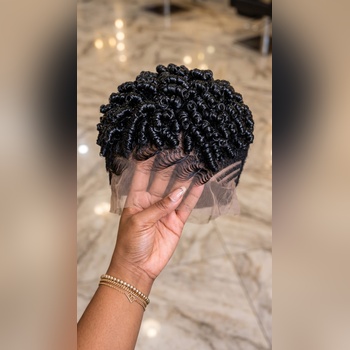
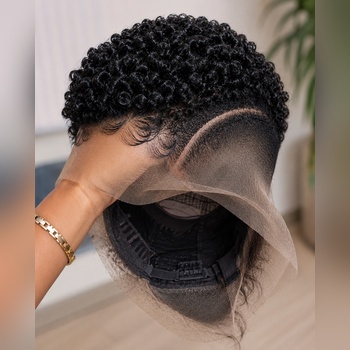
The curls are predominantly jet black and have a glossy surface that makes the individual spirals visible even though the color is very dark. Maintaining separation between these curls is essential. If they are brushed together, the characteristic circular pattern can quickly disappear.
The crown gradually becomes tighter toward the sides, helping the fuller upper section transition naturally into the tapered perimeter.
Double Curved Side-Line Detail
Two parallel curved lines travel backward above the ear, creating the most distinctive element of the side profile. These double shaved side lines follow the natural contour of the head rather than appearing as straight horizontal stripes.
The upper line sits directly beneath the curled crown while the second follows a similar path underneath it. A narrow section of dark hair separates them, giving the design a layered appearance.
On a custom wig, reproducing this feature requires careful ventilation and trimming. The lines need enough contrast to remain clearly visible while still looking integrated with the surrounding tapered hair.
The Tapered Side Construction
The area surrounding the carved lines is kept extremely close to the base. This creates a low tapered pixie profile that emphasizes the difference between the compact crown and the side section.
The hair becomes slightly denser as it approaches the upper curls, avoiding an abrupt transition. Around the ear, the length remains minimal so the ear and jewelry stay completely visible.
This construction is particularly useful for anyone who likes the appearance of a precision barbered pixie but wants the option of wearing it as a removable unit.
Sculpted Temple Waves
The temple includes several carefully directed strands that form elongated curves. These sculpted finger-wave details soften the geometric side design and connect the tapered area with the frontal hairline.
A longer curved tendril extends toward the ear, while finer strands sweep around the upper temple. This prevents the side from appearing too severe despite the very close cut and carved lines.
The contrast between the tiny crown curls, barber-style lines, and delicate temple waves is what gives the hairstyle its distinctive character.
Why Jet Black Works With This Design
Jet black is especially effective because the hairstyle depends heavily on contrast and shine. Light reflects around the outer edges of the circular curls, allowing individual spirals to remain visible.
The same dark color also emphasizes the exposed lines on the side. Instead of introducing additional shades, the design creates dimension through different hair lengths, curl directions, and exposed sections.
For buyers who want the closest interpretation, shades described as jet black, raven black, or natural black are appropriate choices.
The Visible Lace Hairline
The image clearly shows lace extending beyond the forehead, which is useful for understanding the construction before installation. Once fitted and trimmed correctly, this excess material would normally be removed close to the customized hairline.
A fine lace base allows individual hairs to appear as though they emerge directly from the scalp. This becomes especially important around the temple because the hairstyle exposes considerably more of the perimeter than a longer wig would.
For the most realistic result, the lace should complement the wearer’s complexion and the density around the frontal edge should remain controlled.
HD Lace for an Exposed Pixie Hairline
An HD lace pixie wig can work particularly well for this style because there is very little hair available to conceal the frontal base. Fine lace becomes less noticeable after correct trimming and installation.
The knots around the forehead and temple should also be small enough that they do not create obvious dark dots. Professional customization may include knot treatment, careful plucking, and individual strand placement around the perimeter.
However, the hairline should not be over-plucked. This design needs enough density to support the sculpted waves while still retaining a believable transition.
Glueless Construction Options
The hairstyle can also be built as a glueless Wear&Go pixie wig. A properly sized cap, internal elastic support, adjustable fastening, and suitable ear-tab construction can help keep the unit stable without daily adhesive.
Fit is particularly important because the side-line pattern must remain correctly positioned above the ear. A unit that shifts forward or backward can make the carved design appear misplaced.
Accurate measurements should therefore be provided before ordering a custom version.
Human Hair or Synthetic Fiber?
Human hair offers the greatest flexibility for recreating this design. The pin curls can be reset, the temple waves can be reshaped, and the overall finish can be refreshed with controlled heat and professional styling products.
A premium synthetic version can still be practical when the curls and side construction arrive completely pre-styled. Synthetic fibers often retain their set pattern well, reducing the amount of regular curl maintenance required.
For either option, the quality of the construction matters more than simply choosing one fiber type over another.
Where to Get This Pixie Wig Made
Search for a custom pixie wig maker, HD lace wig specialist, barber-style wig designer, or finger-wave wig stylist. This is a more specialized construction than an ordinary curly lace unit because the maker needs to reproduce both the dense pin curls and the precision side design.
Review the stylist’s portfolio carefully. Look for close-up examples of tapered wig sides, exposed hairlines, carved patterns, pixie curls, and temple waves rather than judging only by long lace-front installations.
A stylist who also understands barber-style detailing may be particularly useful for reproducing the double curved lines.
How to Book the Style
When requesting an appointment or custom order, describe the hairstyle as a jet black pin curl pixie lace wig with tapered sides, double curved side lines, and sculpted temple waves.
Send clear reference images and specify that the crown should remain densely curled while the side must stay very close. Also indicate whether you want HD lace, standard lace, human hair, synthetic fiber, or a glueless cap.
Before paying a deposit, confirm whether hair, cap construction, lace customization, styling, and final fitting are included in the quoted price.
Where to Buy Similar Wigs
Custom wig boutiques and independent pixie-wig specialists are generally the best places to search for a design this specific. Ready-made units may reproduce the curly crown but omit the detailed side construction.
When shopping online, look beyond the main front photograph. Side-profile photographs are essential because they reveal whether the tapered area and double-line pattern actually match the desired design.
Also check whether the unit arrives fully styled. A less expensive wig may require additional barbering, lace customization, and curl setting after purchase.
How Much It Costs
| Wig Type | Estimated Price | Typical Construction |
|---|---|---|
| Premium Custom | $450–$900+ | Premium human hair, HD lace, custom cap, precision tapered sides, double-line detailing and hand-set pin curls |
| Standard Custom | $275–$525 | Human hair, lace frontal, customized hairline, pin curls and detailed side work |
| Basic Human Hair | $175–$330 | Human-hair pixie with standard lace and simpler side customization |
| Premium Synthetic | $90–$215 | Quality synthetic fiber, lace front and pre-set compact spiral curls |
| Basic Synthetic | $45–$125 | Standard cap with fixed curls and limited custom side detailing |
The precision side work can increase the price because this hairstyle requires more customization than a basic curly pixie. Custom cap sizing and premium lace can also add to the final cost.
Maintaining the Circular Curls
Avoid brushing directly through the crown. The small loops should remain individually visible, so regular brushing can quickly destroy the intended formation.
Use the fingers to reposition individual curls. If one begins to loosen, a small amount of setting foam can help guide it back into its circular shape.
For human hair, curls can be professionally reset after washing. Excessive heat should still be avoided because repeated high temperatures can eventually affect both the hair and the lace construction.
Protecting the Side-Line Pattern
The double-line design requires different maintenance from the crown. Avoid applying heavy products over the closely cropped side because buildup can reduce the visible contrast between the hair and the carved sections.
As the unit is worn repeatedly, the tiny hairs around these areas may need to be repositioned or trimmed by an experienced wig stylist. Trying to deepen the lines aggressively at home could permanently alter the wig construction.
Professional maintenance is preferable when the original pattern begins losing definition.
Refreshing the Temple Waves
Use a small amount of lightweight styling product and a fine edge tool to guide the temple strands back into their curved formation. Work gradually rather than applying a large amount of gel at once.
The longer tendril near the ear should remain flexible instead of becoming stiff. Keeping this section delicate helps preserve the visual balance between the structured side and the softer frontal styling.
Storing the Wig Between Wears
Store the unit on a properly sized wig stand so the crown curls are not crushed. Avoid laying another object against the side because pressure can disturb the tapered hairs or distort the carved-line pattern.
Keep the wig away from direct sunlight, excessive humidity, and high heat. Before wearing it again, inspect the crown, frontal lace, temple waves, and side pattern separately.
Minor corrections are much easier when performed before several curls or side hairs have moved out of position.
A Detailed Pixie Built Around Contrast
This hairstyle stands out because several techniques are combined without making the overall silhouette bulky. The jet black circular pin curls provide concentrated volume on top, while the close tapered side keeps the profile compact.
The two curved side lines introduce a strong barber-inspired element, and the fine temple waves soften the transition into the lace hairline. For a custom wig recreation, preserving these proportions is more important than simply matching the black color.
The closest result should maintain the tiny spiral curl size, dense rounded crown, extremely close side section, two parallel curved lines, and delicate wave placement around the temple.
Search Terms
jet black pin curl pixie wig with double side lines · black spiral curl pixie lace wig with tapered sides · HD lace pin curl pixie with curved shaved lines · glueless black pixie wig with sculpted temple waves · jet black circular curl pixie with barber side design · pin curl pixie wig with double curved hair lines · black lace pixie with tight spiral crown and tapered side · Wear&Go pin curl pixie wig with side-line detail