
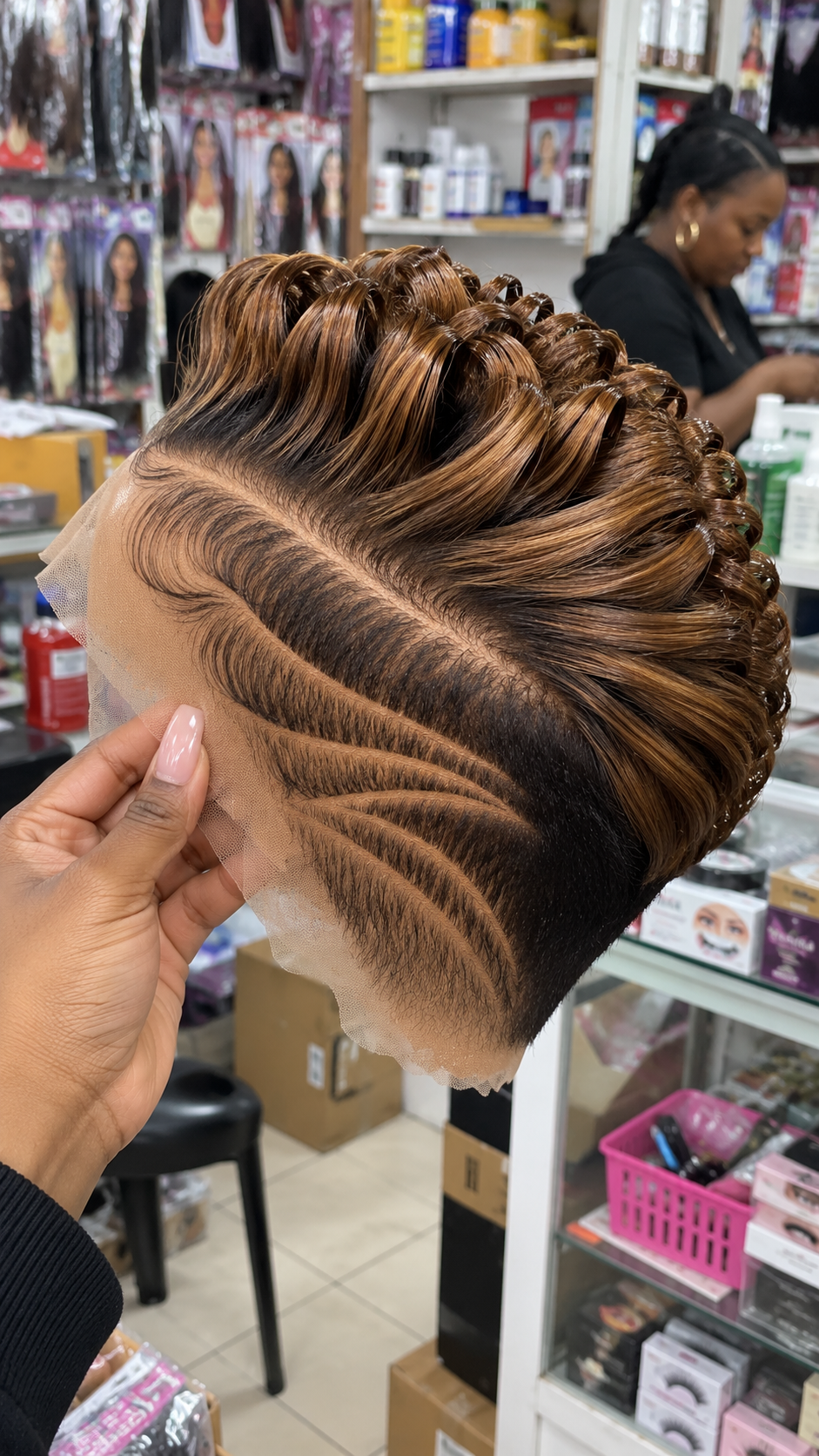
A hairstyle can attract attention through color alone, but this particular wig has far more going on than a simple shade combination. The visual impact comes from the relationship between its dark foundation, warm copper-caramel ribbons, elevated looped sections, exposed side architecture and carefully separated line work. Each element has its own role, yet the result reads as one coordinated design rather than several unrelated techniques placed together.
The photograph also gives an unusually useful view of the construction. Instead of seeing the wig only after installation, we can examine the lace perimeter, the dense side area, the directional parting and the way the upper hair has been shaped into broad loops. For someone planning to order a similar custom unit, this angle is valuable because it reveals details that should be discussed with a wig stylist before the order is placed.
The Color Placement Creates the First Impression
The base appears very dark brown to near-black through much of the lower section. Against that foundation, caramel and copper-brown tones travel through the raised upper strands. The lighter color is not spread evenly across the entire wig. Instead, it follows selected sections of hair, allowing individual loops to become more visible.
This placement matters. Coloring every strand the same warm shade would produce a completely different result. Here, the darker foundation provides depth while the brighter ribbons catch the light along the bends of the hairstyle. The contrast makes the direction of each section easier to see, particularly where the hair rises from the part and curves toward the crown.
Anyone ordering this look should therefore show the stylist the reference photograph rather than requesting only “caramel brown.” A color name cannot communicate placement. Ask for a deep dark foundation with warm copper-caramel ribbons concentrated through the sculpted upper sections. If possible, request a color sample before the entire unit is processed, since caramel, amber, copper and honey tones can look very different under salon lighting.
Broad Loops Give the Crown Its Distinctive Shape
The upper construction is the signature of this wig. Rather than tiny curls covering the surface, the hair is separated into wider sections and shaped into large raised loops. These sections travel backward and diagonally, creating visible rhythm from the front toward the rear.
The front loops stand higher and appear more elongated, while the sections toward the back gradually become tighter and more compact. That change in scale keeps the crown from looking like a repeated row of identical curls. It also creates a sense of direction: the eye naturally follows the hair from the front hairline toward the back of the unit.
This is an important detail to communicate during customization. Asking simply for curls may result in ringlets, finger coils or another curl pattern that does not resemble the photograph. A better description is a sculpted loop formation made from broad sections, with an elevated front and progressively tighter looping toward the rear.
The Side Part Controls the Entire Composition
A strong diagonal part is visible between the raised upper hair and the closely arranged side section. It acts almost like the structural spine of the design. Hair above the part moves upward into the loop formation, while the section below it remains much closer to the surface.
That contrast is what gives the hairstyle its dramatic profile. Without the part, the upper and lower sections could visually merge. With it, there is a clear boundary between height and precision.
The part also helps the warm highlights stand out. Several caramel strands travel close to the part before joining the upper loops. Because the surrounding hair is considerably darker, those lighter strands become visual guides that emphasize the direction of the styling.
Three Curved Side Lines Add a Barber-Inspired Detail
One of the strongest identifying elements is the group of three narrow lines on the side. They are not perfectly horizontal. Each line follows a gentle curve that complements the shape of the head and the diagonal movement of the main part.
The spacing between these lines is equally important. They sit close enough to read as a coordinated group but remain separated clearly enough for each line to be visible. The upper line is longer, while the lower lines become progressively shorter as they approach the lower side area.
This is the kind of detail that should be shown directly to a barber or wig specialist. Describing it only as “three lines” leaves too much room for interpretation. The reference indicates three curved, parallel side channels positioned beneath the main diagonal division. Their proportion and placement contribute significantly to the identity of the hairstyle.
What the Visible Lace Tells a Buyer
The photograph clearly shows lace extending beyond the styled hairline. That tells us the front and side perimeter has been constructed to provide material for fitting and customization. The lace is a light brown or beige tone in the photograph, although its final appearance on a wearer will depend on skin tone, lighting, tinting and installation technique.
It would be inaccurate to identify a specific lace grade from this photograph alone. Terms such as HD lace should only be used when the manufacturer or stylist confirms the material. What can safely be said is that visible lace surrounds the front and side area and that the wig has been prepared with a shaped hairline section.
Before purchasing, ask the seller for the exact lace type, lace color and dimensions. Also confirm whether the lace arrives uncut, whether additional tinting is recommended and whether the hairline has already been customized. Those questions are much more useful than assuming a premium lace category from appearance alone.
The Hairline Requires Careful Installation
The photograph shows fine hair placement close to the lace boundary. Because the side architecture is highly visible, installation accuracy becomes especially important. A poorly positioned unit could shift the diagonal part, alter the relationship between the carved lines and the temple, or place the decorative side section too high or too low.
For that reason, professional fitting is worth considering for the first installation. A wig stylist can check the ear position, temple alignment and front placement before trimming excess lace. The goal should be to preserve the proportions already built into the unit rather than forcing the wig into a different position after the lace has been cut.
If the unit is ordered remotely, send accurate head measurements. Circumference alone is not always enough. Front-to-nape, ear-to-ear and temple measurements can help a custom maker position the side design more predictably.
Who Should Customize This Type of Wig?
This is not a generic unit that should be handed to someone without experience in sculpted wig work. The combination of directional loops, color ribbons, lace fitting and side-line detailing requires several skills. Ideally, look for a stylist who has a portfolio showing precision wig shaping and barber-influenced side work.
If one professional does not provide every service, the process can be divided. A wig maker may construct and fit the unit, a colorist can reproduce the dark-to-caramel palette, and a stylist experienced with sculptural setting can form the upper loops. The side detailing should be completed by someone who understands how to preserve realistic density around the decorative lines.
When contacting a salon, send this image before booking. Ask whether they can reproduce the exact loop direction and triple curved side detail rather than asking whether they can make “something similar.” That distinction helps prevent substitutions that change the character of the design.
Ordering the Look Without Losing Its Identity
Start the order by identifying the non-negotiable elements. In this case they are the dark foundation, copper-caramel upper ribbons, diagonal division, broad loop formation, close side section, three curved side lines and lace perimeter. Those details should appear together on the order notes.
Next, confirm the material. Human hair generally gives a stylist more flexibility for heat-assisted shaping and future restyling, while synthetic options vary considerably depending on fiber quality and heat resistance. Do not assume that every synthetic unit can tolerate the same styling temperature.
Then discuss density. The photograph has enough hair to build substantial loops without making the side section appear bulky. Excessive density could make the upper formation too heavy, while insufficient density might leave gaps between the loops. Ask the maker to recommend density based on the construction rather than selecting the highest percentage automatically.
Finally, request photographs before shipment if the unit is being made to order. A side photograph is particularly important because it allows you to verify the triple lines, diagonal division and color placement before the wig leaves the stylist.
Keeping the Sculpted Sections Intact
Maintenance should focus on preserving the architecture rather than repeatedly manipulating the hair. Constant brushing would work against the deliberate loop formation seen here. Instead, individual sections should be handled only when necessary and reshaped by someone familiar with the original setting method.
When the wig is not being worn, support it on a suitable wig stand so the raised sections are not compressed. Avoid storing it under other items or inside a tight container. The front lace should also be protected from pulling, snagging and excessive adhesive buildup.
Product choice should be conservative. Heavy oils can make sculpted strands separate or collapse, while too much holding product can leave visible residue. Human-hair and synthetic versions may require completely different products, so maintenance instructions should come from the maker who knows the actual fiber used.
Choosing a Salon Appointment or Remote Custom Order
A local appointment offers one major advantage: the stylist can see how the diagonal structure aligns with the wearer’s head before finalizing the lace. This can be particularly helpful because the side design occupies a large visual area. Small changes in placement may alter how the three lines sit above the ear.
For an online custom order, request a consultation before paying. Send the reference photograph, measurements and preferred color interpretation. Ask whether the quoted price includes coloring, sculpted setting, lace customization and the side-line work. A lower base price may not include all of those services.
It is also sensible to ask what happens if the color arrives warmer or darker than expected. Because copper and caramel shades change noticeably under different lighting, an agreed reference photo or color swatch can prevent confusion.
Estimated Custom Wig Price Guide
Actual prices depend on country, hair source, lace specification, density, coloring, construction and stylist experience. The ranges below are general planning estimates rather than seller quotations. A heavily customized unit with multiple services will usually cost more than a basic ready-made wig.
| Wig Category | Estimated Price Range | What to Discuss Before Ordering |
|---|---|---|
| Premium Custom | $450–$900+ | Human hair selection, custom color placement, lace specification, hand-shaped loops, fitted side detailing and installation options |
| Standard Custom | $280–$450 | Hair grade, caramel ribbon placement, lace dimensions, density and whether the triple side design is included |
| Basic Human Hair | $180–$300 | Whether additional coloring and sculpting must be booked separately |
| Premium Synthetic | $110–$220 | Heat tolerance, pre-set loop durability, lace construction and color availability |
| Basic Synthetic | $60–$120 | Fiber limitations, fixed styling, lace coverage and whether custom side work is possible |
What Makes This Design Worth Showing to a Wig Stylist
The strongest part of this wig is the way several techniques reinforce one another. The copper-caramel ribbons make the loops visible; the loops create height; the diagonal division separates that height from the close side area; and the three curved lines turn the side into a deliberate focal point rather than an empty transition.
That relationship is also why copying only one component will not produce the same result. Caramel highlights without the broad loop pattern would look different. Triple lines without the diagonal division would change the side profile. Likewise, the same loop structure in a single flat color would lose much of the dimensional contrast visible in the photograph.
For buyers, the best strategy is to treat the photograph as a complete design reference. Save both the full image and a close crop of the side. When speaking with a salon, identify the color placement, loop scale, diagonal part and three-line geometry separately. Confirm the lace specification rather than assuming it, and ask for progress photos when commissioning a custom unit.
With those details communicated clearly, a stylist has a much better chance of recreating the qualities that make this particular wig recognizable: a deep foundation, warm caramel-copper movement, raised sculpted loops and an unusually precise curved side pattern.
Search Terms
copper caramel sculpted loop wig · dark brown caramel ribbon wig · triple curved side line wig · diagonal part lace wig · caramel loop crown wig · dark root copper sculpted wig · lace front side design wig · warm caramel directional loop wig