
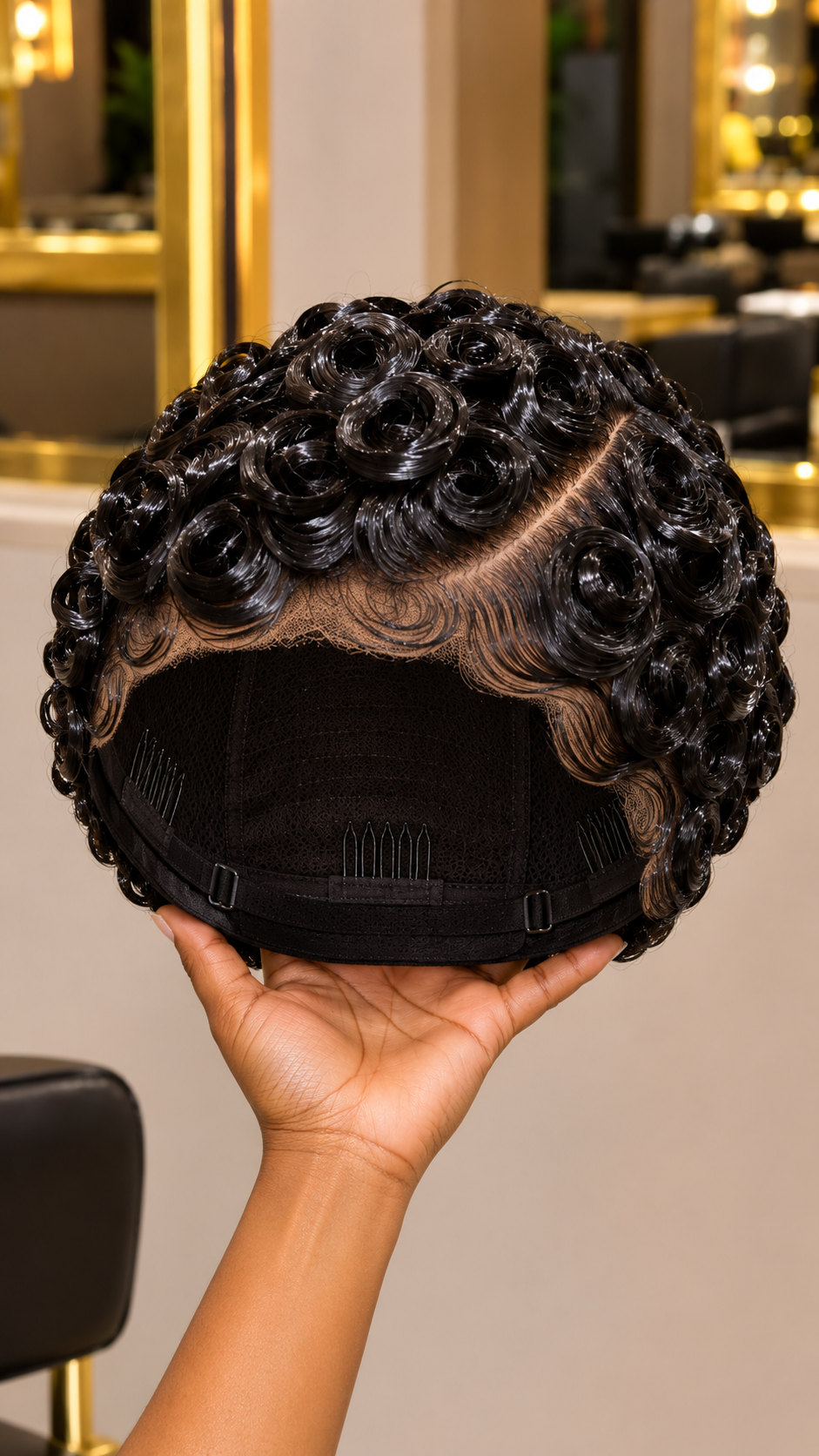
There is something especially appealing about a pixie wig whose design remains recognizable even when it is held upside down. This particular unit brings together glossy black rose-shaped coils, a prominent diagonal part, and delicately sculpted forehead waves. Yet its most useful selling point may be something that many hairstyle photographs overlook: the interior construction is clearly visible, giving prospective buyers an opportunity to examine how the wig is intended to be secured.
The photograph shows a compact black curly wig held in one hand inside an elegantly illuminated salon. Circular coils cover the outer crown, with several larger ringlets around the central and upper areas. The curls overlap in closely arranged groups, creating a rounded silhouette. Near the front, the circular formations transition into elongated finger-wave patterns that follow a clearly visible diagonal part.
The underside is exposed toward the camera. A dark mesh foundation, several securing combs, and adjustable bands are visible. A narrow lace section extends around the styled front hairline. These details make the photograph particularly valuable for customers who want to consider more than the outward appearance of a wig before purchasing.
Although the image shows identifiable construction components, it does not verify whether the fibers are human hair, synthetic, or a blend. It also cannot establish the specific lace grade, manufacturer, or expected lifespan. Those details should be confirmed separately with the supplier.
A Closer Look at the Cap Before Choosing the Hairstyle
Many shoppers focus primarily on the color and curl pattern when selecting a pixie wig. Those characteristics matter, but the cap can have an equally significant influence on wearing comfort and how securely the hairstyle sits throughout the day.
Here, the exposed interior reveals dark mesh-like fabric across much of the opening. Reinforced-looking fabric borders follow the lower edge, and several comb attachments are positioned around the interior perimeter. Adjustable bands with small sliding components are also visible along the lower section.
The photograph shows a comb near the center and additional combs toward the sides. Their teeth point inward toward the opening, suggesting that they are intended to assist with securing the wig to the wearer’s prepared hair. Their actual use should follow the manufacturer’s instructions.
The adjustment bands provide a visible means of altering the fit within the limits of the construction. However, the photograph alone cannot establish the available adjustment range or whether this particular cap will suit every head measurement.
Understanding the Visible Securing Combs
Wig combs are commonly used to help stabilize a cap. Their effectiveness depends on their position, the wearer’s underlying hair, and the way the unit is fitted.
In this image, the combs appear attached to the dark interior fabric rather than directly to the decorative curls. That separation is useful because securing components should not interfere unnecessarily with the hairstyle’s outer shape.
Nevertheless, combs should not be treated as a guarantee of secure wear. Some people may find them uncomfortable, especially when they create tension against sensitive areas or fragile natural hair.
Customers who prefer alternatives should discuss suitable fastening arrangements with a professional wig stylist. Depending on the construction, certain securing methods may be more appropriate than others.
The Adjustment Bands and Fit
The dark adjustable bands extend across the lower interior. Small adjustment components are visible near their ends, allowing some degree of fitting control.
These bands can be relevant when buyers are comparing wigs with different cap sizes. However, adjustment hardware does not eliminate the need for proper head measurements.
A wig that is substantially too large or too small may remain uncomfortable despite adjustment.
Before ordering, request the supplier’s measurement chart. Head circumference is generally important, and custom makers may request additional measurements to determine the appropriate cap dimensions.
For this hairstyle, correct positioning also helps the diagonal part and front waves sit where they are intended.
The Diagonal Part Separates Two Distinct Curl Arrangements
Above the front hairline, a clearly visible part travels diagonally through the dark strands. It creates a lighter channel between the surrounding curls and directs attention toward the sweeping waves beneath it.
The part begins near the upper side of the visible front section and extends toward the central crown area. On one side, several compact circular curls sit close to the separation. On the other, larger ringlets form an overlapping arrangement.
The direction of the part introduces asymmetry into an otherwise rounded pixie silhouette. Instead of making the crown appear uniformly curled, the separation gives the hairstyle a deliberate front orientation.
Its width appears relatively narrow, with fine strands arranged close to either side.
A buyer requesting a similar wig should specify that the part must remain visible and diagonal rather than being replaced with a straight center part or completely concealed beneath curls.
Rose-Shaped Coils Create a Sculptural Crown
The upper curls resemble tightly rolled rosettes, with individual strands forming circular paths around darker centers. Several coils have broad openings, while others are more tightly wound.
This difference in size creates visual variety without disrupting the compact shape.
The largest visible formations appear around the upper central area, where overlapping circles create fullness. Smaller curls continue toward the lower edges, helping the hairstyle retain its rounded contour.
These coils are different from loose hanging spirals. Their lengths are folded into compact circular formations rather than extending freely downward.
They also differ from broad ribbon curls, which usually form longer sweeping loops. Here, the circular shape itself is the dominant styling element.
Recognizing the Correct Curl Diameter
Not every product advertised as a finger-coil pixie has the same curl structure. Some contain tiny pencil-width spirals, while others display larger open circles.
The reference includes several medium-sized rose-like curls and a dense arrangement of smaller loops around them.
When comparing products, examine the diameter of the visible openings rather than relying only on the overall hair length.
Ask the seller for a photograph taken directly above the crown. That angle can reveal how consistently the coils are arranged and whether the larger formations continue across the upper surface.
The exact curl diameter cannot be measured reliably from this photograph without a known scale.
Finger Waves Provide a Delicate Forehead Border
Below the circular curls, the hairstyle transitions into finely arranged finger waves. These strands follow graceful curves across the front hairline, creating a flatter decorative section.
The waves are particularly noticeable beneath the diagonal part. Fine lines of black hair sweep downward and then curve back toward the surrounding curls.
Additional small curved strands appear along the visible side perimeter.
The contrast between the raised rosette curls and the flatter hairline waves produces a layered hairstyle with two distinct forms of movement.
Customers who want a faithful reproduction should preserve this distinction. Replacing the fine waves with large loops would change the appearance considerably.
Black Coloring Keeps Attention on the Hair’s Shape
The unit appears predominantly deep black. Bright reflections travel along the curved strands, creating silver-like highlights where the salon lighting strikes the hair.
These reflections should not be mistaken for verified silver-colored strands.
No clearly separate blonde, copper, burgundy, or other contrasting color sections are visible.
The dark color emphasizes the individual circular formations because light catches their outer surfaces while the openings remain shadowed.
Similarly, the fine forehead waves appear as narrow reflective curves against the darker surrounding hair.
Comparing Natural Black and Jet Black Options
Manufacturers may offer natural black, jet black, and off-black shades that look similar under indoor lighting.
The photograph supports a deep black description, but it does not establish an exact product color number.
Buyers should request photographs of the actual unit in neutral daylight.
If a seller offers multiple black shades, compare them before confirming the order.
The chosen color should remain consistent with the intended appearance of the compact rosette curls and sculpted front waves.
The Lace Perimeter Requires Careful Fitting
A narrow strip of lace-like mesh is visible around the front hairline. It extends beneath the finer decorative strands and approaches the outer edge of the wig.
The lace appears light brown or beige against the dark interior, but its exact material and grade cannot be established from the photograph.
Visible lace does not independently confirm that a wig uses HD lace or any particular premium construction.
Before ordering, ask for written specifications identifying the lace type, dimensions, and available shades.
If any excess lace remains on the delivered unit, it should be trimmed only after the final wearing position has been established.
Careless cutting near the finger-wave pattern may disturb the fine strands along the front.
What the Interior Photograph Still Cannot Confirm
Although the exposed underside provides more information than a typical mannequin photograph, several important details remain unknown.
The image does not establish the material composition of the fibers, the exact cap size, or how the outer curls will behave after washing.
The rear of the hairstyle is not completely visible, and the full exterior side arrangement cannot be assessed from this angle.
The photograph also does not prove that the unit is designed for glueless installation.
Combs and adjustable bands may contribute to securing the wig, but the suitability of adhesive-free wear depends on the complete construction and the wearer’s fit.
Ask the seller to confirm the recommended installation method explicitly.
Where To Buy a Similar Rose-Coil Pixie
Specialist wig boutiques, independent wig makers, and online hair retailers are possible sources for this type of sculpted pixie.
However, ordinary curly wigs may not reproduce the same combination of circular coils and decorative forehead waves.
Search for compact rose-coil pixies and sculpted black finger-curl wigs rather than relying exclusively on broad descriptions such as black curly hair.
Local boutiques can offer the advantage of inspecting the actual cap and fastening components before purchasing.
Independent makers may be able to customize the curl placement and cap dimensions.
The photograph does not establish a verified seller, brand, or current product listing, so availability should be confirmed directly.
Requesting the Right Photographs
Ask the seller for exterior photographs showing the front, both sides, crown, and complete rear.
Request a fully opened underside photograph so the position of every securing component can be examined.
The interior image should show the combs, adjustment bands, cap seams, and lace attachment area.
For a custom order, provide the reference and identify the preferred curl sizes, diagonal part direction, and forehead-wave arrangement.
Ask whether the unit will arrive fully styled or require additional salon work.
Ready-Made Construction Versus Custom Cap Fitting
A ready-made pixie may be appropriate for customers whose measurements fit the supplier’s standard cap sizes.
Its convenience depends on whether the curl arrangement, fastening system, and lace configuration meet the buyer’s preferences.
Custom production may allow more control over cap dimensions and the location of the interior hardware.
It may also provide opportunities to discuss the relationship between the diagonal part, rosette curls, and hairline waves before production.
However, custom ordering does not guarantee that every requested detail can be reproduced exactly.
The maker should explain what is achievable with the selected material and construction.
Illustrative Prices for Black Rose-Coil Pixie Wigs
The following USD amounts are illustrative planning ranges rather than verified live retail prices. They are intended to help buyers consider possible purchasing categories. The actual price of the photographed wig is unknown.
| Wig Category | Illustrative USD Range | Potential Cost Considerations |
|---|---|---|
| Premium Custom | $350–$860+ | Individual cap sizing, carefully positioned securing components, detailed rosette curls, and personalized finger-wave styling. |
| Standard Custom | $185–$450 | Selected cap construction, adjusted curl placement, diagonal parting, and customized front waves. |
| Basic Human Hair | $110–$305 | A human-hair starting unit that may require professional curl setting, fitting, and additional hairline styling. |
| Premium Synthetic | $80–$220 | A manufactured pixie with preformed circular curls and varying cap hardware configurations. |
| Basic Synthetic | $30–$105 | A lower-cost curly pixie that may have simpler curls or fewer customization options. |
Detailed rosette styling may increase labor costs, especially when larger circular formations are individually arranged.
Cap construction and fastening components can also affect the quoted price.
Additional costs may include lace customization, professional fitting, shipping, taxes, and later restyling.
Ask whether the quoted amount includes a fully finished hairstyle and all advertised securing components.
How to Assess the Fit at a Salon Appointment
During the initial fitting, the stylist should establish whether the cap sits securely without creating excessive tension.
The visible combs and adjustment bands should be assessed according to the wearer’s hair condition and comfort.
The diagonal part should sit at the intended position, and the finger waves should follow the forehead naturally.
If excess lace is present, trimming should follow the fitting process rather than precede it.
The stylist should avoid unnecessary manipulation of the rosette curls while securing the unit.
Before leaving the salon, the wearer should understand how to remove and refit the wig without pulling on the decorative hairline strands.
Caring for the Circular Curls
The rounded coils depend on maintaining their individual shapes. Brushing the crown aggressively may stretch the curls and reduce the visibility of their circular centers.
Handle the unit by supporting the cap rather than pulling directly on the outer loops.
If the wig contains human hair, suitable professional resetting may be possible, depending on the hair’s condition and treatment history.
If it contains synthetic fibers, follow the manufacturer’s instructions before using heat, steam, or other reshaping methods.
Heavy styling products may accumulate between the closely arranged coils.
The maintenance routine should focus on preserving their shape without unnecessarily separating neighboring curls.
Keeping the Front Waves Intact
The delicate forehead strands require particular care because they are arranged in fine, directional groups.
Repeated rubbing, brushing, or pulling can disturb their shape.
When putting on or removing the wig, avoid gripping the sculpted hairline.
If the front waves become displaced, consult a stylist familiar with the confirmed fiber before attempting restoration.
Not all materials respond to the same styling products or methods.
Storage and Protection of the Interior Hardware
Store the wig on an appropriately sized stand to help preserve the rounded crown.
Before storage, check that the securing combs and adjustable bands are not tangled in the hair.
Avoid placing heavy objects on the upper curls.
For travel, choose protective packaging with enough space to prevent the rosette formations from being crushed.
Inspect the cap periodically for loose seams, damaged comb attachments, or worn adjustment components.
Any repairs should be carried out using methods appropriate for the construction.
Selecting a Wig That Combines Beauty and Practicality
This black pixie offers more than a decorative arrangement of curls. Its compact rosette crown, diagonal part, and carefully swept finger waves create a recognizable hairstyle, while the visible underside provides useful information about the securing system.
For buyers, the most important decision is not simply whether the curls look attractive. The cap must also fit comfortably, the fastening components must suit the intended wearing method, and the fiber must support the expected maintenance routine.
Before purchasing, verify the material, cap measurements, lace specifications, and complete hardware arrangement. Request additional photographs of the rear and opposite side to establish details not visible here.
A well-matched unit should preserve the sculptural quality of the circular coils while offering a secure, comfortable fit and a realistic care routine.
Search Terms
Black rose coil pixie wig · Deep diagonal part curly wig · Sculpted forehead waves black pixie · Hollow centered circular curls · Black mesh cap with securing combs · Adjustable band curly pixie wig · Glossy rosette crown hairstyle · Finger wave lace front coil wig