
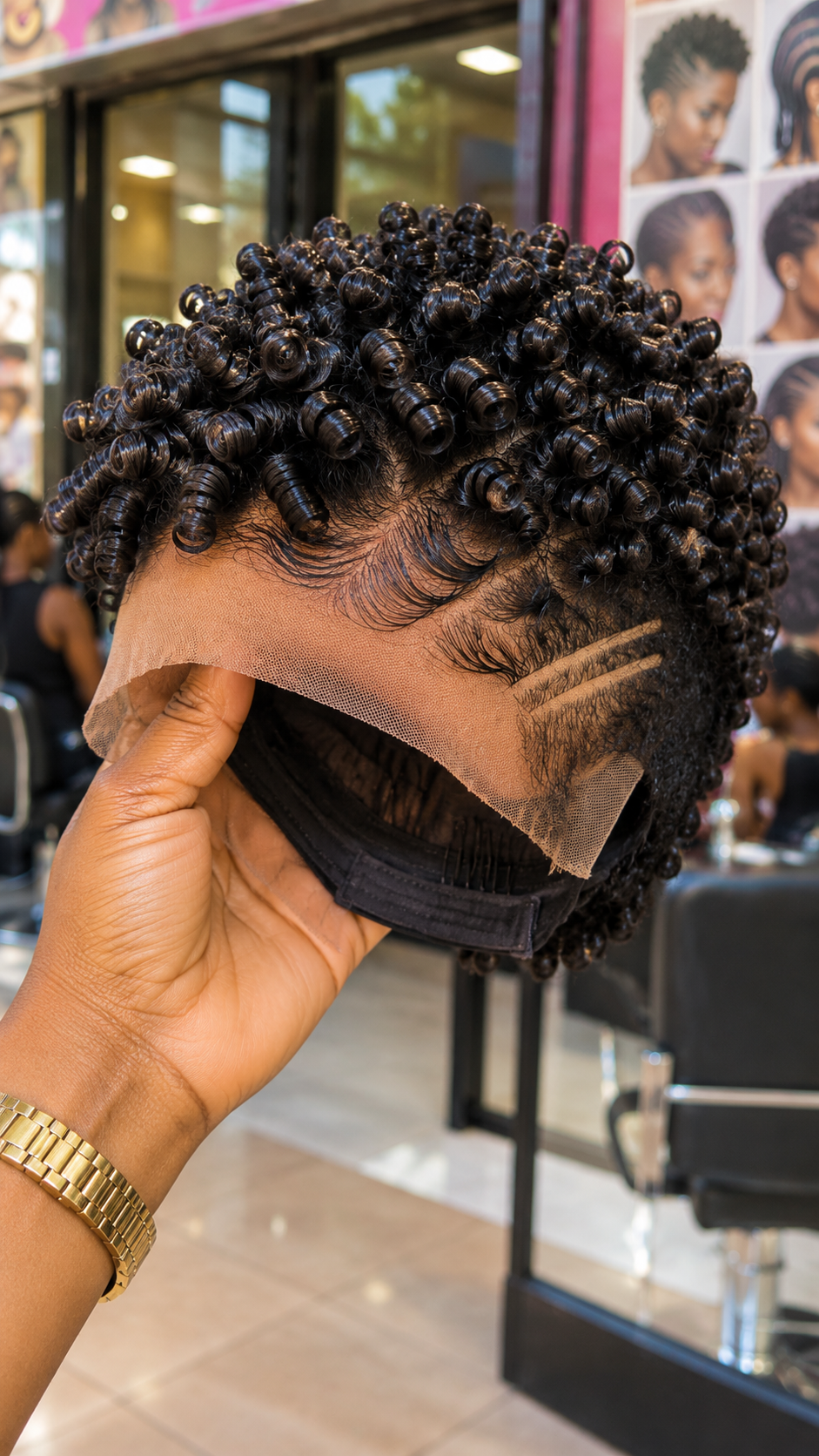
A beautiful short hairstyle can draw attention without dramatic coloring or excessive length. Sometimes, the most impressive details come from carefully arranged curls, a beautifully shaped hairline, and a distinctive finishing touch around the temples. This jet-black pixie wig brings all three elements together through a lively collection of glossy corkscrew curls, delicate sweeping edges, and two striking parallel stripes along the visible side.
The hairstyle features tightly wound cylindrical curls that cover the crown and continue around the sides. Each curl has a rounded, spring-like shape, with several prominent coils extending forward above the hairline. The glossy black strands catch the light, creating subtle reflections that emphasize their spiral construction. Unlike broad finger waves or flat circular rosettes, these curls have a compact, tubular appearance that gives the hairstyle its distinctive personality.
Along the front, finely arranged black strands form soft sweeping movements across the forehead area. These carefully styled edges create a graceful contrast with the raised curls above. On the visible temple, two narrow parallel lines introduce a sharp decorative accent, giving the hairstyle a subtle barber-inspired character.


The photograph shows the wig held in one hand outside a neighborhood beauty salon. An extended beige-tan lace front and part of the dark interior cap are clearly visible, allowing the hairstyle and its construction to be examined together. The background includes salon chairs, hairstyle photographs, and everyday beauty-shop activity, but the wig remains the central subject.
For women who appreciate short hairstyles with character, this design offers a compelling mixture of playful curls and carefully controlled detailing. Its compact proportions make it particularly appealing to those who enjoy the appearance of a curly pixie while wanting something more expressive than an ordinary cropped hairstyle.
What Gives This Black Pixie Its Distinctive Personality?
The most recognizable quality of this wig is the combination of small cylindrical ringlets and decorative temple stripes. These two features create an appealing contrast between rounded softness and geometric precision.
The upper curls are numerous and closely arranged, covering the crown with a lively pattern of coiled strands. Each section twists into a compact spiral, with openings visible at the ends of several curls. Some point forward, others sit upright, and many follow the rounded contour toward the sides.
The hairline is noticeably different. Instead of continuing the same raised curl pattern, fine strands are directed downward into smooth curved sweeps. This change creates a more delicate frame around the front.
The temple stripes provide a third element. Their narrow, nearly parallel shapes interrupt the closely arranged dark side hair, introducing a distinctive decorative detail without overwhelming the hairstyle.
All three elements share the same deep black coloring, allowing their shapes to become the main source of visual interest.
Compact Corkscrew Curls Across the Crown
The crown contains an elaborate arrangement of corkscrew curls that vary slightly in length, diameter, and direction. Their tubular appearance distinguishes them from ordinary loose spirals and wider circular rosettes.
Several curls near the center stand prominently above the surrounding hair. Others appear closer to the base, creating layers of rounded volume.
The individual coils contain tightly aligned strands that wrap around themselves in narrow circular movements. This arrangement creates the spring-like shape associated with corkscrew hairstyles.
Because the curls do not all face the same direction, the surface appears lively rather than rigid. Some openings face the viewer, while others are partially concealed by neighboring curls.
The overall crown remains compact despite this fullness. The curls rise above the head without falling into long hanging sections, preserving the short pixie silhouette.
For a custom reproduction, the stylist should focus on maintaining the tubular curl shape and slightly varied arrangement. Replacing these coils with broad flat loops would significantly change the character of the hairstyle.
The Difference Between Corkscrew Curls and Finger Coils
These terms are sometimes used interchangeably, but they can describe different aspects of hairstyling.
Finger coiling refers to a method in which small sections of hair are wound around the fingers to encourage or create individual curls. Corkscrew curls describe the resulting spiral shape, particularly when a curl forms a compact, spring-like tube.
The photograph clearly shows compact cylindrical spirals, although it does not establish the technique used to create them.
Some curls appear tightly wound with openings at their ends. Others have slightly longer spiral sections that project outward from the crown.
A wig maker might reproduce a similar appearance using several styling techniques, depending on the hair material and available tools.
However, the correct method must be compatible with the fiber. Synthetic hair and human hair can require very different processes.
When discussing the style with a professional, describe the desired finished shape rather than insisting on a particular technique that may not suit the chosen wig.
Why the Curl Arrangement Looks So Full
The crown’s fullness comes from the way numerous small curls occupy different positions across the surface. Rather than relying on a few oversized curls, the hairstyle uses many compact sections that collectively create volume.
The curls near the center appear slightly elevated, while those toward the sides follow the rounded silhouette more closely.
This arrangement produces a gradual transition from the upper crown to the perimeter.
The dark spaces between the spirals also contribute to the appearance of depth. When individual loops overlap, their shadows make the surrounding curls look more prominent.
A well-balanced recreation should preserve enough separation for the individual coils to remain recognizable.
Excessive density might compress the curls into a crowded mass, while insufficient density could create noticeable gaps.
For custom work, discussing the finished crown volume and curl diameter is more helpful than relying exclusively on an advertised density percentage.
The Beautiful Gloss of Jet-Black Hair
This wig features a deep black appearance with glossy reflections visible across the cylindrical curls. The shine follows the direction of individual strands, emphasizing the tightly wound spiral shapes.
In brighter areas, the hair reflects warm highlights from the surrounding environment. These reflections do not necessarily indicate additional hair colors.
The hairstyle appears predominantly black from crown to perimeter, making the different curl arrangements and temple details more noticeable.
Black hair can look especially dramatic when arranged into small polished spirals because the reflective outer surface contrasts with the darker openings inside each curl.
Buyers seeking a similar appearance should compare jet black and natural black options carefully.
Some manufacturers use jet black for an intense, cool-looking shade, while natural black may contain softer brown undertones. These descriptions are not standardized across every supplier.
Photographs taken in neutral daylight can help determine whether the actual color resembles the reference.
The Front Curls Create a Playful Silhouette
One of the charming features of this hairstyle is the way several curls extend slightly forward above the hairline.
These small corkscrew sections introduce movement without forming a long fringe. Their ends remain coiled, allowing them to sit above the delicate front waves.
The forward-facing curls vary in position. Some hang slightly lower, while others remain elevated with the surrounding crown.
This variation prevents the front from appearing overly flat or precisely symmetrical.
It also softens the overall silhouette, balancing the sharper decorative lines visible at the temple.
For women who prefer pixie hairstyles with a little fullness around the forehead, these curls provide an attractive alternative to a heavy side-swept bang.
During custom styling, the front coils should remain short enough to preserve the visibility of the carefully arranged edges beneath them.
Sweeping Baby Hairs Bring Softness to the Hairline
Beneath the raised curls, fine black strands are arranged into a series of soft sweeping movements.
The front hairline contains several delicate curves that follow the forehead area before bending toward the visible temple.
Unlike the tubular crown curls, these strands lie relatively flat against the lace foundation.
The contrast makes both styling areas easier to appreciate. The raised coils introduce fullness, while the flatter edges provide a graceful finishing detail.
Some of the sweeps are broad and flowing, while others form smaller curved sections close to the side.
Their placement gives the hairline a carefully styled appearance without creating oversized decorative loops across the entire forehead.
When ordering a similar unit, ask for fine, controlled baby-hair sweeps that complement the crown rather than covering too much of the front lace.
The Twin Temple Stripes Add a Bold Accent
The visible temple area features two narrow, nearly parallel stripes that immediately distinguish this hairstyle from a conventional curly pixie.
The lines travel diagonally through the closely arranged dark hair, creating a clean decorative effect beneath the curls.
Their spacing remains relatively consistent, allowing them to read as a coordinated pair rather than unrelated marks.
The stripes are particularly effective because they contrast with the rounded corkscrew curls above. While the curls contain circular movements, the temple design introduces a more linear direction.
Despite their sharper appearance, the lines do not overpower the hairstyle. They occupy a limited area near the side, leaving the crown as the main focal point.
The photograph shows a wig rather than a natural haircut, so the exact method used to form these stripes cannot be confirmed. They may involve trimming, directional hair placement, or another construction technique.
For a close reproduction, focus on preserving the visible pair of stripes and their diagonal placement.
Precision Matters in the Temple Design
Small decorative features can substantially influence the appearance of a short hairstyle.
In this design, the temple stripes appear narrow and intentionally placed. Their relatively restrained size helps them complement the surrounding curls.
If the channels were made much wider, the result could look more dramatic and less delicate.
If additional stripes were introduced, the side might become visually crowded.
The spacing also matters. Two lines placed too close together may appear as one broad channel, while lines positioned too far apart could lose their coordinated character.
When commissioning a custom wig, request that the stylist follow the original stripe arrangement rather than adding extra geometric details.
It is also important to confirm that the chosen cap construction can support these visible channels without exposing inappropriate foundation materials.
The Rounded Side Maintains the Pixie Shape
Beyond the temple stripes, the hairstyle continues into small curls that follow the rounded side of the wig.
These coils are generally less prominent than the highest crown curls, helping the overall silhouette narrow gradually toward the lower perimeter.
The side does not appear uniformly shaved or completely flattened. Instead, it combines closely arranged hair near the decorative stripes with curl coverage around the surrounding areas.
This transition gives the hairstyle a balanced appearance.
The darker side strands also provide a visual foundation for the temple design, making the narrow channels easier to recognize.
For a custom wig, side density should be discussed separately from the upper crown. The desired result requires enough hair for the small curls while preserving the decorative stripe area.
Understanding the Lace Before Installation
The photograph shows a beige-tan lace section extending beyond the front hairline and visible temple.
The mesh remains untrimmed, indicating that the wig is being presented before final installation preparation.
Fine strands are attached along the visible hairline, allowing the sweeping edge arrangement to extend across the front.
Because the temple stripes are located close to the lace area, the foundation deserves particular attention during fitting.
The photograph does not establish the exact lace grade, thickness, transparency, or complete dimensions.
Although some sellers advertise premium lace materials, the visible mesh should not automatically be identified as HD lace.
Buyers should request clear photographs of the complete lace foundation and confirm its specifications before placing an order.
The Interior Cap and Its Role in Fit
The wig is held open enough to reveal part of its dark interior cap.
Fabric sections and an internal band are visible beneath the front opening. These components support the hairstyle and form part of its wearable foundation.
However, the photograph does not reveal the entire underside, so the complete construction cannot be established.
The number of adjustment features, attachment combs, and additional securing components should be confirmed with the seller.
Correct cap measurements are important for any wig, but they become especially significant when a hairstyle includes precisely positioned temple details.
A cap that shifts during wear may cause the stripes to sit at an unintended angle.
Before ordering, check circumference, ear-to-ear width, and front-to-nape length rather than relying only on labels such as small, medium, or large.
Which Wig Construction Is Suitable?
Women shopping for this hairstyle may encounter lace-front units, closure wigs, frontal constructions, and standard adjustable caps.
Each type offers different possibilities for hairline customization, comfort, and installation.
A closure generally provides a smaller lace area than a frontal, while certain adjustable caps are designed for convenient everyday wear.
These are general options rather than confirmed descriptions of the photographed wig.
For this particular design, the foundation must support the sweeping front edges and twin temple stripes.
Ask a professional wig maker whether the chosen construction allows these details to be reproduced accurately.
Cap fit should be prioritized alongside appearance, especially for women who intend to wear the hairstyle frequently.
Selecting the Right Curl Length and Density
Short corkscrew curls can appear much shorter after styling than they do when the strands are stretched straight.
For this reason, advertised hair length alone may not provide enough information about the finished appearance.
The photographed crown contains small to medium cylindrical curls with a relatively compact shape.
Some curls project outward, but none of the visible sections develop into long hanging strands.
When ordering a custom unit, discuss the finished curl height, approximate diameter, and overall silhouette.
Density also affects the result. The crown must contain enough hair to support numerous distinct spirals without becoming excessively crowded.
The photograph does not provide a reliable basis for assigning an exact strand length or density percentage.
Ask the supplier for measurements of the completed hairstyle rather than assuming a particular number of inches will produce the same look.
Where to Shop for Similar Curly Pixie Wigs
Similar short hairstyles may be available through online wig retailers, local beauty supply shops, independent wig makers, and salons offering custom units.
However, not every product marketed as a curly pixie will contain the same corkscrew structure or temple detailing.
Some wigs feature loose natural-looking curls. Others contain large open rosettes or broad finger-wave arrangements.
The photographed hairstyle is distinguished by its numerous tubular coils, delicate front sweeps, and paired temple stripes.
When comparing products, look carefully at actual photographs of the hair rather than relying entirely on listing names.
A ready-made wig may be suitable if it already has a similar curl arrangement and side pattern.
For women seeking closer accuracy, custom styling may offer greater control over curl size, density, and stripe placement.
How to Order This Style
Begin by showing the photograph to a seller or professional wig maker and identifying the two most important characteristics: compact glossy corkscrew curls and two diagonal temple stripes.
Explain that the front should include fine sweeping baby hairs rather than a heavy fringe.
Specify a deep black color and a rounded pixie silhouette with small coils continuing around the visible side.
Ask whether the desired arrangement is available as a finished product or requires custom construction.
Request detailed photographs of the actual wig from the front, both sides, rear, and underside.
Confirm the fiber composition, lace specifications, cap measurements, styling method, and securing features.
For custom production, discuss whether progress photographs can be provided before the design is completed.
Before paying, review the total price, production schedule, delivery terms, and applicable return conditions.
Choosing a Salon for Professional Fitting
A hairstylist experienced in lace wigs, short curly installations, and precision hairline styling is a suitable choice for preparing this design.
During consultation, emphasize the importance of protecting the compact corkscrew curls.
The stylist should also examine the temple stripes and ensure that they remain correctly positioned when the wig is worn.
Before trimming the lace, the cap should be fitted comfortably and aligned with the intended hairline.
Any necessary adjustments should preserve the existing curl structure and delicate front sweeps.
If the curls become compressed during delivery, ask whether the stylist can restore them using a method compatible with the wig material.
A final inspection from the front and visible side can help confirm that the stripes and crown retain their intended appearance.
Glueless or Adhesive Installation?
The most suitable installation method depends on the construction of the actual wig and the wearer’s preferences.
Some women prefer glueless wigs because they can be removed without adhesive around the hairline.
Others choose adhesive-based installations for specific wearing routines.
The presence of an interior band does not independently prove that a wig is suitable for secure glueless wear.
Correct cap sizing and compatible securing features are essential for that approach.
Adhesive installations should use products suitable for the lace and skin, with particular care around sensitive areas.
For this hairstyle, the installation should also preserve the fine baby hairs and avoid distorting the temple stripes.
Ask the stylist to explain the advantages and limitations of each method before making a decision.
Illustrative Prices for Corkscrew Pixie Wigs
The price of a similar wig can vary considerably according to the hair material, construction, curl styling, and amount of custom detailing required.
The following USD amounts are illustrative budgeting estimates, not verified current retail prices or quotations for the pictured unit.
| Wig Tier | Illustrative Price Range | Possible Features and Services |
|---|---|---|
| Budget | $35–$100 | Basic synthetic black curly pixie wigs with simplified coils, standard caps, and minimal personalization. |
| Value | $85–$195 | More consistent synthetic corkscrew curls, selected adjustable cap features, and basic hairline preparation. |
| Mid | $150–$355 | Selected higher-quality or human-hair wig bases with additional curl setting and side styling. |
| Premium | $290–$625 | Custom compact coils, carefully arranged baby hairs, coordinated temple stripes, and selected lace preparation. |
| Salon-Grade | $500–$1,250+ | Bespoke wig construction, personalized measurements, detailed curl artistry, precision temple work, and professional fitting. |
These categories describe possible purchasing alternatives rather than confirmed features of the displayed product.
Actual prices depend on the country, seller, fiber composition, workmanship, and services included.
Custom temple detailing and individually arranged corkscrew curls may increase labor costs.
Ask whether the quoted amount includes the base wig, curl preparation, decorative side styling, lace work, shipping, and installation.
What Should You Examine Before Paying?
Product photographs can make a wig look attractive, but they do not always reveal construction quality or maintenance requirements.
For this hairstyle, begin by examining the shape of the individual curls. They should resemble compact, rounded tubes rather than loose waves or broad flat loops.
Next, check the density and direction of the curls around the front and side.
Look carefully at the twin temple stripes and whether their size and placement resemble the reference.
Ask for photographs of the lace and interior cap, particularly when ordering from an unfamiliar seller.
Confirm whether the curls are permanently formed, heat-set, or maintained through regular styling.
Finally, review any available customer photographs showing the product after installation.
These steps can help distinguish a carefully constructed wig from one that simply has a similar promotional description.
How to Maintain the Small Corkscrew Curls
The greatest maintenance priority is preserving the narrow cylindrical shape of the curls.
Ordinary brushing may separate the strands and reduce the compact spiral appearance.
Frequent pulling can also stretch individual coils, causing them to sit differently from neighboring curls.
Ask the supplier how the hairstyle was originally formed and what care products are appropriate for its material.
Synthetic fibers should not be exposed to heat unless specifically approved by the manufacturer.
Human-hair wigs may allow different styling techniques, but the condition of the strands and the original setting method must be considered.
When handling the wig, support the cap rather than pulling directly on the curls.
If several coils lose their shape, professional resetting may be more appropriate than attempting to restyle the entire crown without guidance.
Preventing Product Buildup Around the Coils
Closely arranged curls can retain styling-product residue, particularly when heavy creams or gels are applied frequently.
Visible buildup may reduce the shine of the hair and make neighboring curls stick together.
For this hairstyle, choosing lightweight products compatible with the actual fiber is important.
Avoid repeatedly adding product simply to increase gloss. Too much may make the tightly wound curls look heavy.
Inspect the hair regularly for residue, particularly near the roots and areas where the coils overlap.
Cleaning should follow the supplier’s instructions and take into account how the curls were set.
After washing, the original spiral arrangement may need careful restoration.
Allowing the hair to dry in an appropriate position can help reduce unwanted compression during the process.
Protecting the Delicate Front Edges
The sweeping front strands deserve separate attention because they are arranged differently from the crown curls.
These fine sections lie close to the lace, creating smooth curves across the front hairline.
Repeated rubbing, combing, or unnecessary manipulation may disturb their arrangement.
When removing the wig, avoid gripping the delicate edge strands.
Any adhesive residue should be handled according to the lace manufacturer’s recommendations rather than removed through aggressive pulling.
Ask the stylist which suitable products can help preserve the waves without creating excessive buildup.
Maintaining the original sweep direction will help keep the front looking coordinated with the raised curls.
Keeping the Temple Stripes Visible
The paired side stripes are relatively narrow, making their appearance dependent on the surrounding strands remaining in the intended position.
Heavy styling products, displaced curls, or repeated brushing across the area could reduce their visibility.
During routine inspection, check whether the lines remain distinct and relatively parallel.
Avoid cutting additional stripes or widening the existing channels without professional guidance.
The photograph presents a restrained design, and unnecessary modifications could change its character.
If the stripes become difficult to maintain, consult a wig stylist experienced in precision side detailing.
The appropriate restoration method depends on how the original lines were constructed.
A Realistic Care Schedule for Frequent Wear
Short wigs do not automatically require less attention than longer hairstyles. An intricately styled pixie may need consistent care to retain its shape.
After each wear, inspect the front curls and temple detailing for displaced strands.
During frequent use, check the crown weekly for tangling, compression, and styling-product buildup.
Cleaning frequency should depend on the fiber, environmental conditions, and amount of product used.
A wig worn occasionally may require less frequent washing than one used daily.
Professional maintenance may be useful when multiple curls lose their cylindrical shape or the hairline arrangement becomes difficult to preserve.
These are general care suggestions rather than a fixed schedule appropriate for every wig.
Manufacturer-specific instructions should take priority whenever they are available.
Storing a Corkscrew Pixie Without Losing Its Shape
A supportive wig stand can help protect the compact crown when the unit is not being worn.
Avoid placing the wig beneath heavy clothing or other objects that might flatten the small spirals.
The crown should have enough space for the cylindrical curls to retain their raised shape.
Protect the lace from stretching and avoid allowing the adjustment band to pull against delicate hairline sections.
When packing the wig for travel, consider whether a supportive insert is needed to prevent compression.
Do not store the unit while damp unless the manufacturer’s instructions specifically permit a particular drying arrangement.
A dry, protected storage location can help preserve the hairstyle between uses.
Everyday Fashion Possibilities
The deep black color makes this pixie easy to coordinate with a wide range of outfits.
Bright Ankara prints, neutral blouses, tailored jackets, and simple dresses can all complement the compact hairstyle.
Gold earrings may introduce warmth, particularly when paired with the glossy black curls.
Small studs or hoops allow the temple stripes to remain visible without introducing too many competing details.
For everyday styling, the curls themselves provide enough visual interest that additional hair ornaments may be unnecessary.
The combination of rounded crown volume and narrow side stripes gives the hairstyle a playful yet polished character.
Women who enjoy fashionable short hairstyles may appreciate this balance between casual versatility and decorative finishing.
Wearing This Hairstyle for Special Occasions
For formal events, the compact curls can provide a beautiful finishing touch without requiring a long updo.
The glossy black hair creates an attractive contrast with brightly colored evening clothing or more understated neutral garments.
Statement earrings can complement the hairstyle, although their size should be considered if the temple design is intended to remain visible.
The rounded curls create fullness above the forehead, while the sweeping edges provide an elegant frame around the front.
Because the hairstyle already includes decorative stripes, additional accessories are optional.
A carefully fitted wig with the original coil arrangement preserved can provide a distinctive look for celebrations, dinners, and photographs.
Advantages of This Short Curly Design
One advantage is its compact length. The hairstyle creates significant visual interest without long strands extending around the shoulders.
The numerous small coils provide fullness and movement, making the crown appear lively from different viewing angles.
The deep black color emphasizes curl shape without relying on contrasting highlights.
The front edges introduce a graceful styling element, while the twin temple stripes provide a recognizable decorative signature.
Another appealing quality is the possibility of wearing a precision-inspired short hairstyle without permanently cutting one’s natural hair in the same pattern.
However, this depends on choosing a suitable wig construction and achieving a secure, comfortable fit.
For women who enjoy distinctive pixie designs, these characteristics make the hairstyle an attractive option to explore.
Potential Drawbacks Worth Considering
The small cylindrical curls may require careful handling to preserve their shape.
Repeated brushing, compression, and unsuitable products can disturb the spiral arrangement.
The decorative front edges may also need attention, especially when the wig is frequently installed and removed.
Custom temple detailing can add complexity to both production and maintenance.
Accurate cap sizing remains important because an incorrectly positioned wig may change how the stripes appear beside the face.
Women who prefer very low-maintenance hairstyles should ask how easily the curls can be restored after washing.
The hairstyle’s intricate finish offers visual appeal, but that detail should be considered alongside the care required to maintain it.
Questions to Ask a Custom Wig Maker
Before commissioning a similar hairstyle, ask whether the maker has experience creating compact corkscrew curls and decorative temple designs on short wigs.
Request examples of finished products rather than relying exclusively on descriptions of their styling services.
Discuss how the curled hair will be distributed across the crown and whether the front coils will retain their small cylindrical shape.
Ask how the two temple stripes will be constructed and whether their appearance can be preserved after cleaning.
Confirm what type of lace and cap will be used, together with the expected finished dimensions.
Finally, ask whether any professional maintenance or restyling services are available after delivery.
Clear communication before production can reduce the likelihood of receiving a wig with an inaccurate curl pattern or unintended side details.
A Beautiful Celebration of Short Black Curls
This hairstyle stands out through its combination of tightly wound corkscrew curls, graceful front sweeps, and distinctive twin temple stripes.
The crown contains numerous compact coils that create fullness while maintaining a short, rounded silhouette. Fine strands along the front soften the transition toward the lace foundation, while the two diagonal side stripes introduce a striking contrast.
Its deep black coloring allows the structure of the hair to remain the main attraction. Glossy reflections highlight the individual spirals without the need for additional colors or dramatic accessories.
For women interested in purchasing a similar wig, the most important considerations are curl size, crown density, temple-stripe accuracy, hairline preparation, cap construction, and installation requirements.
Before ordering, request photographs of the actual product and verify the material, measurements, and maintenance instructions.
With the right construction and thoughtful care, a similar short black pixie can offer an expressive hairstyle that brings together playful spiral curls and the precision of beautifully arranged side detailing.
Search Terms
Black corkscrew pixie with twin temple stripes · Glossy black tubular curl wig · Short spiral coil pixie with side lines · Jet black corkscrew lace front hairstyle · Black pixie with double diagonal temple lines · Compact black barrel curls with baby hairs · Short black coiled wig with curved edges · Black spring curl pixie with temple accents