
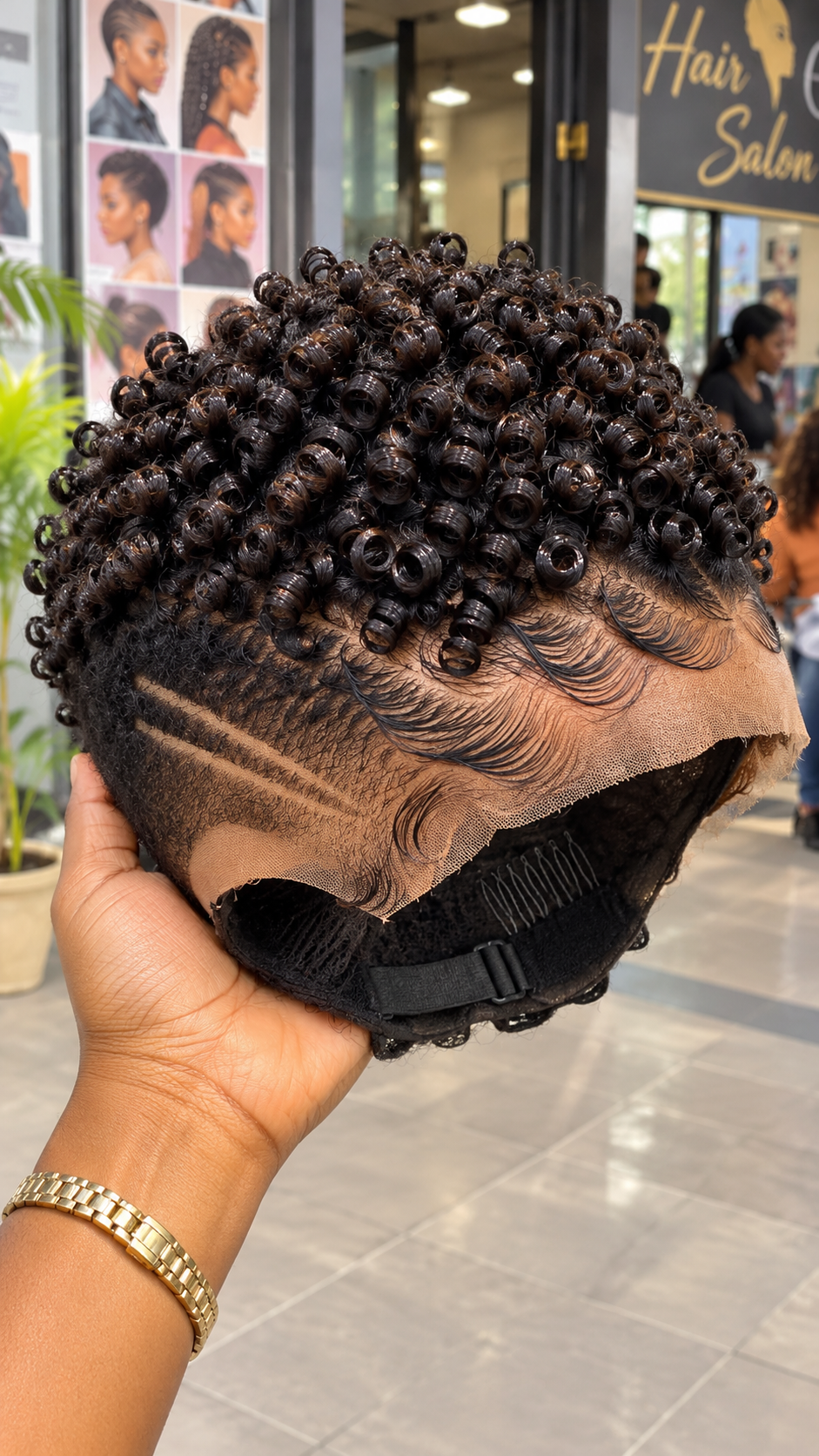
A closely cropped hairstyle can carry an extraordinary amount of detail when the curls, hairline, and side design are arranged with care. This espresso-black pixie wig brings together a densely packed crown of miniature corkscrew ringlets, graceful finger waves across the front lace, and two prominent diagonal lines along the visible temple. Rather than emphasizing length, the hairstyle draws attention to the contrast between its energetic circular curls and the precise geometry of the lower side.
Presented by hand outside a hair salon, the wig is photographed before installation. The upper crown is generously covered with glossy, tightly rolled curls that resemble small hollow cylinders and compact springs. Beneath them, fine strands sweep across the forehead area in overlapping curved sections. The side is noticeably closer to the cap, with two exposed channels cutting diagonally through the darker hair. A beige lace perimeter, black interior comb, and adjustable strap are also visible.
The color appears predominantly very dark espresso brown, approaching black in the shaded areas. Warmer brown reflections can be seen on several ringlets, although the photograph does not establish whether these are intentional highlights or reflections produced by the lighting. The hairstyle does not show a strong two-tone color arrangement.


For buyers considering a similar pixie lace wig, the important decision is not simply whether the product has curls. The coil diameter, arrangement of the forehead waves, width of the side channels, and position of the cap all influence the finished appearance. Understanding these elements before ordering can help avoid receiving a wig that shares the general silhouette but lacks the distinctive character of the reference.
The Corkscrew Crown Creates a Rich, Rounded Silhouette
The upper section is dominated by a dense gathering of small cylindrical curls. Many have clearly visible openings at their ends, while others overlap so closely that only their curved outer surfaces can be seen. The curls remain relatively compact, giving the crown a rounded outline without producing long strands that hang downward.
Some ringlets stand nearly upright, presenting their hollow centers to the camera. Others lean toward neighboring curls, creating overlapping layers. This mixture is important because it gives the hairstyle fullness without making every curl appear identical.
The visible front contains several narrow spirals extending slightly toward the hairline. Farther back, the curls become tightly grouped and create a continuous rounded surface. The rear is only partly visible, so its complete contour cannot be confirmed.
The curl openings are smaller than those commonly associated with oversized rose curls. Their narrow cylindrical appearance gives the hairstyle a more energetic, tightly coiled character.
What Buyers Should Examine in the Curl Pattern
When shopping for a comparable wig, look beyond labels such as curly pixie or finger coil wig. Those terms can describe several different hair constructions.
The photographed crown contains compact corkscrew-style ringlets with relatively narrow openings. A unit made with broad circular loops will appear more open, while ordinary loose curls may produce a softer and less structured silhouette.
Request a close-up image of the actual curls from a potential supplier. Look at whether the strands form recognizable cylindrical rings, how closely the curls sit together, and whether their placement remains consistent across the upper section.
Ask for an overhead photograph as well. The reference shows the crown from a forward-side angle, but it does not reveal the complete distribution of curls across the opposite side.
The Forehead Waves Have an Elegant Feathered Appearance
Below the compact ringlets, the front hairline changes character. Instead of continuing into additional corkscrew curls, fine strands are arranged into elongated curves that follow the lace surface.
Several sections sweep diagonally across the forehead area. Their narrow strands remain individually recognizable, creating a feathered appearance within each broad wave.
The curves become particularly noticeable near the visible temple, where the strands bend downward before turning back toward the lower side. A longer curved flourish appears near the edge of the lace.
This arrangement creates a decorative front without requiring oversized bangs or added accessories. The waves lie relatively flat against the foundation, allowing the raised crown to remain visually dominant.
The transition between the corkscrew curls and the feathered waves also introduces a change in scale. The upper coils are compact and circular, while the lower strands follow longer, flowing paths.
The Risk of Overworking the Hairline
These fine waves may be vulnerable to excessive brushing, unnecessary plucking, or poorly planned lace trimming. Their appearance depends on the direction and placement of relatively small groups of strands.
A stylist who removes too much hair from the perimeter could interrupt the decorative curves. Similarly, applying heavy styling products may cause the individual strands to merge into thicker sections.
During customization, preserve the visible pattern until the wig has been positioned correctly on the wearer’s head. Any changes should be planned according to the intended final hairline rather than the shape of the lace while the unit is being held.
Two Diagonal Temple Channels Add a Barber-Inspired Accent
The visible side contains two exposed diagonal channels running through a closely fitted dark hair section. They follow similar directions and create a striking contrast against the surrounding strands.
The upper line begins beneath the curl-covered section and travels backward through the temple area. A second line follows below it, separated by a band of dark hair.
These channels are relatively narrow, allowing the closely arranged strands between and beneath them to remain important parts of the composition.
The lower hair becomes more compact toward the perimeter, producing the impression of a tapered side. Its shape includes a noticeably angled section near the lower temple.
Although the lines resemble precision barber carving, the photograph cannot establish exactly how the pattern was produced. It may involve cutting, controlled hair placement, or a combination of techniques.
Preserving the Space Between the Lines
The spacing between the two channels is part of the design. If they are brought too close together, the dark section separating them may become difficult to recognize. If they are placed too far apart, the pattern may occupy more of the side than intended.
For a custom wig, send the stylist a cropped photograph of the temple area and explain that both separations should remain clearly visible.
Ask the maker whether the construction supports the requested line placement without exposing unwanted cap material.
Do not attempt to deepen the channels by cutting additional strands before consulting a professional familiar with wig construction. Hair removed from a lace unit cannot simply grow back.
The Espresso-Black Shade Deserves Careful Color Matching
The hair appears exceptionally dark, with espresso-brown reflections visible along some of the circular coils. Its lower side is closer to black, partly because the closely fitted strands receive less direct light.
No obvious blonde, copper, silver, or burgundy color blocks are present. The warmer reflections are distributed subtly rather than arranged as contrasting streaks.
This makes the color easier to combine with different clothing choices while allowing the curl pattern and side geometry to remain the main attractions.
However, photographed hair color can be affected by daylight, exposure, and the reflective quality of the strands. The image should not be used to assign an exact manufacturer color code.
When ordering, compare actual samples or request photographs taken under neutral lighting. A supplier may classify similar-looking shades as natural black, dark brown, or espresso.
The Exposed Interior Offers Valuable Clues About Construction
The underside is clearly visible through the open front of the wig. It appears predominantly black, with a dark elastic adjustment strap crossing the lower interior and a comb attachment positioned above it.
The adjustable component includes a small buckle, allowing the strap to be recognized as part of the cap’s fastening arrangement. The comb is positioned inside the visible opening, where its teeth can be seen against the dark foundation.
These components provide useful information, but they do not reveal every aspect of the wig’s construction. The photograph does not establish the total number of combs, complete cap measurements, or whether additional fastening components are present elsewhere.
Nor does the visible strap automatically establish that the wig is suitable for glueless installation.
Questions to Ask About the Cap
Before purchasing, request a complete interior photograph showing the cap opened fully. Ask the supplier to identify every comb, strap, clip, or other attachment component.
Confirm the available cap sizes and request the measurements needed to select an appropriate fit. For many suppliers, this includes head circumference and other dimensions such as front-to-nape and ear-to-ear measurements.
If adhesive-free wear is important, obtain explicit confirmation that the complete unit supports that installation method. The presence of an adjustable strap alone is not enough to establish suitability.
Also ask whether the cap construction allows the side design to sit correctly at the intended temple position.
Why the Beige Lace Should Remain Intact Until Fitting
A broad beige lace perimeter extends beyond the forehead and temple styling. The mesh remains untrimmed, making this a pre-installation presentation rather than a photograph of the wig being worn.
The lace is especially visible beneath the finger waves, where the fine dark strands contrast with the lighter mesh.
Although the surface appears relatively fine, its exact lace grade cannot be confirmed from the image. Buyers should not assume that it is a particular premium lace category without written product information.
Ask for the lace dimensions and available shades. The best choice should be evaluated according to the intended wearer’s complexion and the proposed installation method.
A professional should establish the correct wearing position before trimming. The delicate forehead waves and nearby temple lines make accurate placement particularly important.
Finding a Specialist Who Can Reproduce This Pixie
Not every salon that installs lace wigs will necessarily specialize in miniature corkscrew curls or precise decorative side channels. For a faithful reproduction, choose a wig maker or stylist who can demonstrate relevant work.
Start by looking for examples of compact spiral pixies, close-fitting temple sections, and sculpted finger-wave hairlines. Examine actual customer photographs whenever available.
Ask whether the maker creates the curls and side accents during production or modifies an existing wig afterward. This distinction may affect how securely the hairstyle retains its arrangement.
A local wig boutique may allow you to inspect a comparable unit in person. An online supplier may provide additional options, but detailed photographs and clear written specifications become especially important.
The photograph itself does not establish a verified supplier or available product listing, so it should be treated as a design reference rather than proof of a particular item for sale.
A Sensible Custom Ordering Process
Begin with the full reference photograph and three close crops: one showing the corkscrew crown, another showing the forehead waves, and a third concentrating on the double temple channels.
Describe the hairstyle as a dark espresso-black pixie with numerous compact cylindrical curls, feathered front waves, and two diagonal side separations.
Clarify that the upper curls should remain tightly grouped rather than becoming loose hanging ringlets. Explain that the temple lines should be relatively narrow and separated by a visible band of dark hair.
Next, confirm the proposed fiber, lace specifications, cap construction, sizing, and installation options. Ask whether the maker can supply a finished-unit photograph before dispatch.
Finally, establish the production timeline, payment terms, revision policy, and any shipping charges. For a complex hairstyle, written agreement about the intended appearance is more useful than relying on a broad product description.
Estimated Budget for a Compact Corkscrew Pixie
Pricing depends on the chosen fiber, cap construction, amount of hand styling, and complexity of the side detailing. The following figures are illustrative USD planning ranges, not verified live selling prices or quotations for the photographed unit.
| Wig Category | Illustrative Price Range | Possible Scope and Limitations |
|---|---|---|
| Premium Custom | $340–$830+ | Individual cap measurements, closely arranged miniature coils, custom temple geometry, and specialist front-wave finishing. |
| Standard Custom | $185–$440 | Selected cap options with personalized curl placement and planned double-channel side work. |
| Basic Human Hair | $110–$285 | A human-hair base unit that may require additional cutting, coil setting, and hairline styling. |
| Premium Synthetic | $80–$210 | A manufactured curled pixie with preformed spirals and varying amounts of decorative detail. |
| Basic Synthetic | $30–$100 | A budget alternative that may have looser curls, simpler hairline work, or no side channels. |
The cylindrical curl arrangement may increase styling labor because the crown contains many closely grouped formations. The temple design introduces additional precision work, especially if the supplier must create the channels while maintaining surrounding coverage.
Installation, lace customization, shipping, taxes, and later curl resetting may be charged separately. Ask for an itemized quotation showing what is included.
Ready-Made or Custom-Made?
A ready-made pixie may be practical for someone who wants a dark, compact curly hairstyle without requiring an exact reproduction. It may cost less initially and can sometimes be obtained more quickly.
However, a standard unit might contain larger ringlets, a plain side, or a simpler front hairline. Those changes can significantly alter the appearance.
Custom work offers the possibility of coordinating the miniature curls, temple channels, and feathered waves from the beginning. The maker can also discuss whether the desired arrangement is compatible with the chosen cap construction.
Neither approach guarantees a better result automatically. The most useful evidence is the quality of the supplier’s previous work and the accuracy of the finished unit.
Preparing for a Salon Fitting
When the wig arrives, inspect the lace for damage and compare the finished curls with the approved reference. Check that the visible adjustable strap operates properly and that the internal comb is securely attached.
At the salon, the stylist should first establish the cap position and check comfort. The temple channels should sit at an appropriate location, and the forehead waves should follow the intended direction.
Only after these checks should excess lace be trimmed. Any additional side adjustments should be discussed carefully because removing hair can expose the foundation.
If the curls have shifted during shipping, the stylist should identify the material before attempting to restore their shape. Heat, steam, or other reshaping methods must not be used without confirming fiber compatibility.
The Real Maintenance Challenge Is Curl Separation
The compact corkscrew crown looks intricate because many small curls remain individually recognizable. Heavy brushing, aggressive handling, or product buildup may cause neighboring strands to merge and obscure their circular openings.
For routine handling, support the cap instead of pulling on the curls. Avoid repeatedly stretching individual ringlets to inspect their length.
Washing frequency should depend on wear, product accumulation, and the supplier’s instructions rather than a universal calendar. A wig used occasionally may require a different routine from one worn regularly.
If the unit is confirmed as human hair, resetting may be possible with appropriate professional techniques, taking account of any processing history. If synthetic, follow the manufacturer’s guidance on washing and heat exposure.
Keeping the Temple Geometry Visible
The side channels may become less noticeable if surrounding strands move across them. This does not necessarily mean the design has been damaged.
Before considering further cutting, ask a stylist to examine whether the hair simply needs repositioning. Avoid widening the channels with scissors or clippers.
The fine waves between the crown and temple should also be handled conservatively. Their narrow ridges help connect the different styling sections.
Storage Without Flattening the Ringlets
A suitable wig stand can support the cap while protecting the compact crown from pressure. Avoid stacking other wigs or accessories on top of the curls.
During travel, use a container that leaves enough room for the ringlets and prevents the lace from catching against rough surfaces.
If the wig is stored for an extended period, inspect it before the next installation. Look for displaced curls, changes in the forehead waves, and any damage to the mesh or fastening components.
Careful storage may reduce the amount of restyling required between wears, although actual maintenance needs depend on the fiber and construction.
Who May Enjoy Wearing This Hairstyle?
This pixie may appeal to women who enjoy detailed curls but prefer a compact overall length. The dense upper ringlets provide fullness, while the closely fitted temple keeps the silhouette controlled.
The double diagonal channels add a distinctive barber-inspired element, making the hairstyle more expressive than a plain curled pixie.
Its dark espresso-black appearance may suit buyers who prefer relatively understated coloring while still wanting intricate styling.
The principal tradeoff is maintenance. The numerous miniature curls and decorative waves may demand more careful handling than an ordinary loose curly wig.
Making the Final Purchase Decision
The strongest reproduction will preserve the relationship between the densely arranged corkscrew crown, elongated forehead waves, and double diagonal temple channels. These elements give the hairstyle its recognizable personality.
Before committing to a purchase, obtain clear information about the hair material, lace type, cap dimensions, fastening components, and expected care requirements. Ask for photographs of the opposite side and rear because the reference does not reveal the entire hairstyle.
A carefully chosen unit should offer more than the correct dark color. It should retain the compact circular curls, balanced side coverage, fine hairline movement, and precise temple pattern that make this pixie distinctive.
Search Terms
Espresso black corkscrew pixie wig · Miniature cylindrical curl crown · Double diagonal temple channel wig · Dark brown spring ringlet pixie · Feathered forehead wave lace unit · Black tapered temple coil wig · Untrimmed beige lace spiral pixie · Adjustable black cap corkscrew wig