
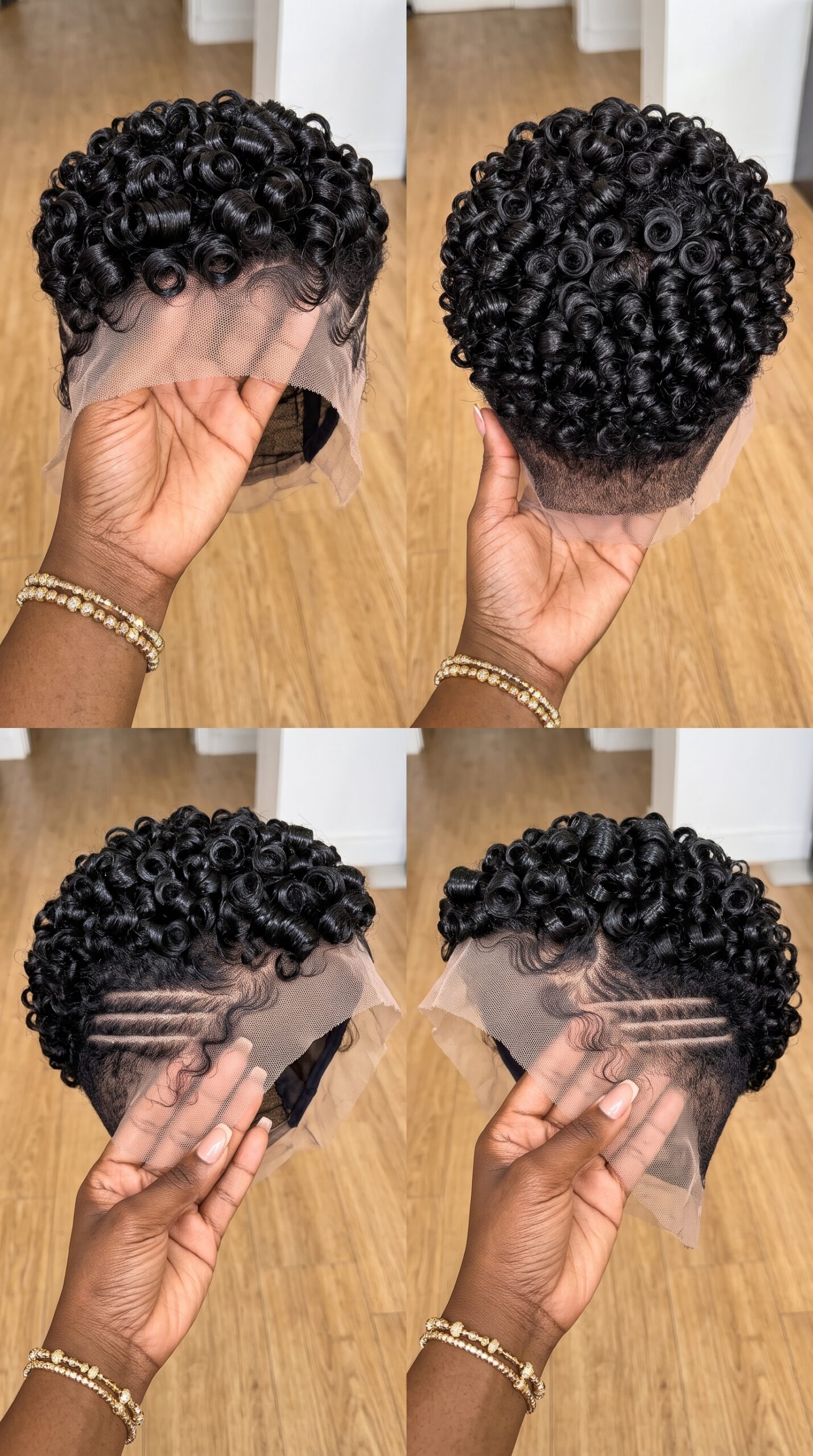
Short black hairstyles can make an unforgettable impression when beautifully rounded curls are combined with carefully shaped side details. This striking pixie wig brings together tightly arranged barrel curls, a softly contoured hairline, and three parallel lines along the tapered sides. The result is a distinctive short hairstyle that blends the fullness of sculpted curls with the precision of barber-inspired detailing.
The photographs present a jet-black wig from four different perspectives, allowing its front, back, and side construction to be examined. Across the crown, numerous glossy cylindrical curls form a rounded silhouette. Each curl appears carefully rolled into a compact circular shape, with several openings visible throughout the upper hair. The sides become considerably shorter beneath the fuller crown, creating a gradual taper toward the lower edges.
One of the most recognizable characteristics is the arrangement of three narrow, parallel lines along the temple areas. These light-colored channels contrast beautifully against the closely cropped black hair. Their placement introduces a sharp decorative element beneath the softer circular curls.


The front hairline contains delicate, curved strands that frame the forehead, while the visible lace extends beyond the styled sections. At the back, the densely arranged curls gradually transition into shorter hair near the nape, creating a compact and balanced finish.
The deep black color gives the hairstyle a classic appearance, while the glossy reflections reveal the intricate construction of the individual curls. Rather than relying on contrasting hair colors, this design draws attention through shape, direction, and carefully controlled styling.
For women who appreciate short curly wigs with distinctive side detailing, this hairstyle offers an attractive combination of elegance, personality, and practical-looking proportions. Its most important characteristics are the rounded barrel curls, closely tapered lower sections, curved front strands, and triple side lines.
The Distinctive Shape of Barrel Curls
The crown contains numerous compact barrel curls that create a beautifully rounded upper silhouette. Unlike ordinary loose curls, these formations have a cylindrical appearance, with strands wrapping around themselves to create visible circular openings.
Some curls face forward, while others are positioned at slightly different angles. This variation gives the upper section a rich, dimensional appearance.
The curls are closely arranged without completely concealing their individual shapes. Larger circular formations appear throughout the crown, while smaller curls fill the spaces between them.
The glossy surface helps emphasize the rounded structure. Light follows the curved strands, creating narrow highlights along the outer edges of each barrel.
The hairstyle maintains a sense of fullness without becoming excessively tall. This is important because the compact silhouette remains one of the defining characteristics of the design.
Women requesting a similar wig should emphasize the cylindrical curl arrangement rather than simply asking for short curly hair. Ordinary spiral ringlets, loose waves, and tightly springing coils may create noticeably different results.
Beautiful Crown Volume Without Excessive Length
The upper section appears full and generously covered with curls, yet the hairstyle remains relatively short.
This effect comes from the way the barrel curls are positioned. Instead of extending downward into long sections, the curls remain concentrated close to the crown.
Their rounded shapes create dimension and fullness without requiring hair that hangs around the face or shoulders.
Across the top, the individual barrels overlap slightly. This arrangement helps create a continuous rounded silhouette while preserving visible curl definition.
Near the front, several curls sit closer to the forehead. Toward the back, the arrangement becomes denser before gradually transitioning into the tapered lower section.
The result is a compact hairstyle with noticeable upper volume and a neatly shaped foundation.
For custom wig orders, customers should discuss the desired finished crown height rather than relying exclusively on advertised hair length. The starting strands may be longer than the finished curl arrangement suggests.
Triple Side Lines Add Precision and Character
The most distinctive lower-section detail is the arrangement of three parallel lines across the closely tapered sides.
These narrow channels extend backward from the temple area, creating a coordinated pattern beneath the rounded curls.
The lines are positioned close enough to appear connected as a decorative design, but they remain individually recognizable.
Their lighter color contrasts against the surrounding black strands, making the pattern particularly noticeable.
Unlike elaborate geometric designs containing numerous intersecting shapes, these accents rely on a simple parallel arrangement.
This restrained styling provides strong visual impact without overwhelming the crown.
The lines also complement the compact tapered sections, creating a clear distinction between the fuller upper hair and shorter lower sides.
Because the photograph shows a wig rather than a haircut on a person, the exact method used to produce the lines cannot be verified. They may be formed through customized hair placement, sectioning, or another construction technique.
How the Side Lines Change the Pixie Silhouette
Decorative side lines do more than introduce an interesting pattern. Their placement also influences the way the hairstyle is perceived.
In this design, the channels run horizontally with a slight directional sweep, following the contour of the side.
They create an organized boundary beneath the curls, emphasizing the difference between the rounded crown and closely cropped lower sections.
The uppermost line sits nearest the curls, while the additional lines extend through the shorter hair below.
This arrangement draws attention toward the temple without adding unnecessary volume.
From the side, the contrast is particularly attractive because the circular barrels appear above the sharper lines.
The hairstyle therefore combines softness and precision within a single compact silhouette.
For customers ordering a customized version, preserving the spacing and direction of these accents is important. Making them excessively wide or positioning them too low could alter the overall appearance.
A Softly Sculpted Front Hairline
The front photograph reveals several delicately curved strands positioned beneath the barrel curls.
These strands follow gentle sweeping directions across the forehead, creating a softer transition between the fuller crown and the lace foundation.
Some of the front curls sit close to the hairline, while others form slightly raised circular shapes above it.
The arrangement helps frame the front of the hairstyle without introducing excessive decorative waves.
Along the visible sides, finer strands curve toward the temples, complementing the closely cropped lower sections.
This treatment gives the front a carefully finished appearance even before installation.
Women seeking a similar wig should communicate their preferences for edge styling. The front can remain close to the photographed arrangement without adding large, elaborate baby-hair patterns that might change its character.
Jet Black Gives the Curls a Luxurious Appearance
The hairstyle uses a deep black color throughout the visible crown and lower sections.
This consistent color allows the individual curl shapes to become the main attraction.
The rounded barrels display glossy reflections along their curved surfaces, while the spaces inside the curls remain darker.
These differences in lighting create visual depth without requiring colored highlights.
The tapered lower section also appears dark, producing strong contrast against the lighter decorative channels.
Black is an appealing choice for women who want an expressive haircut while maintaining a classic hair color.
It can coordinate with different clothing colors, jewelry styles, and makeup preferences.
When purchasing, customers should compare natural black and jet-black hair samples. The photograph shows a very dark finish, but lighting conditions can affect how individual commercial shades appear.
The Back Shows a Beautifully Rounded Finish
The rear photograph provides a particularly useful view of the hairstyle’s construction.
Across the upper back, the barrel curls continue in closely arranged formations. Their circular shapes remain visible as they extend toward the lower crown.
The curls gradually become smaller and more compact near the transition into the nape.
Below them, the hair appears closely tapered, creating a short, neat-looking lower section.
This transition prevents the hairstyle from appearing excessively bulky at the back.
The rounded crown remains prominent, but its fullness is balanced by the narrower lower silhouette.
Customers should pay particular attention to this rear construction when evaluating similar wigs.
Some ready-made curly pixies may have a full front but an uneven or overly bulky back. The photographed design shows a more controlled relationship between the crown and nape.
The Tapered Nape Completes the Short Cut
The nape is an important part of the hairstyle because it determines how the upper fullness transitions into the lower back.
In the photograph, the dense curls gradually give way to closely arranged shorter hair.
The lowest section has a compact appearance, maintaining the proportions of a short pixie.
This gradual reduction in volume creates a balanced rear silhouette.
A bulky nape could make the hairstyle look heavier, while an excessively abrupt transition might appear disconnected from the crown.
The pictured arrangement maintains a smooth progression between these areas.
For natural hair, a professional barber can recommend a suitable taper according to the client’s density, growth pattern, and preferred finish.
For a wig, the maker must consider hair placement and construction techniques that reproduce the same compact appearance.
The Importance of Balanced Side Styling
Both side photographs show similar decorative line arrangements beneath the barrel curls.
This gives the hairstyle a coordinated appearance from different viewing angles.
The curls remain full above the temples, while the closely tapered sections provide space for the parallel lines.
Fine curved strands appear near the front of the temple areas, linking the upper curls to the lower decorative sections.
The symmetry of the side accents is especially useful when the wig is worn with different head positions.
Whether viewed from the left or right, the recognizable relationship between curls and parallel lines remains visible.
Customers seeking this design should ask the stylist to confirm the intended placement on both sides.
A photograph showing only one temple may not provide enough information to reproduce a balanced two-sided arrangement.
What the Four Views Reveal About the Wig
The four photographs provide more useful information than a single front-facing image.
The front view shows the rounded curls, curved hairline strands, and exposed lace foundation.
The rear view reveals the continued curl arrangement and the shorter tapered nape.
The side views show the triple decorative lines and the transition between the crown and temple sections.
Together, these perspectives provide a clearer understanding of the hairstyle’s proportions.
They also demonstrate that the wig is designed to maintain its recognizable appearance from several directions.
However, the photographs do not reveal every internal construction detail or the exact hair material.
Customers should treat the visible styling as a reference while requesting separate technical specifications from the manufacturer.
Understanding the Lace Around the Hairline
The front and side photographs show beige lace extending beyond the styled hairline.
This excess mesh remains untrimmed because the wig is being displayed before installation.
The lace creates a foundation around the front and temple areas, where the carefully arranged strands meet the cap.
The photograph also reveals part of the darker interior construction.
These visible details help distinguish the unit from an ordinary haircut performed directly on natural hair.
However, the precise lace material cannot be established from appearance alone.
Customers should not assume that the wig uses a particular premium lace classification without confirmation.
Before purchasing, request information about the lace dimensions, material, durability, and recommended installation method.
This is particularly important because the decorative temple details need to remain correctly positioned after fitting.
Choosing the Right Cap Construction
A wig cap should provide comfortable support while preserving the hairstyle’s intended shape.
For this design, accurate fitting is especially important because the side lines occupy specific positions around the temples.
If the cap shifts, the decorative details may no longer sit where intended.
The crown should also remain balanced, without leaning excessively toward one side.
Customers should measure their head according to the manufacturer’s instructions before ordering.
Useful measurements commonly include circumference, front-to-nape distance, and ear-to-ear width.
Some custom wig makers also request measurements around the forehead and temples.
The photographs do not reveal all of the cap’s adjustment components, so these should be confirmed with the seller.
Correct construction and fitting can help preserve both comfort and the intended appearance of the hairstyle.
Lace Closure and Frontal Options
Different wig constructions provide different amounts of lace coverage.
A lace closure generally covers a smaller area, while a frontal may extend across more of the front hairline and temple regions.
For a hairstyle containing carefully positioned temple accents, the available coverage can influence how the final design is arranged.
The most suitable construction depends on the intended hairline, cap fit, and installation method.
Although lace is visible in the photographs, the exact closure or frontal specifications cannot be confirmed.
Customers should request underside photographs and written construction details from the seller.
The wig maker can then recommend a suitable foundation for reproducing the front curls, temple styling, and compact rear silhouette.
Can This Curly Pixie Be Worn Glueless?
Some women prefer glueless installation because they want to avoid adhesive during regular wig wear.
Whether this particular hairstyle supports that method depends on the cap construction and its securing components.
Some wigs include adjustable bands, combs, or other retention systems intended to provide additional stability.
However, the photographs do not establish every component included in this unit.
Customers should ask whether the wig is specifically designed for glueless installation rather than assuming that all lace wigs can be worn that way.
A properly fitted cap is particularly important when the sides contain detailed decorative lines.
The hairstyle should remain correctly positioned during normal movement without causing uncomfortable pressure.
Professional fitting can help determine the most appropriate installation approach.
Human Hair or Synthetic Fiber for Barrel Curls
Different hair materials respond differently to curling, washing, heat, and repeated styling.
Human hair may offer flexibility for resetting and reshaping the barrels, depending on its quality and processing.
Suitable synthetic fibers can also retain prepared curl formations, although their styling limitations vary.
The glossy appearance in the photograph does not establish whether the wig contains human hair or synthetic material.
Customers should request accurate specifications directly from the manufacturer.
The selected material should support compact circular curls without losing their intended shape too easily.
Before using heated styling tools, confirm whether the material is heat-compatible and which temperatures are appropriate.
The ideal choice depends on wearing frequency, maintenance expectations, and budget.
Choosing the Correct Curl Diameter
The curls are relatively compact, but their circular openings remain clearly visible.
This creates a distinctive barrel pattern across the crown.
If the curls were significantly smaller, they could resemble tightly packed finger coils rather than rounded barrels.
Larger curls might create excessive crown height or change the overall silhouette.
The photographed hairstyle maintains a balanced curl size that works beautifully with its short tapered sides.
For custom orders, customers should provide close-up reference photographs showing the desired barrel shape.
The stylist should also understand whether the curls need to face forward, upward, or slightly backward.
These details help create an arrangement that resembles the original design rather than a general curly pixie.
Finding the Ideal Hair Density
Density affects both crown fullness and the visibility of individual curls.
The photographed wig has a generously filled upper section, but the barrel formations remain recognizable.
Too little hair may create empty spaces between the curls, while excessive density can make the crown appear crowded.
Some wig manufacturers advertise density options such as 130%, 150%, and 180%.
However, the exact density of the photographed unit cannot be established visually.
The ideal choice depends on the hair material, starting length, cap construction, and intended finished curl size.
Customers should ask their stylist to recommend a suitable density rather than automatically choosing the highest available percentage.
Maintaining visible curl separation is just as important as creating fullness.
Where to Get This Hairstyle Done
Women interested in recreating this appearance can consult professional wig stylists, specialized hair salons, and barbers experienced in precision short hairstyles.
For natural hair, the professional should understand how to create a compact curly crown with closely tapered sides and decorative temple lines.
The outcome will depend on the client’s hair length, density, texture, and condition.
For a wig, a specialist experienced in custom lace construction and sculpted curls may be more appropriate.
The stylist should be comfortable reproducing rounded barrel curls and arranging the lower side details.
Before booking, review examples of previous work from several angles.
Photographs showing both curly crowns and decorative temple patterns are especially useful.
A consultation can help determine whether the hairstyle should be recreated on natural hair or produced as a removable wig.
Questions to Ask a Wig Stylist
Begin by asking whether the stylist has experience creating compact barrel curls rather than ordinary loose spirals.
Discuss the desired crown height and the amount of visible curl separation.
Explain that the sides should remain closely tapered beneath the fuller upper section.
Request three parallel lines near the temple and confirm that the design should appear on both sides.
Ask how the lines will be produced on a wig and whether the method will remain convincing during wear.
Discuss the front hairline and the small curved strands that soften the forehead.
Finally, confirm the hair material, cap specifications, installation options, and maintenance requirements.
Clear communication helps reduce the likelihood of receiving a wig with the correct general shape but different decorative details.
Where To Buy This Wig
Comparable wigs may be available through professional wig boutiques, independent hair makers, beauty supply stores, and online retailers offering customized short curly styles.
Useful searches include black barrel curl pixie wigs, short curly wigs with triple side lines, and tapered spiral pixie lace wigs.
However, ready-made products may not reproduce the exact temple pattern.
Some short curly wigs feature rounded crowns but have completely covered sides. Others include decorative lines but use a different curl structure.
Customers should examine actual product photographs before purchasing.
Front, side, and rear images are particularly valuable for confirming the silhouette.
For a closer reproduction, a customized wig may provide greater control over the barrel curls and temple accents.
The photographs do not identify a verified manufacturer or confirmed retail listing.
How to Order a Customized Version
Begin by contacting a wig maker who accepts detailed styling requests.
Send all four reference views so the professional can examine the front, rear, and side construction.
Explain that the crown should contain compact, glossy black barrel curls with clearly visible circular openings.
Specify the closely tapered lower sections and the triple parallel temple lines.
Ask that the front hairline include softly curved strands rather than excessive decorative baby hair.
Discuss the preferred cap measurements, hair material, finished length, and installation method.
Before paying, confirm the complete price, customization charges, shipping arrangements, and revision policy.
When possible, request photographs of the completed wig from the same four perspectives before shipment.
Ready-Made Wigs Compared with Custom Work
A ready-made short curly wig may provide a convenient starting point for women who appreciate compact black curls.
However, standard products may not include the same triple temple lines or closely tapered rear section.
The curl size may also differ from the barrel formations shown in the photographs.
A custom wig allows greater control over these characteristics.
The maker can discuss the placement of the curls, the shape of the sides, and the exact decorative line arrangement.
Custom construction can also accommodate individual head measurements and installation preferences.
Although personalized work may involve additional costs, it can be worthwhile when the decorative details are central to the desired appearance.
Customers should decide whether a general resemblance is sufficient or whether a close visual match is the priority.
Estimated Prices for Black Barrel Curl Pixie Wigs
The cost of a similar wig depends on hair material, cap construction, density, curl preparation, and the complexity of the decorative side design.
The following amounts are illustrative USD budgeting estimates, not verified current retail prices or confirmed quotations for the photographed unit.
| Price Tier | Estimated Price Range | Typical Features and Considerations |
|---|---|---|
| Budget | $30–$90 | Basic synthetic curly pixie wigs with simpler curl patterns and limited side customization. |
| Value | $70–$180 | Pre-styled short wigs with compact barrel-like curls and more elaborate finishing. |
| Mid | $120–$310 | Human hair or specialty base wigs requiring additional curl setting and side shaping. |
| Premium | $215–$505 | Customized barrel curls, tapered-looking sides, parallel temple lines, and personalized fitting. |
| Salon-Grade | $410–$975+ | Individual cap construction, intricate curl placement, precision side detailing, and professional finishing. |
Additional costs may include shipping, installation, lace preparation, cap adjustments, and future professional restyling.
Customers should obtain a detailed quotation before ordering.
Maintaining the Rounded Barrel Curls
The circular curls are the hairstyle’s most prominent feature, making their preservation particularly important.
Repeated brushing or unnecessary pulling may disturb the barrel shapes and reduce their definition.
Customers should avoid separating the curls simply to create additional volume.
The appropriate maintenance method depends on the hair material and how the curls were originally formed.
Human hair may require suitable setting products or professional reshaping.
Synthetic hair should be maintained according to the manufacturer’s instructions, particularly regarding heat exposure.
If the barrels become flattened or lose their circular openings, professional restoration may be preferable to repeated home experimentation.
Gentle handling can help preserve the full, rounded crown between styling appointments.
Keeping the Triple Temple Lines Visible
The decorative lines depend on the surrounding short strands remaining in their intended positions.
Repeated rubbing or brushing against the pattern may cause neighboring hair to shift across the exposed channels.
This can reduce the clarity of the design.
For wigs, customers should avoid unnecessary cutting or reshaping unless the maker confirms that the construction supports those changes.
For a similar hairstyle created on natural hair, periodic barber appointments may be needed as the tapered sections grow.
The exact maintenance frequency depends on individual hair growth and personal preferences.
Preserving the parallel spacing is important because the decorative pattern contributes significantly to the hairstyle’s identity.
A Practical Care Routine for Regular Wear
Maintenance frequency depends on how often the wig is worn, its hair material, and the products used during styling.
After each use, inspect the crown for flattened or displaced barrel curls.
Check the temple areas to ensure that the decorative lines remain visible.
Examine the lace perimeter and cap for signs of wear or damage.
Washing should follow the manufacturer’s material-specific instructions rather than an arbitrary universal timetable.
During cleansing, avoid unnecessary friction that could disturb the circular curls.
After washing, dry and reshape the wig using methods appropriate for its fiber.
When extensive curl resetting is necessary, professional maintenance may help restore the original appearance.
Protecting the Wig During Storage
The crown should not be tightly compressed because the barrel curls depend on retaining their rounded shapes.
A suitable wig stand or storage form may help support the silhouette.
The unit should be clean and completely dry before extended storage.
Care should be taken around the lace perimeter, cap stitching, and any adjustment components.
If the wig is stored in a box, provide enough space to prevent the upper curls from becoming flattened.
Follow the maker’s recommendations regarding storage conditions and handling.
Thoughtful storage can reduce the amount of work required to refresh the hairstyle before its next use.
Styling This Black Pixie for Different Occasions
The combination of glossy curls and decorative temple lines makes this hairstyle suitable for a variety of fashion preferences.
For special events, the rounded crown provides noticeable detail without requiring additional hair ornaments.
For portrait photography, the side lines create an attractive profile, while the circular curls add dimension from the front.
For everyday outfits, the compact silhouette may appeal to women who prefer short-looking hairstyles.
Gold earrings can complement the deep black color, while silver or pearl accessories offer alternative finishing touches.
The hairstyle can coordinate with neutral outfits, colorful dresses, and tailored clothing.
Its character comes from the combination of curl structure and precision detailing rather than from additional accessories.
Advantages of Barrel Curl Pixie Hairstyles
One advantage is the ability to create visible fullness without relying on long strands.
The circular barrel curls give the crown a decorative appearance while maintaining a compact silhouette.
The closely tapered sides provide contrast and help the upper curls stand out.
The triple parallel lines introduce personality without requiring an elaborate all-over design.
The black color provides a classic foundation that can complement many clothing and makeup choices.
Another advantage is the balanced construction visible from the front, rear, and sides.
For women who enjoy short hairstyles with distinctive barber-inspired detailing, the design offers a compelling combination of curls and precision.
Potential Limitations to Consider
Carefully formed barrel curls may require more maintenance than ordinary loose curls.
Repeated washing, brushing, or compression can affect their original shape.
The decorative temple lines may also require attention to preserve their clarity.
Custom wig construction with detailed side accents may cost more than a basic ready-made curly pixie.
Some customers may prefer hairstyles that require less professional restyling.
Before purchasing, consider wearing frequency, cap comfort, fiber composition, and access to suitable maintenance services.
These practical factors can help determine whether the hairstyle is appropriate for regular wear or occasional use.
Checking the Finished Wig Before Installation
When a completed wig arrives, compare its shape with the reference photographs.
The crown should contain compact black barrel curls with recognizable circular openings.
The front hairline should include softly curved strands that complement the upper section.
Both sides should display the intended triple line arrangement, with consistent spacing and direction.
The rear should transition from full curls into a closely tapered lower section.
Inspect the lace perimeter and interior cap for visible damage before trimming or making permanent adjustments.
Confirm that the wig fits comfortably and that the decorative details sit in the correct positions.
If the unit was custom-made, discuss significant differences with the seller before installation.
The Lasting Appeal of Glossy Barrel Curl Pixies
This hairstyle demonstrates how compact circular curls and precision-shaped side accents can transform a short black pixie into a distinctive salon creation.
The rounded barrel curls give the crown fullness and visual depth, while the closely tapered sides maintain a balanced silhouette.
The triple parallel lines introduce an artistic detail that distinguishes the hairstyle from ordinary short curly wigs.
The softly curved front strands complement the upper curls, and the gradually tapered nape provides a neat-looking rear finish.
The consistent black color allows the hairstyle’s shape and construction to remain the main attraction.
For women interested in recreating this appearance, the essential priorities are compact glossy barrel curls, a rounded crown, closely shaped sides, and carefully positioned triple temple lines.
With suitable customization, accurate fitting, and thoughtful maintenance, this hairstyle offers a beautiful combination of expressive curls, short-hair elegance, and precise side detailing.
Search Terms
Glossy black barrel curl pixie · Triple side line curly pixie wig · Short black cylindrical curl hairstyle · Tapered barrel curls with temple stripes · Jet black pixie lace front curls · Compact barrel curl crown wig · Black curly pixie with parallel side lines · Short barrel curl wig with tapered nape