
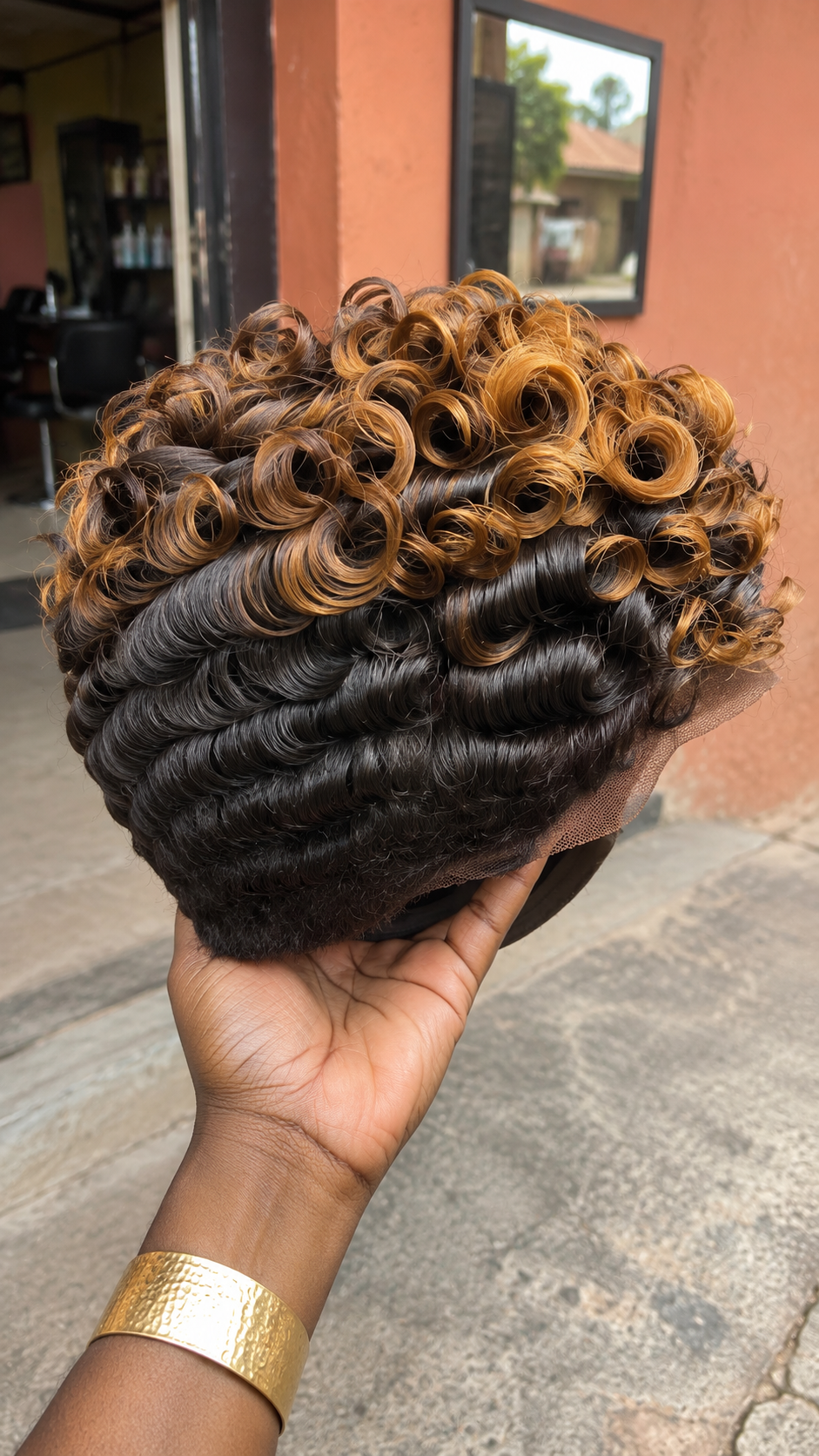
The most interesting detail in this pixie wig is not simply its honey-blonde curls. It is the way those curls sit above a series of glossy black waves, creating two distinct styling arrangements within one compact hairpiece. Golden circular loops occupy the upper crown, while darker strands travel through broad, closely arranged curves along the visible lower section. The contrast gives the wig an elegant silhouette that looks carefully styled from the side.
Photographed outdoors in front of a neighborhood hair salon, the wig is supported in one hand before installation. The image captures a side and partial rear view, showing the upper curl placement, dark lower waves, and a section of beige mesh extending beyond the hair near the right edge. The interior is only partly visible, so the complete cap construction and fastening arrangement cannot be established from this photograph.
The crown combines golden honey, caramel, and warm amber reflections with deeper brown strands. Some circular curls contain noticeably dark interiors, while others display lighter golden surfaces that catch the daylight. Beneath them, the hair becomes predominantly black or very dark espresso brown, arranged into broad, parallel wave ridges that travel toward the lower rear.


For customers searching for a honey-blonde pixie wig with dark roots, the important detail is the relationship between the upper ringlets and the lower sculpted waves. A generic blonde curly wig would not necessarily reproduce this distinctive combination.
Why the Black Waves Deserve Attention First
Most shoppers will initially notice the golden curls, but the darker lower section is equally important to the hairstyle’s appearance. Instead of using an ordinary closely cropped side, the wig contains several broad, flowing wave ridges arranged in a layered pattern.
The uppermost dark section begins beneath the circular curls and sweeps backward across the visible side. Additional ridges follow below it, creating a stacked arrangement with gentle changes in direction.
The waves remain close to the underlying surface. Their strands are carefully aligned, producing long reflective highlights rather than the circular reflections visible in the crown.
Near the lower edge, the hair becomes more compact, with shorter-looking strands creating a rounded finish. This gives the hairstyle a gradual transition rather than an abrupt boundary between the sculpted waves and the lower hair.
The photograph does not establish the method used to form these ridges. They resemble finger-wave-inspired styling, but the exact setting process and products would need to be confirmed with the wig maker.
How the Lower Waves Change the Silhouette
The dark waves create horizontal movement beneath the fuller crown. Their placement visually supports the circular curls without adding excessive width to the hairstyle.
If the lower section were replaced with ordinary curls, the wig would appear more uniformly rounded. If it were cut into a very close fade, the contrast between the raised crown and lower side would become substantially more dramatic.
The photographed hairstyle occupies a middle ground, retaining visible hair throughout the lower section while keeping the overall silhouette compact.
A customer commissioning a similar unit should request a dark sculpted side with broad wave ridges rather than an ordinary shaved-looking taper.
The Golden Crown Contains Open Circular Loops
The upper hair is arranged into numerous circular ringlets, many with clearly visible openings. Several curls face toward the camera, while others tilt diagonally or overlap neighboring loops.
The ringlets vary in apparent diameter. Larger circular formations occupy the central and upper sections, while smaller curls fill the outer edges and transition toward the darker hair below.
These are not loose, hanging spiral curls. Instead, the strands appear gathered into rounded ribbon-like formations that sit close together across the crown.
The curls create a relatively full upper silhouette without extending into an exaggerated vertical shape. Their placement follows the head’s rounded contour.
The golden color emphasizes the individual loops because daylight reflects across their outer surfaces, making the circular formations particularly noticeable.
Matching Curl Diameter and Crown Density
Curl diameter affects both the appearance and proportions of the hairstyle. Oversized rings could increase the height and width of the upper crown, while very small coils might conceal the visible openings.
The reference shows a combination of medium and broad circular curls arranged closely enough to create a continuous upper section.
For custom production, ask the maker to preserve the open-centered ringlet appearance without adding unnecessary volume.
A photograph taken from above would help confirm the full distribution of the curls. Because the supplied image emphasizes the side and partial rear, it does not establish every detail of the frontal crown.
Customers should request additional viewing angles before approving an exact reproduction.
The Color Placement Is More Interesting Than a Simple Ombré
The crown displays warm golden honey-blonde and caramel-brown strands, while the underlying hair becomes much darker.
The lighter sections are concentrated within the circular curls rather than forming a conventional horizontal color band across the entire wig.
Some rings contain honey-gold strands around much of their circumference, while others combine golden and darker brown hair. This creates depth within the individual loops.
Beneath the crown, the visible waves appear predominantly black or very dark espresso brown, with subtle warm reflections from the daylight.
The difference between these sections helps establish the hairstyle’s structure. The golden curls appear elevated, while the dark waves form a restrained foundation.
Choosing the Right Honey-Blonde Shade
Honey blonde is not one universal color. Some manufacturers offer relatively pale golden shades, while others use deeper caramel or amber-brown tones.
The photographed hair appears warm and golden, with darker brown sections that prevent it from looking uniformly bright blonde.
It does not resemble pale platinum, cool ash blonde, or vivid copper-red coloring.
Buyers should request daylight photographs of the proposed material and compare the lighter sections directly with the intended dark base.
If a supplier offers multiple blonde shades, the customer should prioritize the relationship between the golden curls and espresso foundation rather than selecting by color name alone.
A Side and Rear View Helps Explain the Styling
The photograph gives an unusually clear view of the lower wave arrangement, but it does not provide a complete frontal perspective. This matters because the hairstyle may appear different when worn and viewed directly from the front.
The golden curls are concentrated across the visible upper section, while the dark wave ridges travel along the side and toward the rear.
The lower hair narrows toward a compact edge, creating a layered appearance beneath the fuller crown.
No clearly exposed decorative razor lines are visible in this view. The main design comes from the curved hair ridges themselves rather than carved channels.
Customers seeking a faithful reproduction should avoid adding diagonal stripes or geometric temple details merely because they are common in other pixie styles.
The available photograph supports a design based on circular ringlets and closely aligned waves, not a heavily carved side.
How to Describe This Wig to a Stylist
A useful custom-order description should begin with the two styling zones rather than a generic request for honey-blonde curls.
Explain that the upper section requires warm golden circular ringlets with visible openings and darker strands beneath them.
The lower section should contain glossy black or very dark brown waves arranged in broad, closely aligned ridges.
The hairstyle should remain compact, with the upper curls providing most of the volume and the lower hair following the shape of the head.
Ask the maker to reproduce the transition between the two sections rather than introducing a sharp, unrelated boundary.
Because the photograph does not show the complete front, a stylist should discuss the intended frontal hairline before finalizing the construction.
Which Photographs Should Be Requested?
Before commissioning a wig based on this reference, request a frontal photograph, an overhead view, and a complete rear image if additional references are available.
The front view can establish the hairline, parting arrangement, and direction of the curls around the forehead.
An overhead photograph can reveal whether the circular loops continue evenly across the crown.
The rear view can show how the dark sculpted waves finish at the back and whether the lower edge remains compact.
These views help prevent the maker from inventing details that are not visible in the original reference.
Get the Details on This Wig
The photograph confirms the outward appearance of the hairstyle but does not establish the hair material, exact cap design, or manufacturer.
The wig may be constructed from human hair, synthetic fiber, or a blend. Its glossy appearance is not sufficient evidence to identify the composition.
Before purchasing, ask the seller to provide written specifications describing the material, cap size, attachment method, and styling requirements.
It is also important to determine whether the ringlets and lower waves are supplied already styled or must be recreated after delivery.
A supplier should be able to explain whether the two styling arrangements can be maintained through ordinary wear and washing.
The Visible Mesh and Cap Require Separate Inspection
A section of beige mesh extends near the visible edge of the hairpiece. The photograph also exposes part of the dark inner construction beneath the lower hair.
However, the viewing angle does not establish the complete lace dimensions, the location of every attachment component, or the cap circumference.
The mesh should not automatically be identified as HD lace or another specialized material without manufacturer confirmation.
Likewise, its presence does not prove that the wig can be worn without adhesive.
Ask the seller to turn the wig inside out and photograph the complete cap. This should reveal any combs, adjustable straps, elastic sections, and other fastening components.
Choosing Between Glueless, Closure, and Frontal Options
Customers can discuss several construction possibilities with a qualified wig maker, depending on the desired hairline and wearing routine.
A closure-based unit may be appropriate for certain limited-parting arrangements, while a frontal construction may provide more flexibility around the hairline.
A glueless option should only be selected when the cap has been designed and fitted for that purpose. It should not be assumed from the photograph.
The best construction depends on the wearer’s head measurements, scalp comfort, styling preferences, and budget.
Because the complete frontal hairline is not visible, the original wig’s precise construction category cannot be established from this image alone.
Finding a Wig Maker Who Understands This Combination
Customers interested in this hairstyle should search for specialists experienced in sculpted pixie wigs, circular ringlet styling, and finger-wave-inspired arrangements.
Independent wig studios, lace wig salons, and custom hairpiece makers may offer suitable services.
When reviewing previous work, look for examples showing both rounded curls and closely directed wave ridges within the same hairstyle.
A stylist experienced only with ordinary curly wigs may not necessarily be comfortable reproducing the broad lower waves.
Send the reference photograph and discuss the exact arrangement before paying a deposit.
Ask whether the maker can provide approval photographs before shipping, particularly when the wig is being produced to order.
Ready-Made or Custom: What Makes More Sense?
A ready-made honey-blonde curly pixie may be convenient when its crown already resembles the reference.
However, many products contain uniformly curled sides rather than the broad dark wave ridges visible here.
Custom production provides an opportunity to specify the curl diameter, color distribution, wave placement, and cap dimensions.
The additional labor may increase the price, but it can also reduce the need for extensive modifications after delivery.
Before purchasing a basic wig for later customization, consult an experienced stylist to determine whether the original hair density and material can support the desired arrangement.
Not every wig can be safely restyled into circular ringlets or sculpted waves.
Estimated Prices for Honey-Blonde Ringlet Pixie Wigs
The cost of recreating this hairstyle may depend on the material, two-tone color placement, circular curl construction, broad lower waves, and cap preparation.
The following USD amounts are illustrative planning ranges, not verified live retail prices or quotations for the photographed wig.
| Wig Category | Illustrative USD Range | Purchasing Considerations |
|---|---|---|
| Premium Custom | $320–$760+ | Individually arranged honey-blonde rings, dark sculpted wave sections, custom sizing, and possible specialized lace construction. |
| Standard Custom | $170–$390 | Personalized curl placement, dark-to-golden color arrangement, and selected side-wave adjustments. |
| Basic Human Hair | $100–$250 | A possible human-hair foundation requiring additional color work, curl setting, and sculpted lower styling. |
| Premium Synthetic | $75–$180 | A potentially pre-styled alternative with golden circular curls and a dark wave-inspired lower section. |
| Basic Synthetic | $30–$90 | A lower-cost curly pixie option that may approximate the general colors and shape without reproducing the detailed waves. |
These categories represent possible purchasing routes rather than confirmed descriptions of the photographed wig.
Actual prices can vary by supplier, region, material quality, construction complexity, and included services.
Ask whether the quoted amount includes color preparation, finished curls, wave styling, cap adjustments, and any necessary lace work.
Shipping, professional installation, and future maintenance may be separate expenses.
Booking a Stylist for Installation
After receiving the wig, the customer should inspect the golden curls and dark lower waves before making any alterations.
A professional installer can assess the cap fit and determine how the hairstyle should sit on the head.
If lace trimming is necessary, the wig should first be positioned correctly so that the frontal and side sections remain proportional.
The upper ringlets should be handled carefully because pulling or brushing them excessively may disturb their circular shapes.
The lower waves also require attention, as their appearance depends on closely aligned strands following specific curved directions.
Any significant cutting or thinning should be discussed before it begins, since removed wig hair cannot simply grow back.
Maintaining the Golden Circular Curls
The crown’s appearance depends on the circular openings remaining visible. Repeated brushing, compression, or unnecessary separation may alter the ringlets.
Customers should obtain material-specific care instructions before attempting to wash or restyle the wig.
If the unit contains synthetic fibers, heated styling tools should only be used when the manufacturer confirms suitable temperature limits.
If it contains human hair, previous coloring or lightening may affect its response to heat and additional chemical processing.
The golden sections should not be recolored without confirming the fiber composition and processing history.
Protecting the Dark Wave Ridges
The lower waves rely on their aligned strands maintaining broad curved formations.
Heavy product buildup or excessive brushing could disturb the arrangement and reduce the separation between individual ridges.
Ask the original stylist which products are appropriate for refreshing the waves and whether they require periodic professional attention.
When storing the wig, support the cap without pressing directly against the circular crown.
If the lower styling begins to lose its shape, professional restyling may be preferable to attempting extensive corrections without knowing the original technique.
The Advantages and Limitations of This Hairstyle
The main advantage of this pixie wig is its distinctive combination of warm curls and dark, closely arranged waves. The rounded crown provides fullness, while the lower styling creates a compact silhouette.
The combination can also make the hairstyle visually interesting from more than one angle. The golden ringlets attract attention from above, while the sculpted black waves become particularly noticeable from the side.
However, the detailed styling may require more careful maintenance than an ordinary loose curly wig.
The circular loops and wave ridges may not respond identically to washing or manipulation. Their durability depends on the material and construction method.
Customers should also consider whether they prefer a ready-styled unit that requires careful preservation or a simpler hairstyle that can be restyled more freely.
A Distinctive Pixie Wig with Two Beautiful Hair Patterns
This hairstyle combines warm honey-blonde circular ringlets with broad glossy black waves, creating a contrast that is visible throughout the side and partial rear.
Its appeal lies in the way the two styling arrangements complement one another. The golden curls provide rounded fullness, while the darker waves create controlled movement beneath them.
For buyers seeking a similar wig, accurate curl diameter, color distribution, and lower wave placement should be the main priorities.
Request photographs from the front, top, and rear, confirm the fiber and cap specifications, and discuss any custom construction before ordering.
A successful reproduction should preserve the golden open-centered ringlets, dark espresso foundation, broad parallel wave ridges, and compact lower silhouette without introducing unnecessary shaved lines or additional colors.
With thoughtful construction and appropriate fitting, this design offers an attractive option for women who appreciate compact pixie wigs with decorative curls and sculpted wave styling.
Search Terms
Honey blonde ring curls with black waves · Golden circular curl pixie wig · Dark sculpted wave side hairpiece · Caramel blonde open ringlet crown · Black finger wave honey blonde wig · Two tone golden spiral pixie · Espresso wave base blonde curls · Compact honey curl lace wig