
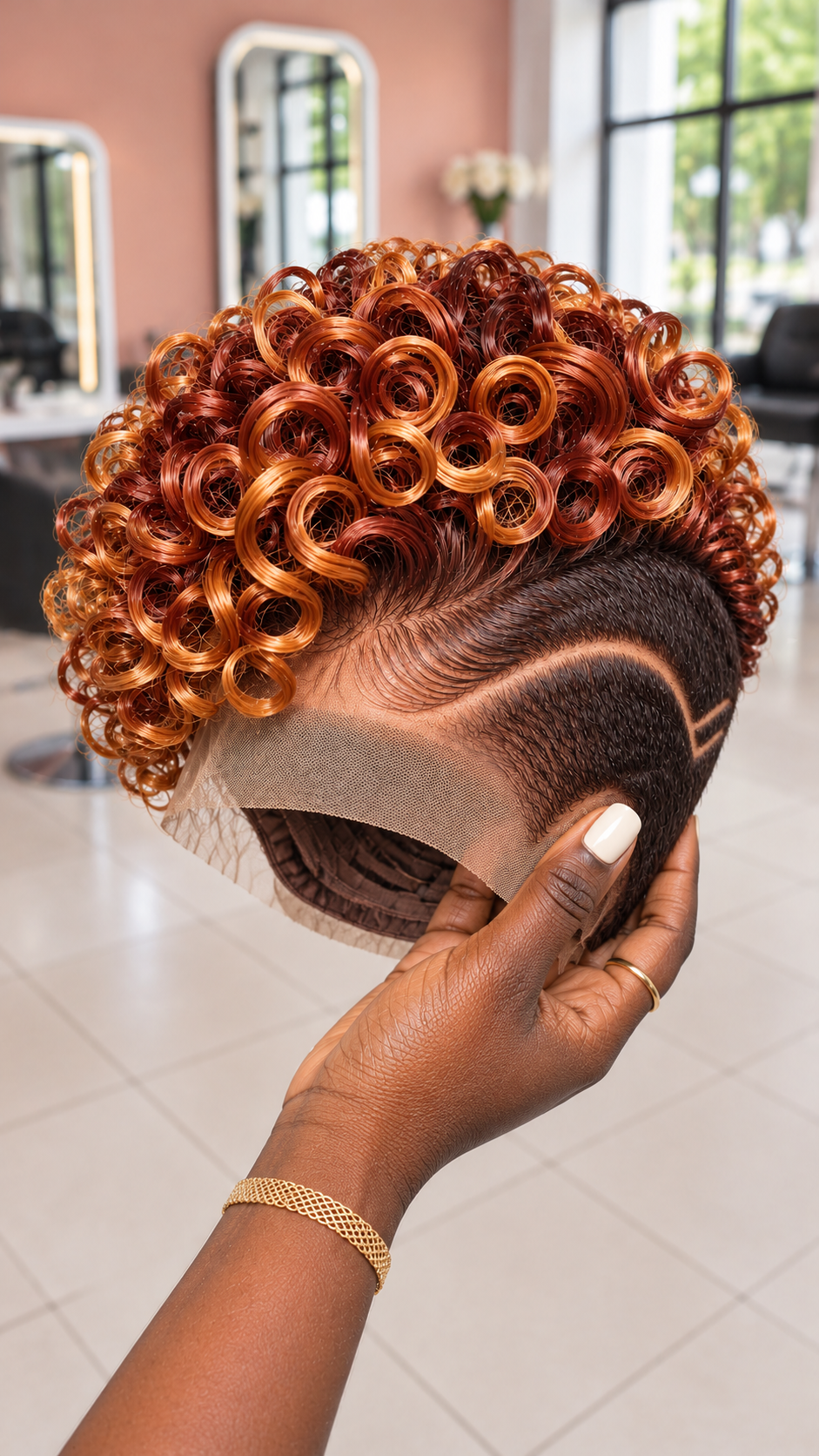
Some pixie wigs make their biggest impression through color, while others rely on unusual curl arrangements or decorative side details. The hairpiece pictured here brings all three elements together. Its upper section is filled with luminous copper-orange ringlets, its lower side is styled in deep black, and two small angled accents interrupt a sweeping temple separation near the back. The combination produces a striking hairstyle whose character depends on the relationship between the bright circular curls and the darker, closely arranged hair beneath them.
Photographed before installation, the wig is held in one hand inside a bright salon with peach-colored walls, large mirrors, and daylight entering through the windows. The viewing angle reveals the curl structure, the direction of the front hair, the decorative temple pattern, and the beige lace extending beyond the hairline. A portion of the brown interior cap is also visible through the opening.
The upper hairstyle consists of numerous glossy ringlets arranged into rounded, hollow-centered formations. Their colors range from bright copper-orange and golden auburn to deeper reddish brown. Several larger loops occupy the front and central upper area, while smaller curls fill the surrounding sections. Beneath them, black hair is directed into a sweeping wave that follows the contour of the temple.


For women searching for a copper pixie wig, a sculpted ringlet lace wig, or a curly hairstyle with decorative side accents, the central question is whether a seller can reproduce the exact color relationship and curl geometry. A generic copper curly wig may share the overall shade but lack the distinctive circular loops and carefully positioned temple details.
Why the Copper Color Has Such a Strong Visual Impact
The upper hair displays an especially warm copper appearance. Some curls resemble polished copper metal, with bright orange-gold reflections traveling along their rounded surfaces. Others contain deeper auburn and reddish-brown strands that create contrast between neighboring loops.
The color is not uniformly orange. Across the upper section, brighter copper strands alternate with darker reddish-brown areas, particularly inside the circular openings and near the roots.
These differences contribute to the hairstyle’s depth. If every curl had exactly the same bright color, the upper surface might appear flatter because the boundaries between individual loops would become less noticeable.
The black foundation beneath the curls creates an additional contrast. Its dark appearance helps separate the copper upper hairstyle from the closely arranged lower side.
The photograph does not establish the precise coloring formula or whether the variations were created through several fiber shades, hair coloring, or lighting. Nevertheless, the visible result clearly belongs to the copper-orange and warm auburn color family.
Buyers commissioning this appearance should request color samples that preserve both the luminous copper surface and the deeper brown areas rather than selecting a uniformly bright orange wig.
Distinguishing Copper Orange From Burgundy and Auburn
Different red-based hair colors can produce significantly different results on the same hairstyle.
Burgundy generally introduces deeper wine-red or violet-red tones. Auburn typically leans toward reddish brown, while copper-orange contains brighter golden and orange reflections.
The pictured wig has a particularly luminous copper appearance, although some curls display a deeper auburn character.
A customer ordering a dark burgundy wig would receive a substantially different color impression, even if the individual ringlets were reproduced accurately.
When discussing a custom order, describe the desired result as bright copper-orange ringlets with warm auburn depth and a black lower side.
Ask for photographs taken under neutral daylight before approving the shade. Salon lighting and camera processing can change how warm colors appear.
The Circular Ringlets Have Carefully Varied Diameters
The curls across the upper hairstyle are not ordinary loose spirals falling naturally around the face. Many form complete or nearly complete circular loops, with strands curving around visible openings.
Several prominent circles sit near the upper front, where their rounded shapes are particularly easy to distinguish. Others overlap diagonally, creating a layered arrangement across the crown.
The loops vary in diameter. Some are comparatively large, with broad openings and several strands arranged along their outer edges. Smaller curls fill the spaces between them, contributing to the compact rounded silhouette.
Near the visible rearward portion, the curls become more closely grouped and slightly smaller in several areas. Their overlapping placement creates a gradual transition into the lower side.
The hairstyle has substantial visual fullness without becoming excessively tall. Its volume comes from the circular arrangement rather than long hair extending far above the head.
For a custom reproduction, the difference between circular loops and ordinary loose ringlets is essential. A supplier who produces a conventional curly pixie may match the color while missing the hairstyle’s most recognizable upper structure.
Maintaining Open Centers Without Excessive Bulk
One of the most important styling considerations is keeping the circular openings visible.
If too much hair is added between the loops, the upper arrangement can become crowded, making individual curls difficult to distinguish. If there is too little hair, noticeable gaps may appear across the crown.
The reference uses a combination of larger circular formations and smaller surrounding curls to create continuity.
A wig maker should consider loop diameter, direction, and density together rather than selecting these details independently.
Customers should request an elevated photograph of any completed custom unit. This can reveal whether the circular openings remain visible across the crown and whether the overall height resembles the reference.
The photograph does not establish the original curl-setting technique, so buyers should also ask whether the loops require professional resetting after washing.
The Black Foundation Makes the Upper Hair Appear More Luminous
Immediately beneath the copper ringlets, the hair becomes much darker. The visible front-side foundation appears black or very dark espresso brown, with glossy strands directed backward from the hairline.
This contrast creates a deliberate division between the bright upper hairstyle and the compact temple.
The black strands do not form an equally curly lower section. Instead, they lie closer to the wig base, following a sweeping direction beneath the raised copper loops.
The transition helps the hairstyle retain its pixie proportions. Without the lower dark section, the ringlets would occupy a greater portion of the visible silhouette and change the overall effect.
The dark foundation also emphasizes the pale curved parting near the temple, making the side geometry easier to recognize.
For buyers who want the photographed appearance, preserving this black-to-copper relationship is more important than making every strand the same color.
The Sweeping Temple Parting Creates the Main Side Division
Along the visible side, a prominent curved separation runs through the black hair. It begins near the front-side area and follows a sweeping path toward the rear.
The pale channel separates the upper dark sweep from the compact lower panel. Its shape follows the natural contour of the wig rather than forming a straight horizontal stripe.
The exposed separation is relatively narrow, allowing the surrounding black hair to remain the dominant lower-side color.
Above the channel, the strands travel backward toward the copper curls. Below it, the hair lies closer to the cap in a slightly different direction.
This difference creates a layered appearance without requiring a completely shaved side.
The photograph does not establish whether the channel was produced using clippers, a razor, carefully arranged parting, or another method. Buyers should describe the visible separation and its position rather than assume a particular production technique.
Two Angled Marks Add a Distinctive Temple Accent
Near the rearward end of the main curved parting, two short angled separation marks are visible. They sit close together and point toward the surrounding upper-side hair.
These marks are not a large geometric design covering the entire temple. They are small accents positioned near the end of the sweeping main channel.
Their compact size makes them interesting because the principal visual attraction remains the copper ringlet crown.
The two accents appear as short diagonal notches rather than a complete crossed X pattern. Their placement gives the lower hairstyle a distinctive character without creating excessive decoration.
For an accurate reproduction, the maker should preserve the direction, approximate spacing, and modest size of these marks.
Enlarging them considerably or adding several additional stripes would change the visual balance.
Why the Small Marks Should Be Planned Before Final Styling
Decorative work near the temple can be difficult to change once a wig has been completed.
The maker must account for the amount of hair available and the proximity of the underlying cap material.
Cutting too aggressively could expose lace or fabric, particularly if the supporting construction was not designed for close side detailing.
For custom production, ask the seller whether the two short accents can be created during the original styling process.
Request a close side photograph before final approval. This will help confirm that the accents remain separate and correctly positioned near the curved parting.
Do not assume that an ordinary barber can safely recreate the marks on any finished wig. The cap should be examined before irreversible cutting is attempted.
The Lower Side Retains Hair Coverage
Beneath the curved parting, the black hair appears closely arranged against the wig base. The strands form a compact panel that gradually narrows toward the lower side.
The photograph does not show an entirely bare skin fade. Instead, the lower region retains visible dark hair, providing a solid background for the narrow decorative channels.
This coverage is important. If the lower side were made completely bare, the hairstyle would have a harsher appearance and a more pronounced contrast between the upper and lower sections.
The reference instead balances the bright copper crown with a relatively restrained black side.
Customers choosing a ready-made alternative should examine the density of the lower panel. A wig with similar copper curls but much fuller side hair could appear bulky, while one with excessively sparse coverage might expose the construction beneath it.
The Front Sweep Connects the Hairline to the Ringlets
Near the forehead, fine black strands follow a curved direction toward the visible temple. They form a broad, close-fitting sweep beneath the upper curls.
The front styling does not rely on numerous separate baby-hair spirals extending across the forehead. Instead, the strands remain grouped into a relatively restrained directional pattern.
This creates a gentle transition between the beige lace and the fuller copper hairstyle.
Several golden curls extend slightly forward, but they remain part of the circular upper arrangement rather than forming a long fringe.
The photograph shows the hairpiece before installation, so the final position of the front strands against the wearer’s forehead cannot be determined.
Cap fit and lace preparation will influence the finished hairline, and a stylist should preserve the existing direction wherever possible.
Examining the Untrimmed Beige Lace
A broad section of beige-toned lace extends beyond the front and visible temple. The mesh hangs freely beneath the styled hair, making the pre-installation condition clear.
The lace appears light compared with the black side hair, particularly where it passes over the hand and exposed cap opening.
However, the photograph does not establish the lace’s commercial classification. Visible mesh alone does not confirm HD lace, Swiss lace, or another specific product category.
Buyers should ask the supplier to identify the actual lace material and whether different shades are available.
The extended lace provides space for fitting, but it should not be trimmed before the wig has been positioned correctly on the intended wearer.
Removing too much lace prematurely could reduce fitting flexibility or disturb the fine front styling.
The Visible Brown Cap Does Not Reveal Every Construction Detail
Part of the brown interior cap is visible beneath the front lace. Dark fabric and stitched structural sections can be seen through the opening.
The photograph does not expose the complete underside, so the total number of combs, the exact adjustment system, and the full rear construction remain uncertain.
It also does not establish that the wig can be worn securely without adhesive.
Before purchasing, request a complete inside-out photograph showing all attachment components.
Ask for cap circumference, front-to-back length, and ear-to-ear measurements.
If the supplier offers adjustable straps, combs, elastic bands, or other securing options, confirm which are included with the selected unit.
The ability to wear a wig without adhesive depends on its construction and individual fit, not simply on the presence of lace or an internal band.
Choosing a Lace Construction for the Intended Installation
Buyers may encounter ready-made and custom wig options described as closure, frontal, or glueless units. These terms refer to different construction or installation choices and should not be treated as interchangeable.
A lace closure usually provides a more limited area of lace coverage, while a frontal may offer a wider section across the front hairline. The exact dimensions vary by product.
For a hairstyle with a prominent curved temple parting and decorative side accents, the position of the lace and underlying cap material is particularly important.
A seller should explain whether the chosen construction can support the intended side styling without exposing unsuitable materials.
Do not assume that the photographed unit uses a particular closure or frontal arrangement. The visible perspective is not sufficient to confirm the complete lace coverage.
The best construction should be selected according to fit, styling needs, and the supplier’s demonstrated capabilities.
Where To Buy This Wig
Specialized wig boutiques, custom lace wig makers, and salons experienced in sculpted curly pixie hairstyles are suitable places to search for a comparable product.
Useful search descriptions include copper-orange ringlet pixie wig, golden auburn circular curl hairpiece, sculpted pixie wig with angled temple lines, and black-sided copper lace wig.
When browsing online listings, compare actual photographs rather than relying solely on hairstyle names.
A generic copper curly wig may have the correct approximate color but lack the large circular loops. Another wig may reproduce the ringlets while using a different decorative side pattern.
For ready-made products, request photographs of the actual unit available for shipment.
For custom production, review the maker’s previous work involving open circular curls and precision temple styling.
No specific supplier or current stock availability can be established from the photograph alone.
Preparing a Custom Order That Preserves the Side Accent
A clear custom-order request should identify the hairstyle’s most important visual details before discussing smaller adjustments.
Start with the upper curls. Explain that the hairstyle should contain golden copper-orange circular loops with visible openings and varied diameters.
Next, specify the dark black foundation beneath the ringlets and the broad swept front section.
Identify the curved temple separation and the two small angled marks near its rearward end.
Ask the maker to preserve the close-fitting lower side rather than creating a completely shaved-looking region.
Finally, confirm hair material, cap measurements, lace specifications, and intended installation method.
If possible, request a progress photograph showing the temple detail before final styling is completed.
This can help identify significant differences while corrections remain feasible.
Ready-Made Convenience Versus Custom Reproduction
A ready-made wig may offer faster delivery and a lower initial price. It can be suitable if the buyer finds a unit with comparable curls, color distribution, and cap measurements.
However, the two angled temple marks may be difficult to find in ordinary product catalogs.
Custom production offers more control over the decorative geometry, curl size, color balance, and cap fit.
The trade-off may involve additional styling labor and higher expense.
Before choosing either option, determine which details are essential. The upper copper loops, black side, sweeping curved parting, and twin angled accents are the strongest identifying elements.
An accurately styled ready-made wig may still provide better value than an expensive custom unit that fails to reproduce these details.
Illustrative Pricing for a Copper Ringlet Pixie Wig
The price of a comparable wig may depend on hair material, lace construction, cap measurements, color processing, curl-setting labor, and the precision required for the decorative side accents.
The photograph does not establish the manufacturer, fiber composition, or actual selling price.
The following US dollar amounts are illustrative planning ranges rather than verified live retail quotations.
| Wig Category | Illustrative USD Range | Potential Purchase Scope |
|---|---|---|
| Premium Custom | $340–$790+ | Individual cap sizing, detailed copper ringlet arrangement, custom color work, and precision twin-accent temple styling. |
| Standard Custom | $175–$415 | Selected adjustments to curl size, color distribution, cap fit, and curved side detail. |
| Basic Human Hair | $100–$270 | A human-hair base unit that may require additional copper coloring and professional circular curl setting. |
| Premium Synthetic | $70–$205 | A higher-grade synthetic option with potentially prearranged ringlets and prepared lace construction. |
| Basic Synthetic | $30–$105 | A lower-cost alternative where curl arrangement, color depth, and temple precision may vary. |
These categories represent possible purchasing approaches, not confirmed versions of the photographed product.
Installation, shipping, lace preparation, color customization, cap alterations, and future curl restoration may be charged separately.
Ask for an itemized quotation that identifies which services are included and whether the completed wig will reproduce the agreed temple design.
Booking a Stylist for Installation and Final Fitting
After receiving the wig, inspect the upper curls, color distribution, curved side parting, and angled accents before making adjustments.
When booking a salon appointment, explain that the wig contains carefully positioned circular curls and a small decorative pattern close to the temple.
Ask whether the stylist has experience fitting sculpted pixie wigs while preserving intricate side details.
At the appointment, the cap should be positioned and checked for comfort before any lace is trimmed.
The curved separation should align appropriately with the temple, and the upper curls should maintain their intended position relative to the forehead.
If the side requires further shaping, the stylist should inspect the underlying construction before using cutting tools.
The two angled marks should remain small and separate rather than being enlarged or replaced with a different motif.
Maintaining the Copper Ringlets Between Salon Visits
The upper curls depend on retaining their circular shapes and visible openings. Aggressive brushing may separate the strands and change the carefully arranged upper surface.
Before washing, ask the seller whether the curls are intended to retain their shape or require professional resetting afterward.
If the wig contains synthetic fibers, avoid heat tools unless the manufacturer confirms the permitted temperature.
If the unit contains human hair, professional restyling may be possible, but the method should account for previous processing and the original setting technique.
For confirmed color-treated human hair, repeated washing, excessive heat, and sunlight exposure may contribute to changes in the copper shade.
Synthetic fibers may have different maintenance requirements, and conventional dyeing should not be attempted without manufacturer guidance.
During storage, avoid placing heavy objects against the circular loops. Ask the maker whether a wig stand or another support method is appropriate for maintaining the hairstyle.
Protecting the Decorative Lines From Unnecessary Manipulation
The two small angled accents and the main curved temple separation are vulnerable to changes in hair direction.
Repeated brushing across the channels may move strands into the exposed areas, making the pattern less noticeable.
The surrounding black hair should be maintained carefully rather than repeatedly trimmed to restore the design.
Ask the maker which styling products were used to position the lower hair and whether localized maintenance is possible.
If the decorative marks begin to lose their appearance, an experienced stylist may be able to restore the directional placement without extensive cutting.
The appropriate method depends on the material and construction of the wig.
Photographs Worth Requesting Before Final Payment
The reference provides a strong view of the golden copper ringlets, black front sweep, and twin temple accents.
However, the complete opposite side, rear, and underside are not visible.
A direct front photograph would clarify how the ringlets frame the forehead.
An opposite-side image would reveal whether the decorative marks are repeated or whether the second side has a different arrangement.
A rear photograph would show how the copper curls continue toward the nape.
A complete underside photograph would help verify the cap construction, attachment hardware, and lace coverage.
A short video under neutral lighting could provide a more reliable impression of the copper-orange color and rounded silhouette.
A Copper Pixie Whose Smallest Detail Makes a Big Difference
This hairstyle combines luminous copper-orange circular ringlets with a dark black temple, a sweeping curved parting, and two small angled accents.
The upper curls provide fullness and movement, while the lower side remains close-fitting and carefully arranged. The crossed-looking but separate short marks near the curved channel create a distinctive decorative detail without overwhelming the hairstyle.
The untrimmed beige lace and partially visible brown interior provide useful information about the wig’s pre-installation condition, although they do not establish its complete specifications or fiber composition.
For buyers seeking a comparable design, the strongest approach is to prioritize the circular curl openings, warm copper color depth, black side coverage, and accurate placement of the two temple accents.
A successful reproduction should preserve those details without introducing extra geometric lines, excessive crown volume, or a uniformly orange color that removes the darker depth between the curls.
With careful supplier communication, appropriate professional fitting, and maintenance suited to the confirmed hair material, this sculpted pixie design offers a distinctive alternative to ordinary copper curly wigs.
Search Terms
Copper orange circular ringlet pixie wig · Golden auburn hollow loop crown wig · Black temple copper curl lace wig · Twin angled temple accent hairstyle · Sweeping curved side part copper pixie · Untrimmed beige lace orange ringlet wig · Dark rooted fiery copper rosette hairpiece · Two short diagonal temple notches wig