
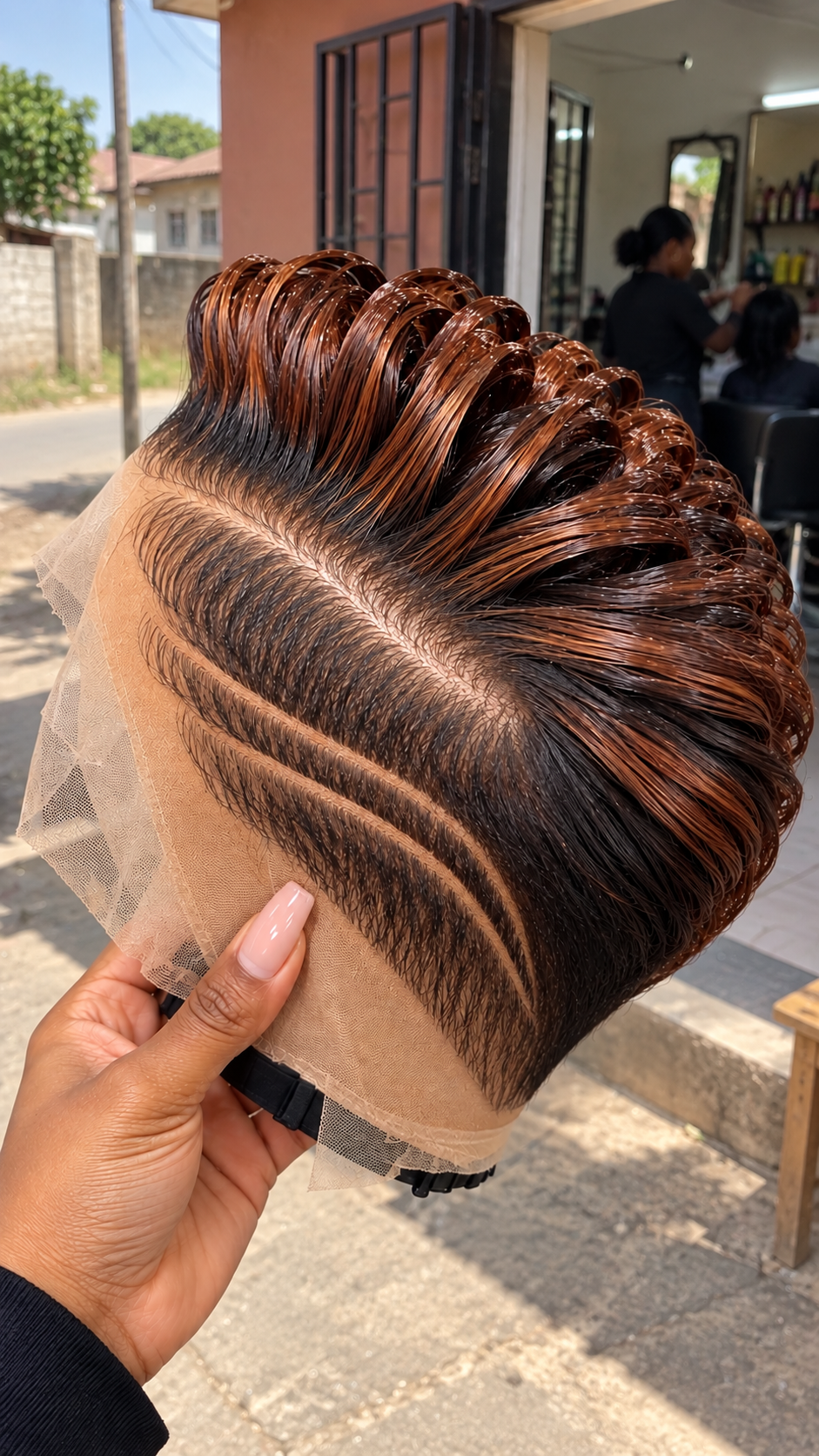
Copper does its best work in this wig where the hair rises away from the dark base. Long, curved sections lift through the top, carrying warm reddish-copper strands over a near-black foundation. Beneath that movement, the visible side stays close and dark, interrupted by a narrow curved channel. The contrast gives the hairstyle its personality: height and color above, a closely fitted outline below, and a sweeping separation that keeps the two areas distinct.
This is a wig worth discussing through its shape before its color name. A seller could offer a copper pixie and still supply something completely different: tiny curls, an evenly colored crop, or a rounded cut without the lifted top. Here, the attraction comes from the way elongated wave sections arc upward and backward. Their copper coloring follows the raised lengths, while the darker roots remain visible near the part and along the side.
The photograph shows the unit held outside a neighborhood salon, before final fitting. Excess brown-toned lace surrounds the visible perimeter, and dark banding with adjustment hardware can be seen beneath the lower edge. Those details make this a useful purchasing reference, but they do not confirm the fiber, lace grade, full cap construction, or intended securing method. A well-planned order should preserve the visible design while obtaining those missing specifications directly from the supplier.
Follow the Copper from the Roots to the Raised Sections
The color is not evenly distributed from the base to every end. The visible root area is predominantly dark, with copper becoming more noticeable as the longer strands rise into the upper waves. Some dark strands continue through the colored sections, creating depth between the warm ribbons of hair. This placement matters more than choosing a general red or brown shade from a catalog.


Ask the seller how they describe the actual color arrangement. It may be marketed under a rooted, highlighted, or two-tone description, but the terminology should be supported by photographs of the unit being offered. A product name alone does not establish where the copper begins or how much of the dark base remains visible.
The copper reads as a warm reddish brown in the sunlight. Bright points across the upper sections reflect the outdoor lighting; they should not be interpreted as silver strands or a separate pale highlight color. Indoor footage would help establish whether the actual shade appears deeper, redder, or more brown away from direct sun.
If the dark-to-copper relationship is what attracts you, put it near the top of the order brief. A uniformly copper wig would remove much of the contrast around the part and side. Likewise, coloring only a few isolated tips could produce a subtler result than the broader warm sections shown here.
The Lifted Top Gives This Cut Its Direction
The upper hair forms elongated loops and sweeping arcs rather than compact circular pin curls. Each section appears to travel away from the exposed part, rise, and then bend toward the back. The repeated movement creates a crest-like profile without turning the entire wig into a rounded mass of curls.
There is visible space beneath some raised sections. That openness contributes to the silhouette and distinguishes the style from a densely packed coil set. Asking for more hair through the top could change the effect, particularly if the additional density fills those spaces and makes the crown look heavier.
At the same time, the angle is important. The wig is tilted in hand, so its height in the photograph cannot be translated directly into a measurement on a wearer. Request a view on a suitable head at eye level before deciding whether the lift is right for you. A top-down product photograph can exaggerate some relationships and conceal others.
When speaking with a stylist, describe the direction of movement rather than asking only for volume. The reference needs upward and backward curves, not simply a taller crown. A stylist who understands that distinction can discuss how the available length and material will support the desired arrangement.
Read the Two Visible Channels Separately
A broad pale separation runs between the lifted top and the closely laid side panel. Lower down, a much narrower curved channel passes through the dark side hair. These are two different visual elements. The upper separation organizes the hairstyle, while the lower line adds a graphic detail within the close side section.
The narrow line is especially important to identify correctly. It is not a set of several parallel stripes, and the photograph does not show a cross pattern or a feather-shaped design. Ordering extra lines would alter the reference rather than simply improve it. If you want this exact direction, ask for one restrained curved side channel in the visible panel.
Because the image shows a wig, the line should not be described as a verified shaved design on the wearer’s scalp. Ask the maker how the effect is created in the unit and how it will appear after fitting. Its width and visibility may change when the cap is supported differently.
Do not ask a barber to deepen the line before the wig has been assessed. Removing hair close to a foundation can expose construction that was previously concealed. The first step is to establish whether the supplied line already gives the intended result when the cap is correctly positioned.
Where This Wig Comes From
The setting shows a salon entrance and activity inside, but it does not establish the identity of a maker or a physical purchasing location. There is no verified business name, city, country, or ordering link in the photograph. Anyone offering this exact unit should be able to provide separate product and business information.
To source a similar piece, look for custom wig makers, boutiques selling cropped lace units, and wig stylists whose portfolios include lifted wave work and close side detailing. These skills may be offered together or by different professionals. Establish whether the business sells the base, creates the color, and completes the final set.
A local salon can be a useful starting point if you want an in-person assessment. Ask whether they can source an appropriate unit or work on one you supply. Send this reference before booking so they can decide whether the available hair, construction, and coloring options suit the requested result.
For online shopping, search descriptions that combine the important elements: dark roots, copper swept waves, a cropped lace unit, and a close side panel. Use those results to find candidates, then judge the actual product evidence. Similar search wording does not guarantee a matching haircut.
Before visiting or paying, confirm the business address or dispatch location, appointment arrangements, and delivery coverage. If the seller operates without a public storefront, ask how fittings and alterations are handled. Clear purchasing details should accompany the hairstyle photographs rather than being left until after payment.
Choose the Buying Route That Matches Your Priorities
A finished stock wig may suit you if its fit, color placement, and upper movement already match what you want. Ask whether the photograph shows the actual item for sale or an example that will be recreated. That distinction affects what you can reasonably expect from the delivered product.
A custom order offers more opportunity to specify the dark root area, copper distribution, side line, and amount of lift. It also requires a more detailed agreement. Ask the maker which elements can be controlled closely and which depend on the selected base, fiber, or measurements.
Another route is to buy a suitable base and commission the color and styling locally. Before doing so, have the stylist assess the proposed product. A closely cut side may be difficult to alter, and insufficient top length could prevent the elongated arcs from forming as intended.
If you already own a wig, avoid assuming it can be converted from the photograph alone. Send interior and exterior views to the stylist and explain its known material and processing history. A consultation should determine feasibility before you pay for a full transformation service.
Whichever route you choose, separate the underlying product from the finished styling. Ask whether the photographed arrangement is included, whether it is temporary, and what preparation remains after delivery. This prevents a base wig from being mistaken for a fully completed recreation.
The Budget Behind Copper Color and Wave Setting
The amounts below are illustrative USD planning allowances, not verified current offers. They do not identify the material or value of the photographed unit. They provide a way to compare possible purchasing categories while requesting a complete written quotation for your chosen specification.
| Purchase Category | Illustrative USD Allowance | What the Quotation Should Explain |
|---|---|---|
| Premium Custom | $520–$1,150+ | Individual sizing, selected foundation, controlled dark-to-copper placement, detailed lifted setting, and revision arrangements. |
| Standard Custom | $285–$590 | Available base options, reference-based cutting, color coverage, side detailing, and final styling before dispatch. |
| Basic Human Hair | $155–$350 | Written material information, processing history, usable length, and additional charges for coloring and wave work. |
| Premium Synthetic | $90–$225 | Fiber specification, supplied color pattern, permitted styling methods, sizing, and expectations after cleaning. |
| Basic Synthetic | $35–$100 | Actual unit views, available colors, construction limits, fit options, and return eligibility before alteration. |
The distinctive work here is not just a haircut. The quotation may need to account for placing copper through the longer upper sections, preserving the dark side, arranging the raised waves, and refining the visible channel. Those services may be included in a custom price or charged separately.
Ask for a total that identifies the wig, color work, haircut, set, fitting, and delivery. If installation is offered, establish exactly what it includes. A general installation charge may not cover the detailed wave arrangement or any further color adjustment.
Also discuss the cost of resetting the style after cleaning. If the crest-like shape depends on a professional set, ongoing styling becomes part of the ownership budget. A lower initial purchase price may be less useful if the required aftercare is unavailable where you live.
For international delivery, ask which charges are included and whether import-related costs might be collected separately. Compare complete purchasing routes, including any local appointment needed after arrival. This creates a more realistic budget than comparing only the headline prices of different wigs.
Approve the Color in More Than One Light
The outdoor presentation makes the copper especially noticeable along the raised strands. Before ordering, request the same unit indoors near a window and under ordinary room lighting. This helps you judge the shade without relying on one bright view.
Ask the seller to show the dark root area closely. The amount of dark hair between the part and the copper sections is an important part of the design. If the color begins too close to the foundation, the upper and lower areas may lose the contrast visible in the reference.
A color sample is useful when the maker offers one, particularly for custom work. Otherwise, ask for a clear comparison with their available copper shades. Terms such as auburn, cinnamon, and copper may be used differently by different suppliers, so a visual agreement is preferable to relying on the name alone.
If you want the photograph’s appearance, avoid adding extra blonde strands or a brighter red section without considering the effect on the entire silhouette. The visible color placement already emphasizes the upward movement. Additional colors would create a different focal point.
Confirm the Foundation Before Planning Installation
The exposed mesh gives useful information about the unfinished perimeter, but it does not establish a particular lace grade. Brown-toned lace is visible around the front and side areas shown. Its suitability for a wearer depends on the actual material, color, positioning, and preparation.
Request a full interior photograph, including the area under the lifted top and the perimeter. A dark band and adjustment components are visible beneath the lower edge, but the complete securing system is not shown. Ask the seller to identify each included component and explain how the unit is intended to be worn.
Do not infer adhesive-free suitability from the presence of an adjustable element. Fit and construction need to be considered together. Ask whether the supplier recommends a particular wearing method for this exact unit and what preparation is required before the first use.
Likewise, the hair’s shine and strand appearance do not verify human hair or synthetic fiber. Obtain the written material description before discussing heat, coloring, or resetting. The correct care and styling options depend on information the photograph cannot provide.
Make the Fitting About the Side as Much as the Front
This style exposes a substantial close side panel, so its position matters. During fitting, check where the broad upper separation sits in relation to your forehead and temple. A cap positioned too far forward or backward could change the balance between the raised top and the side line.
Provide measurements according to the chosen maker’s instructions. Explain whether you need particular temple coverage and whether you prefer the reference’s visible side exposure. Do not rely entirely on a size label from a different product.
View the wig from both profiles before approving permanent changes. The photograph offers one strong side-oriented angle, but it cannot show how the opposite side is arranged. Ask whether the second side repeats the line, uses a different treatment, or remains plain.
If excess lace needs trimming, settle the cap position first. Then let the stylist assess how much perimeter should remain for the intended fit and wearing method. The visible mesh in the photograph is an unfinished area, not a measurement of where the final edge should sit.
Have the stylist show you the rear in a mirror or photograph. The complete nape is hidden in this reference, and a longer back could alter the cropped profile. Agree on that area explicitly rather than allowing it to become an assumption in the order.
Test the Upper Movement Before Reducing Any Hair
The raised sections use length to create their arcs. If the top feels too tall at the first fitting, ask the stylist to assess the setting and direction before cutting. A lower arrangement may be possible without removing the hair needed to recreate the curves later.
Similarly, a crowded-looking crown may need redistribution rather than thinning. Removing density can expose more of the foundation or weaken the support of neighboring sections. The stylist should explain what a proposed adjustment will change and whether it can be achieved through styling first.
Take a few ordinary photographs during the consultation. An eye-level front view and side profile can be more useful for judging everyday proportions than a close view from above. Use them to decide whether the lift complements your face and whether the copper remains visible from the angles that matter to you.
If you prefer a restrained version, say so before the final set. You can ask for a lower crest while preserving the upward and backward movement. That is a clearer request than simply asking for less volume, which might lead to a different haircut.
Find Out What Happens After Washing
Before purchasing, ask whether the elongated waves are a temporary arrangement, a persistent curl pattern, or a combination of the two. The answer determines what the wig will look like after routine cleaning and how much work is needed to restore the photograph’s silhouette.
Request instructions for the actual material and the method used to create the set. For synthetic fiber, confirm permitted tools and heat compatibility before attempting a reset. For human hair, ask about processing history and the recommended approach to caring for the colored lengths.
The copper sections may require different attention from an uncolored base, but no particular treatment can be prescribed from the image alone. The supplier should identify suitable products and explain whether the shade needs any special care. Avoid experimenting with dye or color-depositing products without confirming compatibility.
Ask to see an example of the same product after washing and drying. This can reveal whether you are buying a hairstyle that largely returns on its own or a base that needs detailed professional work. Both can be valid purchases when the expectations are clear.
Keep the Lift Without Constant Handling
The top consists of connected sections that move together. Repeatedly separating the strands can dismantle the elongated loops and turn the crest into loose hair. Ask the stylist to demonstrate how to correct a displaced section while leaving its neighbors intact.
Handle the cap using the method recommended by the supplier rather than gripping the colored waves. The raised lengths are prominent and easy to reach, but they should not become handles during application or removal. Repeated pulling may disturb both the set and the perimeter arrangement.
Between wears, use support that does not stretch the cap or press the upper arches downward. Ask how to position the wig so the close side is supported without being pushed outward. A storage method suitable for a long wig may not protect this lifted silhouette.
For travel, establish whether the seller can recommend protective packing. If the style arrives compressed, seek targeted instructions before brushing through it. One displaced wave may need a small correction, while a complete reset is a different task.
Finish the Order with Clear Delivery and Revision Terms
For a custom purchase, ask for final views before dispatch: the selected side, opposite profile, front, back, top, and interior. Compare the copper placement, dark side panel, line, and amount of lift with the written brief. Resolve visible differences while the maker still has the unit.
Clarify when production ends and when shipping begins. If the wig is intended for an occasion, leave time for arrival inspection and fitting. A parcel delivery date is not necessarily the date the piece will be fully prepared for wear.
On arrival, examine the unit before washing, cutting, or applying products. Check the seller’s conditions and document any concern while the wig remains unaltered. Contact the supplier if the delivered color, construction, or haircut differs from the agreement.
Finally, know who will handle future adjustments. A local stylist may provide resets, while the original maker may be needed for construction changes. Having that arrangement in place makes the purchase easier to maintain beyond its first appearance.
Let the Copper Follow the Shape
The strongest part of this hairstyle is the way color and movement support each other. Copper travels through the lifted lengths, the dark roots give the upper sections depth, and the close side creates a clear foundation beneath the sweep. The narrow curved line adds interest without competing with the crest.
Choose a supplier who can discuss those relationships and show how they will be delivered in the actual product. Confirm the material, fit, complete cost, and resetting requirements before final approval. With those decisions settled, the reference becomes a clear order for a distinctive cropped wig rather than a vague request for copper hair.
Search Terms
dark root copper swept wig · lifted copper wave pixie · single curved side line wig · black base copper ribbon curls · exposed brown lace cropped wig · elongated loop crown hairstyle · close side panel copper wig · backward swept two tone pixie